Introduction to Clinical Research
              and
     Good Clinical Practice
    Ahmed Abdelmabood Zeeneldin
     MD Medical Oncology, Egypt
    Master of Clinical Research, UK
Items to be covered
• Clinical Research
• GCP
Scientific Research
• Observations
• Relations


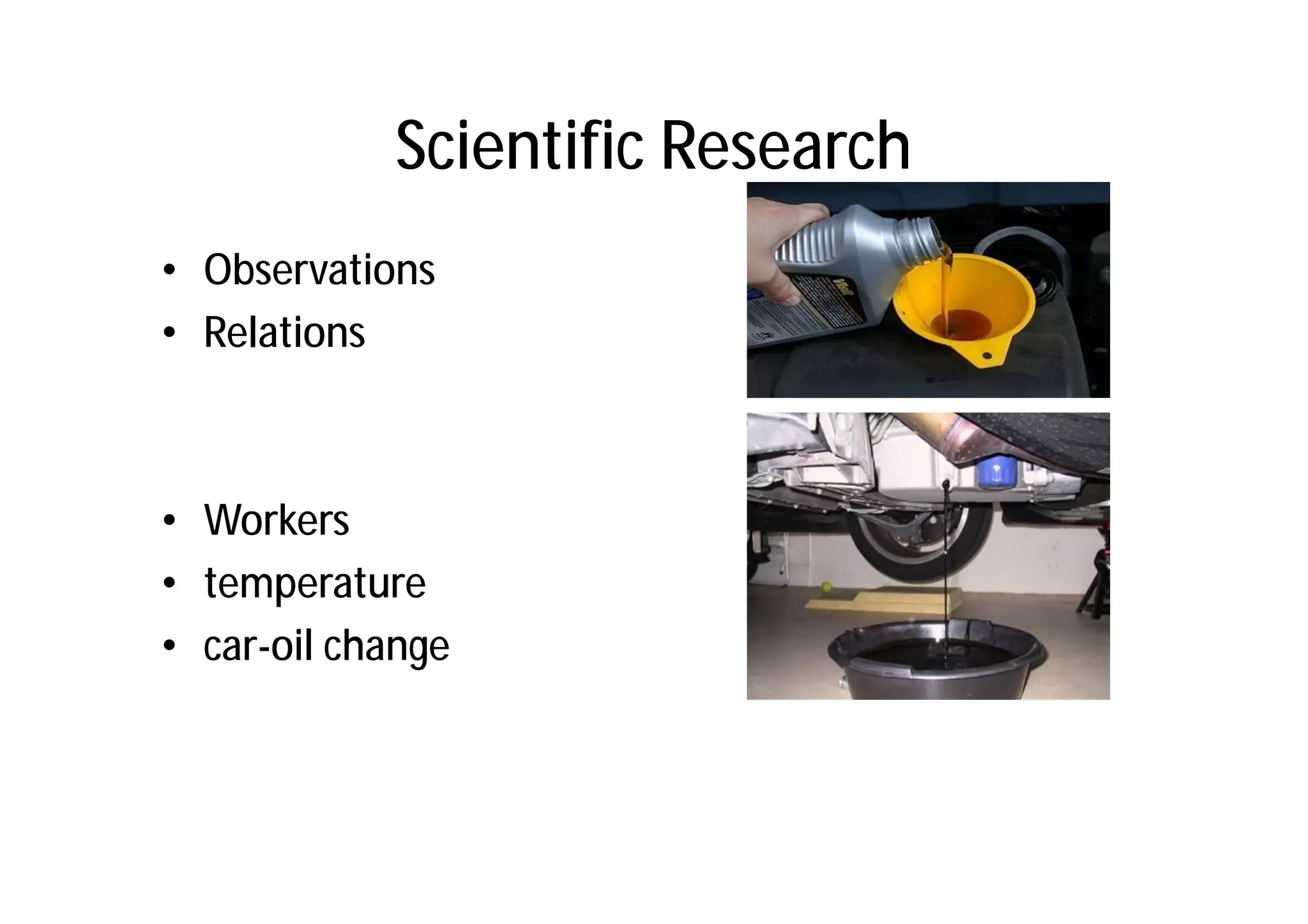
• Workers
• temperature
• car-oil change
Clinical Research
• Observations
• Relations


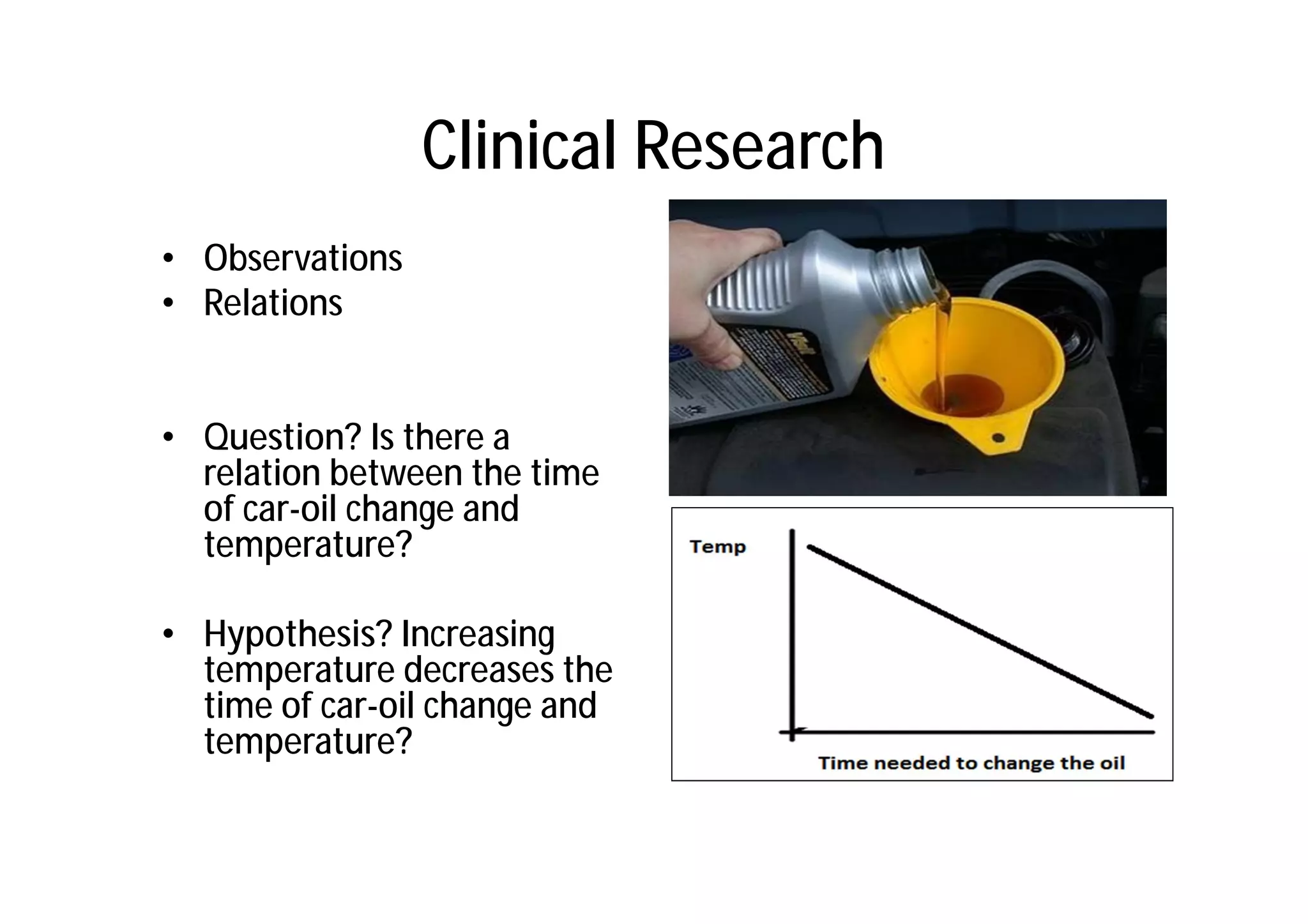
• Question? Is there a
  relation between the time
  of car-oil change and        •
  temperature?

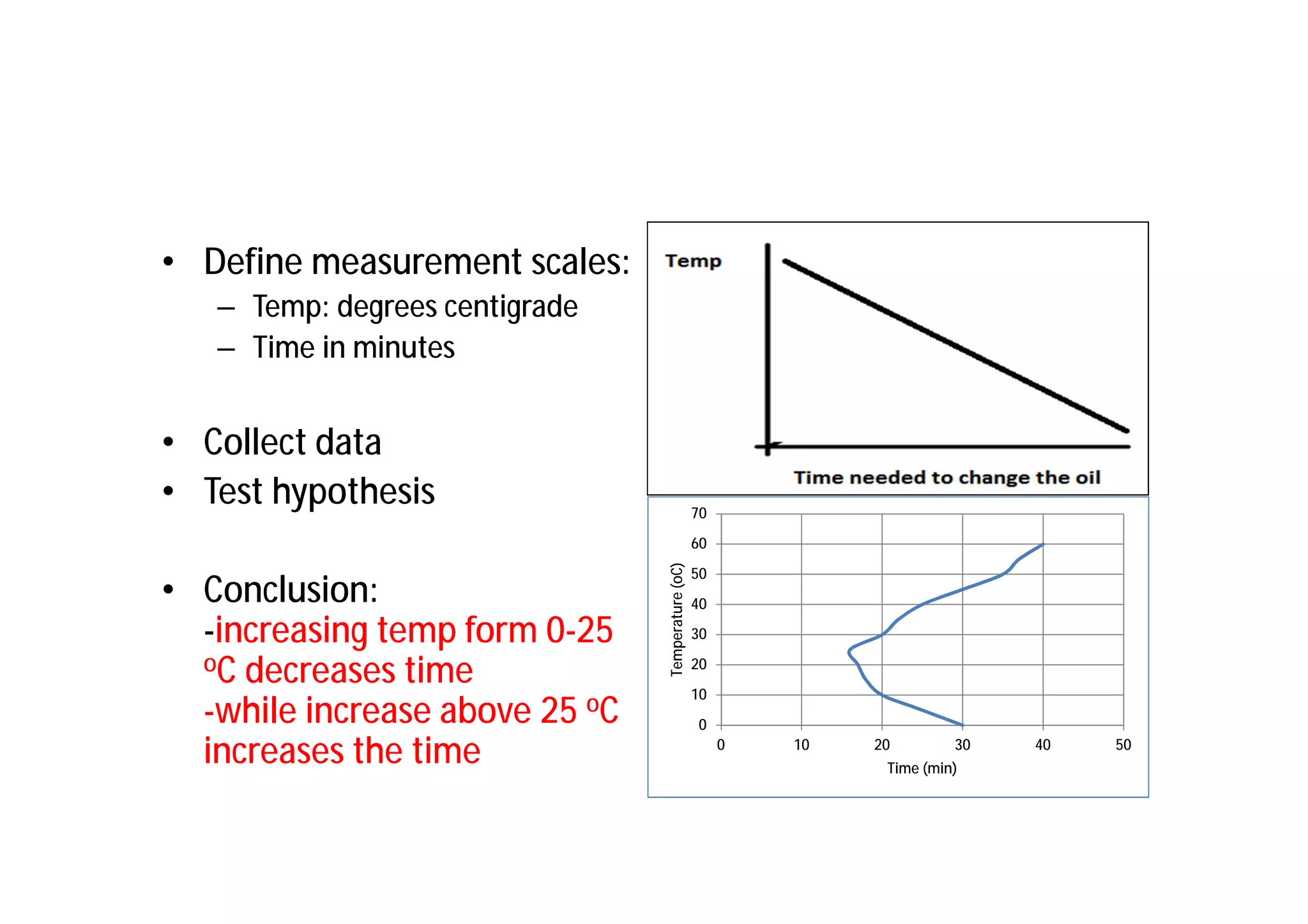
• Hypothesis? Increasing
  temperature decreases the
  time of car-oil change and
  temperature?
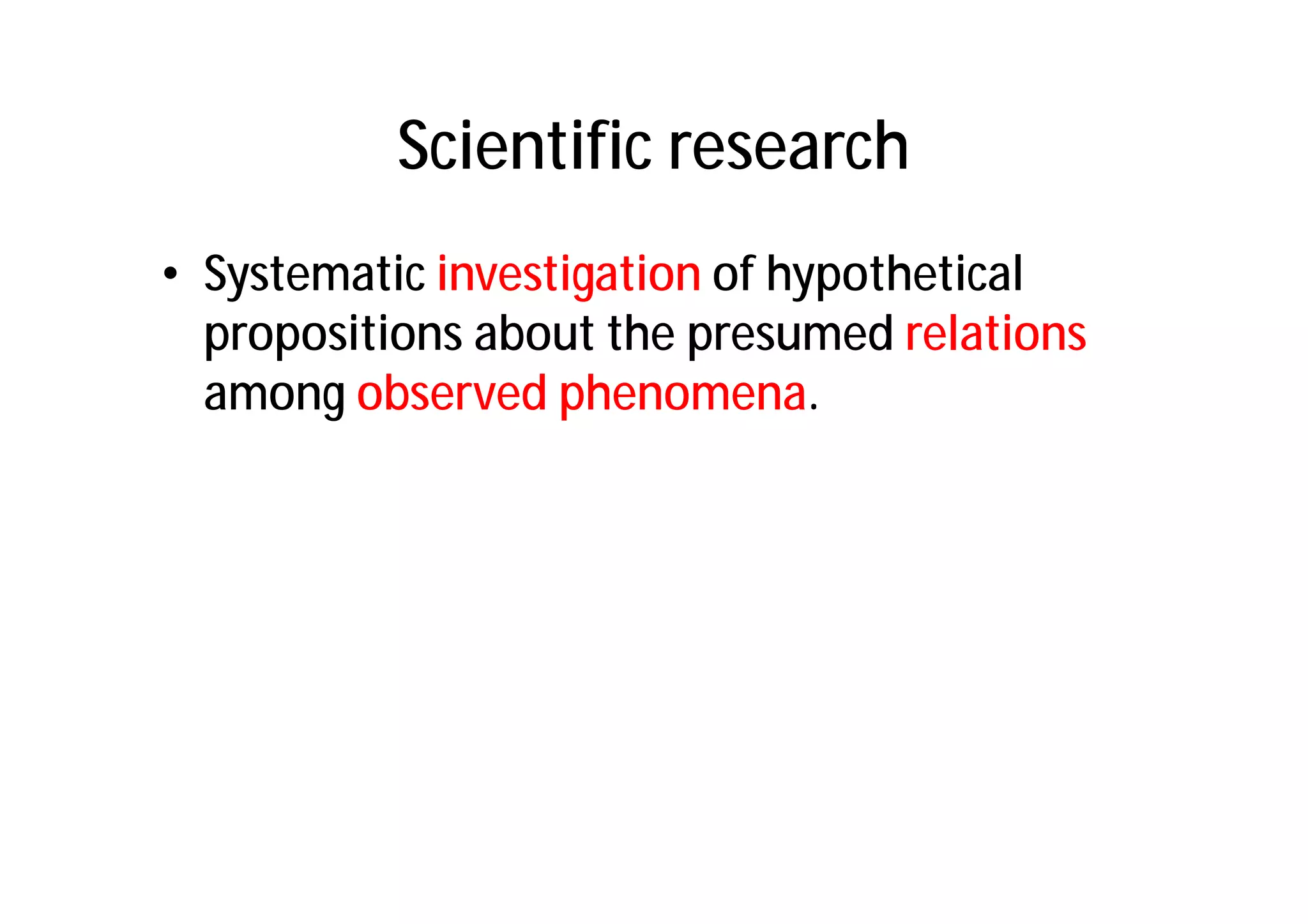
• Define measurement scales:
   – Temp: degrees centigrade
   – Time in minutes


• Collect data
• Test hypothesis                                  70
                                                   60


                                Temperature (oC)
                                                   50
• Conclusion:                                      40

  -increasing temp form 0-25                       30

  oC decreases time                                20
                                                   10
  -while increase above 25 oC                      0

  increases the time                                    0   10   20        30
                                                                  Time (min)
                                                                                40   50
Scientific research
• Systematic investigation of hypothetical
  propositions about the presumed relations
  among observed phenomena.
Clinical research
• Scientific research
• On
  – humans or
  – materials or
  – data of human origin
Clinical research
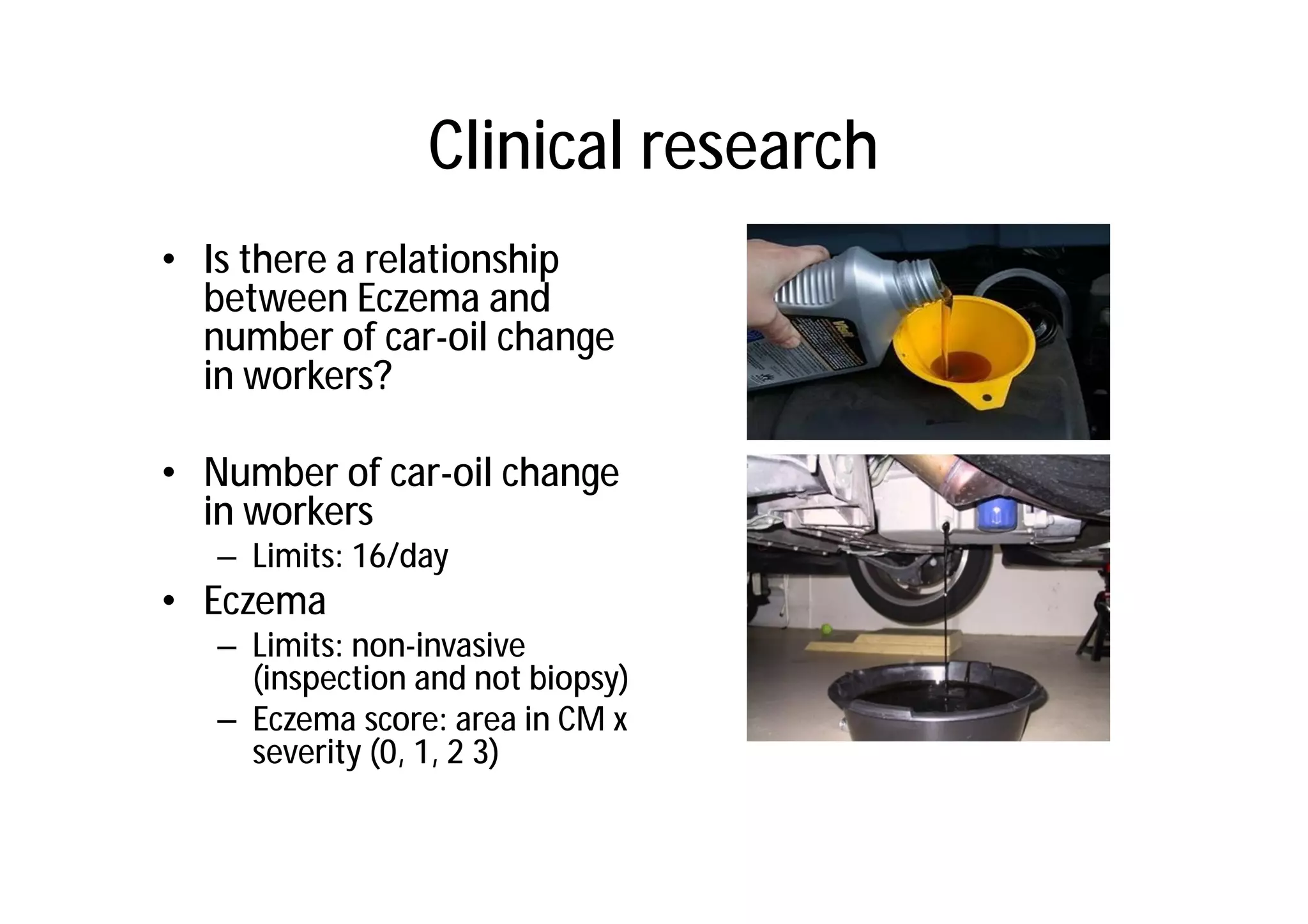
• Is there a relationship
  between Eczema and
  number of car-oil change
  in workers?

• Number of car-oil change
  in workers
   – Limits: 16/day
• Eczema
   – Limits: non-invasive
     (inspection and not biopsy)
   – Eczema score: area in CM x
     severity (0, 1, 2 3)
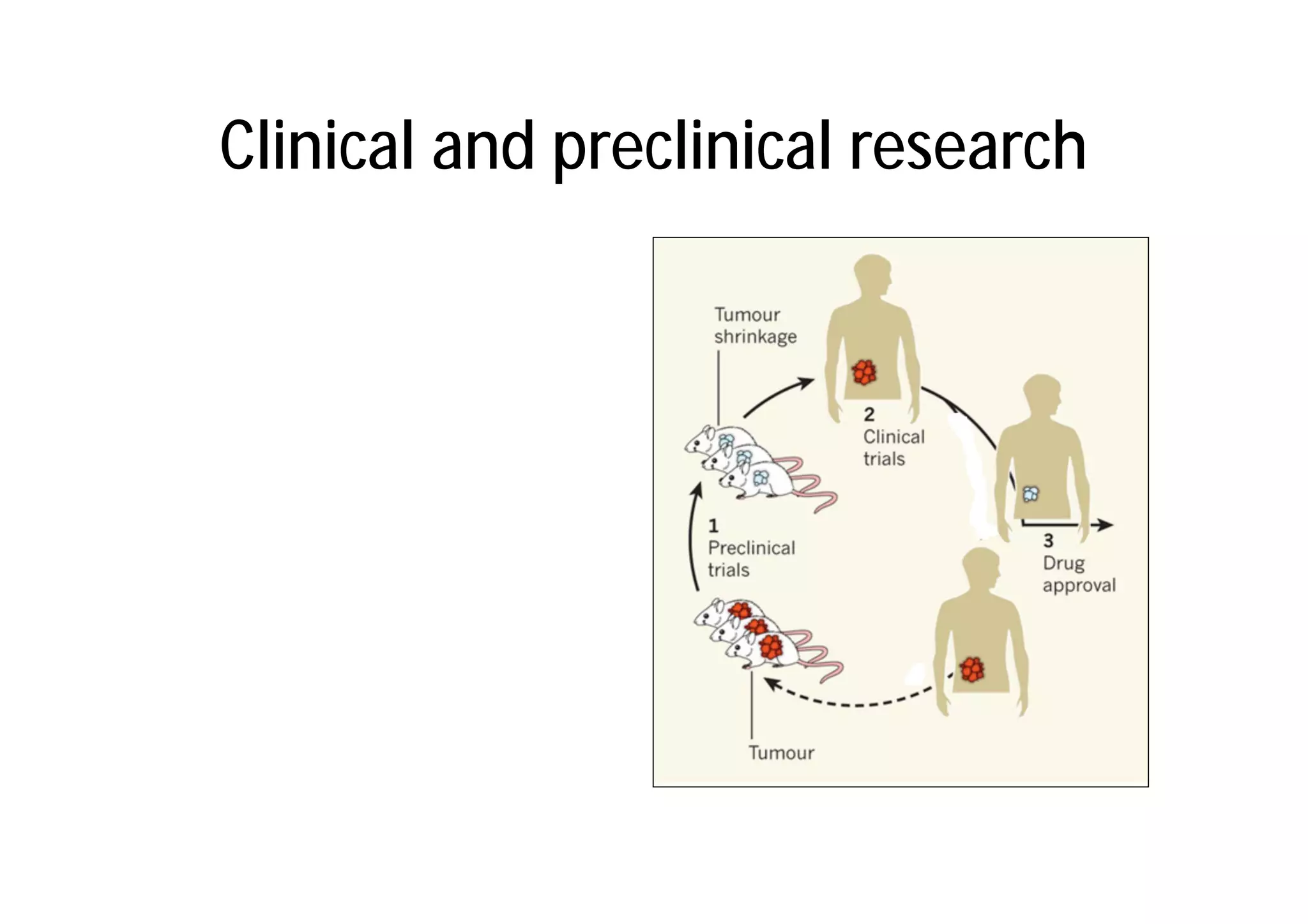
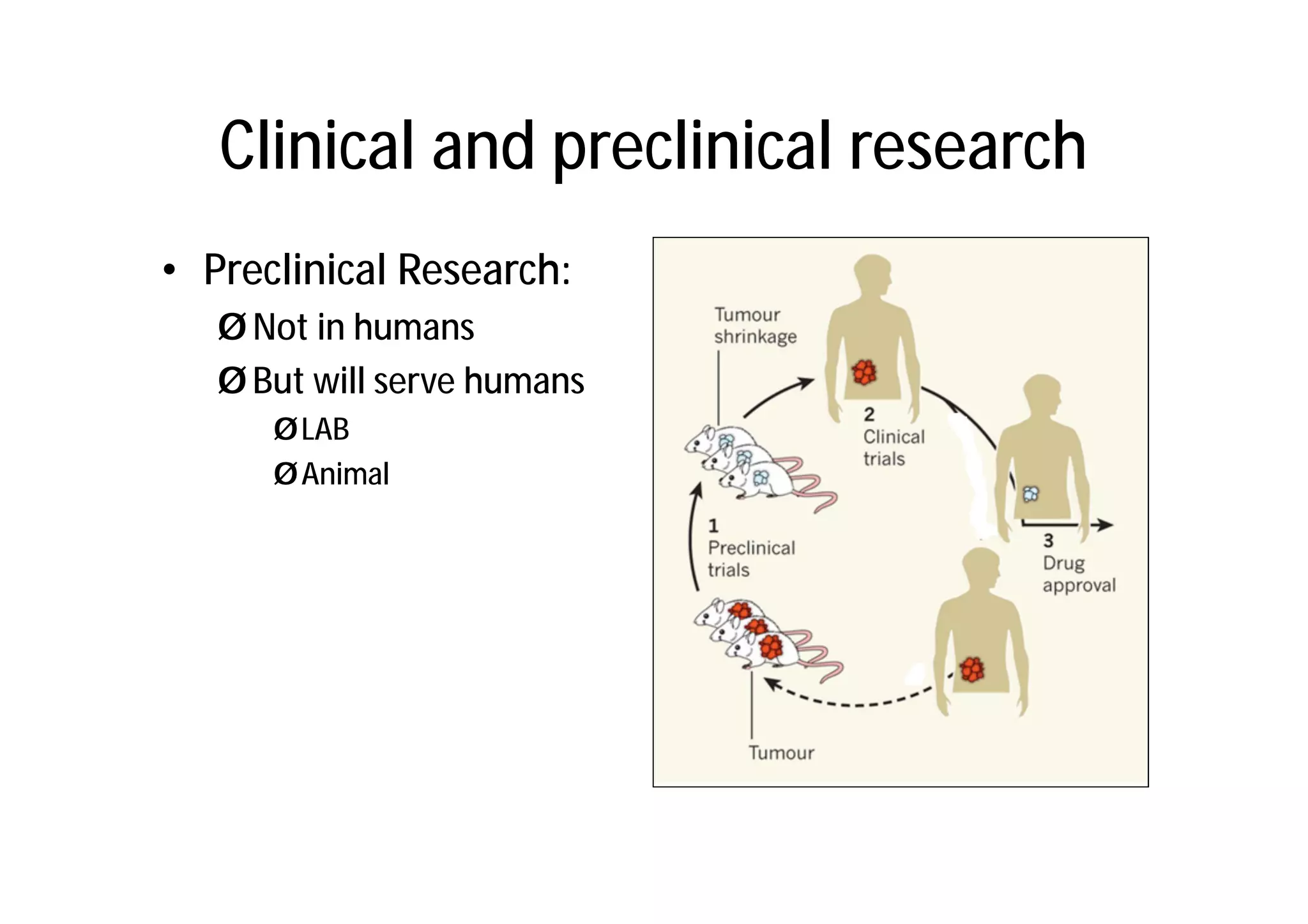
Clinical and preclinical research
• Preclinical Research:
   Ø Not in humans
   Ø But will serve humans
      Ø LAB
      Ø Animal
Why we do research?
– To gain knowledge
  • treat, prevent, diagnose diseases
  • Human welfare
  • Current and future patients


                      Ahmed Zeeneldin   11
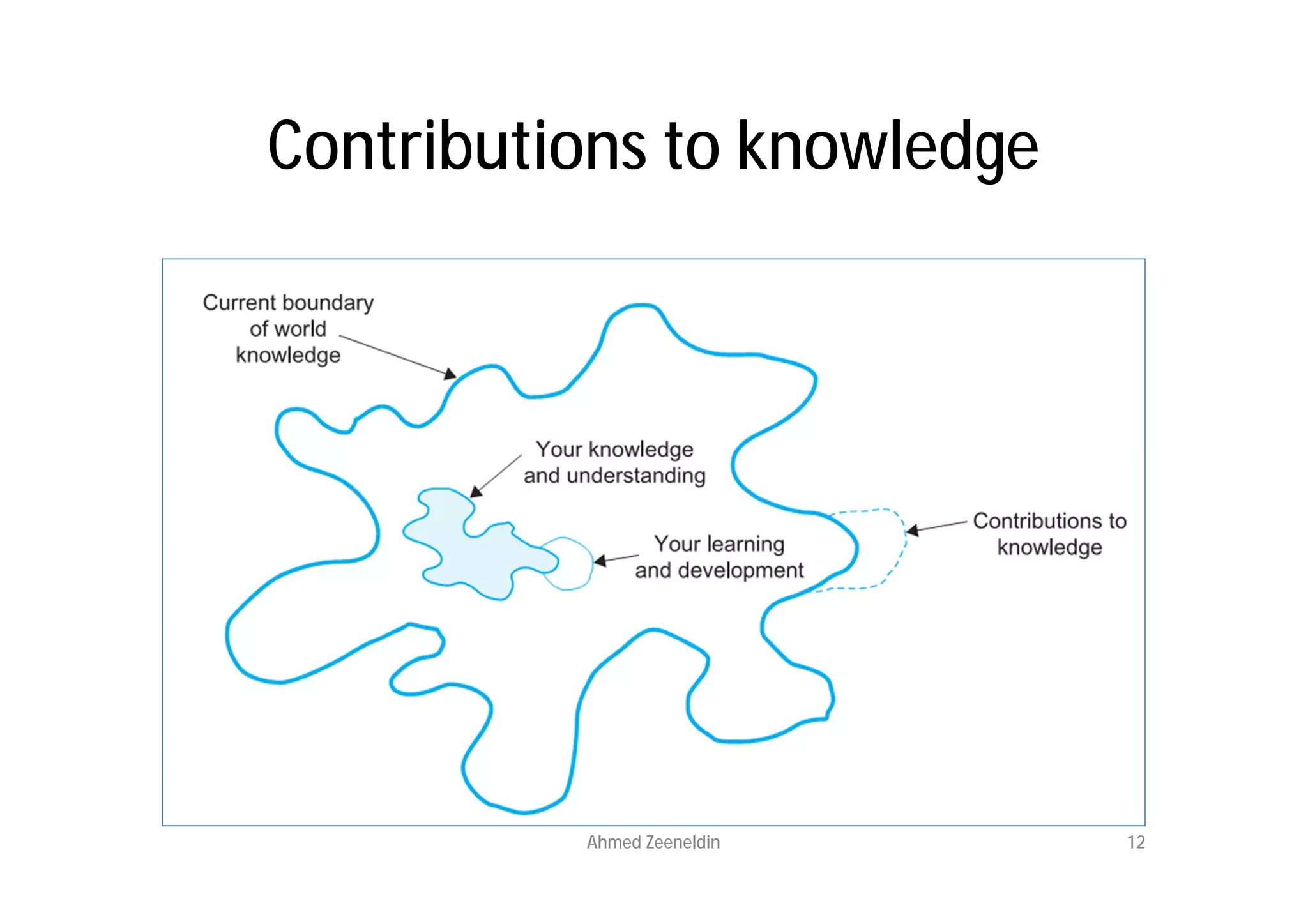
Contributions to knowledge


          Ahmed Zeeneldin    12
Why subjects engage in research?
 – To help their diseases
 – To help other patients
 – Other benefits:
    • e.g. payment


                     Ahmed Zeeneldin   13
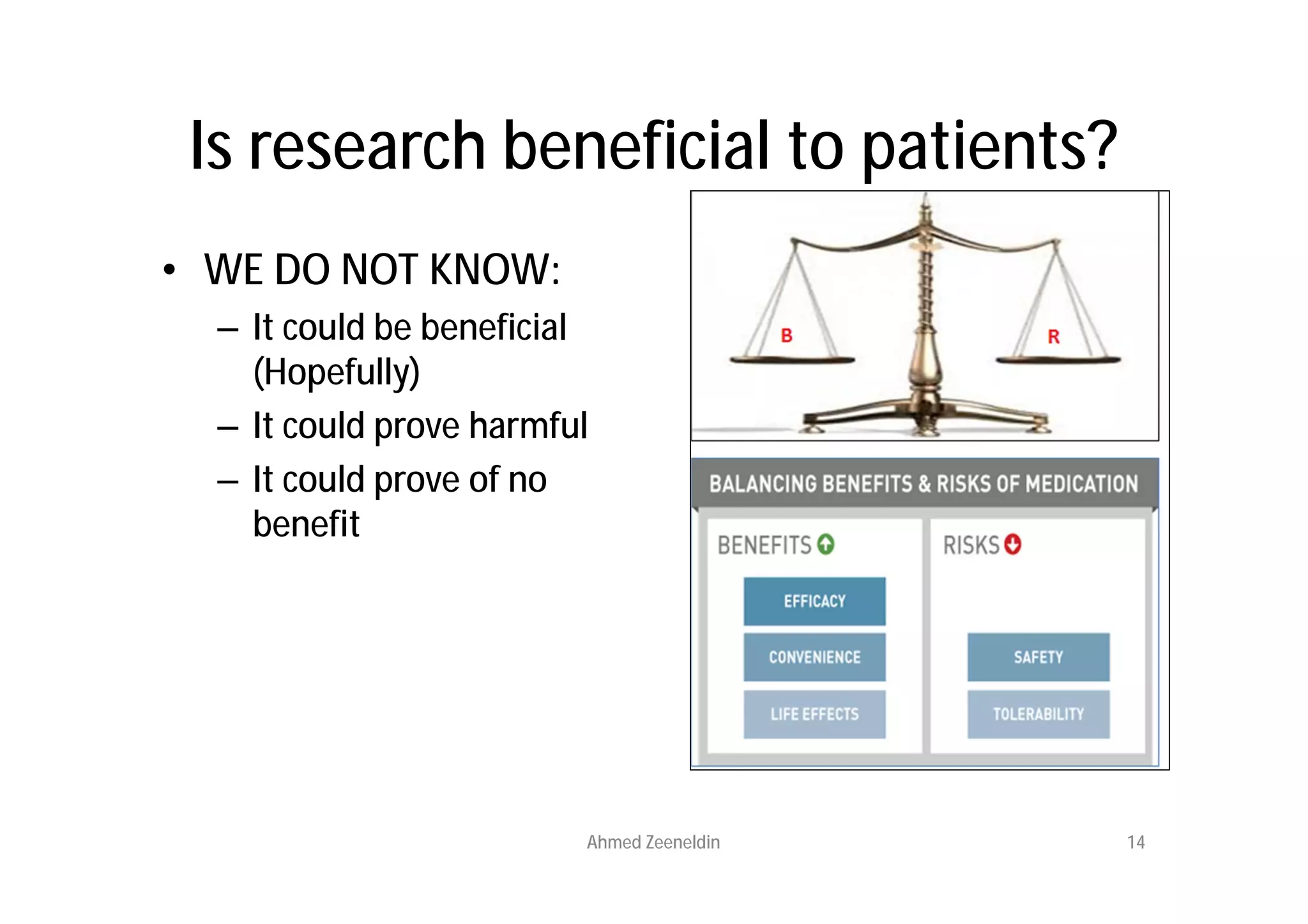
Is research beneficial to patients?
• WE DO NOT KNOW:
  – It could be beneficial
    (Hopefully)
  – It could prove harmful
  – It could prove of no
    benefit


                         Ahmed Zeeneldin   14
Research vs. routine practice
• Practice:
   – Standard
   – approved
   – benefit
• Research: may not always benefit:
   – Non-standard
   – Non-approved
   – Benefit?
      • May receive highest care
      • May directly benefit
      • May be harmed
• Research gives Knowledge for better health
• Individual: respect, safety and dignity

                               Ahmed Zeeneldin   15
Study designs in health research
• Observational:
  – No intervention
• Experimental:
  – Intervention and outcome
     • Semi-experimental
     • True-Experimental


                       Ahmed Zeeneldin   16
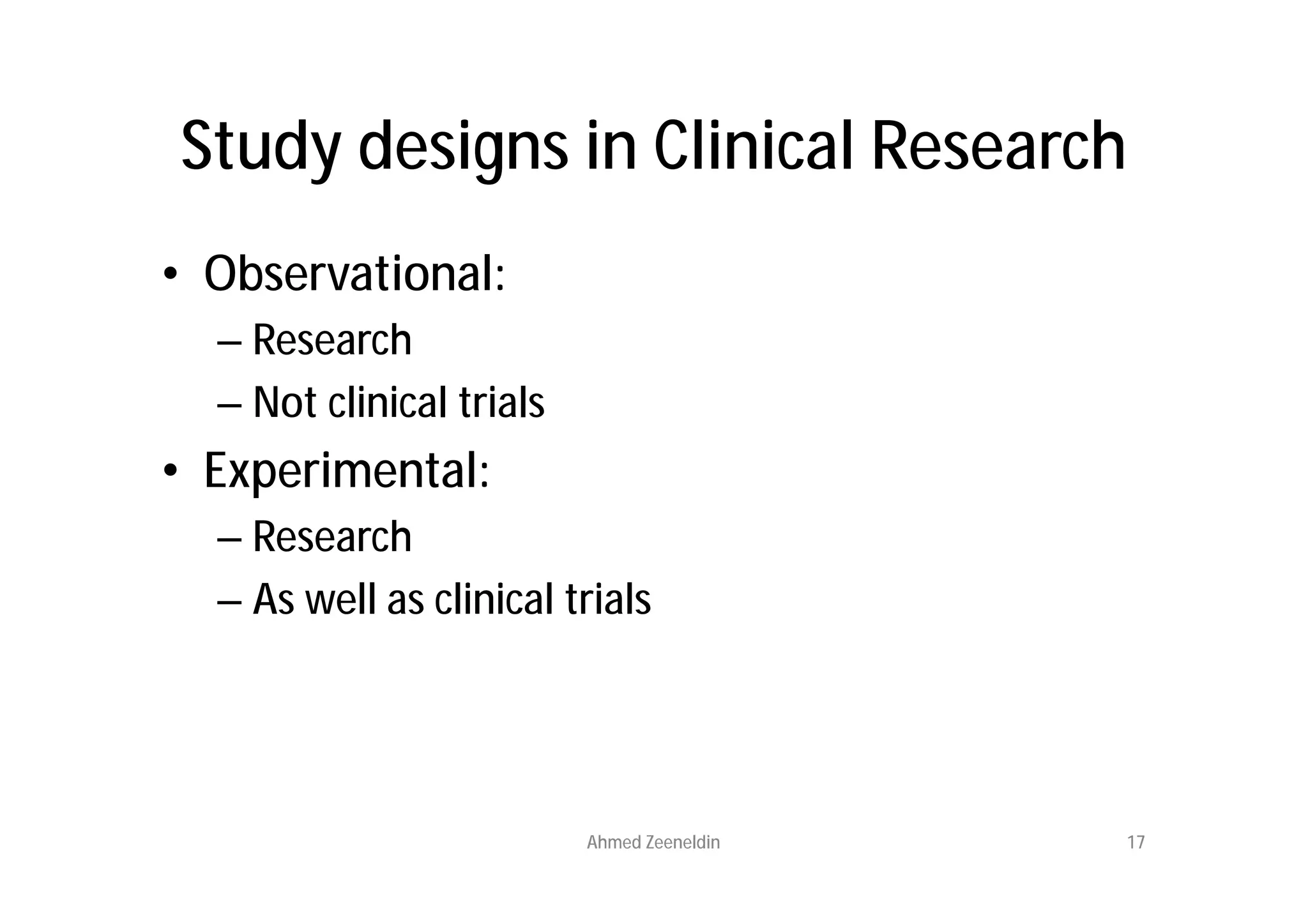
Study designs in Clinical Research
• Observational:
  – Research
  – Not clinical trials
• Experimental:
  – Research
  – As well as clinical trials


                          Ahmed Zeeneldin   17
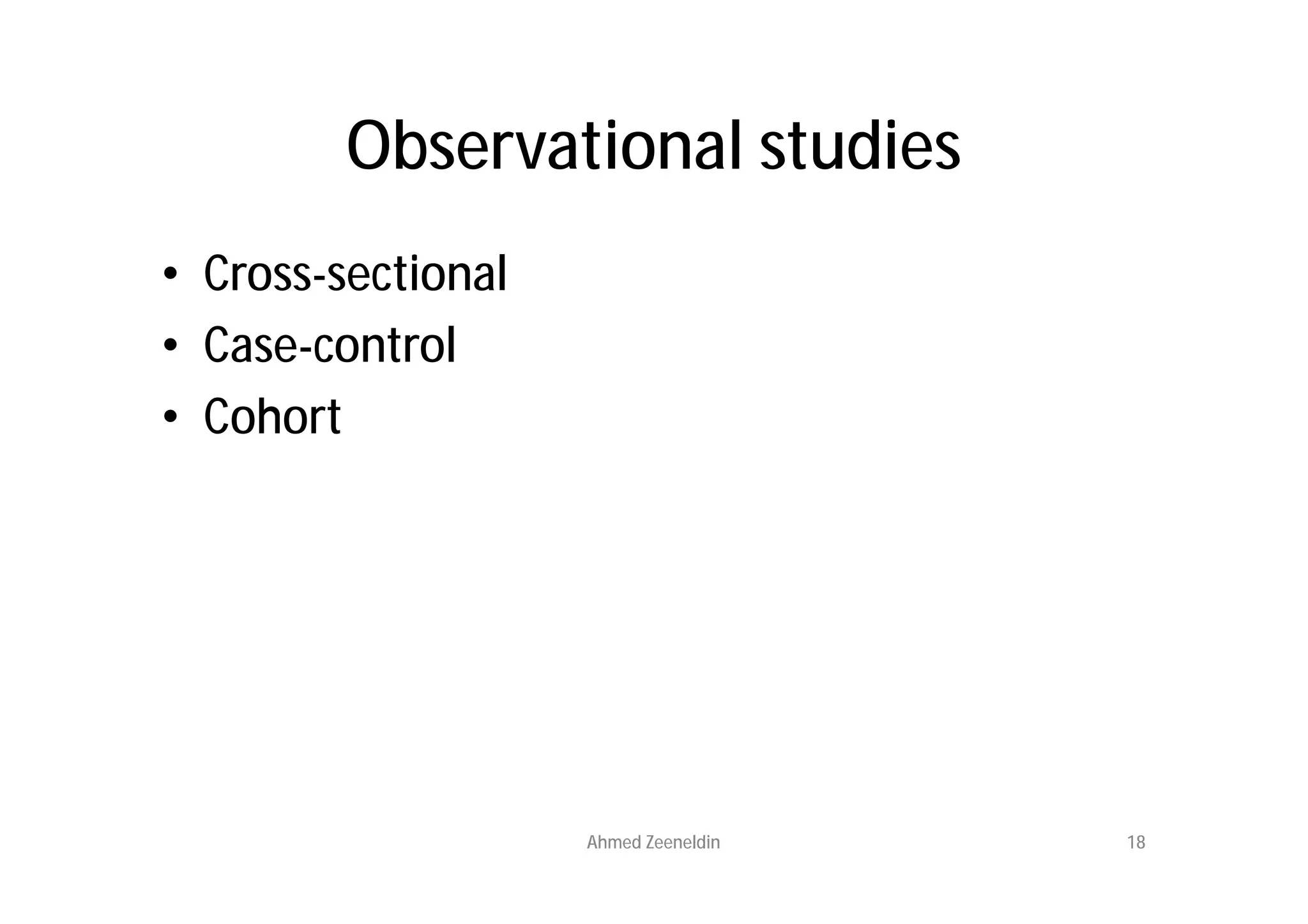
Observational studies
• Cross-sectional
• Case-control
• Cohort


                    Ahmed Zeeneldin   18
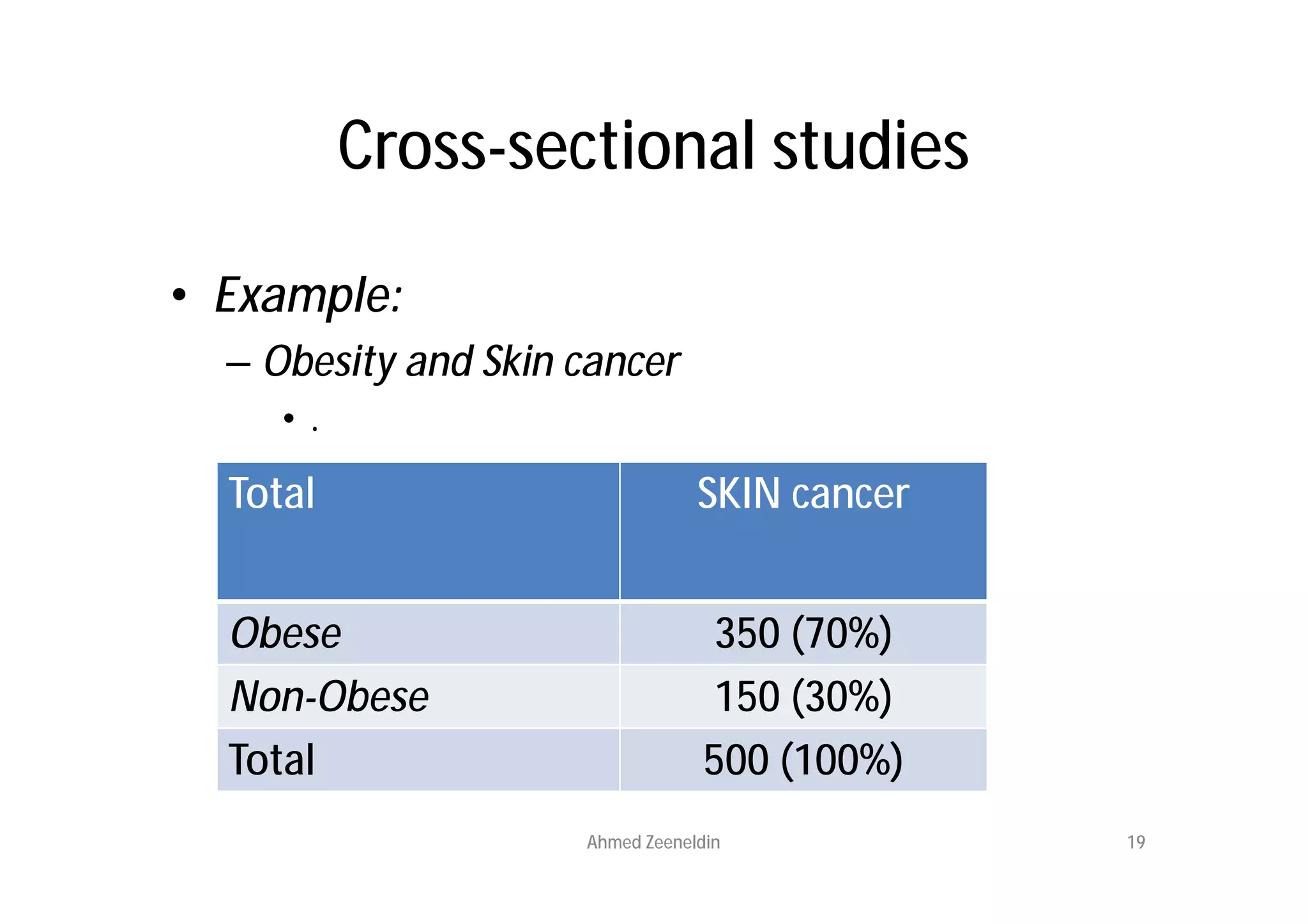
Cross-sectional studies

• Example:
  – Obesity and Skin cancer
     •.

  Total                          SKIN cancer


  Obese                           350 (70%)
  Non-Obese                       150 (30%)
  Total                           500 (100%)
                     Ahmed Zeeneldin           19
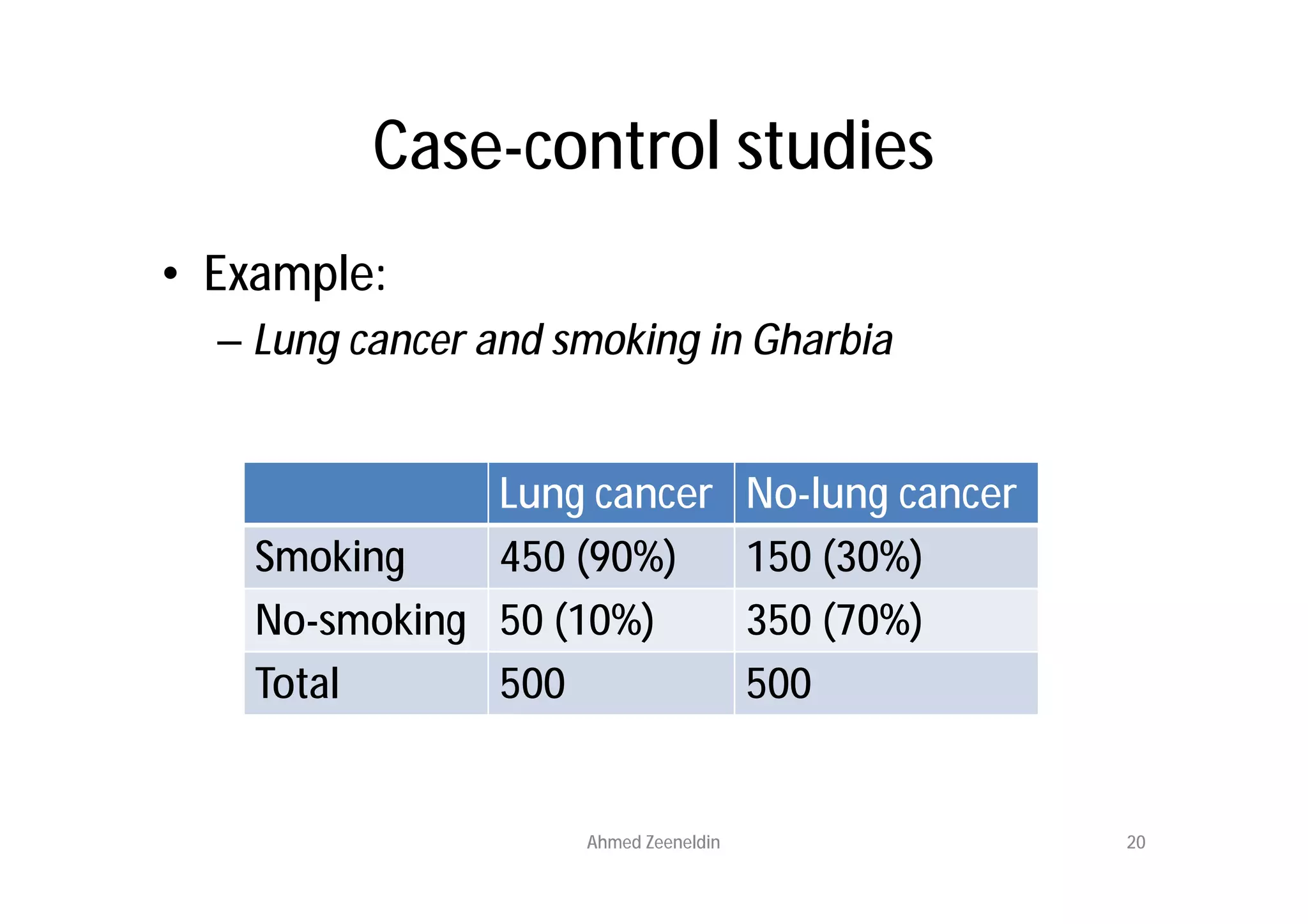
Case-control studies
• Example:
  – Lung cancer and smoking in Gharbia


               Lung cancer             No-lung cancer
    Smoking    450 (90%)               150 (30%)
    No-smoking 50 (10%)                350 (70%)
    Total      500                     500


                     Ahmed Zeeneldin                    20
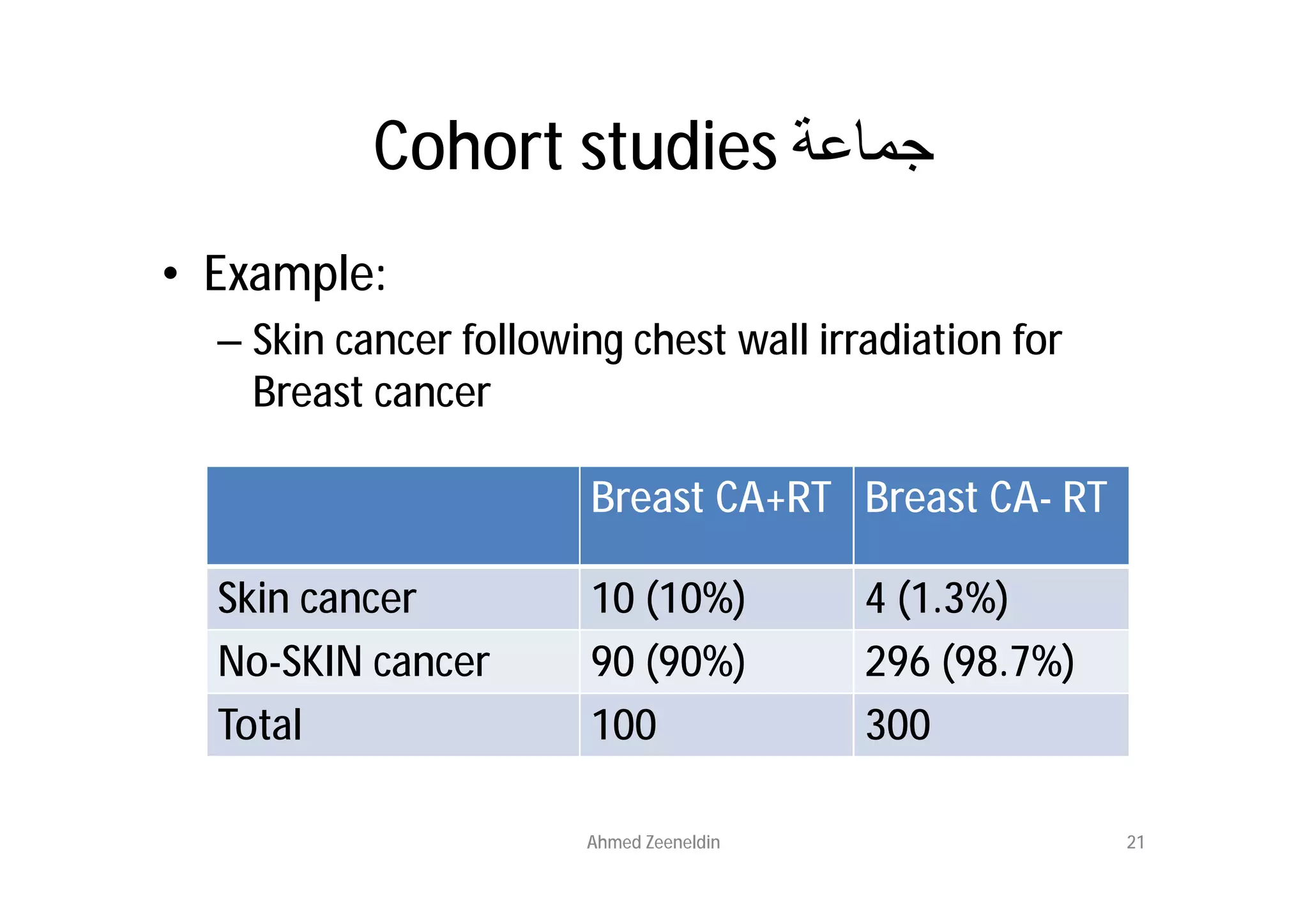
Cohort studies ‫ﺟﻤﺎﻋﺔ‬
• Example:
  – Skin cancer following chest wall irradiation for
    Breast cancer

                        Breast CA+RT Breast CA- RT

  Skin cancer           10 (10%)         4 (1.3%)
  No-SKIN cancer        90 (90%)         296 (98.7%)
  Total                 100              300

                       Ahmed Zeeneldin                 21
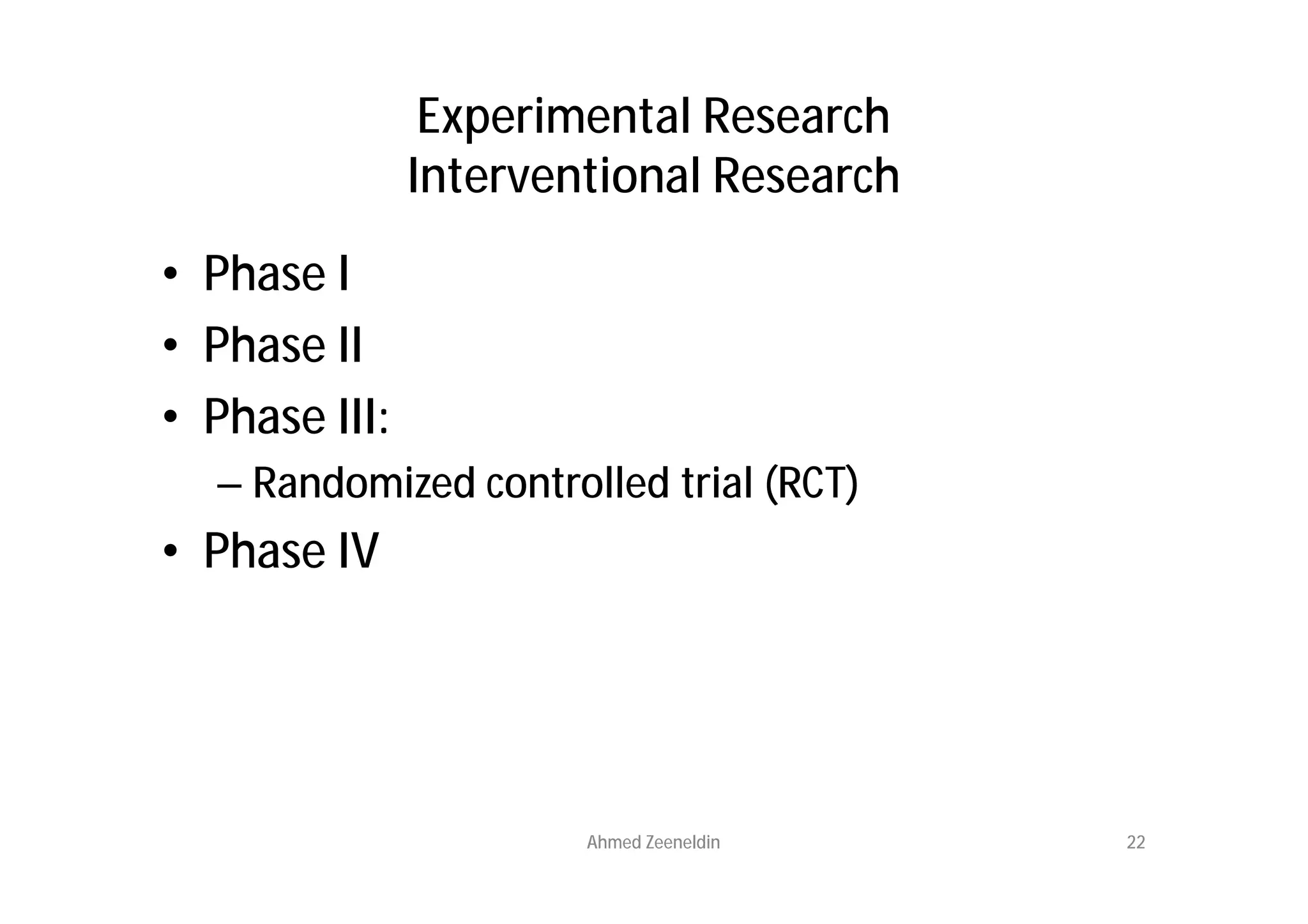
Experimental Research
               Interventional Research
• Phase I
• Phase II
• Phase III:
  – Randomized controlled trial (RCT)
• Phase IV


                       Ahmed Zeeneldin   22
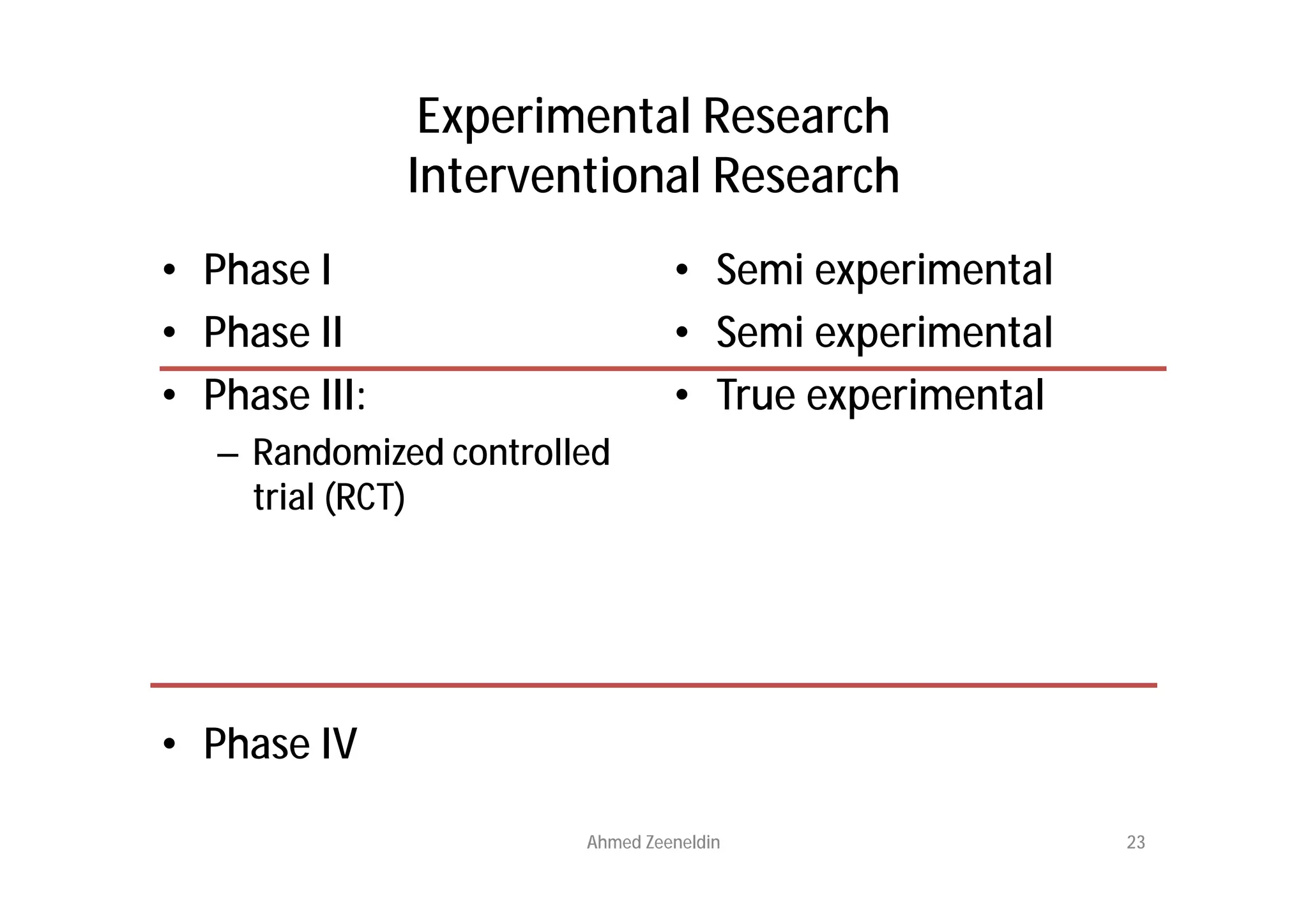
Experimental Research
               Interventional Research
• Phase I                        • Semi experimental
• Phase II                       • Semi experimental
• Phase III:                     • True experimental
   – Randomized controlled
     trial (RCT)


• Phase IV

                        Ahmed Zeeneldin                23
Example of clinical trials
• Use of Nigella Sativa oil in treatment of
  metastatic malignant melanoma
• ‫اﺳﺗﺧدام زﯾت ﺣﺑﺔ اﻟﺑرﻛﺔ ﻓﻲ ﻋﻼج ﺳرطﺎن اﻟﺟﻠد اﻟﺻﺑﻐﻲ اﻟﻣﻧﺗﺷر‬
Question?
• Why not going ahead and using this in all
  patients ? ~ 100, 000
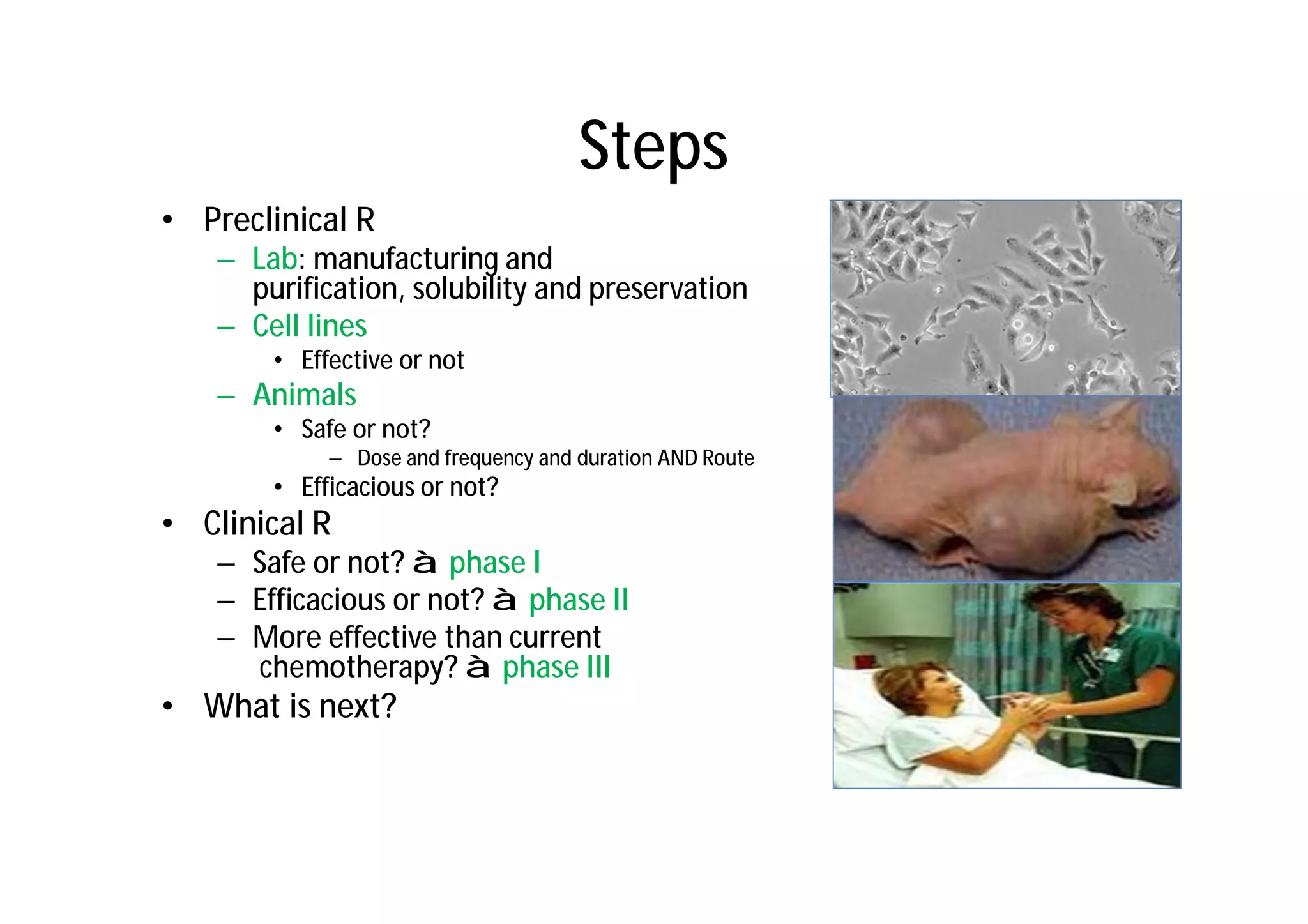
Steps
• Preclinical R
   – Lab: manufacturing and
     purification, solubility and preservation
   – Cell lines
       • Effective or not
   – Animals
       • Safe or not?
            – Dose and frequency and duration AND Route
       • Efficacious or not?
• Clinical R
   – Safe or not? à phase I
   – Efficacious or not? à phase II
   – More effective than current
     chemotherapy? à phase III
• What is next?
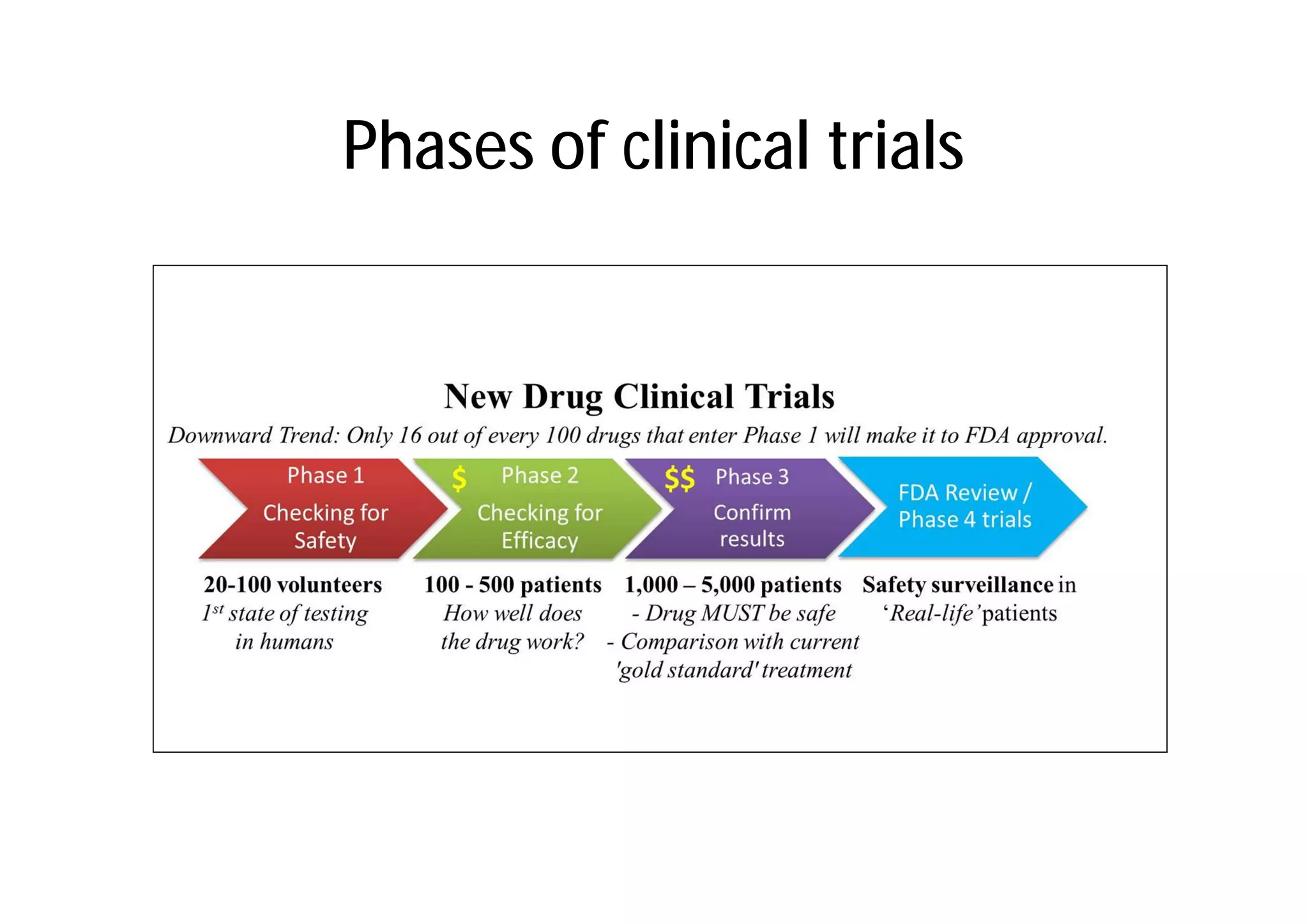
Phases of clinical trials
Why we use trials?
• Animal and human trials
• Predictability of safety and efficacy
• Animals:
  – Safety prediction
  – Diseases are different in animals: X efficacy
• Humans:
  – Safety and efficacy prediction
• Prediction is never perfect
                       Ahmed Zeeneldin              28
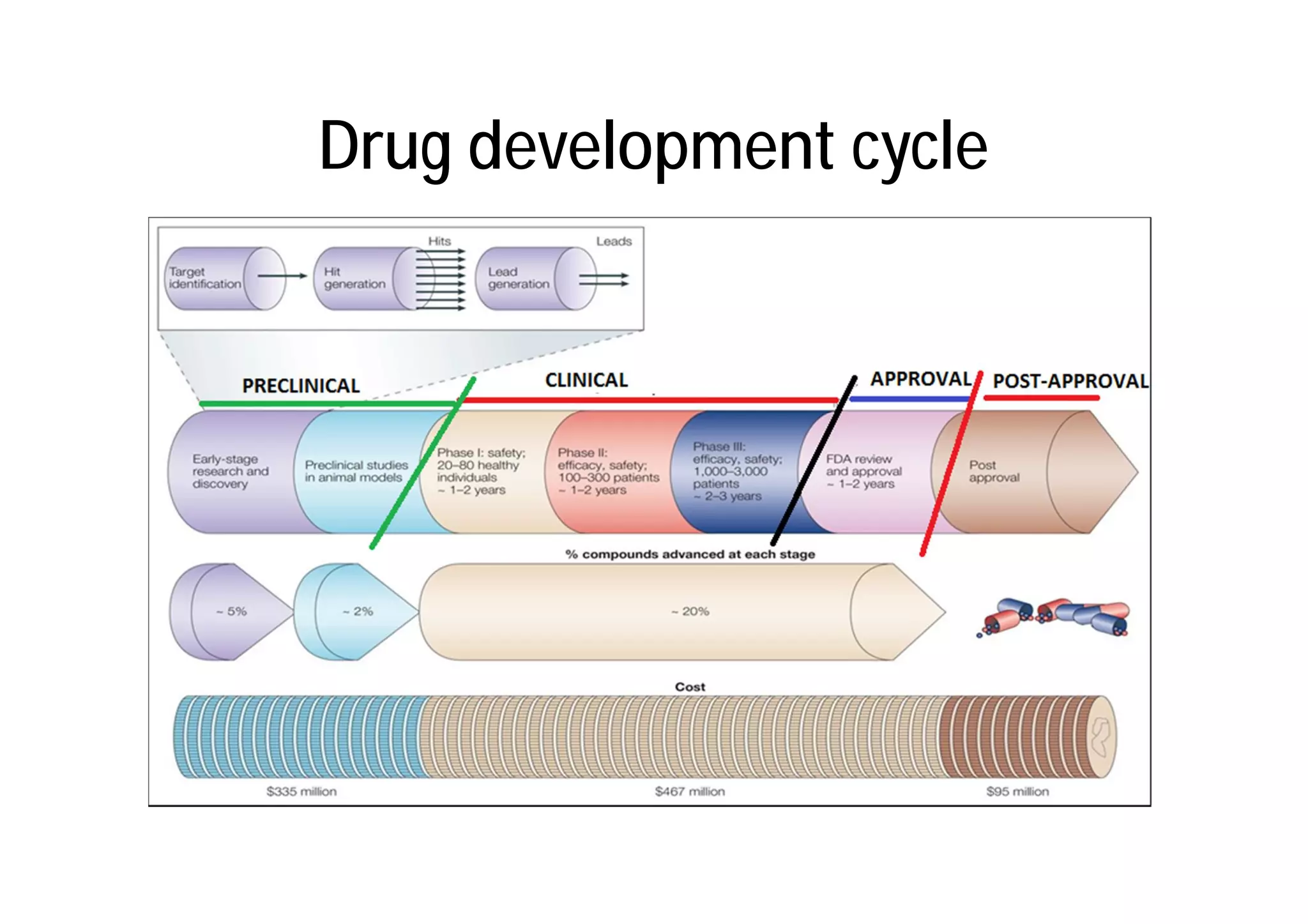
Drug development cycle
Ethics in research
Preclinical Lab research
• New viruses
• New war weapons
• Resistant microbes
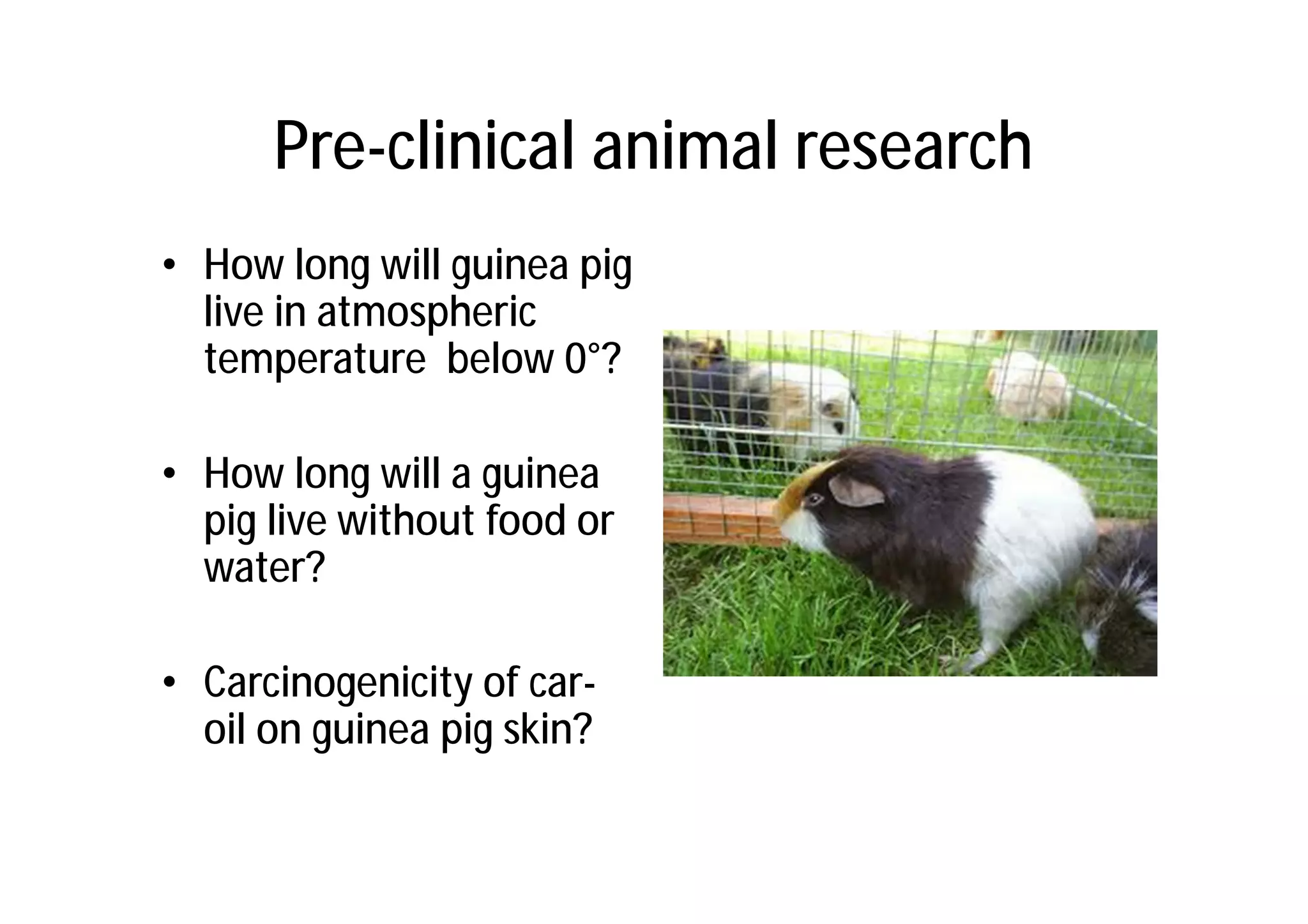
Pre-clinical animal research
• How long will guinea pig
  live in atmospheric
  temperature below 0°?

• How long will a guinea
  pig live without food or
  water?

• Carcinogenicity of car-
  oil on guinea pig skin?
Clinical research
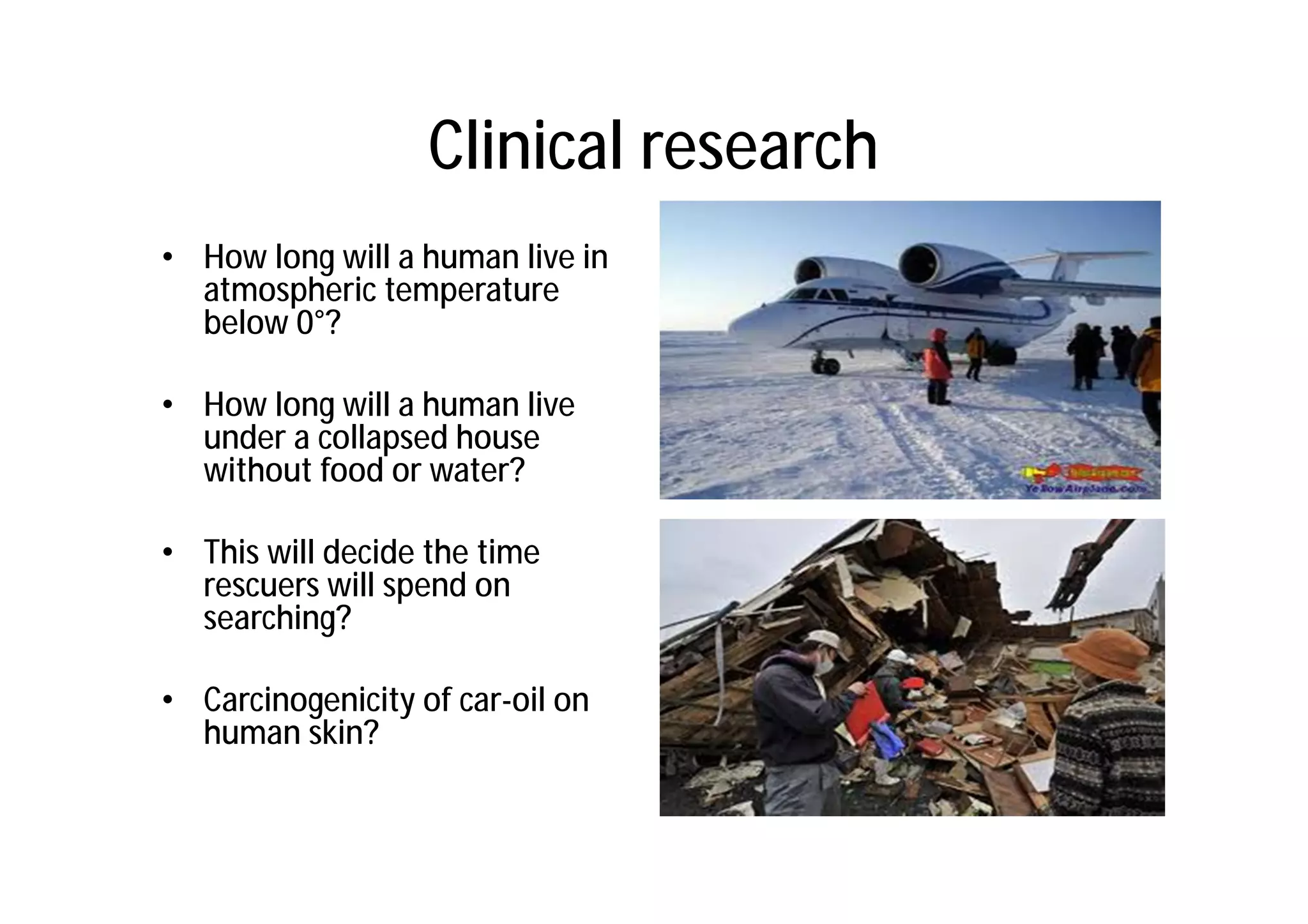
• How long will a human live in
  atmospheric temperature
  below 0°?

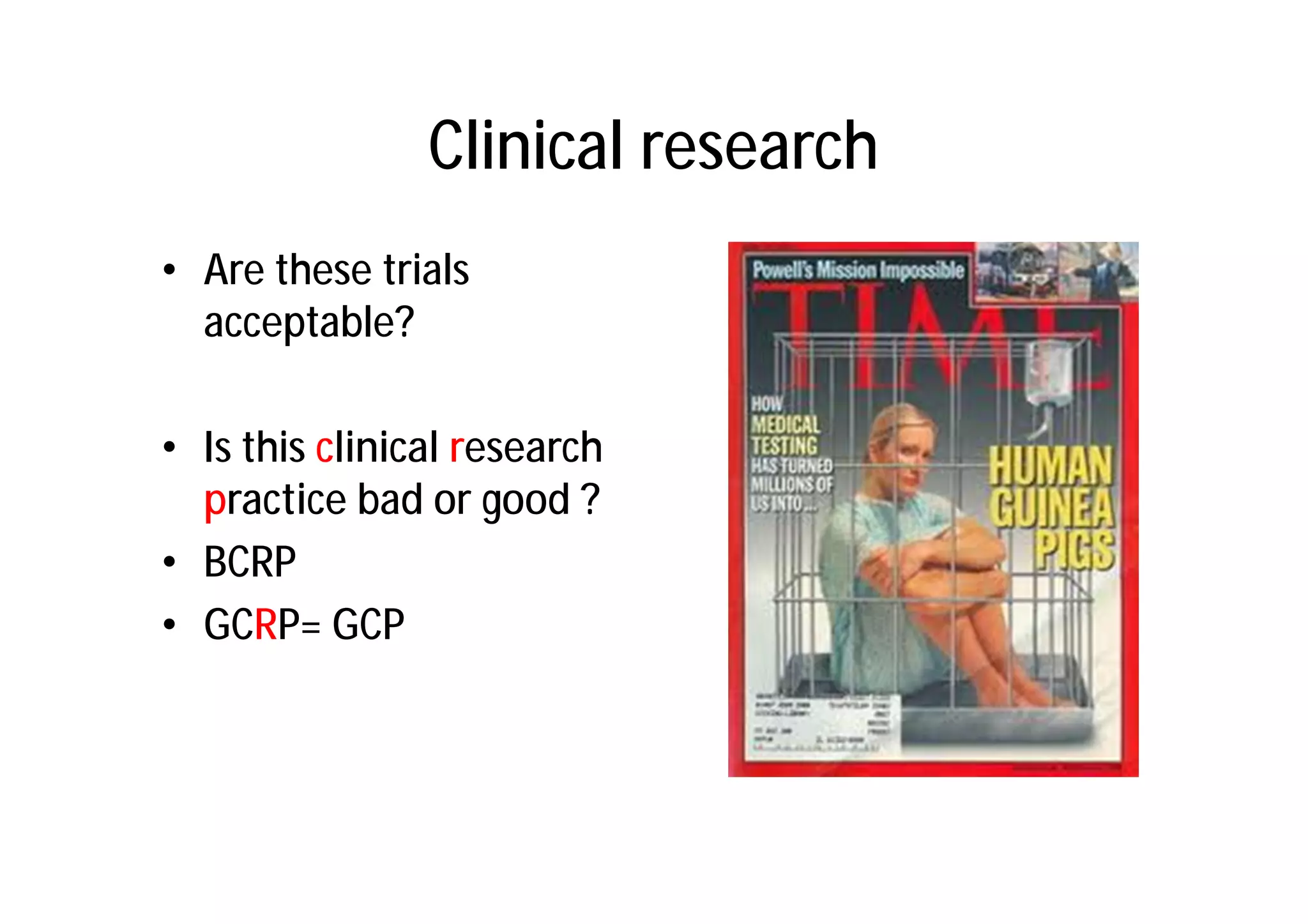
• How long will a human live
  under a collapsed house
  without food or water?

• This will decide the time
  rescuers will spend on
  searching?

• Carcinogenicity of car-oil on
  human skin?
Clinical research
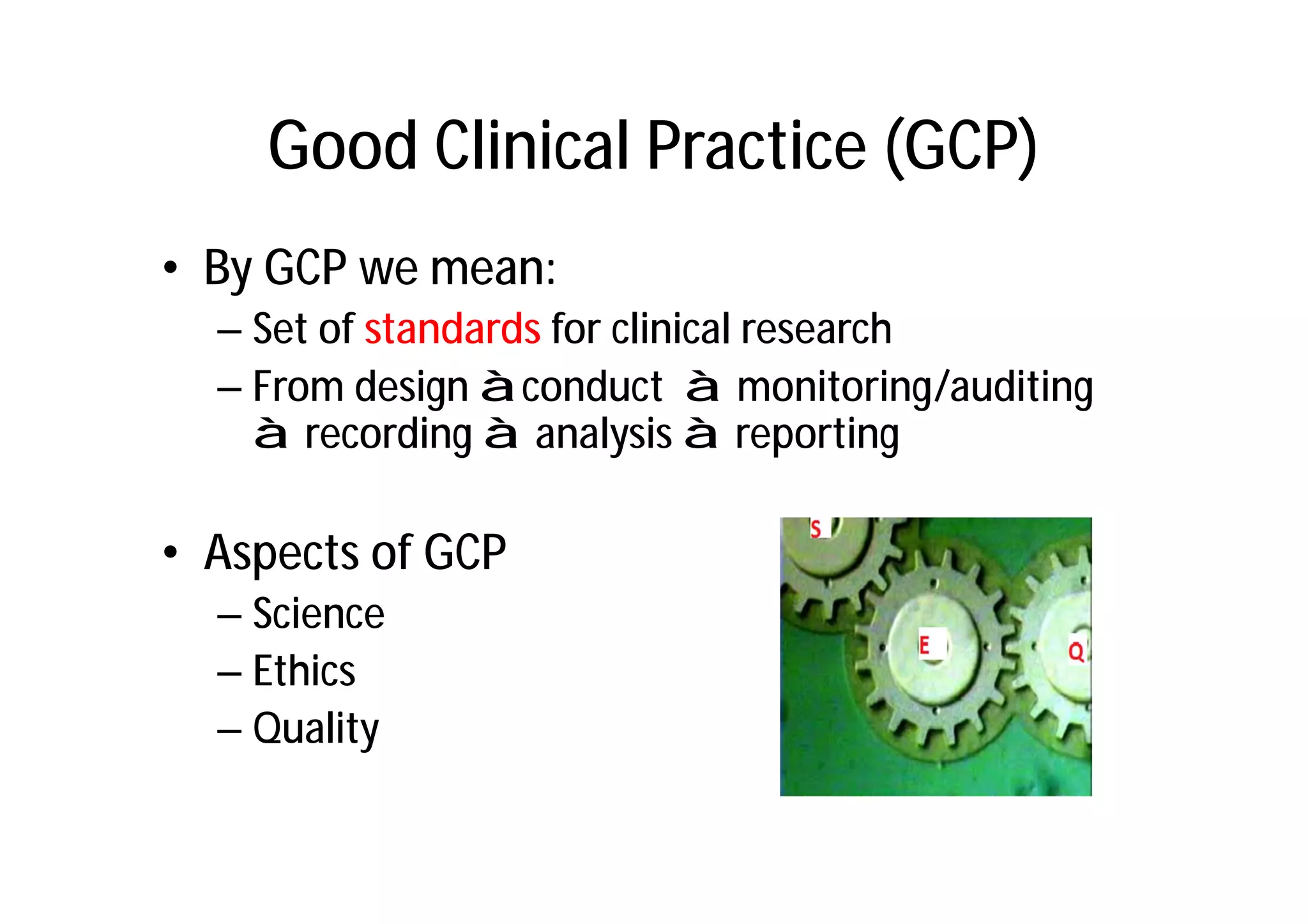
• Are these trials
  acceptable?

• Is this clinical research
  practice bad or good ?
• BCRP
• GCRP= GCP
Good Clinical Practice (GCP)
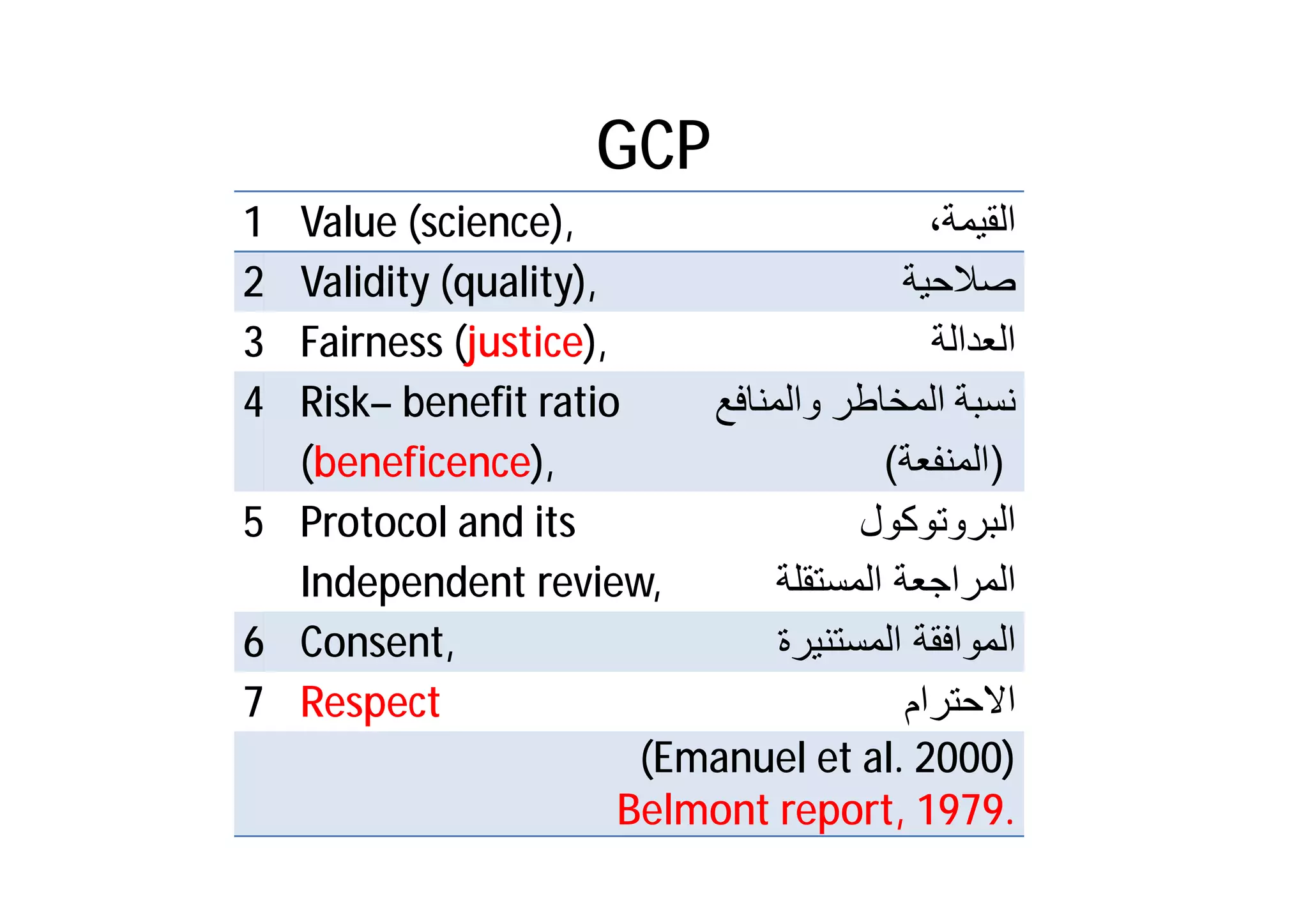
• By GCP we mean:
  – Set of standards for clinical research
  – From design àconduct à monitoring/auditing
    à recording à analysis à reporting

• Aspects of GCP
  – Science
  – Ethics
  – Quality
GCP
1 Value (science),                         ،‫اﻟﻘﯾﻣﺔ‬
2 Validity (quality),                    ‫ﺻﻼﺣﯾﺔ‬
3 Fairness (justice),                      ‫اﻟﻌداﻟﺔ‬
4 Risk– benefit ratio     ‫ﻧﺳﺑﺔ اﻟﻣﺧﺎطر واﻟﻣﻧﺎﻓﻊ‬
  (beneficence),                       (‫)اﻟﻣﻧﻔﻌﺔ‬
5 Protocol and its                   ‫اﻟﺑروﺗوﻛول‬
  Independent review,          ‫اﻟﻣراﺟﻌﺔ اﻟﻣﺳﺗﻘﻠﺔ‬
6 Consent,                     ‫اﻟﻣواﻓﻘﺔ اﻟﻣﺳﺗﻧﯾرة‬
7 Respect                                ‫اﻻﺣﺗرام‬
                       (Emanuel et al. 2000)
                      Belmont report, 1979.
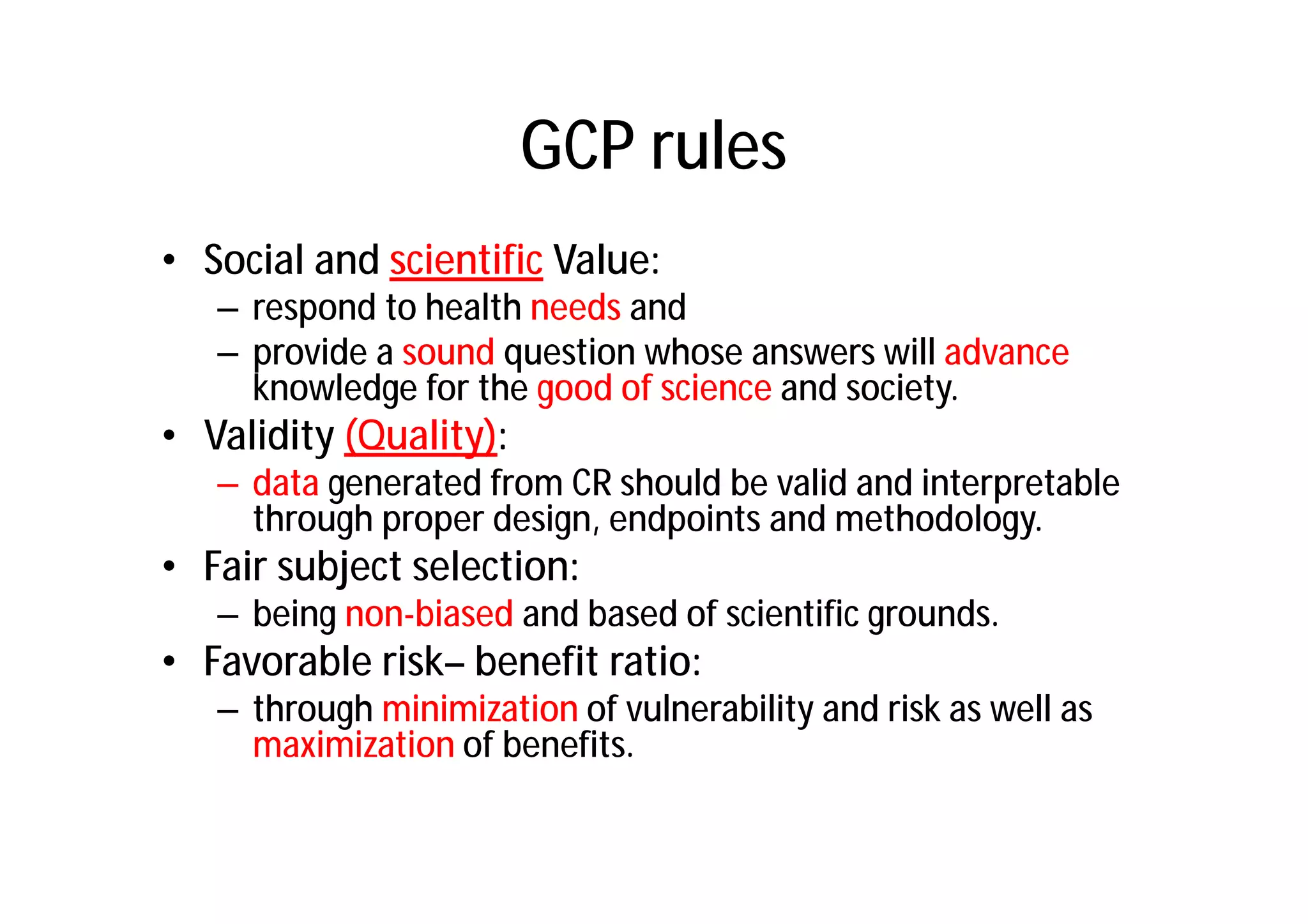
GCP rules
• Social and scientific Value:
   – respond to health needs and
   – provide a sound question whose answers will advance
     knowledge for the good of science and society.
• Validity (Quality):
   – data generated from CR should be valid and interpretable
     through proper design, endpoints and methodology.
• Fair subject selection:
   – being non-biased and based of scientific grounds.
• Favorable risk– benefit ratio:
   – through minimization of vulnerability and risk as well as
     maximization of benefits.
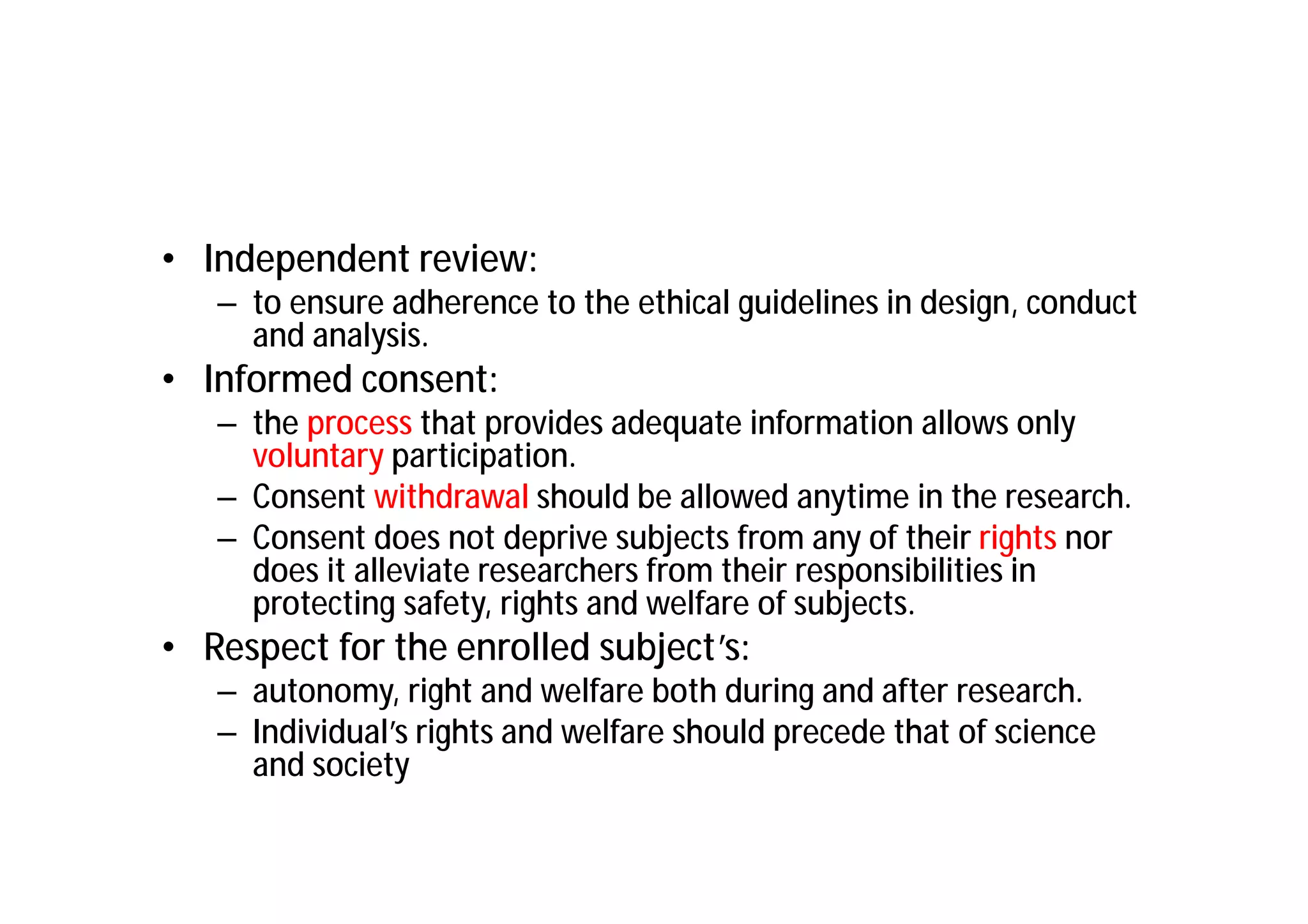
• Independent review:
   – to ensure adherence to the ethical guidelines in design, conduct
     and analysis.
• Informed consent:
   – the process that provides adequate information allows only
     voluntary participation.
   – Consent withdrawal should be allowed anytime in the research.
   – Consent does not deprive subjects from any of their rights nor
     does it alleviate researchers from their responsibilities in
     protecting safety, rights and welfare of subjects.
• Respect for the enrolled subject’s:
   – autonomy, right and welfare both during and after research.
   – Individual’s rights and welfare should precede that of science
     and society
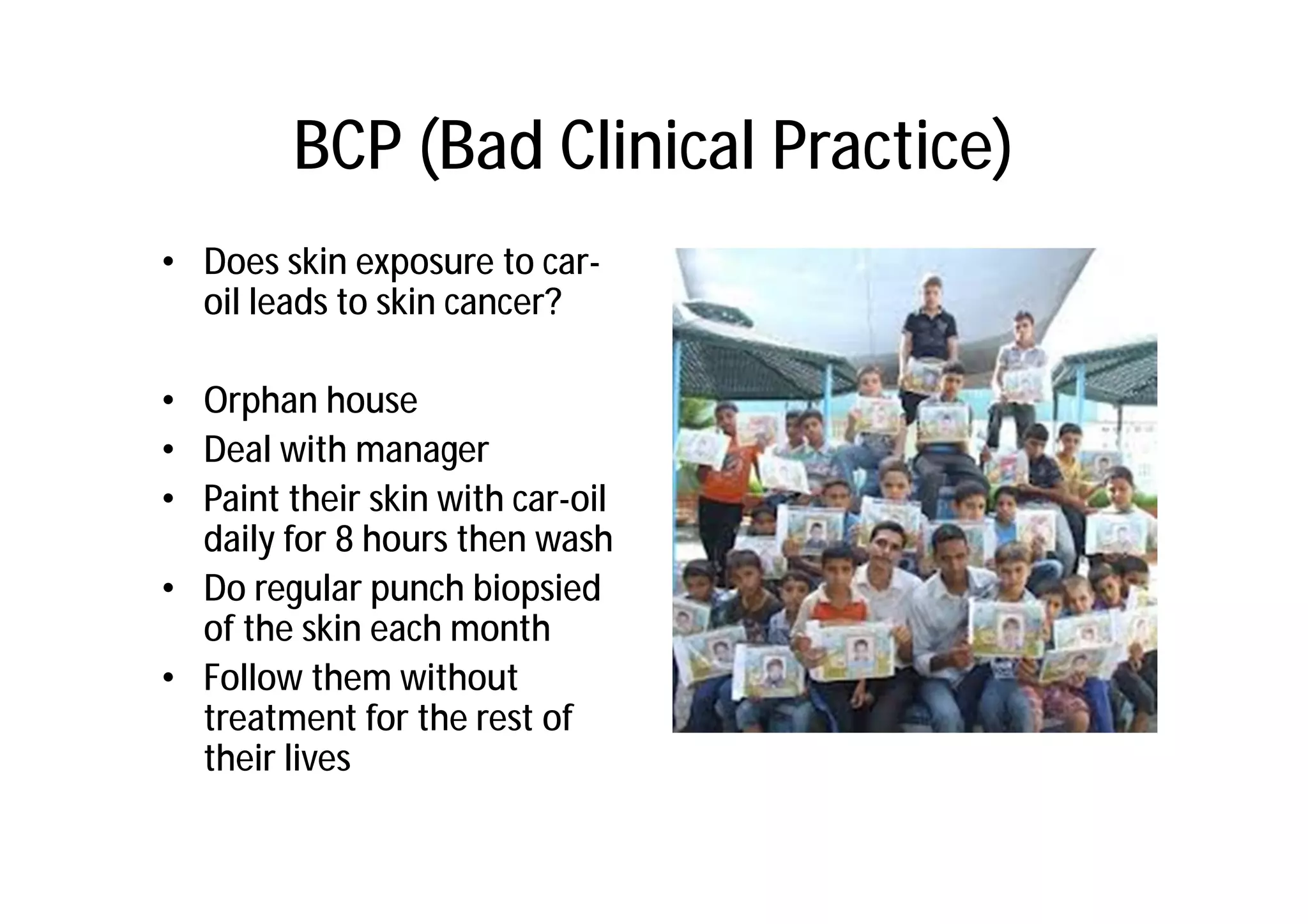
BCP (Bad Clinical Practice)
• Does skin exposure to car-
  oil leads to skin cancer?

• Orphan house
• Deal with manager
• Paint their skin with car-oil
  daily for 8 hours then wash
• Do regular punch biopsied
  of the skin each month
• Follow them without
  treatment for the rest of
  their lives
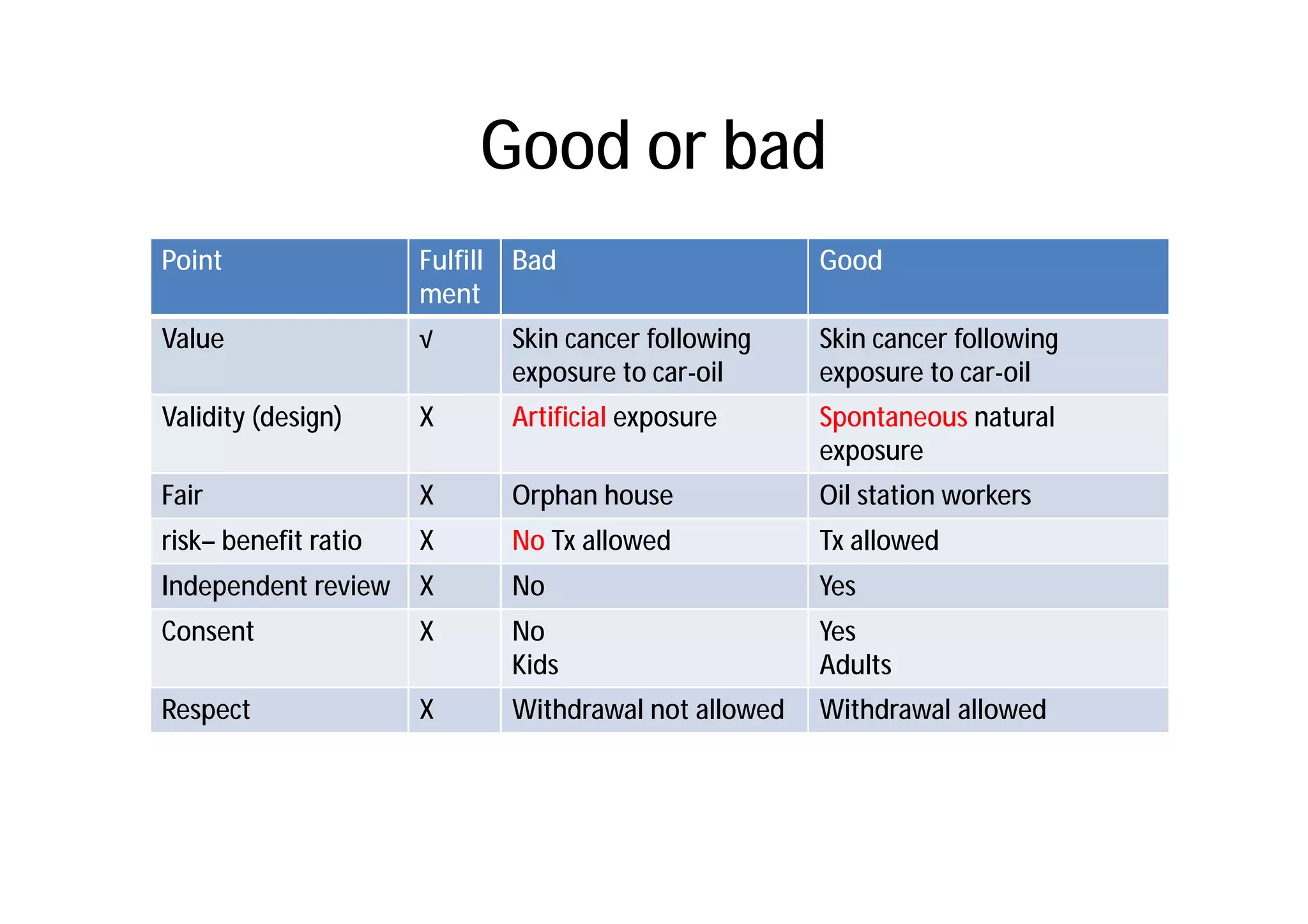
Good or bad
Point                 Fulfill   Bad                      Good
                      ment
Value                 √         Skin cancer following    Skin cancer following
                                exposure to car-oil      exposure to car-oil
Validity (design)     X         Artificial exposure      Spontaneous natural
                                                         exposure
Fair                  X         Orphan house             Oil station workers
risk– benefit ratio   X         No Tx allowed            Tx allowed
Independent review    X         No                       Yes
Consent               X         No                       Yes
                                Kids                     Adults
Respect               X         Withdrawal not allowed   Withdrawal allowed
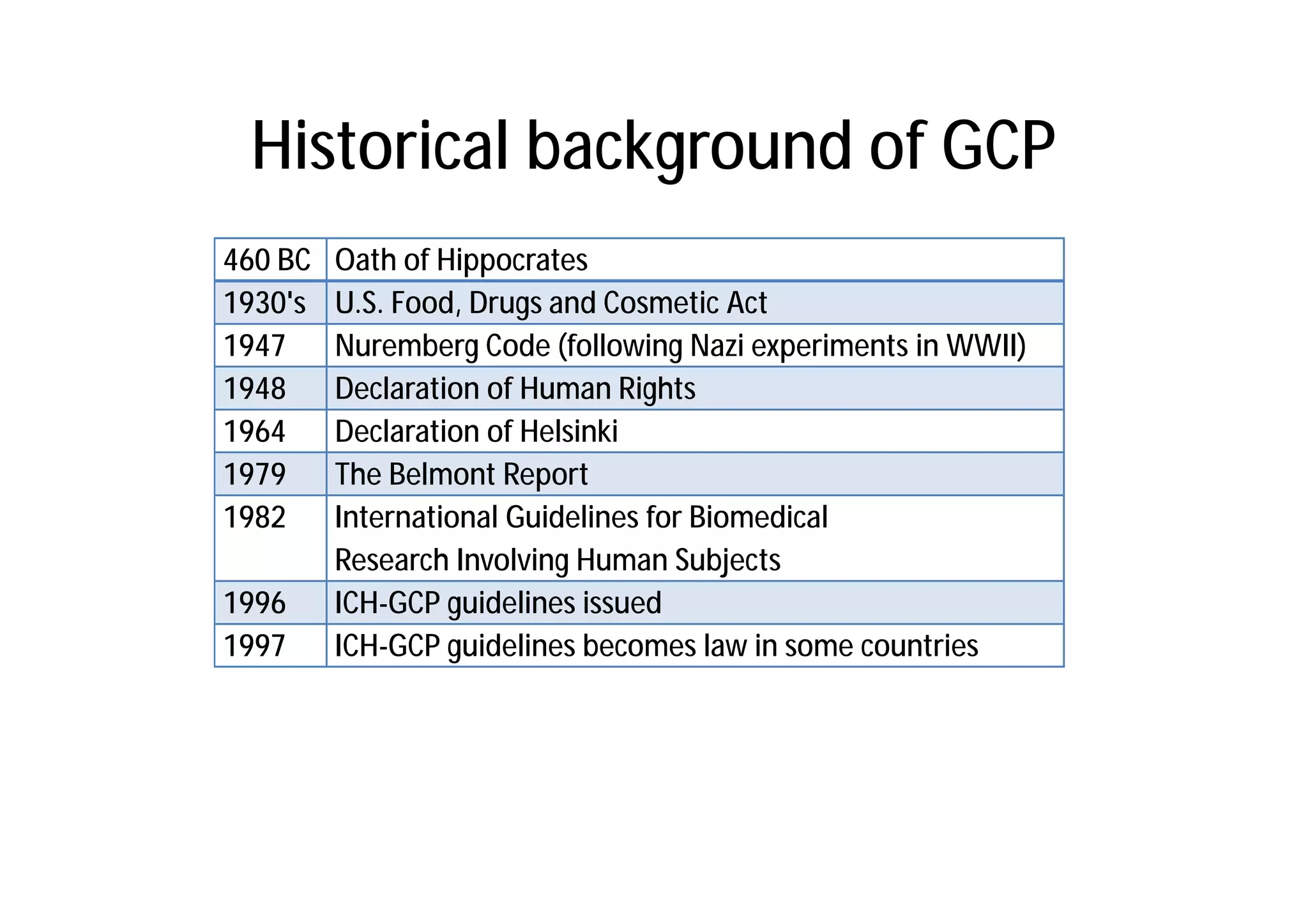
Historical background of GCP
460 BC   Oath of Hippocrates
1930's   U.S. Food, Drugs and Cosmetic Act
1947     Nuremberg Code (following Nazi experiments in WWII)
1948     Declaration of Human Rights
1964     Declaration of Helsinki
1979     The Belmont Report
1982     International Guidelines for Biomedical
         Research Involving Human Subjects
1996     ICH-GCP guidelines issued
1997     ICH-GCP guidelines becomes law in some countries
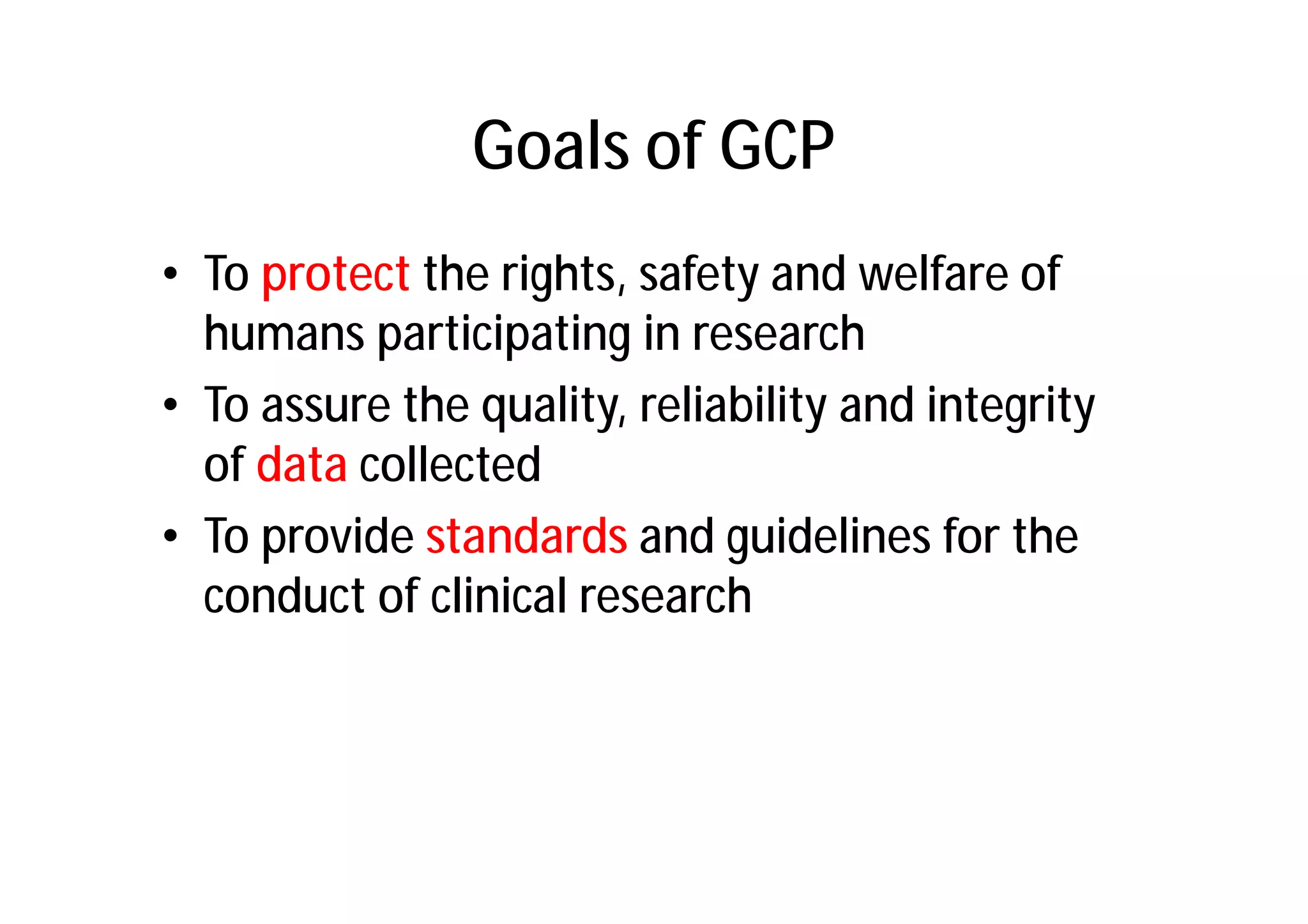
Goals of GCP
• To protect the rights, safety and welfare of
  humans participating in research
• To assure the quality, reliability and integrity
  of data collected
• To provide standards and guidelines for the
  conduct of clinical research
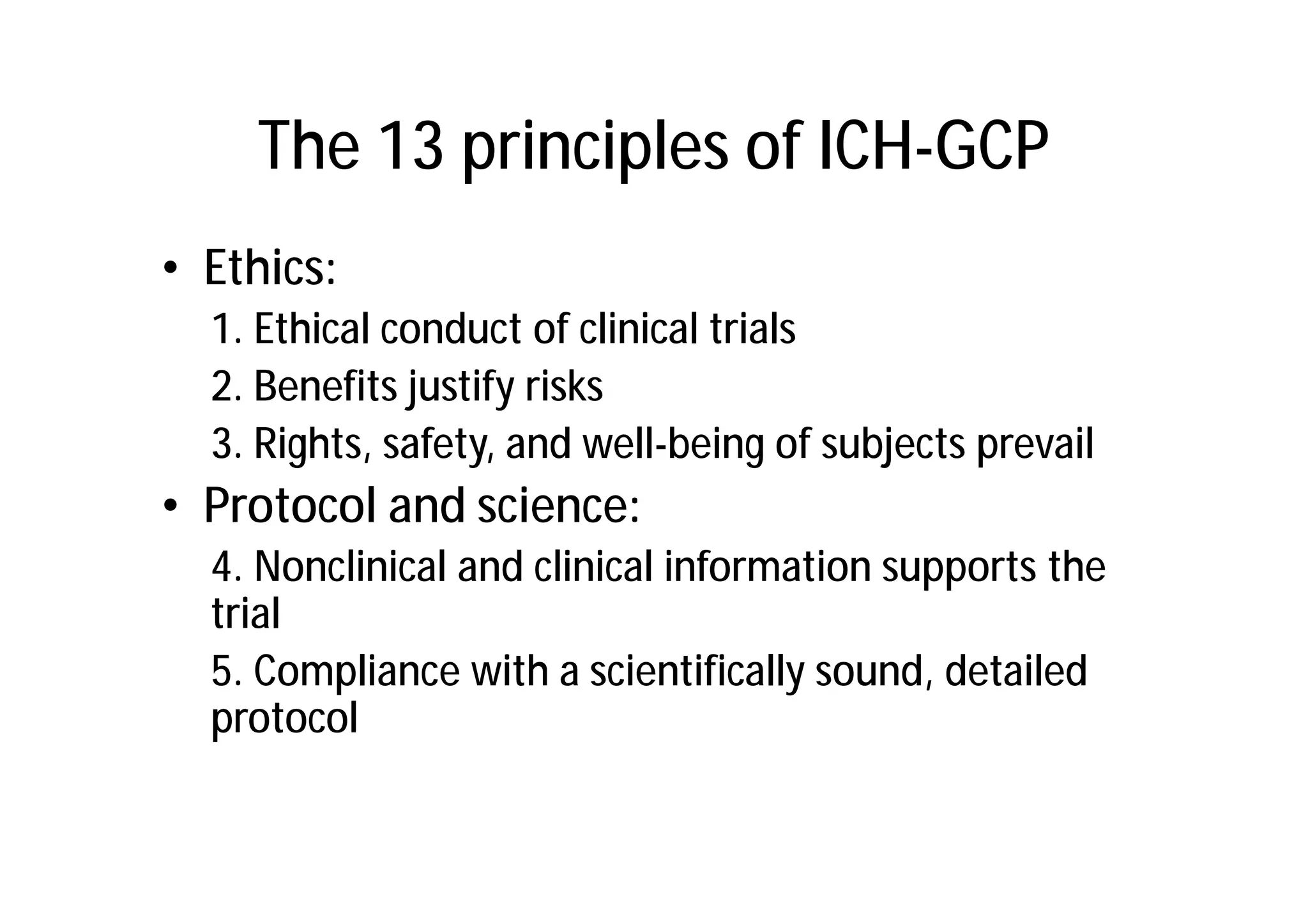
The 13 principles of ICH-GCP
• Ethics:
  1. Ethical conduct of clinical trials
  2. Benefits justify risks
  3. Rights, safety, and well-being of subjects prevail
• Protocol and science:
  4. Nonclinical and clinical information supports the
  trial
  5. Compliance with a scientifically sound, detailed
  protocol
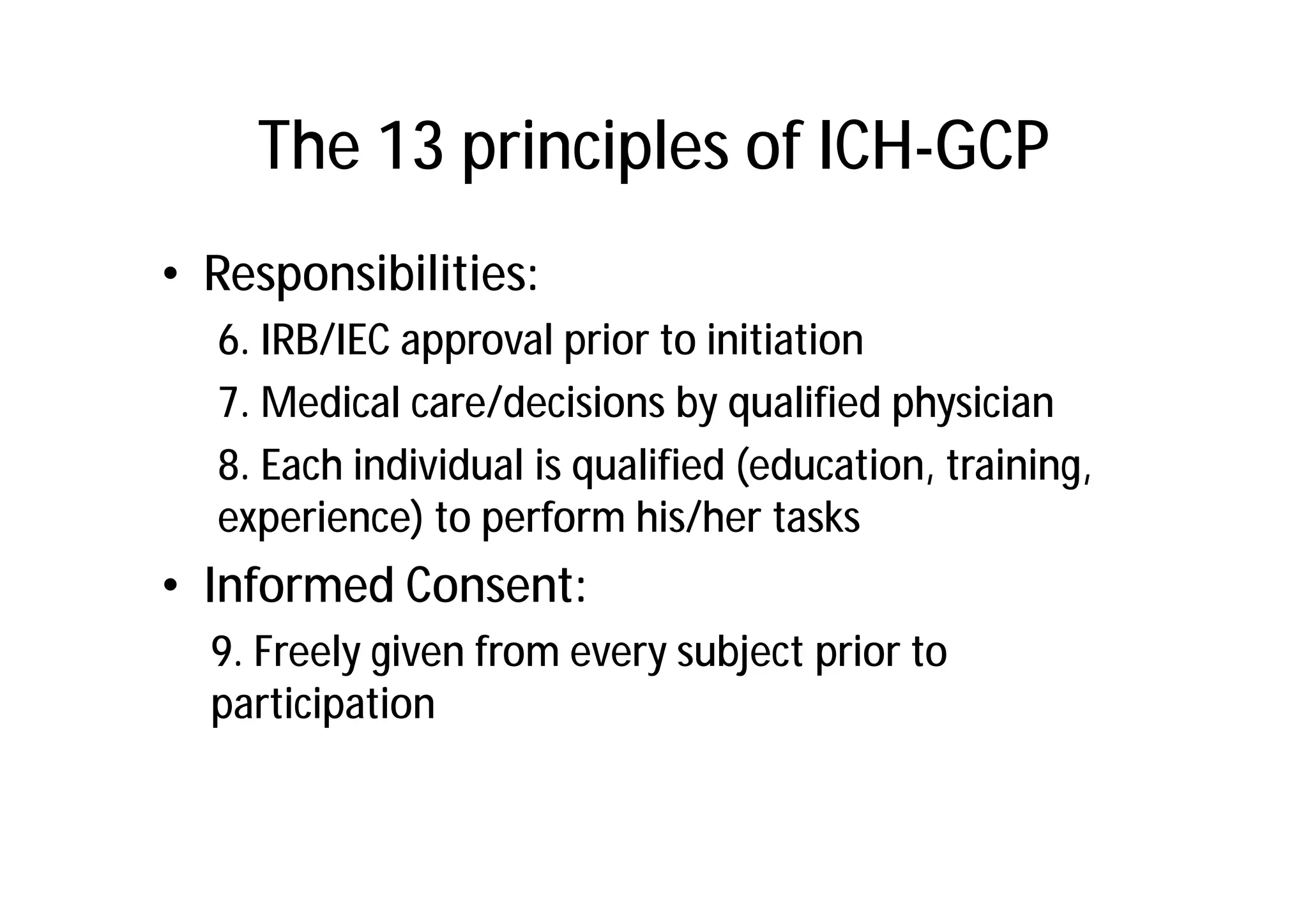
The 13 principles of ICH-GCP
• Responsibilities:
  6. IRB/IEC approval prior to initiation
  7. Medical care/decisions by qualified physician
  8. Each individual is qualified (education, training,
  experience) to perform his/her tasks
• Informed Consent:
  9. Freely given from every subject prior to
  participation
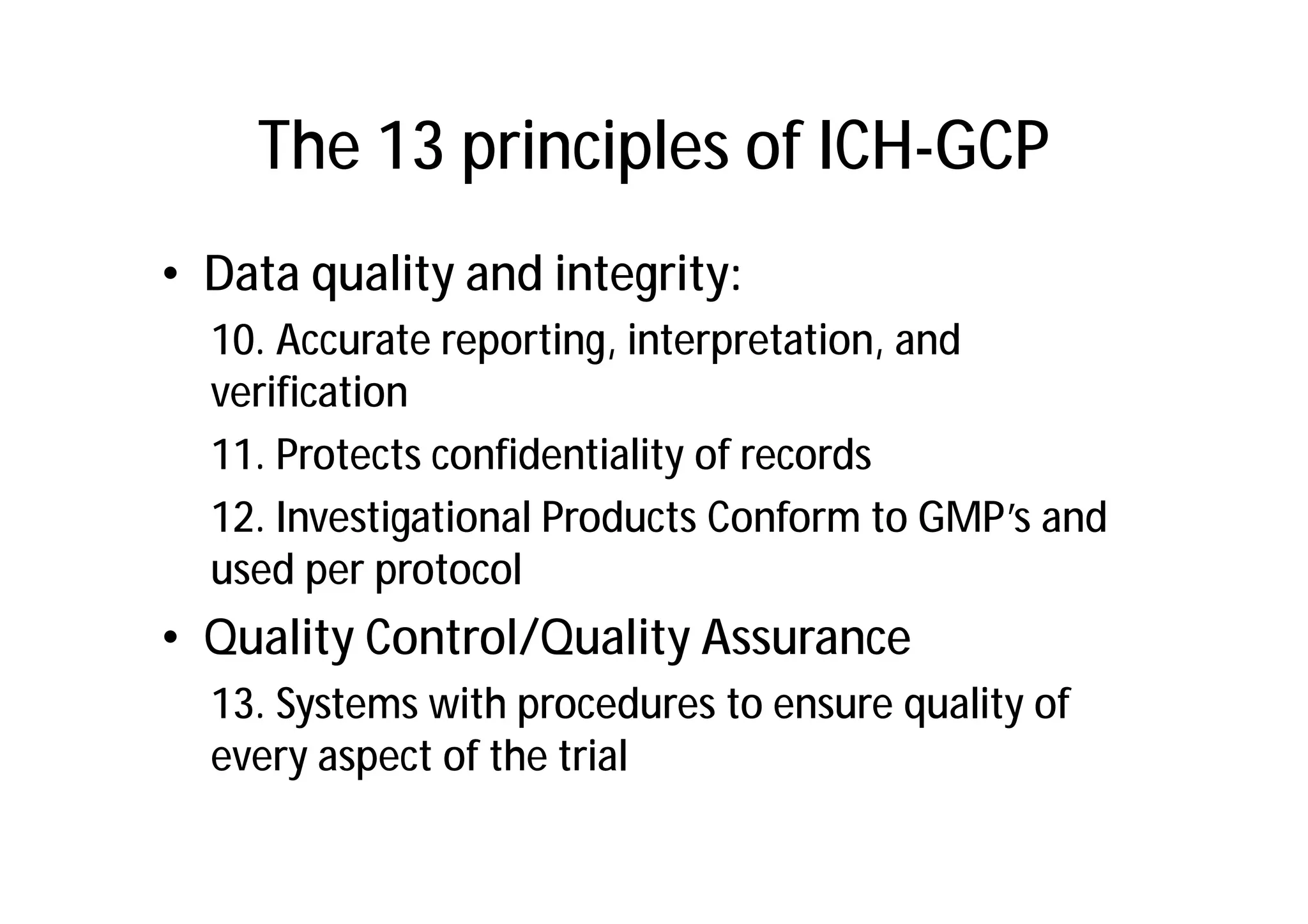
The 13 principles of ICH-GCP
• Data quality and integrity:
  10. Accurate reporting, interpretation, and
  verification
  11. Protects confidentiality of records
  12. Investigational Products Conform to GMP’s and
  used per protocol
• Quality Control/Quality Assurance
  13. Systems with procedures to ensure quality of
  every aspect of the trial
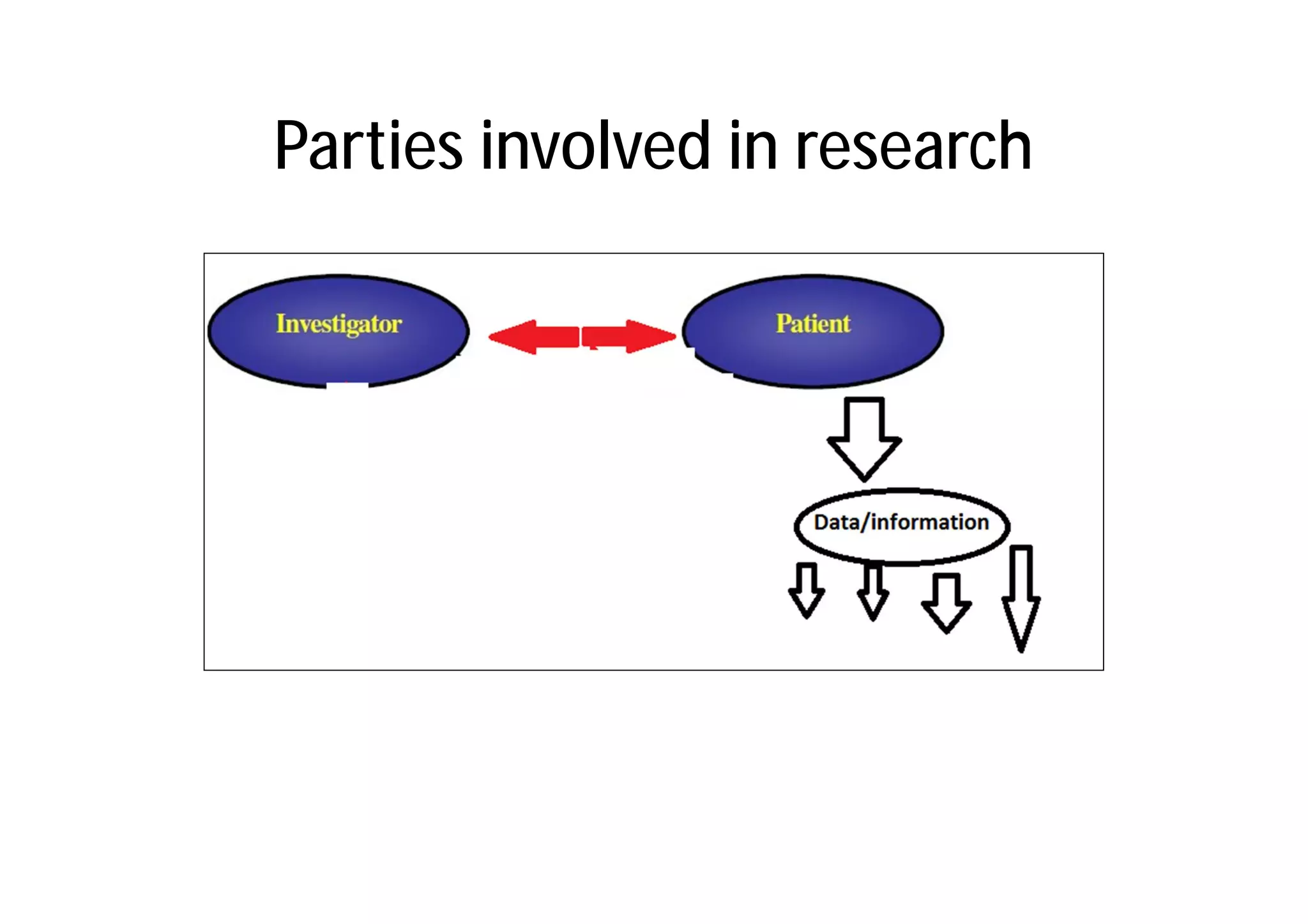
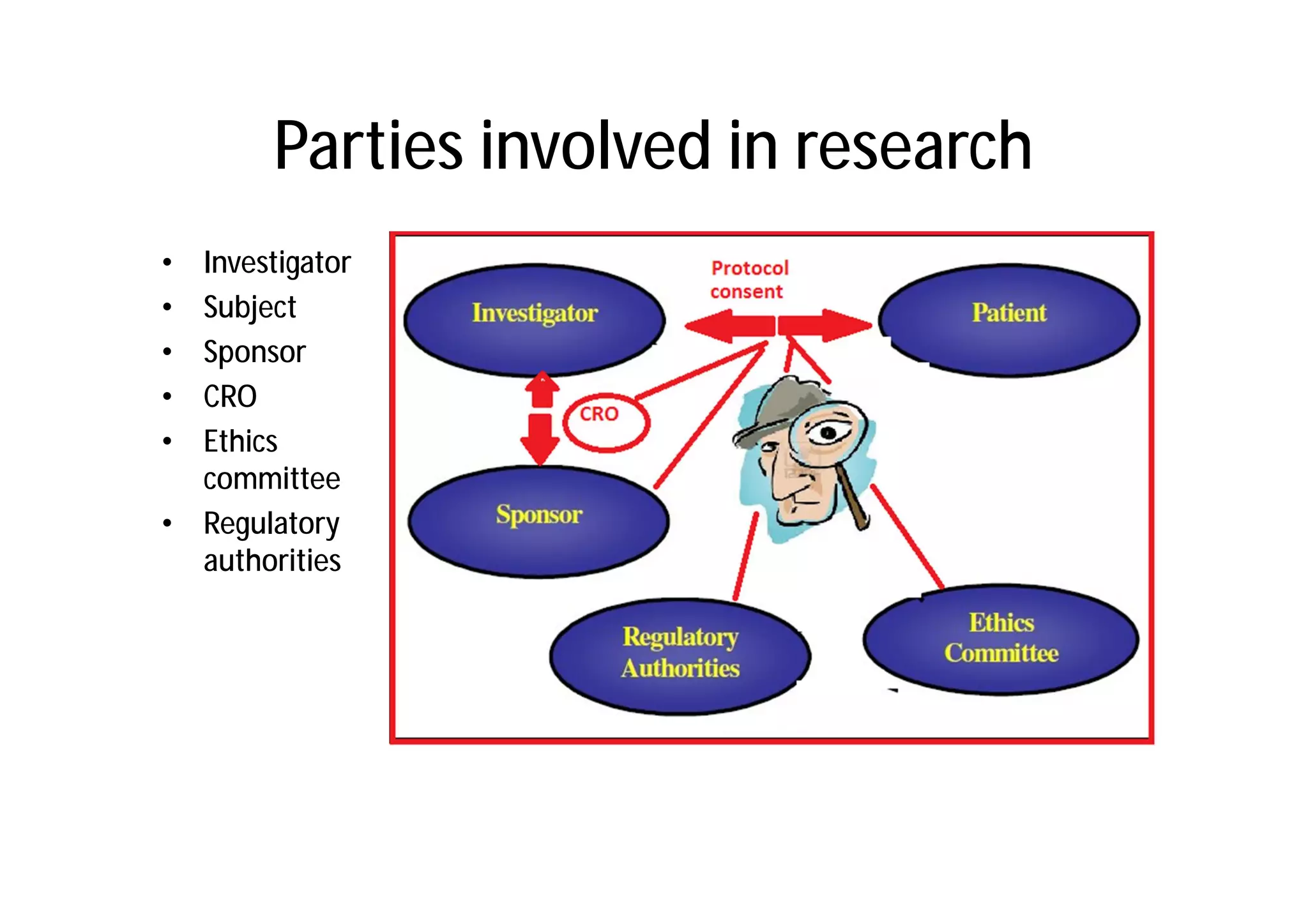
Parties involved in research
• Investigator
• Subject
• Sponsor
• CRO
• Ethics
  committee
• Regulatory
  authorities
Summary
• Scientific research
• Clinical research
• Clinical trials
   – Phase I, II, III and IV
• Ethics in research
• GCP: standards or guidelines to ensure research is
  scientific, ethical and of good quality
• Parties involved in research and their role and
  responsibilities
Thank You


        Ahmed A Zeeneldin
Director of Research Center (RCENCI)
         Tel: 01111 000 943
   Email: azeeneldin@gmail.com
            Ahmed Zeeneldin            49

Introduction to clinical research and gcp

  • 1.
    Introduction to ClinicalResearch and Good Clinical Practice Ahmed Abdelmabood Zeeneldin MD Medical Oncology, Egypt Master of Clinical Research, UK
  • 2.
    Items to becovered • Clinical Research • GCP
  • 3.
    Scientific Research • Observations •Relations • Workers • temperature • car-oil change
  • 4.
    Clinical Research • Observations •Relations • Question? Is there a relation between the time of car-oil change and • temperature? • Hypothesis? Increasing temperature decreases the time of car-oil change and temperature?
  • 5.
    • Define measurementscales: – Temp: degrees centigrade – Time in minutes • Collect data • Test hypothesis 70 60 Temperature (oC) 50 • Conclusion: 40 -increasing temp form 0-25 30 oC decreases time 20 10 -while increase above 25 oC 0 increases the time 0 10 20 30 Time (min) 40 50
  • 6.
    Scientific research • Systematicinvestigation of hypothetical propositions about the presumed relations among observed phenomena.
  • 7.
    Clinical research • Scientificresearch • On – humans or – materials or – data of human origin
  • 8.
    Clinical research • Isthere a relationship between Eczema and number of car-oil change in workers? • Number of car-oil change in workers – Limits: 16/day • Eczema – Limits: non-invasive (inspection and not biopsy) – Eczema score: area in CM x severity (0, 1, 2 3)
  • 9.
  • 10.
    Clinical and preclinicalresearch • Preclinical Research: Ø Not in humans Ø But will serve humans Ø LAB Ø Animal
  • 11.
    Why we doresearch? – To gain knowledge • treat, prevent, diagnose diseases • Human welfare • Current and future patients Ahmed Zeeneldin 11
  • 12.
    Contributions to knowledge Ahmed Zeeneldin 12
  • 13.
    Why subjects engagein research? – To help their diseases – To help other patients – Other benefits: • e.g. payment Ahmed Zeeneldin 13
  • 14.
    Is research beneficialto patients? • WE DO NOT KNOW: – It could be beneficial (Hopefully) – It could prove harmful – It could prove of no benefit Ahmed Zeeneldin 14
  • 15.
    Research vs. routinepractice • Practice: – Standard – approved – benefit • Research: may not always benefit: – Non-standard – Non-approved – Benefit? • May receive highest care • May directly benefit • May be harmed • Research gives Knowledge for better health • Individual: respect, safety and dignity Ahmed Zeeneldin 15
  • 16.
    Study designs inhealth research • Observational: – No intervention • Experimental: – Intervention and outcome • Semi-experimental • True-Experimental Ahmed Zeeneldin 16
  • 17.
    Study designs inClinical Research • Observational: – Research – Not clinical trials • Experimental: – Research – As well as clinical trials Ahmed Zeeneldin 17
  • 18.
    Observational studies • Cross-sectional •Case-control • Cohort Ahmed Zeeneldin 18
  • 19.
    Cross-sectional studies • Example: – Obesity and Skin cancer •. Total SKIN cancer Obese 350 (70%) Non-Obese 150 (30%) Total 500 (100%) Ahmed Zeeneldin 19
  • 20.
    Case-control studies • Example: – Lung cancer and smoking in Gharbia Lung cancer No-lung cancer Smoking 450 (90%) 150 (30%) No-smoking 50 (10%) 350 (70%) Total 500 500 Ahmed Zeeneldin 20
  • 21.
    Cohort studies ‫ﺟﻤﺎﻋﺔ‬ •Example: – Skin cancer following chest wall irradiation for Breast cancer Breast CA+RT Breast CA- RT Skin cancer 10 (10%) 4 (1.3%) No-SKIN cancer 90 (90%) 296 (98.7%) Total 100 300 Ahmed Zeeneldin 21
  • 22.
    Experimental Research Interventional Research • Phase I • Phase II • Phase III: – Randomized controlled trial (RCT) • Phase IV Ahmed Zeeneldin 22
  • 23.
    Experimental Research Interventional Research • Phase I • Semi experimental • Phase II • Semi experimental • Phase III: • True experimental – Randomized controlled trial (RCT) • Phase IV Ahmed Zeeneldin 23
  • 24.
    Example of clinicaltrials • Use of Nigella Sativa oil in treatment of metastatic malignant melanoma • ‫اﺳﺗﺧدام زﯾت ﺣﺑﺔ اﻟﺑرﻛﺔ ﻓﻲ ﻋﻼج ﺳرطﺎن اﻟﺟﻠد اﻟﺻﺑﻐﻲ اﻟﻣﻧﺗﺷر‬
  • 25.
    Question? • Why notgoing ahead and using this in all patients ? ~ 100, 000
  • 26.
    Steps • Preclinical R – Lab: manufacturing and purification, solubility and preservation – Cell lines • Effective or not – Animals • Safe or not? – Dose and frequency and duration AND Route • Efficacious or not? • Clinical R – Safe or not? à phase I – Efficacious or not? à phase II – More effective than current chemotherapy? à phase III • What is next?
  • 27.
  • 28.
    Why we usetrials? • Animal and human trials • Predictability of safety and efficacy • Animals: – Safety prediction – Diseases are different in animals: X efficacy • Humans: – Safety and efficacy prediction • Prediction is never perfect Ahmed Zeeneldin 28
  • 29.
  • 30.
  • 31.
    Preclinical Lab research •New viruses • New war weapons • Resistant microbes
  • 32.
    Pre-clinical animal research •How long will guinea pig live in atmospheric temperature below 0°? • How long will a guinea pig live without food or water? • Carcinogenicity of car- oil on guinea pig skin?
  • 33.
    Clinical research • Howlong will a human live in atmospheric temperature below 0°? • How long will a human live under a collapsed house without food or water? • This will decide the time rescuers will spend on searching? • Carcinogenicity of car-oil on human skin?
  • 34.
    Clinical research • Arethese trials acceptable? • Is this clinical research practice bad or good ? • BCRP • GCRP= GCP
  • 35.
    Good Clinical Practice(GCP) • By GCP we mean: – Set of standards for clinical research – From design àconduct à monitoring/auditing à recording à analysis à reporting • Aspects of GCP – Science – Ethics – Quality
  • 36.
    GCP 1 Value (science), ،‫اﻟﻘﯾﻣﺔ‬ 2 Validity (quality), ‫ﺻﻼﺣﯾﺔ‬ 3 Fairness (justice), ‫اﻟﻌداﻟﺔ‬ 4 Risk– benefit ratio ‫ﻧﺳﺑﺔ اﻟﻣﺧﺎطر واﻟﻣﻧﺎﻓﻊ‬ (beneficence), (‫)اﻟﻣﻧﻔﻌﺔ‬ 5 Protocol and its ‫اﻟﺑروﺗوﻛول‬ Independent review, ‫اﻟﻣراﺟﻌﺔ اﻟﻣﺳﺗﻘﻠﺔ‬ 6 Consent, ‫اﻟﻣواﻓﻘﺔ اﻟﻣﺳﺗﻧﯾرة‬ 7 Respect ‫اﻻﺣﺗرام‬ (Emanuel et al. 2000) Belmont report, 1979.
  • 37.
    GCP rules • Socialand scientific Value: – respond to health needs and – provide a sound question whose answers will advance knowledge for the good of science and society. • Validity (Quality): – data generated from CR should be valid and interpretable through proper design, endpoints and methodology. • Fair subject selection: – being non-biased and based of scientific grounds. • Favorable risk– benefit ratio: – through minimization of vulnerability and risk as well as maximization of benefits.
  • 38.
    • Independent review: – to ensure adherence to the ethical guidelines in design, conduct and analysis. • Informed consent: – the process that provides adequate information allows only voluntary participation. – Consent withdrawal should be allowed anytime in the research. – Consent does not deprive subjects from any of their rights nor does it alleviate researchers from their responsibilities in protecting safety, rights and welfare of subjects. • Respect for the enrolled subject’s: – autonomy, right and welfare both during and after research. – Individual’s rights and welfare should precede that of science and society
  • 39.
    BCP (Bad ClinicalPractice) • Does skin exposure to car- oil leads to skin cancer? • Orphan house • Deal with manager • Paint their skin with car-oil daily for 8 hours then wash • Do regular punch biopsied of the skin each month • Follow them without treatment for the rest of their lives
  • 40.
    Good or bad Point Fulfill Bad Good ment Value √ Skin cancer following Skin cancer following exposure to car-oil exposure to car-oil Validity (design) X Artificial exposure Spontaneous natural exposure Fair X Orphan house Oil station workers risk– benefit ratio X No Tx allowed Tx allowed Independent review X No Yes Consent X No Yes Kids Adults Respect X Withdrawal not allowed Withdrawal allowed
  • 41.
    Historical background ofGCP 460 BC Oath of Hippocrates 1930's U.S. Food, Drugs and Cosmetic Act 1947 Nuremberg Code (following Nazi experiments in WWII) 1948 Declaration of Human Rights 1964 Declaration of Helsinki 1979 The Belmont Report 1982 International Guidelines for Biomedical Research Involving Human Subjects 1996 ICH-GCP guidelines issued 1997 ICH-GCP guidelines becomes law in some countries
  • 42.
    Goals of GCP •To protect the rights, safety and welfare of humans participating in research • To assure the quality, reliability and integrity of data collected • To provide standards and guidelines for the conduct of clinical research
  • 43.
    The 13 principlesof ICH-GCP • Ethics: 1. Ethical conduct of clinical trials 2. Benefits justify risks 3. Rights, safety, and well-being of subjects prevail • Protocol and science: 4. Nonclinical and clinical information supports the trial 5. Compliance with a scientifically sound, detailed protocol
  • 44.
    The 13 principlesof ICH-GCP • Responsibilities: 6. IRB/IEC approval prior to initiation 7. Medical care/decisions by qualified physician 8. Each individual is qualified (education, training, experience) to perform his/her tasks • Informed Consent: 9. Freely given from every subject prior to participation
  • 45.
    The 13 principlesof ICH-GCP • Data quality and integrity: 10. Accurate reporting, interpretation, and verification 11. Protects confidentiality of records 12. Investigational Products Conform to GMP’s and used per protocol • Quality Control/Quality Assurance 13. Systems with procedures to ensure quality of every aspect of the trial
  • 46.
  • 47.
    Parties involved inresearch • Investigator • Subject • Sponsor • CRO • Ethics committee • Regulatory authorities
  • 48.
    Summary • Scientific research •Clinical research • Clinical trials – Phase I, II, III and IV • Ethics in research • GCP: standards or guidelines to ensure research is scientific, ethical and of good quality • Parties involved in research and their role and responsibilities
  • 49.
    Thank You Ahmed A Zeeneldin Director of Research Center (RCENCI) Tel: 01111 000 943 Email: azeeneldin@gmail.com Ahmed Zeeneldin 49