Aruna Devi P.
Assistant Professor, Department of CS
Operator Overloading
 It Facilitates the use of Compile time Polymorphism
 When overloading the meaning of the operator should
not be changed.
 Allowing C++’s operators to work with user defined
data type such as objects
 Use all operators with user-defined objects
 Requires great care while overloading operators.
 Program will be difficult to understand
 Examples of already overloaded operators
 Operator << is both the stream-insertion operator and the
bitwise left-shift operator
 + and -, perform arithmetic on multiple types
 Compiler generates the appropriate code based on the
manner in which the operator is used
Overloading …
 Operator Overloading
 Function definition is written as usual
 Operator keyword is used in declaration followed by
the symbol for the operator being overloaded
 operator+ is used to overload the addition operator
(+)
 Using operators
 To use an operator on a class object it must be
overloaded first
 Assignment operator by default performs member wise
assignment
 Address operator (&) by default returns the address of an object
Restrictions on Operator Overloading
 C++ operators that can be overloaded
 C++ Operators that cannot be overloaded
Operators that cannot be overloaded
. .* :: ?: sizeof
Operators that can be overloaded
+ - * / % ^ & |
~ ! = < > += -= *=
/= %= ^= &= |= << >> >>=
<<= == != <= >= && || ++
-- ->* , -> [] () new delete
new[] delete[]
Restrictions on Operator Overloading
 Overloading restrictions
 Precedence of an operator cannot be changed
 Associativity of an operator cannot be changed
 Arity (number of operands) cannot be changed
 Unary operators remain unary, and binary operators remain
binary
 Operators &, *, + and - each have unary and binary versions
 Unary and binary versions can be overloaded separately
 No new operators can be created
 Use only existing operators
 No overloading operators for built-in types
 Cannot change how two integers are added
 Produces a syntax error
Operator Function
 Uses the Operator Keyword for function declaration
 Overloading the operator is done by statements in the
operator function definition.
 Operator function can be
 Member function
 Non member function as Friend
The way of defining the function differs for both the
method.
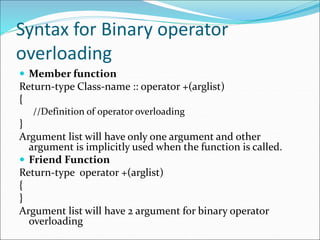
Syntax for Binary operator
overloading
 Member function
Return-type Class-name :: operator +(arglist)
{
//Definition of operator overloading
}
Argument list will have only one argument and other
argument is implicitly used when the function is called.
 Friend Function
Return-type operator +(arglist)
{
}
Argument list will have 2 argument for binary operator
overloading
Operator Functions as Class Members vs.
as friend Functions
 Member vs non-member
 Operator functions can be member or non-member
functions
 When overloading ( ), [ ], -> or any of the assignment
operators, it could be done with a member function
 Operator functions as member functions
 Leftmost operand must be an object (or reference to an
object) of the class
 If left operand of a different type, operator function must be a non-
member function
 Operator functions as non-member functions
 Must be friend if needs to access private or protected
members
 Enable the operator to be commutative
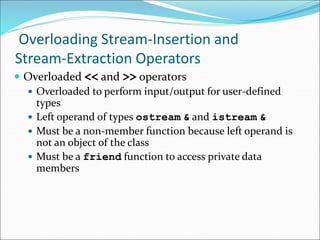
Overloading Stream-Insertion and
Stream-Extraction Operators
 Overloaded << and >> operators
 Overloaded to perform input/output for user-defined
types
 Left operand of types ostream & and istream &
 Must be a non-member function because left operand is
not an object of the class
 Must be a friend function to access private data
members
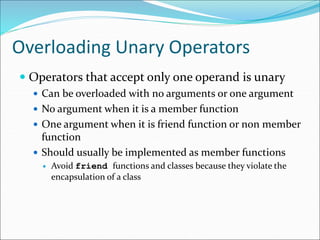
Overloading Unary Operators
 Operators that accept only one operand is unary
 Can be overloaded with no arguments or one argument
 No argument when it is a member function
 One argument when it is friend function or non member
function
 Should usually be implemented as member functions
 Avoid friend functions and classes because they violate the
encapsulation of a class
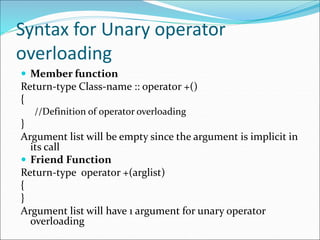
Syntax for Unary operator
overloading
 Member function
Return-type Class-name :: operator +()
{
//Definition of operator overloading
}
Argument list will be empty since the argument is implicit in
its call
 Friend Function
Return-type operator +(arglist)
{
}
Argument list will have 1 argument for unary operator
overloading
Conclusion
 Operator overloading is one of the feature of C++
that’s implements Compile time polymorphism.
 Overloading code should be written with greater care.
 Meaning of the operator should be preserved
 Use any of the two method for declaring the operator
function

Operator overloading

  • 1.
    Aruna Devi P. AssistantProfessor, Department of CS
  • 2.
    Operator Overloading  ItFacilitates the use of Compile time Polymorphism  When overloading the meaning of the operator should not be changed.  Allowing C++’s operators to work with user defined data type such as objects  Use all operators with user-defined objects  Requires great care while overloading operators.  Program will be difficult to understand  Examples of already overloaded operators  Operator << is both the stream-insertion operator and the bitwise left-shift operator  + and -, perform arithmetic on multiple types  Compiler generates the appropriate code based on the manner in which the operator is used
  • 3.
    Overloading …  OperatorOverloading  Function definition is written as usual  Operator keyword is used in declaration followed by the symbol for the operator being overloaded  operator+ is used to overload the addition operator (+)  Using operators  To use an operator on a class object it must be overloaded first  Assignment operator by default performs member wise assignment  Address operator (&) by default returns the address of an object
  • 4.
    Restrictions on OperatorOverloading  C++ operators that can be overloaded  C++ Operators that cannot be overloaded Operators that cannot be overloaded . .* :: ?: sizeof Operators that can be overloaded + - * / % ^ & | ~ ! = < > += -= *= /= %= ^= &= |= << >> >>= <<= == != <= >= && || ++ -- ->* , -> [] () new delete new[] delete[]
  • 5.
    Restrictions on OperatorOverloading  Overloading restrictions  Precedence of an operator cannot be changed  Associativity of an operator cannot be changed  Arity (number of operands) cannot be changed  Unary operators remain unary, and binary operators remain binary  Operators &, *, + and - each have unary and binary versions  Unary and binary versions can be overloaded separately  No new operators can be created  Use only existing operators  No overloading operators for built-in types  Cannot change how two integers are added  Produces a syntax error
  • 6.
    Operator Function  Usesthe Operator Keyword for function declaration  Overloading the operator is done by statements in the operator function definition.  Operator function can be  Member function  Non member function as Friend The way of defining the function differs for both the method.
  • 7.
    Syntax for Binaryoperator overloading  Member function Return-type Class-name :: operator +(arglist) { //Definition of operator overloading } Argument list will have only one argument and other argument is implicitly used when the function is called.  Friend Function Return-type operator +(arglist) { } Argument list will have 2 argument for binary operator overloading
  • 8.
    Operator Functions asClass Members vs. as friend Functions  Member vs non-member  Operator functions can be member or non-member functions  When overloading ( ), [ ], -> or any of the assignment operators, it could be done with a member function  Operator functions as member functions  Leftmost operand must be an object (or reference to an object) of the class  If left operand of a different type, operator function must be a non- member function  Operator functions as non-member functions  Must be friend if needs to access private or protected members  Enable the operator to be commutative
  • 9.
    Overloading Stream-Insertion and Stream-ExtractionOperators  Overloaded << and >> operators  Overloaded to perform input/output for user-defined types  Left operand of types ostream & and istream &  Must be a non-member function because left operand is not an object of the class  Must be a friend function to access private data members
  • 10.
    Overloading Unary Operators Operators that accept only one operand is unary  Can be overloaded with no arguments or one argument  No argument when it is a member function  One argument when it is friend function or non member function  Should usually be implemented as member functions  Avoid friend functions and classes because they violate the encapsulation of a class
  • 11.
    Syntax for Unaryoperator overloading  Member function Return-type Class-name :: operator +() { //Definition of operator overloading } Argument list will be empty since the argument is implicit in its call  Friend Function Return-type operator +(arglist) { } Argument list will have 1 argument for unary operator overloading
  • 12.
    Conclusion  Operator overloadingis one of the feature of C++ that’s implements Compile time polymorphism.  Overloading code should be written with greater care.  Meaning of the operator should be preserved  Use any of the two method for declaring the operator function