Department of Information Technology 1Soft Computing (ITC4256 )
Introduction to
Soft Computing
Dr. C.V. Suresh Babu
Professor
Department of IT
Hindustan Institute of Science & Technology
Department of Information Technology 2Soft Computing (ITC4256 )
Discussion Topics
• What is Soft Computing?
• What is Hard Computing?
• What is Fuzzy Logic Models?
• What is Neural Networks (NN)?
• What is Genetic Algorithms or Evaluation Programming?
• What is probabilistic reasoning?
• Difference between fuzziness and probability
• AI and Soft Computing
• Future of Soft Computing
Department of Information Technology 3Soft Computing (ITC4256 )
Soft computing differs from conventional (hard)
computing in that, unlike hard computing, it is tolerant
of imprecision, uncertainty, partial truth, and
approximation. In effect, the role model for soft
computing is the human mind.
What is Soft Computing ?
Department of Information Technology 4Soft Computing (ITC4256 )
Hard computing, i.e., conventional computing, requires a precisely stated analytical
model and often a lot of computation time.
• Many analytical models are valid for ideal cases.
• Real world problems exist in a non-ideal environment.
• Premises and guiding principles of Hard Computing are
- Precision, Certainty, and Rigor.
• Many contemporary problems do not lend themselves to precise solutions such as
• Recognition problems (handwriting, speech, objects, images, texts)
• Mobile robot coordination, forecasting, combinatorial problems etc.
• Reasoning on natural languages
What is Hard Computing ?
Department of Information Technology 5Soft Computing (ITC4256 )
What is SC?
Another possible definition of soft computing is to consider it as an anti-thesis
to the concept of computer we now have, which can be described with all the adjectives such as hard,
crisp, rigid, inflexible and stupid. Along this track,
one may see soft computing as an attempt to mimic natural creatures: plants, animals, human beings,
which are soft, flexible, adaptive and clever. In this sense soft computing is the name of a family of
problem-solving methods that have analogy with biological reasoning and problem solving (sometimes
referred to as cognitive computing).
The basic methods included in cognitive computing are
• fuzzy logic (FL)
• neural networks (NN)
• genetic algorithms (GA)
Note: this methods which do not derive from classical theories.
Department of Information Technology 6Soft Computing (ITC4256 )
Soft computing employs ANN, EC, FL etc, in a
complementary rather than a competitive way.
• One example of a particularly effective combination is
"neurofuzzy systems.”
• Such systems are becoming increasingly visible as
consumer products ranging from air conditioners and
washing machines to photocopiers, camcorders and
many industrial applications.
Implications of Soft Computing
Department of Information Technology 7Soft Computing (ITC4256 )
The principal constituents, i.e., tools, techniques, of Soft
Computing (SC) are
• Fuzzy Logic (FL),
• Artificial Neural Networks (ANN),
• Evolutionary Computation (EC),
• Swarm Intelligence (i.e. Ant colony optimization and
Particle swarm optimization, )
• Additionally Some Machine Learning (ML) and
Probabilistic Reasoning (PR) areas.
Tools & Techniques of Soft Computing
Department of Information Technology 8Soft Computing (ITC4256 )
Properties of Soft computing
• Learning from experimental data  generalization
• Soft computing techniques derive their power of generalization
from approximating or interpolating to produce outputs from
previously unseen inputs by using outputs from previous learned
inputs
• Generalization is usually done in a high dimensional space.
Department of Information Technology 9Soft Computing (ITC4256 )
• Handwriting recognition
• Automotive systems and manufacturing
• Image processing and data compression
• Architecture
• Decision-support systems
• Data Mining
• Power systems
• Control Systems
Recent Applications using Soft Computing
Department of Information Technology 10Soft Computing (ITC4256 )
Single absolute truth is exist:
Absolute truths are not exist
Need for Soft Computing
Department of Information Technology 11Soft Computing (ITC4256 )
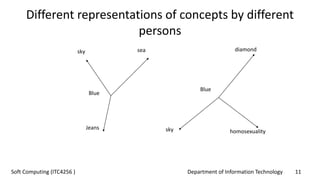
Different representations of concepts by different
persons
Blue
sky sea
Jeans
Blue
diamond
homosexualitysky
Department of Information Technology 12Soft Computing (ITC4256 )
Different representations of concepts in different
languages
• Blue
– Pale blue one word in Russian
– Dark blue one another word in Russian
• Pigmy has many single words for description of forest:
• Forest under rain
• Forest after rain
• Forest in hot season
• Forest in morning
• Forest in evening
• and so on
Department of Information Technology 13Soft Computing (ITC4256 )
The tools for soft computing
• Fuzzy logic models
• Neural networks
• Genetic algorithms
• Probabilistic reasoning
Department of Information Technology 14Soft Computing (ITC4256 )
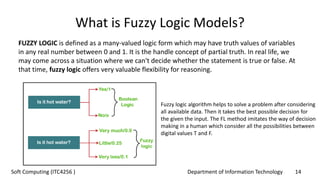
What is Fuzzy Logic Models?
FUZZY LOGIC is defined as a many-valued logic form which may have truth values of variables
in any real number between 0 and 1. It is the handle concept of partial truth. In real life, we
may come across a situation where we can't decide whether the statement is true or false. At
that time, fuzzy logic offers very valuable flexibility for reasoning.
Fuzzy logic algorithm helps to solve a problem after considering
all available data. Then it takes the best possible decision for
the given the input. The FL method imitates the way of decision
making in a human which consider all the possibilities between
digital values T and F.
Department of Information Technology 15Soft Computing (ITC4256 )
Examples of tasks solving by Fuzzy models
• Control of clothes washer
• Making of decision in diagnostic systems (expert systems in medicine,
for example)
• Making of decision in business planning
May be used knowledge such as:
If temperature is high then diagnose is grippe with confidence 80%
If speed is slow then increase transfer of fuel
Department of Information Technology 16Soft Computing (ITC4256 )
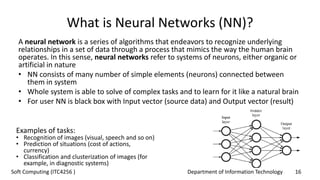
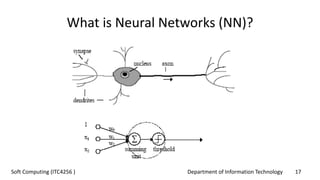
What is Neural Networks (NN)?
A neural network is a series of algorithms that endeavors to recognize underlying
relationships in a set of data through a process that mimics the way the human brain
operates. In this sense, neural networks refer to systems of neurons, either organic or
artificial in nature
• NN consists of many number of simple elements (neurons) connected between
them in system
• Whole system is able to solve of complex tasks and to learn for it like a natural brain
• For user NN is black box with Input vector (source data) and Output vector (result)
Examples of tasks:
• Recognition of images (visual, speech and so on)
• Prediction of situations (cost of actions,
currency)
• Classification and clusterization of images (for
example, in diagnostic systems)
Department of Information Technology 17Soft Computing (ITC4256 )
What is Neural Networks (NN)?
Department of Information Technology 18Soft Computing (ITC4256 )
What is Genetic Algorithms or Evaluation Programming?
Genetic Algorithm (GA) is a search-based optimization
technique based on the principles of Genetics and Natural
Selection. It is frequently used to find optimal or near-optimal
solutions to difficult problems which otherwise would take a
lifetime to solve.
Examples of application:
• Finding of optimal (suitable) path,
• Finding of better structure of neural network
• Finding of configuration of robot
• Optimal cutting
Department of Information Technology 19Soft Computing (ITC4256 )
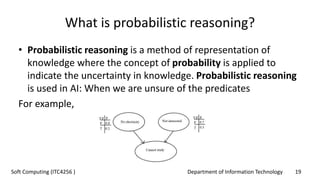
What is probabilistic reasoning?
• Probabilistic reasoning is a method of representation of
knowledge where the concept of probability is applied to
indicate the uncertainty in knowledge. Probabilistic reasoning
is used in AI: When we are unsure of the predicates
For example,
Department of Information Technology 20Soft Computing (ITC4256 )
Examples of applications of probabilistic reasoning
• Recognition of speech
• Navigation of mobile robots
• And so on
Department of Information Technology 21Soft Computing (ITC4256 )
Difference between fuzziness and probability (from
modeling of world)
• Probability deal with unknown entity (time, property before any
event). After any event the entity become known.
• Fuzziness is own property of any entity or (concept or object or
property). It may be more or less but not disappears practically.
• May be fuzzy probability and probability of fuzziness
• Probability may be use for simulation of fuzziness
Department of Information Technology 22Soft Computing (ITC4256 )
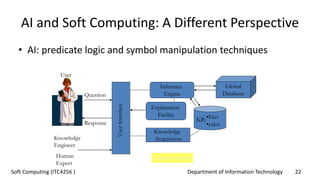
AI and Soft Computing: A Different Perspective
• AI: predicate logic and symbol manipulation techniques
UserInterface
Inference
Engine
Explanation
Facility
Knowledge
Acquisition
KB:•Fact
•rules
Global
Database
Knowledge
Engineer
Human
Expert
Question
Response
Expert Systems
User
Department of Information Technology 23Soft Computing (ITC4256 )
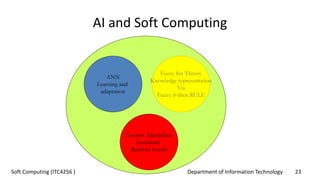
AI and Soft Computing
ANN
Learning and
adaptation
Fuzzy Set Theory
Knowledge representation
Via
Fuzzy if-then RULE
Genetic Algorithms
Systematic
Random Search
Department of Information Technology 24Soft Computing (ITC4256 )
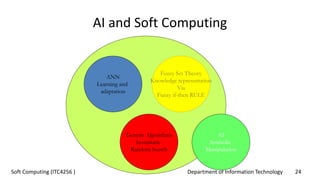
AI and Soft Computing
ANN
Learning and
adaptation
Fuzzy Set Theory
Knowledge representation
Via
Fuzzy if-then RULE
Genetic Algorithms
Systematic
Random Search
AI
Symbolic
Manipulation
Department of Information Technology 25Soft Computing (ITC4256 )
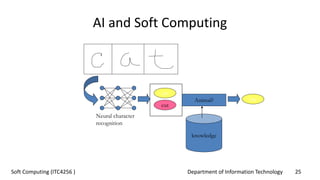
AI and Soft Computing
cat
cut
knowledge
Animal? cat
Neural character
recognition
Department of Information Technology 26Soft Computing (ITC4256 )
• Soft computing is likely to play an especially
important role in science and engineering, but
eventually its influence may extend much
farther.
• Soft computing represents a significant paradigm shift in the aims
of computing
•A shift which reflects the fact that the human mind, unlike present day computers,
possesses a remarkable ability to store and process information which is pervasively
imprecise, uncertain and lacking in categoricity.
Future of Soft Computing

Introduction to soft computing V 1.0

  • 1.
    Department of InformationTechnology 1Soft Computing (ITC4256 ) Introduction to Soft Computing Dr. C.V. Suresh Babu Professor Department of IT Hindustan Institute of Science & Technology
  • 2.
    Department of InformationTechnology 2Soft Computing (ITC4256 ) Discussion Topics • What is Soft Computing? • What is Hard Computing? • What is Fuzzy Logic Models? • What is Neural Networks (NN)? • What is Genetic Algorithms or Evaluation Programming? • What is probabilistic reasoning? • Difference between fuzziness and probability • AI and Soft Computing • Future of Soft Computing
  • 3.
    Department of InformationTechnology 3Soft Computing (ITC4256 ) Soft computing differs from conventional (hard) computing in that, unlike hard computing, it is tolerant of imprecision, uncertainty, partial truth, and approximation. In effect, the role model for soft computing is the human mind. What is Soft Computing ?
  • 4.
    Department of InformationTechnology 4Soft Computing (ITC4256 ) Hard computing, i.e., conventional computing, requires a precisely stated analytical model and often a lot of computation time. • Many analytical models are valid for ideal cases. • Real world problems exist in a non-ideal environment. • Premises and guiding principles of Hard Computing are - Precision, Certainty, and Rigor. • Many contemporary problems do not lend themselves to precise solutions such as • Recognition problems (handwriting, speech, objects, images, texts) • Mobile robot coordination, forecasting, combinatorial problems etc. • Reasoning on natural languages What is Hard Computing ?
  • 5.
    Department of InformationTechnology 5Soft Computing (ITC4256 ) What is SC? Another possible definition of soft computing is to consider it as an anti-thesis to the concept of computer we now have, which can be described with all the adjectives such as hard, crisp, rigid, inflexible and stupid. Along this track, one may see soft computing as an attempt to mimic natural creatures: plants, animals, human beings, which are soft, flexible, adaptive and clever. In this sense soft computing is the name of a family of problem-solving methods that have analogy with biological reasoning and problem solving (sometimes referred to as cognitive computing). The basic methods included in cognitive computing are • fuzzy logic (FL) • neural networks (NN) • genetic algorithms (GA) Note: this methods which do not derive from classical theories.
  • 6.
    Department of InformationTechnology 6Soft Computing (ITC4256 ) Soft computing employs ANN, EC, FL etc, in a complementary rather than a competitive way. • One example of a particularly effective combination is "neurofuzzy systems.” • Such systems are becoming increasingly visible as consumer products ranging from air conditioners and washing machines to photocopiers, camcorders and many industrial applications. Implications of Soft Computing
  • 7.
    Department of InformationTechnology 7Soft Computing (ITC4256 ) The principal constituents, i.e., tools, techniques, of Soft Computing (SC) are • Fuzzy Logic (FL), • Artificial Neural Networks (ANN), • Evolutionary Computation (EC), • Swarm Intelligence (i.e. Ant colony optimization and Particle swarm optimization, ) • Additionally Some Machine Learning (ML) and Probabilistic Reasoning (PR) areas. Tools & Techniques of Soft Computing
  • 8.
    Department of InformationTechnology 8Soft Computing (ITC4256 ) Properties of Soft computing • Learning from experimental data  generalization • Soft computing techniques derive their power of generalization from approximating or interpolating to produce outputs from previously unseen inputs by using outputs from previous learned inputs • Generalization is usually done in a high dimensional space.
  • 9.
    Department of InformationTechnology 9Soft Computing (ITC4256 ) • Handwriting recognition • Automotive systems and manufacturing • Image processing and data compression • Architecture • Decision-support systems • Data Mining • Power systems • Control Systems Recent Applications using Soft Computing
  • 10.
    Department of InformationTechnology 10Soft Computing (ITC4256 ) Single absolute truth is exist: Absolute truths are not exist Need for Soft Computing
  • 11.
    Department of InformationTechnology 11Soft Computing (ITC4256 ) Different representations of concepts by different persons Blue sky sea Jeans Blue diamond homosexualitysky
  • 12.
    Department of InformationTechnology 12Soft Computing (ITC4256 ) Different representations of concepts in different languages • Blue – Pale blue one word in Russian – Dark blue one another word in Russian • Pigmy has many single words for description of forest: • Forest under rain • Forest after rain • Forest in hot season • Forest in morning • Forest in evening • and so on
  • 13.
    Department of InformationTechnology 13Soft Computing (ITC4256 ) The tools for soft computing • Fuzzy logic models • Neural networks • Genetic algorithms • Probabilistic reasoning
  • 14.
    Department of InformationTechnology 14Soft Computing (ITC4256 ) What is Fuzzy Logic Models? FUZZY LOGIC is defined as a many-valued logic form which may have truth values of variables in any real number between 0 and 1. It is the handle concept of partial truth. In real life, we may come across a situation where we can't decide whether the statement is true or false. At that time, fuzzy logic offers very valuable flexibility for reasoning. Fuzzy logic algorithm helps to solve a problem after considering all available data. Then it takes the best possible decision for the given the input. The FL method imitates the way of decision making in a human which consider all the possibilities between digital values T and F.
  • 15.
    Department of InformationTechnology 15Soft Computing (ITC4256 ) Examples of tasks solving by Fuzzy models • Control of clothes washer • Making of decision in diagnostic systems (expert systems in medicine, for example) • Making of decision in business planning May be used knowledge such as: If temperature is high then diagnose is grippe with confidence 80% If speed is slow then increase transfer of fuel
  • 16.
    Department of InformationTechnology 16Soft Computing (ITC4256 ) What is Neural Networks (NN)? A neural network is a series of algorithms that endeavors to recognize underlying relationships in a set of data through a process that mimics the way the human brain operates. In this sense, neural networks refer to systems of neurons, either organic or artificial in nature • NN consists of many number of simple elements (neurons) connected between them in system • Whole system is able to solve of complex tasks and to learn for it like a natural brain • For user NN is black box with Input vector (source data) and Output vector (result) Examples of tasks: • Recognition of images (visual, speech and so on) • Prediction of situations (cost of actions, currency) • Classification and clusterization of images (for example, in diagnostic systems)
  • 17.
    Department of InformationTechnology 17Soft Computing (ITC4256 ) What is Neural Networks (NN)?
  • 18.
    Department of InformationTechnology 18Soft Computing (ITC4256 ) What is Genetic Algorithms or Evaluation Programming? Genetic Algorithm (GA) is a search-based optimization technique based on the principles of Genetics and Natural Selection. It is frequently used to find optimal or near-optimal solutions to difficult problems which otherwise would take a lifetime to solve. Examples of application: • Finding of optimal (suitable) path, • Finding of better structure of neural network • Finding of configuration of robot • Optimal cutting
  • 19.
    Department of InformationTechnology 19Soft Computing (ITC4256 ) What is probabilistic reasoning? • Probabilistic reasoning is a method of representation of knowledge where the concept of probability is applied to indicate the uncertainty in knowledge. Probabilistic reasoning is used in AI: When we are unsure of the predicates For example,
  • 20.
    Department of InformationTechnology 20Soft Computing (ITC4256 ) Examples of applications of probabilistic reasoning • Recognition of speech • Navigation of mobile robots • And so on
  • 21.
    Department of InformationTechnology 21Soft Computing (ITC4256 ) Difference between fuzziness and probability (from modeling of world) • Probability deal with unknown entity (time, property before any event). After any event the entity become known. • Fuzziness is own property of any entity or (concept or object or property). It may be more or less but not disappears practically. • May be fuzzy probability and probability of fuzziness • Probability may be use for simulation of fuzziness
  • 22.
    Department of InformationTechnology 22Soft Computing (ITC4256 ) AI and Soft Computing: A Different Perspective • AI: predicate logic and symbol manipulation techniques UserInterface Inference Engine Explanation Facility Knowledge Acquisition KB:•Fact •rules Global Database Knowledge Engineer Human Expert Question Response Expert Systems User
  • 23.
    Department of InformationTechnology 23Soft Computing (ITC4256 ) AI and Soft Computing ANN Learning and adaptation Fuzzy Set Theory Knowledge representation Via Fuzzy if-then RULE Genetic Algorithms Systematic Random Search
  • 24.
    Department of InformationTechnology 24Soft Computing (ITC4256 ) AI and Soft Computing ANN Learning and adaptation Fuzzy Set Theory Knowledge representation Via Fuzzy if-then RULE Genetic Algorithms Systematic Random Search AI Symbolic Manipulation
  • 25.
    Department of InformationTechnology 25Soft Computing (ITC4256 ) AI and Soft Computing cat cut knowledge Animal? cat Neural character recognition
  • 26.
    Department of InformationTechnology 26Soft Computing (ITC4256 ) • Soft computing is likely to play an especially important role in science and engineering, but eventually its influence may extend much farther. • Soft computing represents a significant paradigm shift in the aims of computing •A shift which reflects the fact that the human mind, unlike present day computers, possesses a remarkable ability to store and process information which is pervasively imprecise, uncertain and lacking in categoricity. Future of Soft Computing