1
Introduction to Neuro-fuzzy
and Soft computing
Dr. Prafull Chandra Narooka
Department of Computer Science
School of Engineering & Systems
Sciences
MDS University, Ajmer
What is computing?
2
 Counting, calculating
 The discipline of computing is the systematic study
of algorithmic processes that describe and transform
information: their theory, analysis, design, efficiency,
implementation, and application.
 Types of computing
 Hard computing
 Soft Computing
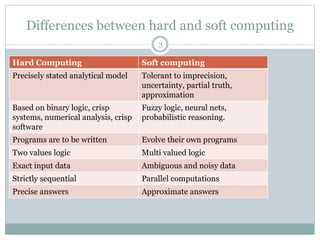
Differences between hard and soft computing
3
Hard Computing Soft computing
Precisely stated analytical model Tolerant to imprecision,
uncertainty, partial truth,
approximation
Based on binary logic, crisp
systems, numerical analysis, crisp
software
Fuzzy logic, neural nets,
probabilistic reasoning.
Programs are to be written Evolve their own programs
Two values logic Multi valued logic
Exact input data Ambiguous and noisy data
Strictly sequential Parallel computations
Precise answers Approximate answers
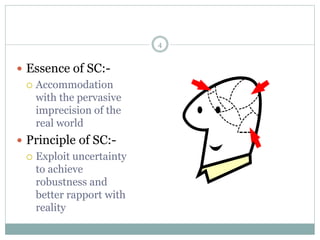
 Essence of SC:-
 Accommodation
with the pervasive
imprecision of the
real world
 Principle of SC:-
 Exploit uncertainty
to achieve
robustness and
better rapport with
reality
4
Artificial intelligence
5
 If intelligence can be induced in machines it is called
as artificial intelligence.
 Soft computing is a part of artificial intelligent
techniques
 Closed related to machine
intelligence/computational intelligence
What is Soft computing
6
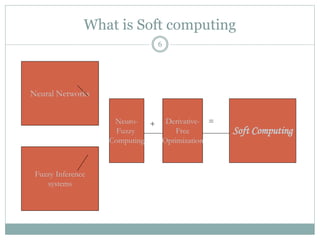
Neural Networks
Fuzzy Inference
systems
Neuro-
Fuzzy
Computing
Derivative-
Free
Optimization
Soft Computing
+ =
What is Soft computing
7
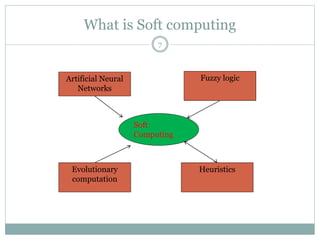
Artificial Neural
Networks
Evolutionary
computation
Fuzzy logic
Heuristics
Soft
Computing
Introduction
8
 SC is an innovative approach to
constructing computationally intelligent
systems
 Intelligent systems that possess humanlike
expertise within a specific domain, adapt
themselves and learn to perform better in
changing environments
 These systems explain how they make
decisions or take actions
 They are composed of two features:
“adaptivity” & “knowledge
Introduction Contd….
9
 Neural Networks (NN) that recognize patterns &
adapts themselves to cope with changing
environments
 Fuzzy inference systems that incorporate human
knowledge & perform inference & decision making
Adaptivity + Expertise = NF & SC
What is the difference between Fuzzy Logic and Neural Networks?
10
 Fuzzy logic allows making definite decisions based on
imprecise or ambiguous data
 ANN tries to incorporate human thinking process to solve
problems without mathematically modeling them.
 Both these methods can be used to solve nonlinear
problems, and problems that are not properly specified, but
they are not related.
 ANN tries to apply the thinking process in the human brain
to solve problems.
Latest developments in the field of soft
computing
11
 Areas of image processing
 Image retrieval
 Image analysis
 Remote sensing
 Data mining
 Swarm intelligence
 Diffusion process
 Agent’s technology

SoftComputing1

  • 1.
    1 Introduction to Neuro-fuzzy andSoft computing Dr. Prafull Chandra Narooka Department of Computer Science School of Engineering & Systems Sciences MDS University, Ajmer
  • 2.
    What is computing? 2 Counting, calculating  The discipline of computing is the systematic study of algorithmic processes that describe and transform information: their theory, analysis, design, efficiency, implementation, and application.  Types of computing  Hard computing  Soft Computing
  • 3.
    Differences between hardand soft computing 3 Hard Computing Soft computing Precisely stated analytical model Tolerant to imprecision, uncertainty, partial truth, approximation Based on binary logic, crisp systems, numerical analysis, crisp software Fuzzy logic, neural nets, probabilistic reasoning. Programs are to be written Evolve their own programs Two values logic Multi valued logic Exact input data Ambiguous and noisy data Strictly sequential Parallel computations Precise answers Approximate answers
  • 4.
     Essence ofSC:-  Accommodation with the pervasive imprecision of the real world  Principle of SC:-  Exploit uncertainty to achieve robustness and better rapport with reality 4
  • 5.
    Artificial intelligence 5  Ifintelligence can be induced in machines it is called as artificial intelligence.  Soft computing is a part of artificial intelligent techniques  Closed related to machine intelligence/computational intelligence
  • 6.
    What is Softcomputing 6 Neural Networks Fuzzy Inference systems Neuro- Fuzzy Computing Derivative- Free Optimization Soft Computing + =
  • 7.
    What is Softcomputing 7 Artificial Neural Networks Evolutionary computation Fuzzy logic Heuristics Soft Computing
  • 8.
    Introduction 8  SC isan innovative approach to constructing computationally intelligent systems  Intelligent systems that possess humanlike expertise within a specific domain, adapt themselves and learn to perform better in changing environments  These systems explain how they make decisions or take actions  They are composed of two features: “adaptivity” & “knowledge
  • 9.
    Introduction Contd…. 9  NeuralNetworks (NN) that recognize patterns & adapts themselves to cope with changing environments  Fuzzy inference systems that incorporate human knowledge & perform inference & decision making Adaptivity + Expertise = NF & SC
  • 10.
    What is thedifference between Fuzzy Logic and Neural Networks? 10  Fuzzy logic allows making definite decisions based on imprecise or ambiguous data  ANN tries to incorporate human thinking process to solve problems without mathematically modeling them.  Both these methods can be used to solve nonlinear problems, and problems that are not properly specified, but they are not related.  ANN tries to apply the thinking process in the human brain to solve problems.
  • 11.
    Latest developments inthe field of soft computing 11  Areas of image processing  Image retrieval  Image analysis  Remote sensing  Data mining  Swarm intelligence  Diffusion process  Agent’s technology