By
-Jigar Patel
M.Sc. Bioinformatics
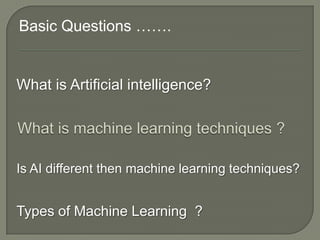
What is Artificial intelligence?
Is AI different then machine learning techniques?
Basic Questions …….
Types of Machine Learning ?
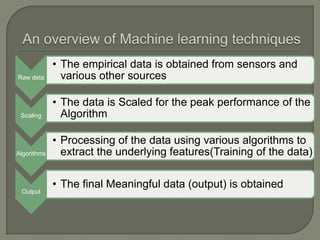
Raw data
• The empirical data is obtained from sensors and
various other sources
Scaling
• The data is Scaled for the peak performance of the
Algorithm
Algorithms
• Processing of the data using various algorithms to
extract the underlying features(Training of the data)
Output
• The final Meaningful data (output) is obtained
1. Machine learning, it’s a branch of Artificial intelligence, which is
basically concerned with the development of algorithms that take
as input empirical data, such as that from sensors or databases.
2. The data obtained is then processed by the algorithm is
designed to identify complex relationships thought to be features
of the underlying mechanism that generated the data, and
employ these identified patterns to make predictions based on
new data.
3. One fundamental difficulty is that the set of all possible behaviors
given all possible inputs is (in most cases of practical interest)
too large to be included in the set of observed examples. Hence
the learner must generalize from the given examples in order to
produce a useful output from new data inputs.
It is the process in which an algorithm can
perform accurately on a new data (raw
data) after the training of the data
The training data used is generally of
unknown probability distribution or a bit of
noisy data so the learner has to extract
something informative from the data which
will lead to useful predictions
Supervised Learning
Unsupervised Learning
Reinforcement Learning
Semi-supervised learning
Transduction
 Supervised learning is the machine learning task
of concluding a function from labeled training data
 This inferred function should predict the correct
output value for any valid input object.
 The training data contains training examples or
training values
 In supervised learning the training data consist of
the input object and the Output object(Supervisory
signal ).
 A supervised learning algorithm analyzes the
training data and produces an inferred
function, which is called a classifier
1. Nature of Training data
2. Build a Training set.
3. Feature selection from the Training set
4. Determine the Structure of learned
Function Eg. SOM, SVM, ANN
5. Test the accuracy of the function.
 Unsupervised Learning is used when the data
is unlabeled or we have to find out the hidden
structure.
 Since the examples given to the learner are
unlabeled, there is no error to evaluate a
potential solution.
 This is the distinguishing feature that
separates from supervised learning and
reinforced learning
 Eg. Clustering ,PCA,SOM
 This method works on reinforcement from the outside.
The connections among the neurons in the hidden
layer are randomly arranged, then reshuffled as the
network is told how close it is to solving the problem.
 Reinforcement learning is also called supervised
learning, because it requires a teacher. The teacher
may be a training set of data or an observer who
grades the performance of the network results.
 Both unsupervised and reinforcement suffer from
relative slowness and inefficiency relying on a random
shuffling to find the proper connection weights.
 Eg. Genetic Algorithm
ANN
1. Artificial neural networks is a type of
learning algorithm that use Neural
network (NN) which are inspired from
biological neurons .
2. It consists of nodes and layers
Input, hidden layer, output layer
3. Each layers are connected by nodes and
specific weights values used for
calculations.
Support vector machines (SVMs) are a set
of related supervised learning methods
used for classification and regression.
Its consist of many steps and uses support
vectors ,Hyper planes and feature space
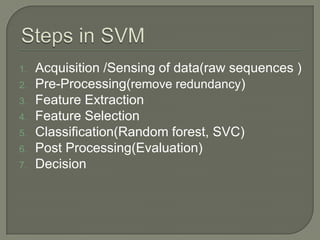
1. Acquisition /Sensing of data(raw sequences )
2. Pre-Processing(remove redundancy)
3. Feature Extraction
4. Feature Selection
5. Classification(Random forest, SVC)
6. Post Processing(Evaluation)
7. Decision
Genetic algorithms (GAs) are adaptive
methods which may be used to solve search
and optimization problems. They are based
on the genetic processes Inspired by the
biological evolution process
Uses concepts of “Natural Selection” and
“Genetic Inheritance” (Darwin 1859)
Originally developed by John Holland (1975)
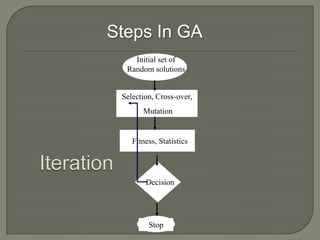
Selection, Cross-over,
Mutation
Initial set of
Random solutions
Fitness, Statistics
Stop
Decision
Steps In GA
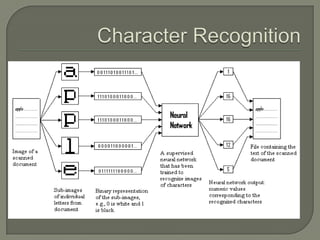
• Character recognition
• Handwriting: processing checks
• Bioinformatics Software's
• Medical Diagnosis
• Credit Card fraud
• Pattern recognition: SNOOPE (bomb detector in
U.S. airports)
Machine Learning techniques

Machine Learning techniques

  • 1.
  • 2.
    What is Artificialintelligence? Is AI different then machine learning techniques? Basic Questions ……. Types of Machine Learning ?
  • 3.
    Raw data • Theempirical data is obtained from sensors and various other sources Scaling • The data is Scaled for the peak performance of the Algorithm Algorithms • Processing of the data using various algorithms to extract the underlying features(Training of the data) Output • The final Meaningful data (output) is obtained
  • 4.
    1. Machine learning,it’s a branch of Artificial intelligence, which is basically concerned with the development of algorithms that take as input empirical data, such as that from sensors or databases. 2. The data obtained is then processed by the algorithm is designed to identify complex relationships thought to be features of the underlying mechanism that generated the data, and employ these identified patterns to make predictions based on new data. 3. One fundamental difficulty is that the set of all possible behaviors given all possible inputs is (in most cases of practical interest) too large to be included in the set of observed examples. Hence the learner must generalize from the given examples in order to produce a useful output from new data inputs.
  • 5.
    It is theprocess in which an algorithm can perform accurately on a new data (raw data) after the training of the data The training data used is generally of unknown probability distribution or a bit of noisy data so the learner has to extract something informative from the data which will lead to useful predictions
  • 6.
    Supervised Learning Unsupervised Learning ReinforcementLearning Semi-supervised learning Transduction
  • 7.
     Supervised learningis the machine learning task of concluding a function from labeled training data  This inferred function should predict the correct output value for any valid input object.  The training data contains training examples or training values  In supervised learning the training data consist of the input object and the Output object(Supervisory signal ).  A supervised learning algorithm analyzes the training data and produces an inferred function, which is called a classifier
  • 8.
    1. Nature ofTraining data 2. Build a Training set. 3. Feature selection from the Training set 4. Determine the Structure of learned Function Eg. SOM, SVM, ANN 5. Test the accuracy of the function.
  • 9.
     Unsupervised Learningis used when the data is unlabeled or we have to find out the hidden structure.  Since the examples given to the learner are unlabeled, there is no error to evaluate a potential solution.  This is the distinguishing feature that separates from supervised learning and reinforced learning  Eg. Clustering ,PCA,SOM
  • 10.
     This methodworks on reinforcement from the outside. The connections among the neurons in the hidden layer are randomly arranged, then reshuffled as the network is told how close it is to solving the problem.  Reinforcement learning is also called supervised learning, because it requires a teacher. The teacher may be a training set of data or an observer who grades the performance of the network results.  Both unsupervised and reinforcement suffer from relative slowness and inefficiency relying on a random shuffling to find the proper connection weights.  Eg. Genetic Algorithm
  • 11.
    ANN 1. Artificial neuralnetworks is a type of learning algorithm that use Neural network (NN) which are inspired from biological neurons . 2. It consists of nodes and layers Input, hidden layer, output layer 3. Each layers are connected by nodes and specific weights values used for calculations.
  • 12.
    Support vector machines(SVMs) are a set of related supervised learning methods used for classification and regression. Its consist of many steps and uses support vectors ,Hyper planes and feature space
  • 13.
    1. Acquisition /Sensingof data(raw sequences ) 2. Pre-Processing(remove redundancy) 3. Feature Extraction 4. Feature Selection 5. Classification(Random forest, SVC) 6. Post Processing(Evaluation) 7. Decision
  • 14.
    Genetic algorithms (GAs)are adaptive methods which may be used to solve search and optimization problems. They are based on the genetic processes Inspired by the biological evolution process Uses concepts of “Natural Selection” and “Genetic Inheritance” (Darwin 1859) Originally developed by John Holland (1975)
  • 15.
    Selection, Cross-over, Mutation Initial setof Random solutions Fitness, Statistics Stop Decision Steps In GA
  • 16.
    • Character recognition •Handwriting: processing checks • Bioinformatics Software's • Medical Diagnosis • Credit Card fraud • Pattern recognition: SNOOPE (bomb detector in U.S. airports)

Editor's Notes

  • #7 Transductionor transductive inference, tries to predict new outputs on specific and fixed (test) cases from observed, specific (training) cases.Semi-supervised learning combines both labeled and unlabeled examples to generate an appropriate function or classifier.
  • #13 Regression analysis is widely used for prediction and forecasting, where its use has substantial overlap with the field of machine learning.