Aims Recap on the key themes of Interactionism. An analysis of Interactionist accounts and research studies  of Educational Underachievement. An evaluation of Interactionism and Labelling theory. Homework : Read through all of the Research studies given out in class and do the activities set.
Interactionism Key Themes
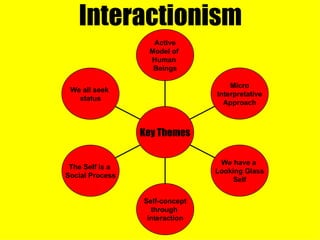
Interactionism We all seek  status The Self is a  Social Process Self-concept through  interaction We have a  Looking Glass Self Micro Interpretative Approach Active Model of  Human  Beings Key Themes
Interactionist Critique of Functionalist & Marxist Accounts Three key criticisms Interactionists would make of Functionalist & Marxist accounts of Educational Underachievement include: 1……………………………………………… 2……………………………………………… 3……………………………………………….
Three key criticisms Interactionists would make of Functionalist & Marxist accounts of Educational Underachievement include: 1. Deterministic Model  of Human Beings 2. Both focus on  external factors  and fail  to take into account  internal factors   such as the  role of the organisation of  the school  and  teachers’ expectations   and  labelling . 3. Both approaches are  one dimensional     and  biased  - either education system is  seen as good or bad. Interactionist  recognise that there is a mix.
Defining Determinism Determinism   =   Theories that see human behaviour as directed and  caused/determined  by forces beyond the control of the individual.  For Interactionists both Functionalism and Marxism are  deterministic .
Interactionist Critique Both Functionalist and Marxist accounts of working class underachievement may  reinforce  and  reproduce  the negative  labelling  schools and teachers have of working class students and encourage them to blame the family and/or society rather than addressing the  organisation  of the school and teachers’  expectations  and  labelling .
I blame the family! I blame  Society!
Schools & teachers off the hook!
Interactionist Accounts Interactionists focus on two key areas in accounting for educational underachievement: The Organisation of the School Teachers’ Expectations  LABELLING
The Organisation of the School   Interactionists believe the organisation of the school can have a profound influence on the progress of students.  This has been described as the  “School Effect”.   Streaming  and  banding  can reinforce and reproduce labelling.
The School Effect: Smith & Tomlinson “ The results of the present study show that there are very important differences between urban comprehensive schools .... The level of achievement is radically higher in some schools than in others. The findings show that the same child would get a CSE grade 3 in English at one school, but an O level grade B in English at another. There are equally large differences in maths and in exam results in total across all subjects.” A Study of Multi-Racial Comprehensives  1989
 
Interactionist Model of Human Beings Human beings actively construct their social world. We think, reflect, make choices based on the  meanings  we give to our actions and the actions of others.   For Interactionists the role of the sociologist is to understand the meanings human beings to their actions and how they  interpret  – give meaning to the actions of others.
To understand the  meanings  people give to their actions it is necessary to understand the  culture ,  perspective , and  strategies  of the social actors.  It is only through using  Interpretativ e research methods such as informal interviews and participant observation that sociologists can understand the  meanings  social actors give to their actions.
To Interactionists, the explanation of human behaviour needs to take account of the  subjective states  of individuals, and the  meanings  that individuals attach to external stimuli.  For example, a pupil who achieves a poor test result might  interpret  the result in different ways and attach  different meanings  to it.
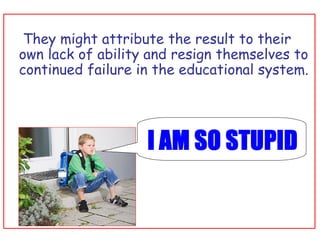
  They might attribute the result to their own lack of ability and resign themselves to continued failure in the educational system.
They may believe the result has been caused by them failing to work sufficiently hard, and they might resolve to work with renewed effort .
On the other hand, they might attach little or no importance to the result, or they could deny the validity of the test and continue to believe that they have considerable ability despite the result.
Interactionist Approach to Education Within education, as in society as a whole, other people are perhaps the most important influence: their words and actions will constantly be  interpreted  and given  meanings .
Status Interactionist emphasise that all human beings seek  status  in their own eyes and in the eyes of others, particularly significant others.  If people cannot achieve status through the  conventional status avenues  they will adopt  alternative status channels .
For Interactionists, your view of yourself, or  self-concept , is produced in  interaction  with others.  Status  is key element of our self concept. The self-concept of a pupil may be modified if others constantly contradict it. For example, pupils who consider themselves to be a ‘joker’, may be forced to reconsider if nobody laughs at their jokes.

Interaction may be particularly important as the pupil develops the aspects of his or her  self-concept   concerned with academic ability.
Social Roles Another important Interactionist concept is that of  social roles . Within schools there are the obvious roles of pupils and teachers.  For Interactionists these roles are not fixed and unchangeable.
Teachers may disagree with each other about the sort of person who makes the ideal teacher, and about the types of behaviour that are consistent with the pupil role .
Similarly, pupils may have different ideas about what makes the  ideal teacher , or for that matter the  ideal pupil . They may be unable to live up to the model of the  ideal pupil  held by their teachers.
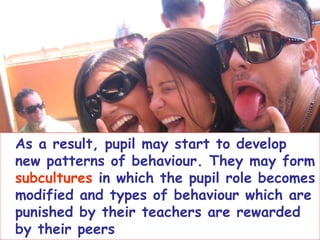
As a result, pupil may start to develop new patterns of behaviour. They may form  subcultures  in which the pupil role becomes modified and types of behaviour which are punished by their teachers are rewarded by their peers .
 
Subcultures Functionalist Cultural deprivation theories also use the idea of  subculture , but in a very different way.  For Interactionists,  subcultures  emerge through social interaction within school as pupils develop ways of coping with school life.  Subcultures  for Interactionists are actively produced by those who are members of them.
In cultural deprivation theory, however, the  subcultures  which influence educational attainment exist  prior  (before) to the child going to school, and those who fail in the education system are the passive victims of the limitations of their own upbringing.
Interactionist are very critical of cultural deprivation theorists model of  sub-cultures  which they consider  deterministic . In contrast, Interactionists emphasise that  subcultures  emerge when students cannot achieve  status  through  conventional status channels  and therefore need to adopt their own  alternative status channels .
Organisation of the School The type of school and how it is  organised  can have a very profound influence upon teachers expectations of students and students self image and self esteem.  Some types of organisations reinforce negative labelling while others may encourage students from poorer backgrounds to do well.
Interactionists focus on the  processes  within the school that result in different levels of achievement.  Interactionists, far more than any other type of sociologist, have researched into the details of day-to-day life in schools.
Teachers’ Expectations Interactionists focus primarily on the class room processes in accounting for educational underachievement.  Of fundamental importance to a child’s self concept and progress is, according to Interactionists, the teachers’ expectations .
Activity In pairs please read through the research study you have been assigned and do the following: Underline key points. Briefly summarise the key findings. Give an overall assessment (evaluation) of the study and its key findings. Prepare a report back to the rest of the class.

SociologyExchange.co.uk Shared Resource

  • 1.
    Aims Recap onthe key themes of Interactionism. An analysis of Interactionist accounts and research studies of Educational Underachievement. An evaluation of Interactionism and Labelling theory. Homework : Read through all of the Research studies given out in class and do the activities set.
  • 2.
  • 3.
    Interactionism We allseek status The Self is a Social Process Self-concept through interaction We have a Looking Glass Self Micro Interpretative Approach Active Model of Human Beings Key Themes
  • 4.
    Interactionist Critique ofFunctionalist & Marxist Accounts Three key criticisms Interactionists would make of Functionalist & Marxist accounts of Educational Underachievement include: 1……………………………………………… 2……………………………………………… 3……………………………………………….
  • 5.
    Three key criticismsInteractionists would make of Functionalist & Marxist accounts of Educational Underachievement include: 1. Deterministic Model of Human Beings 2. Both focus on external factors and fail to take into account internal factors such as the role of the organisation of the school and teachers’ expectations and labelling . 3. Both approaches are one dimensional and biased - either education system is seen as good or bad. Interactionist recognise that there is a mix.
  • 6.
    Defining Determinism Determinism = Theories that see human behaviour as directed and caused/determined by forces beyond the control of the individual. For Interactionists both Functionalism and Marxism are deterministic .
  • 7.
    Interactionist Critique BothFunctionalist and Marxist accounts of working class underachievement may reinforce and reproduce the negative labelling schools and teachers have of working class students and encourage them to blame the family and/or society rather than addressing the organisation of the school and teachers’ expectations and labelling .
  • 8.
    I blame thefamily! I blame Society!
  • 9.
    Schools & teachersoff the hook!
  • 10.
    Interactionist Accounts Interactionistsfocus on two key areas in accounting for educational underachievement: The Organisation of the School Teachers’ Expectations LABELLING
  • 11.
    The Organisation ofthe School Interactionists believe the organisation of the school can have a profound influence on the progress of students. This has been described as the “School Effect”. Streaming and banding can reinforce and reproduce labelling.
  • 12.
    The School Effect:Smith & Tomlinson “ The results of the present study show that there are very important differences between urban comprehensive schools .... The level of achievement is radically higher in some schools than in others. The findings show that the same child would get a CSE grade 3 in English at one school, but an O level grade B in English at another. There are equally large differences in maths and in exam results in total across all subjects.” A Study of Multi-Racial Comprehensives 1989
  • 13.
  • 14.
    Interactionist Model ofHuman Beings Human beings actively construct their social world. We think, reflect, make choices based on the meanings we give to our actions and the actions of others. For Interactionists the role of the sociologist is to understand the meanings human beings to their actions and how they interpret – give meaning to the actions of others.
  • 15.
    To understand the meanings people give to their actions it is necessary to understand the culture , perspective , and strategies of the social actors. It is only through using Interpretativ e research methods such as informal interviews and participant observation that sociologists can understand the meanings social actors give to their actions.
  • 16.
    To Interactionists, theexplanation of human behaviour needs to take account of the subjective states of individuals, and the meanings that individuals attach to external stimuli. For example, a pupil who achieves a poor test result might interpret the result in different ways and attach different meanings to it.
  • 17.
    Theymight attribute the result to their own lack of ability and resign themselves to continued failure in the educational system.
  • 18.
    They may believethe result has been caused by them failing to work sufficiently hard, and they might resolve to work with renewed effort .
  • 19.
    On the otherhand, they might attach little or no importance to the result, or they could deny the validity of the test and continue to believe that they have considerable ability despite the result.
  • 20.
    Interactionist Approach toEducation Within education, as in society as a whole, other people are perhaps the most important influence: their words and actions will constantly be interpreted and given meanings .
  • 21.
    Status Interactionist emphasisethat all human beings seek status in their own eyes and in the eyes of others, particularly significant others. If people cannot achieve status through the conventional status avenues they will adopt alternative status channels .
  • 22.
    For Interactionists, yourview of yourself, or self-concept , is produced in interaction with others. Status is key element of our self concept. The self-concept of a pupil may be modified if others constantly contradict it. For example, pupils who consider themselves to be a ‘joker’, may be forced to reconsider if nobody laughs at their jokes.
  • 23.
    Interaction may beparticularly important as the pupil develops the aspects of his or her self-concept concerned with academic ability.
  • 24.
    Social Roles Anotherimportant Interactionist concept is that of social roles . Within schools there are the obvious roles of pupils and teachers. For Interactionists these roles are not fixed and unchangeable.
  • 25.
    Teachers may disagreewith each other about the sort of person who makes the ideal teacher, and about the types of behaviour that are consistent with the pupil role .
  • 26.
    Similarly, pupils mayhave different ideas about what makes the ideal teacher , or for that matter the ideal pupil . They may be unable to live up to the model of the ideal pupil held by their teachers.
  • 27.
    As a result,pupil may start to develop new patterns of behaviour. They may form subcultures in which the pupil role becomes modified and types of behaviour which are punished by their teachers are rewarded by their peers .
  • 28.
  • 29.
    Subcultures Functionalist Culturaldeprivation theories also use the idea of subculture , but in a very different way. For Interactionists, subcultures emerge through social interaction within school as pupils develop ways of coping with school life. Subcultures for Interactionists are actively produced by those who are members of them.
  • 30.
    In cultural deprivationtheory, however, the subcultures which influence educational attainment exist prior (before) to the child going to school, and those who fail in the education system are the passive victims of the limitations of their own upbringing.
  • 31.
    Interactionist are verycritical of cultural deprivation theorists model of sub-cultures which they consider deterministic . In contrast, Interactionists emphasise that subcultures emerge when students cannot achieve status through conventional status channels and therefore need to adopt their own alternative status channels .
  • 32.
    Organisation of theSchool The type of school and how it is organised can have a very profound influence upon teachers expectations of students and students self image and self esteem. Some types of organisations reinforce negative labelling while others may encourage students from poorer backgrounds to do well.
  • 33.
    Interactionists focus onthe processes within the school that result in different levels of achievement. Interactionists, far more than any other type of sociologist, have researched into the details of day-to-day life in schools.
  • 34.
    Teachers’ Expectations Interactionistsfocus primarily on the class room processes in accounting for educational underachievement. Of fundamental importance to a child’s self concept and progress is, according to Interactionists, the teachers’ expectations .
  • 35.
    Activity In pairsplease read through the research study you have been assigned and do the following: Underline key points. Briefly summarise the key findings. Give an overall assessment (evaluation) of the study and its key findings. Prepare a report back to the rest of the class.