Memory Hooks for
 use with AQA
GCSE and AS / A2
   Sociology
The “Memory Hooks” used in this presentation have
    been built up over many years. They have been
   developed by teachers and students at Balby Carr
  CSSC, Doncaster and are used to help students to
       remember important factual information.
  The memory hooks are colour coded and organised
according to the various themes. Please see next slide.
    Media hooks are in the process of development
 If anyone has any useful memory hooks that are not
          featured here, please let us know!
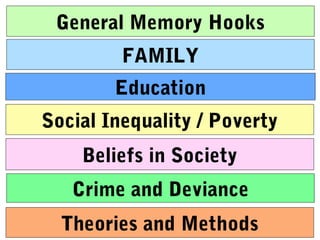
General Memory Hooks
         FAMILY
        Education
Social Inequality / Poverty
    Beliefs in Society
   Crime and Deviance
  Theories and Methods
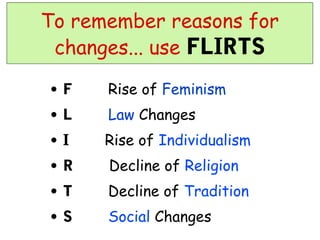
To remember reasons for
 changes... use FLIRTS

•F    Rise of Feminism
• L   Law Changes
•I    Rise of Individualism
• R   Decline of Religion
• T   Decline of Tradition
•S    Social Changes
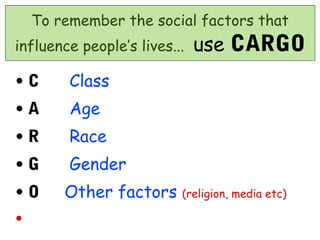
To remember the social factors that
influence people’s lives...   use CARGO

•   C    Class
• A      Age
• R      Race
• G      Gender
• O     Other factors     (religion, media etc)

•
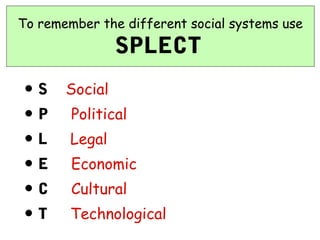
To remember the different social systems use
                SPLECT
•S     Social
•P      Political
•L      Legal
•E      Economic
•C      Cultural
•T      Technological
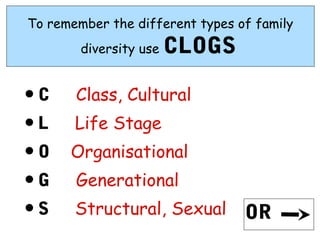
To remember the different types of family
        diversity use   CLOGS

•C     Class, Cultural
•L     Life Stage
•O    Organisational
•G     Generational
•S     Structural, Sexual        OR
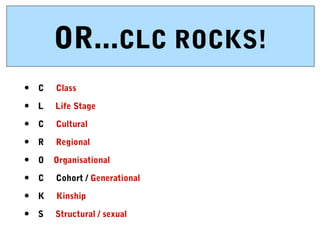
OR...CLC ROCKS!
•   C   Class

•   L   Life Stage

•   C   Cultural

•   R   Regional

•   O   Organisational

•   C   Cohort / Generational

•   K   Kinship

•   S   Structural / sexual
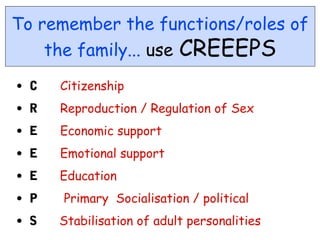
To remember the functions/roles of
    the family... use CREEEPS

•C   Citizenship

•R   Reproduction / Regulation of Sex

•E   Economic support

•E   Emotional support

•E   Education

•P   Primary Socialisation / political

•S   Stabilisation of adult personalities
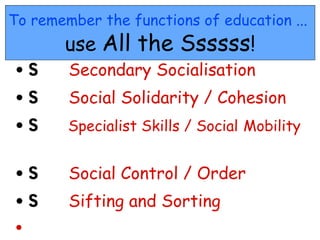
To remember the functions of education ...
        use All the Ssssss!
•   S   Secondary Socialisation
• S     Social Solidarity / Cohesion
• S     Specialist Skills / Social Mobility


•   S   Social Control / Order
• S     Sifting and Sorting
•
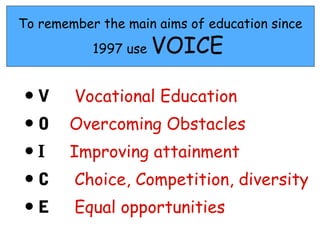
To remember the main aims of education since
           1997 use   VOICE

•V      Vocational Education
•O     Overcoming Obstacles
•I     Improving attainment
•C      Choice, Competition, diversity
•E      Equal opportunities
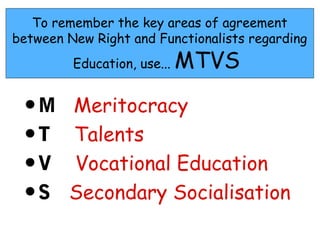
To remember the key areas of agreement
between New Right and Functionalists regarding
         Education, use...   MTVS

 •M     Meritocracy
 •T     Talents
 •V     Vocational Education
 •S     Secondary Socialisation
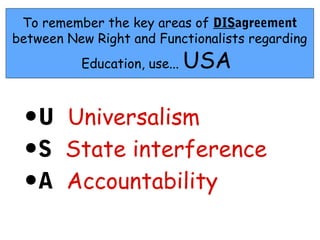
To remember the key areas of DISagreement
between New Right and Functionalists regarding
          Education, use...   USA

 •   U Universalism
 •   S State interference
 •   A Accountability
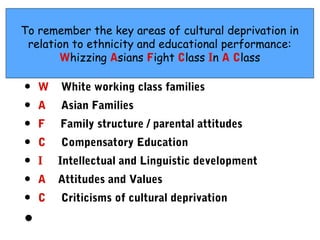
To remember the key areas of cultural deprivation in
 relation to ethnicity and educational performance:
       Whizzing Asians Fight Class In A Class

•   W   White working class families
•   A   Asian Families
•   F   Family structure / parental attitudes
•   C   Compensatory Education
•   I   Intellectual and Linguistic development
•   A   Attitudes and Values
•   C   Criticisms of cultural deprivation

•
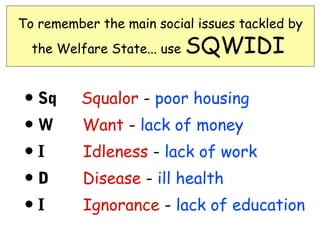
To remember the main social issues tackled by
  the Welfare State... use   SQWIDI

• Sq      Squalor - poor housing
•W        Want - lack of money
•I        Idleness - lack of work
•D        Disease - ill health
•I        Ignorance - lack of education
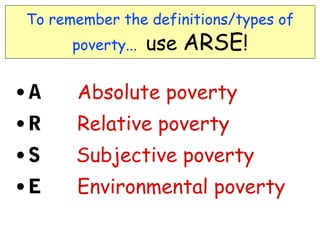
To remember the definitions/types of
       poverty...   use ARSE!

•A     Absolute poverty
• R    Relative poverty
• S    Subjective poverty
• E    Environmental poverty
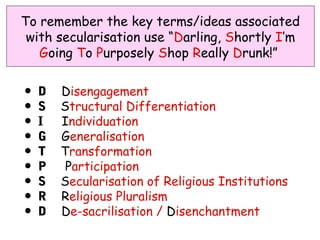
To remember the key terms/ideas associated
 with secularisation use “Darling, Shortly I’m
   Going To Purposely Shop Really Drunk!”


•   D   Disengagement
•   S   Structural Differentiation
•   I   Individuation
•   G   Generalisation
•   T   Transformation
•   P    Participation
•   S   Secularisation of Religious Institutions
•   R   Religious Pluralism
•   D   De-sacrilisation / Disenchantment
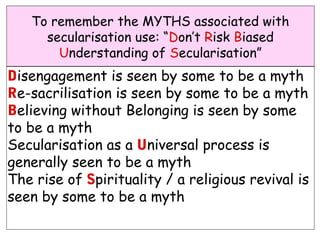
To remember the MYTHS associated with
     secularisation use: “Don’t Risk Biased
       Understanding of Secularisation”
Disengagement is seen by some to be a myth
Re-sacrilisation is seen by some to be a myth
Believing without Belonging is seen by some
to be a myth
Secularisation as a Universal process is
generally seen to be a myth
The rise of Spirituality / a religious revival is
seen by some to be a myth
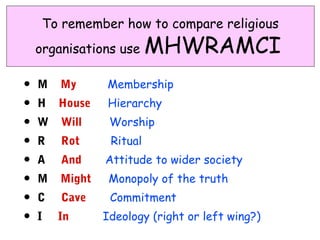
To remember how to compare religious
    organisations use     MHWRAMCI
•   M   My      Membership
•   H   House   Hierarchy
•   W   Will     Worship
•   R   Rot      Ritual
•   A   And     Attitude to wider society
•   M   Might    Monopoly of the truth
•   C   Cave     Commitment
•   I   In      Ideology (right or left wing?)
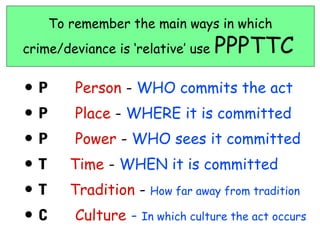
To remember the main ways in which
crime/deviance is ‘relative’ use   PPPTTC
•P       Person - WHO commits the act
•P       Place - WHERE it is committed
•P       Power - WHO sees it committed
•T      Time - WHEN it is committed
•T      Tradition -   How far away from tradition

•C       Culture -   In which culture the act occurs
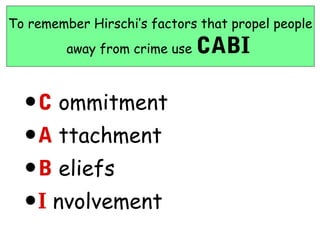
To remember Hirschi’s factors that propel people
         away from crime use   CABI

  • C ommitment
  • A ttachment
  • B eliefs
  • I nvolvement
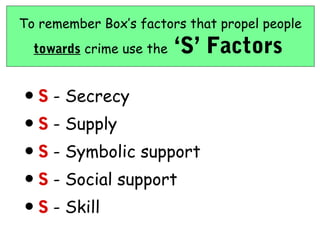
To remember Box’s factors that propel people
  towards crime use the   ‘S’ Factors

• S - Secrecy
• S - Supply
• S - Symbolic support
• S - Social support
• S - Skill
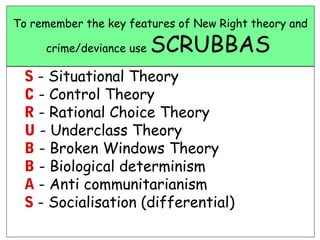
To remember the key features of New Right theory and

     crime/deviance use   SCRUBBAS
  S - Situational Theory
  C - Control Theory
  R - Rational Choice Theory
  U - Underclass Theory
  B - Broken Windows Theory
  B - Biological determinism
  A - Anti communitarianism
  S - Socialisation (differential)
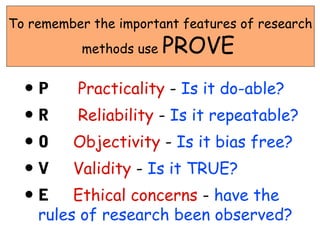
To remember the important features of research
           methods use   PROVE
  •P      Practicality - Is it do-able?
  •R      Reliability - Is it repeatable?
  •O     Objectivity - Is it bias free?
  •V     Validity - Is it TRUE?
  •E     Ethical concerns - have the
    rules of research been observed?
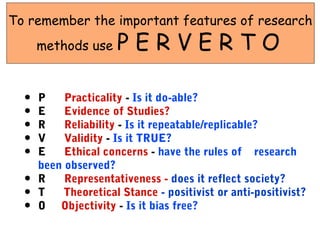
To remember the important features of research
      methods use     PERVERTO

  •   P    Practicality - Is it do-able?
  •   E    Evidence of Studies?
  •   R    Reliability - Is it repeatable/replicable?
  •   V    Validity - Is it TRUE?
  •   E    Ethical concerns - have the rules of research
      been observed?
  •   R    Representativeness - does it reflect society?
  •   T    Theoretical Stance - positivist or anti-positivist?
  •   O Objectivity - Is it bias free?
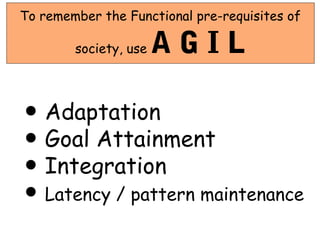
To remember the Functional pre-requisites of

        society, use   AGIL

•  Adaptation
•  Goal Attainment
•  Integration
• Latency / pattern maintenance

SociologyExchange.co.uk Shared Resource

  • 1.
    Memory Hooks for use with AQA GCSE and AS / A2 Sociology
  • 2.
    The “Memory Hooks”used in this presentation have been built up over many years. They have been developed by teachers and students at Balby Carr CSSC, Doncaster and are used to help students to remember important factual information. The memory hooks are colour coded and organised according to the various themes. Please see next slide. Media hooks are in the process of development If anyone has any useful memory hooks that are not featured here, please let us know!
  • 3.
    General Memory Hooks FAMILY Education Social Inequality / Poverty Beliefs in Society Crime and Deviance Theories and Methods
  • 4.
    To remember reasonsfor changes... use FLIRTS •F Rise of Feminism • L Law Changes •I Rise of Individualism • R Decline of Religion • T Decline of Tradition •S Social Changes
  • 5.
    To remember thesocial factors that influence people’s lives... use CARGO • C Class • A Age • R Race • G Gender • O Other factors (religion, media etc) •
  • 6.
    To remember thedifferent social systems use SPLECT •S Social •P Political •L Legal •E Economic •C Cultural •T Technological
  • 7.
    To remember thedifferent types of family diversity use CLOGS •C Class, Cultural •L Life Stage •O Organisational •G Generational •S Structural, Sexual OR
  • 8.
    OR...CLC ROCKS! • C Class • L Life Stage • C Cultural • R Regional • O Organisational • C Cohort / Generational • K Kinship • S Structural / sexual
  • 9.
    To remember thefunctions/roles of the family... use CREEEPS •C Citizenship •R Reproduction / Regulation of Sex •E Economic support •E Emotional support •E Education •P Primary Socialisation / political •S Stabilisation of adult personalities
  • 10.
    To remember thefunctions of education ... use All the Ssssss! • S Secondary Socialisation • S Social Solidarity / Cohesion • S Specialist Skills / Social Mobility • S Social Control / Order • S Sifting and Sorting •
  • 11.
    To remember themain aims of education since 1997 use VOICE •V Vocational Education •O Overcoming Obstacles •I Improving attainment •C Choice, Competition, diversity •E Equal opportunities
  • 12.
    To remember thekey areas of agreement between New Right and Functionalists regarding Education, use... MTVS •M Meritocracy •T Talents •V Vocational Education •S Secondary Socialisation
  • 13.
    To remember thekey areas of DISagreement between New Right and Functionalists regarding Education, use... USA • U Universalism • S State interference • A Accountability
  • 14.
    To remember thekey areas of cultural deprivation in relation to ethnicity and educational performance: Whizzing Asians Fight Class In A Class • W White working class families • A Asian Families • F Family structure / parental attitudes • C Compensatory Education • I Intellectual and Linguistic development • A Attitudes and Values • C Criticisms of cultural deprivation •
  • 15.
    To remember themain social issues tackled by the Welfare State... use SQWIDI • Sq Squalor - poor housing •W Want - lack of money •I Idleness - lack of work •D Disease - ill health •I Ignorance - lack of education
  • 16.
    To remember thedefinitions/types of poverty... use ARSE! •A Absolute poverty • R Relative poverty • S Subjective poverty • E Environmental poverty
  • 17.
    To remember thekey terms/ideas associated with secularisation use “Darling, Shortly I’m Going To Purposely Shop Really Drunk!” • D Disengagement • S Structural Differentiation • I Individuation • G Generalisation • T Transformation • P Participation • S Secularisation of Religious Institutions • R Religious Pluralism • D De-sacrilisation / Disenchantment
  • 18.
    To remember theMYTHS associated with secularisation use: “Don’t Risk Biased Understanding of Secularisation” Disengagement is seen by some to be a myth Re-sacrilisation is seen by some to be a myth Believing without Belonging is seen by some to be a myth Secularisation as a Universal process is generally seen to be a myth The rise of Spirituality / a religious revival is seen by some to be a myth
  • 19.
    To remember howto compare religious organisations use MHWRAMCI • M My Membership • H House Hierarchy • W Will Worship • R Rot Ritual • A And Attitude to wider society • M Might Monopoly of the truth • C Cave Commitment • I In Ideology (right or left wing?)
  • 20.
    To remember themain ways in which crime/deviance is ‘relative’ use PPPTTC •P Person - WHO commits the act •P Place - WHERE it is committed •P Power - WHO sees it committed •T Time - WHEN it is committed •T Tradition - How far away from tradition •C Culture - In which culture the act occurs
  • 21.
    To remember Hirschi’sfactors that propel people away from crime use CABI • C ommitment • A ttachment • B eliefs • I nvolvement
  • 22.
    To remember Box’sfactors that propel people towards crime use the ‘S’ Factors • S - Secrecy • S - Supply • S - Symbolic support • S - Social support • S - Skill
  • 23.
    To remember thekey features of New Right theory and crime/deviance use SCRUBBAS S - Situational Theory C - Control Theory R - Rational Choice Theory U - Underclass Theory B - Broken Windows Theory B - Biological determinism A - Anti communitarianism S - Socialisation (differential)
  • 24.
    To remember theimportant features of research methods use PROVE •P Practicality - Is it do-able? •R Reliability - Is it repeatable? •O Objectivity - Is it bias free? •V Validity - Is it TRUE? •E Ethical concerns - have the rules of research been observed?
  • 25.
    To remember theimportant features of research methods use PERVERTO • P Practicality - Is it do-able? • E Evidence of Studies? • R Reliability - Is it repeatable/replicable? • V Validity - Is it TRUE? • E Ethical concerns - have the rules of research been observed? • R Representativeness - does it reflect society? • T Theoretical Stance - positivist or anti-positivist? • O Objectivity - Is it bias free?
  • 26.
    To remember theFunctional pre-requisites of society, use AGIL • Adaptation • Goal Attainment • Integration • Latency / pattern maintenance