Introduction to Sociology
Naveed Siddiqui
PhD. M.B.E. PgDip Information Technology
Founder & CEO – Naveed Media Academy
www.facebook.com/NaveedAhmedSiddiqui33
www.linkedin.com/in/dr-naveed-siddiqui-191a4b2b
www.youtube.com/user/nvd30
www.youtube.com/user/NaveedAhmedSiddiqui3
nasiddiqui333@gmail.com
00971 56 237 4597
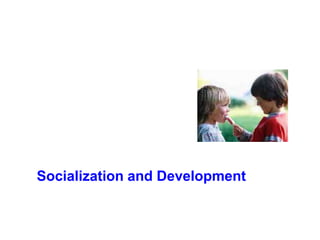
Socialization and Development
What to Expect in This Chapter...
 What is Socialization?
 Biology vs. Culture in Socialization
 The Concept of Self
 Dimensions of Human Development
 Theories of Development
 Early Socialization Influences in
American Society
 Adult Socialization
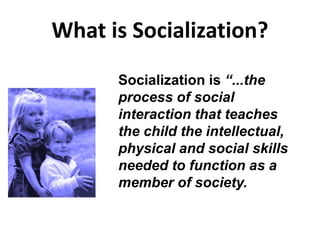
What is Socialization?
Socialization is “...the
process of social
interaction that teaches
the child the intellectual,
physical and social skills
needed to function as a
member of society.
Biology vs. Culture in Socialization
 This is an age-old controversy, commonly
known as the “nature-nurture debate.”
• Early social scientists minimized the role of
biology as a result of experiments by Pavlov,
Watson and others
• The 1970’s witnessed a resurgence of interest
in biology, known as sociobiology.
The Case for Culture: Deprivation and
Development
 Several cases from the annals of social science
research demonstrate the importance of social
contact and cultural content in development:
• Victor, The Wild Boy of Aveyron who had been living
alone in a forest for 5 or 6 years
• Anna, illegitimate daughter of a disapproving family who
kept her isolated
• Genie, daughter of a nearly blind mother who had been
kept harnessed to a potty seat for hours each day
The Concept of Self
 Human beings have both social identities
and personal identities
Social identities consist of all the statuses, or
positions, that we occupy in society.
Personal identities consist of the self-
reflections and self-images that are based at
least in part on our social identities
 Our personal identity is also referred to as
our self.
Dimensions of Human Development:
Cognitive Development
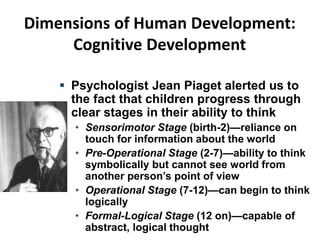
 Psychologist Jean Piaget alerted us to
the fact that children progress through
clear stages in their ability to think
• Sensorimotor Stage (birth-2)—reliance on
touch for information about the world
• Pre-Operational Stage (2-7)—ability to think
symbolically but cannot see world from
another person’s point of view
• Operational Stage (7-12)—can begin to think
logically
• Formal-Logical Stage (12 on)—capable of
abstract, logical thought
Dimensions of Human Development:
Moral Development
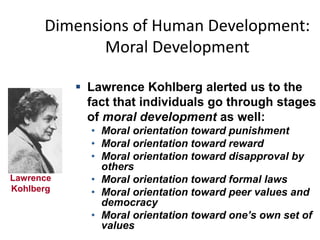
 Lawrence Kohlberg alerted us to the
fact that individuals go through stages
of moral development as well:
• Moral orientation toward punishment
• Moral orientation toward reward
• Moral orientation toward disapproval by
others
• Moral orientation toward formal laws
• Moral orientation toward peer values and
democracy
• Moral orientation toward one’s own set of
values
Lawrence
Kohlberg
Dimensions of Human Development:
Gender Identity
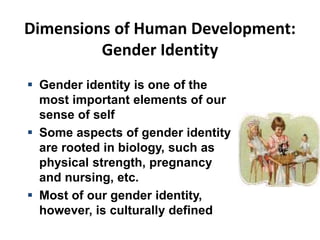
 Gender identity is one of the
most important elements of our
sense of self
 Some aspects of gender identity
are rooted in biology, such as
physical strength, pregnancy
and nursing, etc.
 Most of our gender identity,
however, is culturally defined
Theories of Development: Charles
Horton Cooley
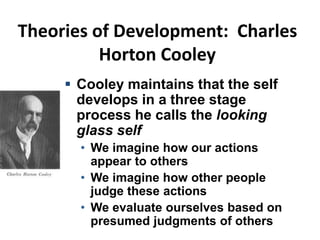
 Cooley maintains that the self
develops in a three stage
process he calls the looking
glass self
• We imagine how our actions
appear to others
• We imagine how other people
judge these actions
• We evaluate ourselves based on
presumed judgments of others
Theories of Development: George
Herbert Mead
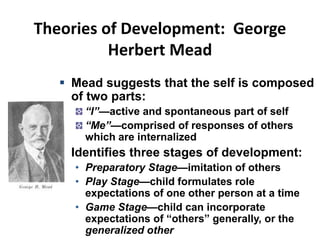
 Mead suggests that the self is composed
of two parts:
“I”—active and spontaneous part of self
“Me”—comprised of responses of others
which are internalized
 Identifies three stages of development:
• Preparatory Stage—imitation of others
• Play Stage—child formulates role
expectations of one other person at a time
• Game Stage—child can incorporate
expectations of “others” generally, or the
generalized other
Psychological Theories of Development:
Freud and Erikson
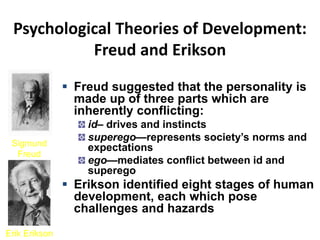
 Freud suggested that the personality is
made up of three parts which are
inherently conflicting:
id– drives and instincts
superego—represents society’s norms and
expectations
ego—mediates conflict between id and
superego
 Erikson identified eight stages of human
development, each which pose
challenges and hazards
Erik Erikson
Sigmund
Freud
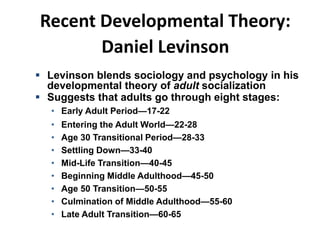
Recent Developmental Theory:
Daniel Levinson
 Levinson blends sociology and psychology in his
developmental theory of adult socialization
 Suggests that adults go through eight stages:
• Early Adult Period—17-22
• Entering the Adult World—22-28
• Age 30 Transitional Period—28-33
• Settling Down—33-40
• Mid-Life Transition—40-45
• Beginning Middle Adulthood—45-50
• Age 50 Transition—50-55
• Culmination of Middle Adulthood—55-60
• Late Adult Transition—60-65
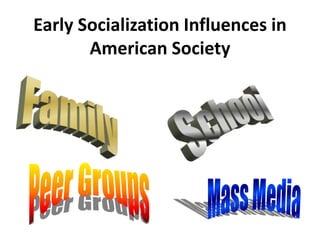
Early Socialization Influences in
American Society
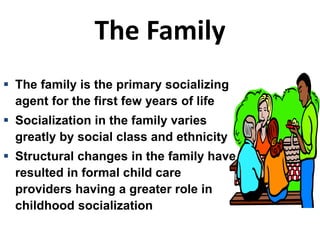
The Family
 The family is the primary socializing
agent for the first few years of life
 Socialization in the family varies
greatly by social class and ethnicity
 Structural changes in the family have
resulted in formal child care
providers having a greater role in
childhood socialization
The School
 The school is a formal agent of
socialization that seeks to socialize
children in selected skills and knowledge
 Numerous issues face the school as a
socializing agent as a result of conflict
between local values and state/federal
demands:
• Prayer
• AIDS and education
• Evolution
The Peer Group
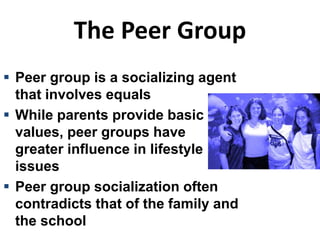
 Peer group is a socializing agent
that involves equals
 While parents provide basic
values, peer groups have
greater influence in lifestyle
issues
 Peer group socialization often
contradicts that of the family and
the school
The Mass Media
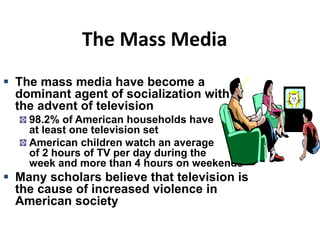
 The mass media have become a
dominant agent of socialization with
the advent of television
98.2% of American households have
at least one television set
American children watch an average
of 2 hours of TV per day during the
week and more than 4 hours on weekends
 Many scholars believe that television is
the cause of increased violence in
American society
Adult Socialization
 Adult socialization is the process by
which adults internalize new role
expectation
 An important feature of adult socialization
is resocialization, exposure to radically
different expectations than one has
previously encountered
• Often resocialization takes place within total
institutions such as prisons, mental hospitals,
or religious cults
Adult Socialization: Marriage
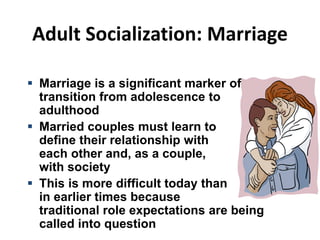
 Marriage is a significant marker of a
transition from adolescence to
adulthood
 Married couples must learn to
define their relationship with
each other and, as a couple,
with society
 This is more difficult today than
in earlier times because
traditional role expectations are being
called into question
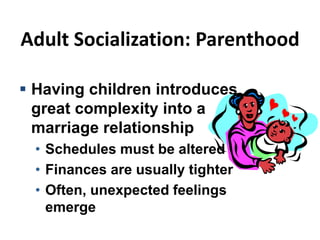
Adult Socialization: Parenthood
 Having children introduces
great complexity into a
marriage relationship
• Schedules must be altered
• Finances are usually tighter
• Often, unexpected feelings
emerge
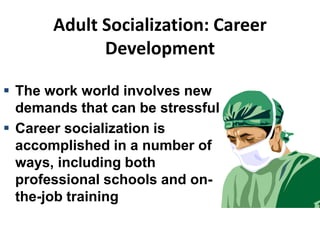
Adult Socialization: Career
Development
 The work world involves new
demands that can be stressful
 Career socialization is
accomplished in a number of
ways, including both
professional schools and on-
the-job training
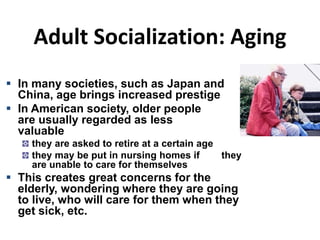
Adult Socialization: Aging
 In many societies, such as Japan and
China, age brings increased prestige
 In American society, older people
are usually regarded as less
valuable
they are asked to retire at a certain age
they may be put in nursing homes if they
are unable to care for themselves
 This creates great concerns for the
elderly, wondering where they are going
to live, who will care for them when they
get sick, etc.
Introduction to Sociology
Naveed Siddiqui
PhD. M.B.E. PgDip Information Technology
Founder & CEO – Naveed Media Academy
www.facebook.com/NaveedAhmedSiddiqui33
www.linkedin.com/in/dr-naveed-siddiqui-191a4b2b
www.youtube.com/user/nvd30
www.youtube.com/user/NaveedAhmedSiddiqui3
nasiddiqui333@gmail.com
00971 56 237 4597

Sociology

  • 1.
    Introduction to Sociology NaveedSiddiqui PhD. M.B.E. PgDip Information Technology Founder & CEO – Naveed Media Academy www.facebook.com/NaveedAhmedSiddiqui33 www.linkedin.com/in/dr-naveed-siddiqui-191a4b2b www.youtube.com/user/nvd30 www.youtube.com/user/NaveedAhmedSiddiqui3 nasiddiqui333@gmail.com 00971 56 237 4597
  • 2.
  • 3.
    What to Expectin This Chapter...  What is Socialization?  Biology vs. Culture in Socialization  The Concept of Self  Dimensions of Human Development  Theories of Development  Early Socialization Influences in American Society  Adult Socialization
  • 4.
    What is Socialization? Socializationis “...the process of social interaction that teaches the child the intellectual, physical and social skills needed to function as a member of society.
  • 5.
    Biology vs. Culturein Socialization  This is an age-old controversy, commonly known as the “nature-nurture debate.” • Early social scientists minimized the role of biology as a result of experiments by Pavlov, Watson and others • The 1970’s witnessed a resurgence of interest in biology, known as sociobiology.
  • 6.
    The Case forCulture: Deprivation and Development  Several cases from the annals of social science research demonstrate the importance of social contact and cultural content in development: • Victor, The Wild Boy of Aveyron who had been living alone in a forest for 5 or 6 years • Anna, illegitimate daughter of a disapproving family who kept her isolated • Genie, daughter of a nearly blind mother who had been kept harnessed to a potty seat for hours each day
  • 7.
    The Concept ofSelf  Human beings have both social identities and personal identities Social identities consist of all the statuses, or positions, that we occupy in society. Personal identities consist of the self- reflections and self-images that are based at least in part on our social identities  Our personal identity is also referred to as our self.
  • 8.
    Dimensions of HumanDevelopment: Cognitive Development  Psychologist Jean Piaget alerted us to the fact that children progress through clear stages in their ability to think • Sensorimotor Stage (birth-2)—reliance on touch for information about the world • Pre-Operational Stage (2-7)—ability to think symbolically but cannot see world from another person’s point of view • Operational Stage (7-12)—can begin to think logically • Formal-Logical Stage (12 on)—capable of abstract, logical thought
  • 9.
    Dimensions of HumanDevelopment: Moral Development  Lawrence Kohlberg alerted us to the fact that individuals go through stages of moral development as well: • Moral orientation toward punishment • Moral orientation toward reward • Moral orientation toward disapproval by others • Moral orientation toward formal laws • Moral orientation toward peer values and democracy • Moral orientation toward one’s own set of values Lawrence Kohlberg
  • 10.
    Dimensions of HumanDevelopment: Gender Identity  Gender identity is one of the most important elements of our sense of self  Some aspects of gender identity are rooted in biology, such as physical strength, pregnancy and nursing, etc.  Most of our gender identity, however, is culturally defined
  • 11.
    Theories of Development:Charles Horton Cooley  Cooley maintains that the self develops in a three stage process he calls the looking glass self • We imagine how our actions appear to others • We imagine how other people judge these actions • We evaluate ourselves based on presumed judgments of others
  • 12.
    Theories of Development:George Herbert Mead  Mead suggests that the self is composed of two parts: “I”—active and spontaneous part of self “Me”—comprised of responses of others which are internalized  Identifies three stages of development: • Preparatory Stage—imitation of others • Play Stage—child formulates role expectations of one other person at a time • Game Stage—child can incorporate expectations of “others” generally, or the generalized other
  • 13.
    Psychological Theories ofDevelopment: Freud and Erikson  Freud suggested that the personality is made up of three parts which are inherently conflicting: id– drives and instincts superego—represents society’s norms and expectations ego—mediates conflict between id and superego  Erikson identified eight stages of human development, each which pose challenges and hazards Erik Erikson Sigmund Freud
  • 14.
    Recent Developmental Theory: DanielLevinson  Levinson blends sociology and psychology in his developmental theory of adult socialization  Suggests that adults go through eight stages: • Early Adult Period—17-22 • Entering the Adult World—22-28 • Age 30 Transitional Period—28-33 • Settling Down—33-40 • Mid-Life Transition—40-45 • Beginning Middle Adulthood—45-50 • Age 50 Transition—50-55 • Culmination of Middle Adulthood—55-60 • Late Adult Transition—60-65
  • 15.
    Early Socialization Influencesin American Society
  • 16.
    The Family  Thefamily is the primary socializing agent for the first few years of life  Socialization in the family varies greatly by social class and ethnicity  Structural changes in the family have resulted in formal child care providers having a greater role in childhood socialization
  • 17.
    The School  Theschool is a formal agent of socialization that seeks to socialize children in selected skills and knowledge  Numerous issues face the school as a socializing agent as a result of conflict between local values and state/federal demands: • Prayer • AIDS and education • Evolution
  • 18.
    The Peer Group Peer group is a socializing agent that involves equals  While parents provide basic values, peer groups have greater influence in lifestyle issues  Peer group socialization often contradicts that of the family and the school
  • 19.
    The Mass Media The mass media have become a dominant agent of socialization with the advent of television 98.2% of American households have at least one television set American children watch an average of 2 hours of TV per day during the week and more than 4 hours on weekends  Many scholars believe that television is the cause of increased violence in American society
  • 20.
    Adult Socialization  Adultsocialization is the process by which adults internalize new role expectation  An important feature of adult socialization is resocialization, exposure to radically different expectations than one has previously encountered • Often resocialization takes place within total institutions such as prisons, mental hospitals, or religious cults
  • 21.
    Adult Socialization: Marriage Marriage is a significant marker of a transition from adolescence to adulthood  Married couples must learn to define their relationship with each other and, as a couple, with society  This is more difficult today than in earlier times because traditional role expectations are being called into question
  • 22.
    Adult Socialization: Parenthood Having children introduces great complexity into a marriage relationship • Schedules must be altered • Finances are usually tighter • Often, unexpected feelings emerge
  • 23.
    Adult Socialization: Career Development The work world involves new demands that can be stressful  Career socialization is accomplished in a number of ways, including both professional schools and on- the-job training
  • 24.
    Adult Socialization: Aging In many societies, such as Japan and China, age brings increased prestige  In American society, older people are usually regarded as less valuable they are asked to retire at a certain age they may be put in nursing homes if they are unable to care for themselves  This creates great concerns for the elderly, wondering where they are going to live, who will care for them when they get sick, etc.
  • 25.
    Introduction to Sociology NaveedSiddiqui PhD. M.B.E. PgDip Information Technology Founder & CEO – Naveed Media Academy www.facebook.com/NaveedAhmedSiddiqui33 www.linkedin.com/in/dr-naveed-siddiqui-191a4b2b www.youtube.com/user/nvd30 www.youtube.com/user/NaveedAhmedSiddiqui3 nasiddiqui333@gmail.com 00971 56 237 4597