Adult Development Adult Development 1.  Biological 2.  Psychological models   3.  Sociocultural factors 4.  Integrative models      Biological Psychological  models Erikson’s  psychosocial model Levinson’s model of personal development Sociocultural factors Integrative models - Holistic
Biological Development “Beauty at every age is a maxim” Physical and biological changes 2000 U.S. life expectancy – 76.5 years Various theories of aging Racial/ethnic disparities Deterioration in vision and hearing Changes in cognitive functioning
Psychological perspective Erikson’s theory – Identity – identity confusion Intimacy-isolation Generativity-self absorption Integrity-despair Levinson’s age graded model “ teachable moments” – Havighurst
Psychological models  Six periods of identity development: neutrality, acceptance, awareness, experimentation, transition and  recognition Sexual identity model stages – confusion, comparison, tolerance, identity, acceptance, identity pride, synthesize self
Adult Development Sociocultural factors Age, race, gender, ethnicity, socioeconomic status and sexual orientation Social roles – normative beliefs Social expectations Curriculum decisions
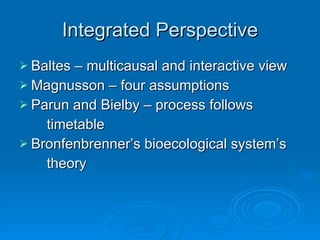
Integrated Perspective Baltes – multicausal and interactive view Magnusson – four assumptions Parun and Bielby – process follows timetable Bronfenbrenner’s bioecological system’s theory
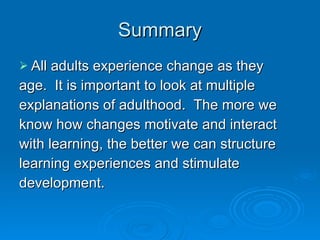
Summary All adults experience change as they age.  It is important to look at multiple explanations of adulthood.  The more we know how changes motivate and interact with learning, the better we can structure  learning experiences and stimulate development.


Adult development

  • 1.
    Adult Development AdultDevelopment 1. Biological 2. Psychological models 3. Sociocultural factors 4. Integrative models Biological Psychological models Erikson’s psychosocial model Levinson’s model of personal development Sociocultural factors Integrative models - Holistic
  • 2.
    Biological Development “Beautyat every age is a maxim” Physical and biological changes 2000 U.S. life expectancy – 76.5 years Various theories of aging Racial/ethnic disparities Deterioration in vision and hearing Changes in cognitive functioning
  • 3.
    Psychological perspective Erikson’stheory – Identity – identity confusion Intimacy-isolation Generativity-self absorption Integrity-despair Levinson’s age graded model “ teachable moments” – Havighurst
  • 4.
    Psychological models Six periods of identity development: neutrality, acceptance, awareness, experimentation, transition and recognition Sexual identity model stages – confusion, comparison, tolerance, identity, acceptance, identity pride, synthesize self
  • 5.
    Adult Development Socioculturalfactors Age, race, gender, ethnicity, socioeconomic status and sexual orientation Social roles – normative beliefs Social expectations Curriculum decisions
  • 6.
    Integrated Perspective Baltes– multicausal and interactive view Magnusson – four assumptions Parun and Bielby – process follows timetable Bronfenbrenner’s bioecological system’s theory
  • 7.
    Summary All adultsexperience change as they age. It is important to look at multiple explanations of adulthood. The more we know how changes motivate and interact with learning, the better we can structure learning experiences and stimulate development.
  • 8.
  • 9.
  • 10.