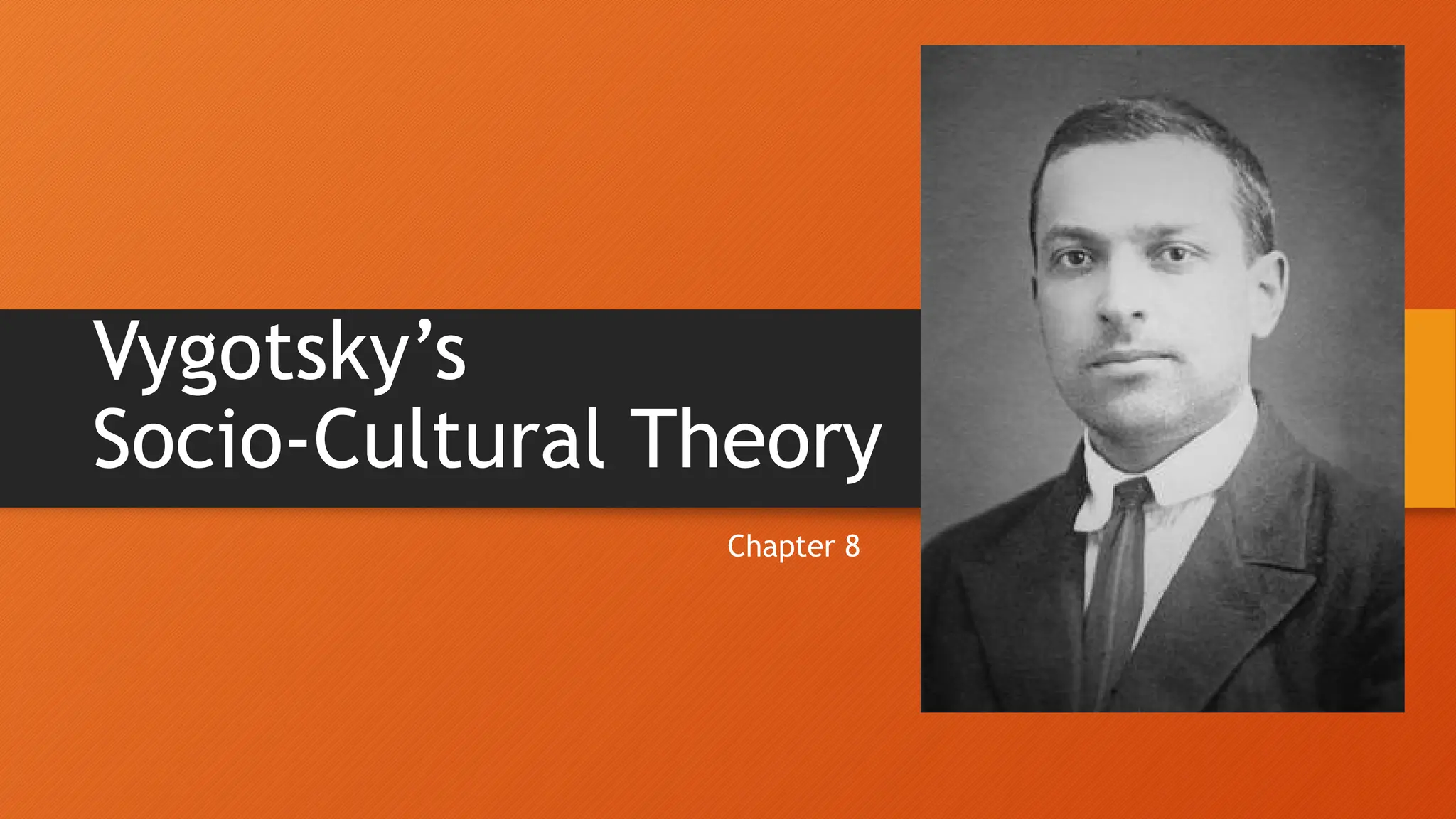
Vygotsky’s
Socio-Cultural Theory
Chapter 8
Lev Semonovich Vygotsky
• The Mozart of Psychology‖
• Lev Semonovich Vygotsky was born in Western Russia on November 5,
1986.His father, Semi L‘vovich, founded the ―Society of Education in
Gomel , and held a wide range of active interest including foreign language,
‖
history, literature, theater and arts. His mother was educated as teacher.
• His work began when he was studying learning and
development to improve his own teaching.
• He wrote on language, thought, psychology of art, learning
and development and educating students with special
needs.
Sociocultural theory of development
• Crucial influence that social interactions and language,
embedded within a cultural context, have on cognitive
development.
• Vygotsky emphasized that effective learning happens through
participation in social activities.
• Parents, teachers and other adults in the learner‘s environment
all contribute to the process. They explain, model, assist, give
directions and provide feedback.
• Peers, on the other hand, cooperate and collaborate and enrich
the learning experience.
Language
• Language can be viewed as a verbal expression of culture.
• Every culture has the words it needs for its lifestyle.
• It opens the door for learners to acquire knowledge that others already
have.
• It is use to know and understand the world and solve problems.
• It serves a social function but it also has an important individual function.
It helps the learner to regulate and reflect on his own thinking
Zone of Proximal Development
Zone of Actual Development
- Which the child may perform certain level of competency she/ he
may not immediately be at it
Zone of Proximal Development
- The difference between what the child accomplish alone and what
he/she can accomplish with guidance of another.
Scaffolding
Refers to the support or assistance that lets the child accomplish a
task he/she cannot accomplish independently.
It is not about doing the task for the child while he/she watches.
It is not about doing short cuts for the child
It should involve the judicious assistance given by the adult or peer
so that the child can move from the zone of actual to the zone of
proximal development.

Profeduc 1 report chap )llllllllll 8.pptx

  • 1.
  • 2.
    Lev Semonovich Vygotsky •The Mozart of Psychology‖ • Lev Semonovich Vygotsky was born in Western Russia on November 5, 1986.His father, Semi L‘vovich, founded the ―Society of Education in Gomel , and held a wide range of active interest including foreign language, ‖ history, literature, theater and arts. His mother was educated as teacher. • His work began when he was studying learning and development to improve his own teaching. • He wrote on language, thought, psychology of art, learning and development and educating students with special needs.
  • 3.
    Sociocultural theory ofdevelopment • Crucial influence that social interactions and language, embedded within a cultural context, have on cognitive development. • Vygotsky emphasized that effective learning happens through participation in social activities. • Parents, teachers and other adults in the learner‘s environment all contribute to the process. They explain, model, assist, give directions and provide feedback. • Peers, on the other hand, cooperate and collaborate and enrich the learning experience.
  • 4.
    Language • Language canbe viewed as a verbal expression of culture. • Every culture has the words it needs for its lifestyle. • It opens the door for learners to acquire knowledge that others already have. • It is use to know and understand the world and solve problems. • It serves a social function but it also has an important individual function. It helps the learner to regulate and reflect on his own thinking
  • 5.
    Zone of ProximalDevelopment Zone of Actual Development - Which the child may perform certain level of competency she/ he may not immediately be at it Zone of Proximal Development - The difference between what the child accomplish alone and what he/she can accomplish with guidance of another.
  • 6.
    Scaffolding Refers to thesupport or assistance that lets the child accomplish a task he/she cannot accomplish independently. It is not about doing the task for the child while he/she watches. It is not about doing short cuts for the child It should involve the judicious assistance given by the adult or peer so that the child can move from the zone of actual to the zone of proximal development.