   As we pass through the different stages
    our behaviors and attitudes change in
    ways that reflect the social expectations
    of that stage
   An individual’s life course in influenced
    by social location
   In earlier times, children were
    considered mini adults- kept in line by
    beatings and psychological torture
   The current view is that children are
    tender and innocent and parents should
    guide their children’s physical, emotional
    and social development while providing
    them with care, comfort and protection
•   Economic changes resulting from the
    Industrial Revolution brought about material
    surpluses that allow millions of teens to
    remain outside the labor force
    – At the same time there was a demand for education
      to increase
•   Biologically equipped for work and
    marriage but denied both, teens suffer
    inner turmoil and develop their own
    standards of clothing, hairstyles, language,
    music, and protection
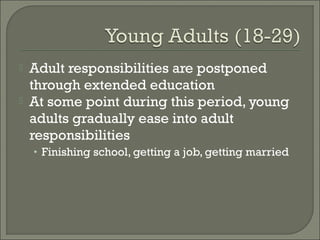
   Adult responsibilities are postponed
    through extended education
   At some point during this period, young
    adults gradually ease into adult
    responsibilities
    • Finishing school, getting a job, getting married
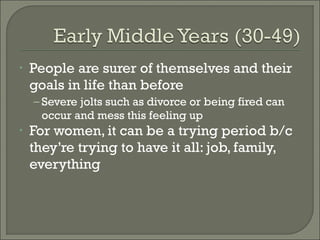
•   People are surer of themselves and their
    goals in life than before
    – Severe jolts such as divorce or being fired can
     occur and mess this feeling up
•   For women, it can be a trying period b/c
    they’re trying to have it all: job, family,
    everything
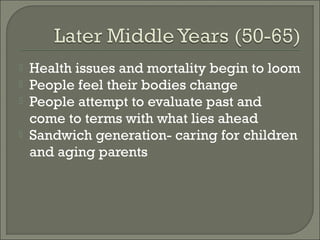
   Health issues and mortality begin to loom
   People feel their bodies change
   People attempt to evaluate past and
    come to terms with what lies ahead
   Sandwich generation- caring for children
    and aging parents
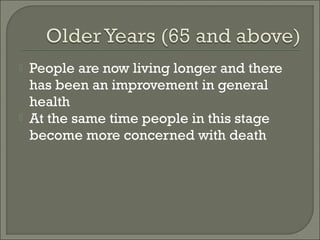
   People are now living longer and there
    has been an improvement in general
    health
   At the same time people in this stage
    become more concerned with death
•   Socialization serves a # of social functions
    – Ensuring social order is main function
•   w/socialization, norms and values can be
    instilled within the child
    – Socialized individuals support their society
      • Working to contribute to its prosperity and obeying laws
•   Socialization of children teaches parents
    qualities useful for enhancing human
    relations in society
•   Children are socialized to grow up and
    support their parents in old age and in some
    cases they are contributors to the family’s
    economic well-being
•   Some aspects of socialization are harmful to
    children
•   An enormous power builds up on the
    parents who can thus be tempted to exploit
    and abuse children
    – Child labor, slavery, child pornography and abuse
•   Children are viewed as their parents
    personal possession and are denied many
    rights that adults enjoy as members of
    society
•   Adults defend the physical punishment of
    children by saying “its for their own good”
   Focuses on how children develop a self
    from interactions with parents and other
    people in their lives
   Cooley’s looking glass process
   Mead’s Role Taking Process

Socialization through the life course

  • 2.
    As we pass through the different stages our behaviors and attitudes change in ways that reflect the social expectations of that stage  An individual’s life course in influenced by social location
  • 3.
    In earlier times, children were considered mini adults- kept in line by beatings and psychological torture  The current view is that children are tender and innocent and parents should guide their children’s physical, emotional and social development while providing them with care, comfort and protection
  • 4.
    Economic changes resulting from the Industrial Revolution brought about material surpluses that allow millions of teens to remain outside the labor force – At the same time there was a demand for education to increase • Biologically equipped for work and marriage but denied both, teens suffer inner turmoil and develop their own standards of clothing, hairstyles, language, music, and protection
  • 5.
    Adult responsibilities are postponed through extended education  At some point during this period, young adults gradually ease into adult responsibilities • Finishing school, getting a job, getting married
  • 6.
    People are surer of themselves and their goals in life than before – Severe jolts such as divorce or being fired can occur and mess this feeling up • For women, it can be a trying period b/c they’re trying to have it all: job, family, everything
  • 7.
    Health issues and mortality begin to loom  People feel their bodies change  People attempt to evaluate past and come to terms with what lies ahead  Sandwich generation- caring for children and aging parents
  • 8.
    People are now living longer and there has been an improvement in general health  At the same time people in this stage become more concerned with death
  • 10.
    Socialization serves a # of social functions – Ensuring social order is main function • w/socialization, norms and values can be instilled within the child – Socialized individuals support their society • Working to contribute to its prosperity and obeying laws • Socialization of children teaches parents qualities useful for enhancing human relations in society • Children are socialized to grow up and support their parents in old age and in some cases they are contributors to the family’s economic well-being
  • 11.
    Some aspects of socialization are harmful to children • An enormous power builds up on the parents who can thus be tempted to exploit and abuse children – Child labor, slavery, child pornography and abuse • Children are viewed as their parents personal possession and are denied many rights that adults enjoy as members of society • Adults defend the physical punishment of children by saying “its for their own good”
  • 12.
    Focuses on how children develop a self from interactions with parents and other people in their lives  Cooley’s looking glass process  Mead’s Role Taking Process