Agenda Check in Next week’s reflection is the final reflection Parenting Roles and Child Socialization Get out early and go observe socialization
Final Reflection Page Length:  5.5 to 6 pages Sources:  Make sure to use at least 10-15 key terms or topics used in the book. Readings:  All course readings. Question:  How can knowledge acquired in this course be applied to personal and professional development? Specifically address the following questions:
Final Reflection Defining “Family” How has the course content informed how you look at families and your understanding of your family of origin? Definitions of “families” are influence by cultural, social and religious values and theoretical paradigms. How do you define family and what theoretical paradigms and values inform your definition of family? How do diversity issues influence definitions of “family”? Challenges Impacting Families What do you think are the most perplexing problems facing families in 2010/2011 and what strengths do you think families possess to help address these problems? Are there particular kinds of problems and strengths that are unique to particular kinds of families? If so, please describe and discuss. Future Expectations As you look to your future, imagine it is 2015, that you have graduated from school and that you are working in your profession. What will you be doing and how can the knowledge acquired in this course be applied in your personal and professional life?
Chapter 11:  Parenting Roles and Child Socialization
Good Parenting Varies according to context. Is often based on white, middle-class, Western norms. Is shaped by family strategies for survival.
Motherhood and Fatherhood Parental Investment Theory -reproductive strategies that best increase the likelihood that genetic material will be passed on through offspring varies according to sex. Ethological Perspective -women bond more closely with children because they are the early providers of satisfaction for infants’ basic physical needs.
Critiques of these Theories Men can perform expressive roles and women instrumental ones. Animal behavior shows that males and females use both strategies. Full-time care-giving fathers raise children who have strong and healthy attachments to both parents.
Parent-Child Attachment Secure -comfort with a mix of proximity and distance, little exposure to risk. Insecure-resistant -parents distance themselves from children, exposing child to risk. Insecure-avoidant -parents are overly close to their children, and the child is angry when separation occurs. Disorganized -do not desire closeness; are not distressed by distance.
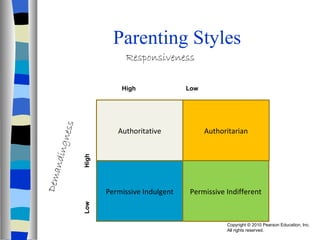
Parenting Styles Authoritative Permissive Indifferent Authoritarian Permissive Indulgent Responsiveness Demandingness High  Low Low    High
Corporal Punishment Is the use of physical force to correct behavior. Must be viewed in a socio-cultural context, including: Culturally prescribed meanings Social structural variations
Theories of  Socialization Processes Learning/Behaviorist Psychoanalytic Child Development Symbolic Interaction
Learning/Behaviorist Frame of Reference Assumes that the same principles of learning apply to humans as to other animals. Both  classical conditioning  (Pavlov) and  operant conditioning  (Skinner) explain learning as a conditioned response to external stimuli.
Psychoanalytic Frame of Reference Stresses the importance of biological drives and unconscious psychic processes to personality formation. Freud Identified 5 Stages of Human Development: Oral Anal Phallic Latency Genital
Child Development Frames of Reference Erik Erikson  viewed socialization as a lifelong process. He identified 8 stages of development. At each stage the individual must resolve a crisis brought on by physiological changes and a constantly changing social situation. Jean Piaget  focused on the importance of cognition. He identified 4 stages of development. He argued that development is an ability to reason abstractly, think logically, and organize rules into complex structures.
Erikson’s Eight Stages of Development Infancy– trust versus mistrust Early Childhood– autonomy versus shame and doubt Young Childhood– initiative versus guilt School Age– industry versus inferiority Adolescence– identity versus role confusion Young Adulthood– intimacy versus isolation Adulthood and Middle Age– generativity versus stagnation Old Age– integrity versus despair
Piaget’s Four Stages of Intellectual Development Sensorimotor  (birth to 18 months)–based on physical understandings of self and world. Preoperational  (18 months to 7 years)–language acquisition and treatment of objects as symbolic. Concrete operational  (7 to 12 years)–learns cause and effect, can manipulate tools and classify objects, understands permanence, considers others’ views. Formal operational  (12 years and up)–develops ability to think abstractly, can develop alternative solutions to problems.
Symbolic Interaction Frame of Reference This sociological perspective focuses on: Symbols Language Internalized meanings It sees socialization as a lifelong process, developed through interaction.
Symbolic Interaction Stryker Identified Four Basic Assumptions: Humans must be studied on their own level. The most fruitful approach to social behavior is through analyzing society. The human infant at birth is asocial. A socialized human being is both an actor and a reactor.
Symbolic Interaction Development of a  social self  occurs through interaction with others. Significant others  and  reference groups  are those that we psychologically identify with and seek acceptance from. Socialization stages  and  interaction processes  provide us with a sense of self, others, and social relationships.
Symbolic Interaction Very early experiences provide infants with their first sense of self, others, and social relationships. For most infants, the mother is the first, primary, and most significant other. The infant internalizes a sense of self-worth and self-image through repetitive interactions.
Symbolic Interaction Mead asserted that individuals develop a mental construct, the  generalized other , which allows people to see themselves from the standpoints of others. His model includes three  Stages of Observation: Preparatory stage –Children imitate others; Play stage –Children take roles of others; and Game stage –Children participate in games involving rules.
Socialization in Adolescence Adolescence is a period of active engagement in: Sex role identification Interaction with the opposite sex Participation in new social activities Acquisition of vocational skills Increasing independence from parents A new sense of self-reliance For teens, school and peer groups are central sources of reference, interaction, and identity .
Gender Identity and Sex-Role Socialization Sex  refers to the biological condition of being male or female. Sex Roles  refer to social expectations associated with biological sex. Gender  is the totality of being male or female. Gender Roles  are social expectations associated with being masculine or feminine (and may not correspond with one’s sex). Gender Identity  refers to the way one perceives or defines oneself.
Gender Identity and Sex Role Socialization Sexual and gender identity formation are developmental processes. These processes do not always involve an orderly sequence of stages. Identities change as a result of: Available social constructs; The socio-political landscape; and One’s own position in that landscape.
Gender Identity can include… Membership Knowledge “ I’m a girl” Gender Typicality “ Im just like other girls” Gender Contentedness “ I like being a girl” Pressure for gender conformity “ I ought to act like a girl” Intergroup Bias “ Girls are better than boys”
Female–Male Differences Males and Females Differ: Normatively Attitudinally Behaviorally Physically The  belief  that sex differences are innate provides ideological justification for a system of sex stratification.
Sex Role Socialization Children learn appropriate sex roles early in life through interaction with others. Sex-typing persists in adulthood. Gender Roles are Reinforced in: Home School Workplace Religious organizations Mass media
Ethnic/Racial Socialization Transmission from adults to children of information regarding race and ethnicity Parents focus on 4 general areas cultural socialization  heritage and history; cultural customs and traditions; ethnic pride preparation for bias promote their children’s awareness of discrimination and prepare them to cope with it promotion of mistrust need for wariness and distrust in interracial interactions Egalitarianism encourage their children to value individual qualities over racial group membership or avoid any mention of race in discussions Parental conversations increase with age, vary by gender & class
Observation for the long weekend Go observe families at home or at the mall… socialization patterns of families  Behavior management Sex/ Gender role Ethnic  Parent-child attachment Closeness Warmth Responsiveness Demandingness We will talk about your observations at the beginning of our next class

Ppt ch11 parenting_socialization

  • 1.
    Agenda Check inNext week’s reflection is the final reflection Parenting Roles and Child Socialization Get out early and go observe socialization
  • 2.
    Final Reflection PageLength: 5.5 to 6 pages Sources: Make sure to use at least 10-15 key terms or topics used in the book. Readings: All course readings. Question: How can knowledge acquired in this course be applied to personal and professional development? Specifically address the following questions:
  • 3.
    Final Reflection Defining“Family” How has the course content informed how you look at families and your understanding of your family of origin? Definitions of “families” are influence by cultural, social and religious values and theoretical paradigms. How do you define family and what theoretical paradigms and values inform your definition of family? How do diversity issues influence definitions of “family”? Challenges Impacting Families What do you think are the most perplexing problems facing families in 2010/2011 and what strengths do you think families possess to help address these problems? Are there particular kinds of problems and strengths that are unique to particular kinds of families? If so, please describe and discuss. Future Expectations As you look to your future, imagine it is 2015, that you have graduated from school and that you are working in your profession. What will you be doing and how can the knowledge acquired in this course be applied in your personal and professional life?
  • 4.
    Chapter 11: Parenting Roles and Child Socialization
  • 5.
    Good Parenting Variesaccording to context. Is often based on white, middle-class, Western norms. Is shaped by family strategies for survival.
  • 6.
    Motherhood and FatherhoodParental Investment Theory -reproductive strategies that best increase the likelihood that genetic material will be passed on through offspring varies according to sex. Ethological Perspective -women bond more closely with children because they are the early providers of satisfaction for infants’ basic physical needs.
  • 7.
    Critiques of theseTheories Men can perform expressive roles and women instrumental ones. Animal behavior shows that males and females use both strategies. Full-time care-giving fathers raise children who have strong and healthy attachments to both parents.
  • 8.
    Parent-Child Attachment Secure-comfort with a mix of proximity and distance, little exposure to risk. Insecure-resistant -parents distance themselves from children, exposing child to risk. Insecure-avoidant -parents are overly close to their children, and the child is angry when separation occurs. Disorganized -do not desire closeness; are not distressed by distance.
  • 9.
    Parenting Styles AuthoritativePermissive Indifferent Authoritarian Permissive Indulgent Responsiveness Demandingness High Low Low High
  • 10.
    Corporal Punishment Isthe use of physical force to correct behavior. Must be viewed in a socio-cultural context, including: Culturally prescribed meanings Social structural variations
  • 11.
    Theories of Socialization Processes Learning/Behaviorist Psychoanalytic Child Development Symbolic Interaction
  • 12.
    Learning/Behaviorist Frame ofReference Assumes that the same principles of learning apply to humans as to other animals. Both classical conditioning (Pavlov) and operant conditioning (Skinner) explain learning as a conditioned response to external stimuli.
  • 13.
    Psychoanalytic Frame ofReference Stresses the importance of biological drives and unconscious psychic processes to personality formation. Freud Identified 5 Stages of Human Development: Oral Anal Phallic Latency Genital
  • 14.
    Child Development Framesof Reference Erik Erikson viewed socialization as a lifelong process. He identified 8 stages of development. At each stage the individual must resolve a crisis brought on by physiological changes and a constantly changing social situation. Jean Piaget focused on the importance of cognition. He identified 4 stages of development. He argued that development is an ability to reason abstractly, think logically, and organize rules into complex structures.
  • 15.
    Erikson’s Eight Stagesof Development Infancy– trust versus mistrust Early Childhood– autonomy versus shame and doubt Young Childhood– initiative versus guilt School Age– industry versus inferiority Adolescence– identity versus role confusion Young Adulthood– intimacy versus isolation Adulthood and Middle Age– generativity versus stagnation Old Age– integrity versus despair
  • 16.
    Piaget’s Four Stagesof Intellectual Development Sensorimotor (birth to 18 months)–based on physical understandings of self and world. Preoperational (18 months to 7 years)–language acquisition and treatment of objects as symbolic. Concrete operational (7 to 12 years)–learns cause and effect, can manipulate tools and classify objects, understands permanence, considers others’ views. Formal operational (12 years and up)–develops ability to think abstractly, can develop alternative solutions to problems.
  • 17.
    Symbolic Interaction Frameof Reference This sociological perspective focuses on: Symbols Language Internalized meanings It sees socialization as a lifelong process, developed through interaction.
  • 18.
    Symbolic Interaction StrykerIdentified Four Basic Assumptions: Humans must be studied on their own level. The most fruitful approach to social behavior is through analyzing society. The human infant at birth is asocial. A socialized human being is both an actor and a reactor.
  • 19.
    Symbolic Interaction Developmentof a social self occurs through interaction with others. Significant others and reference groups are those that we psychologically identify with and seek acceptance from. Socialization stages and interaction processes provide us with a sense of self, others, and social relationships.
  • 20.
    Symbolic Interaction Veryearly experiences provide infants with their first sense of self, others, and social relationships. For most infants, the mother is the first, primary, and most significant other. The infant internalizes a sense of self-worth and self-image through repetitive interactions.
  • 21.
    Symbolic Interaction Meadasserted that individuals develop a mental construct, the generalized other , which allows people to see themselves from the standpoints of others. His model includes three Stages of Observation: Preparatory stage –Children imitate others; Play stage –Children take roles of others; and Game stage –Children participate in games involving rules.
  • 22.
    Socialization in AdolescenceAdolescence is a period of active engagement in: Sex role identification Interaction with the opposite sex Participation in new social activities Acquisition of vocational skills Increasing independence from parents A new sense of self-reliance For teens, school and peer groups are central sources of reference, interaction, and identity .
  • 23.
    Gender Identity andSex-Role Socialization Sex refers to the biological condition of being male or female. Sex Roles refer to social expectations associated with biological sex. Gender is the totality of being male or female. Gender Roles are social expectations associated with being masculine or feminine (and may not correspond with one’s sex). Gender Identity refers to the way one perceives or defines oneself.
  • 24.
    Gender Identity andSex Role Socialization Sexual and gender identity formation are developmental processes. These processes do not always involve an orderly sequence of stages. Identities change as a result of: Available social constructs; The socio-political landscape; and One’s own position in that landscape.
  • 25.
    Gender Identity caninclude… Membership Knowledge “ I’m a girl” Gender Typicality “ Im just like other girls” Gender Contentedness “ I like being a girl” Pressure for gender conformity “ I ought to act like a girl” Intergroup Bias “ Girls are better than boys”
  • 26.
    Female–Male Differences Malesand Females Differ: Normatively Attitudinally Behaviorally Physically The belief that sex differences are innate provides ideological justification for a system of sex stratification.
  • 27.
    Sex Role SocializationChildren learn appropriate sex roles early in life through interaction with others. Sex-typing persists in adulthood. Gender Roles are Reinforced in: Home School Workplace Religious organizations Mass media
  • 28.
    Ethnic/Racial Socialization Transmissionfrom adults to children of information regarding race and ethnicity Parents focus on 4 general areas cultural socialization heritage and history; cultural customs and traditions; ethnic pride preparation for bias promote their children’s awareness of discrimination and prepare them to cope with it promotion of mistrust need for wariness and distrust in interracial interactions Egalitarianism encourage their children to value individual qualities over racial group membership or avoid any mention of race in discussions Parental conversations increase with age, vary by gender & class
  • 29.
    Observation for thelong weekend Go observe families at home or at the mall… socialization patterns of families Behavior management Sex/ Gender role Ethnic Parent-child attachment Closeness Warmth Responsiveness Demandingness We will talk about your observations at the beginning of our next class

Editor's Notes

  • #29 Several studies, based on African American samples, have found that boys are more likely to receive messages regarding racial barriers, whereas girls are more likely to receive messages regarding racial pride