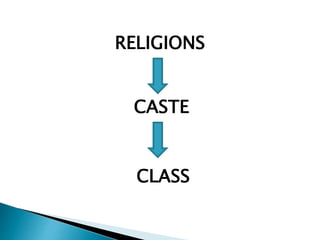
RELIGIONS
CASTE
CLASS
Characteristics
•Religion is not a phenomenon of
recent emergence.
•Religion is a powerful instrument of
social control.
•Religion represents one of the main
social facts of man.
•Religion and man’s faith in super
natural forces
•Religion minded rural india
The term ‘Caste’ itself is not an Indian
one, coming from the Portuguese
‘Caste’ meaning, ‘race’ or ‘pure stock’
“Caste is a closed social group” - D.N. Majumdar and
T.N. Madan
CASTE
Two different aspects of the caste system
varna and Jati.
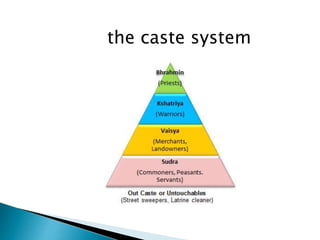
the caste system
CHARACTERISTICS OF CASTE SYSTEM
1. Caste is Innate(natural) -A man dies in the same caste
in which he is born and it is the caste that determines his
status in life.
2.Food Habits- a Brahmin is not permitted to eat non-vegetarian
food.
3.Caste is Endogamous- practice of marrying within a
specific ethnic group, class, or social group
4.Hierarchical Social Structure-At the lowest are those
castes from whom the higher castes cannot accept any food or
drink, not even they may be touched without contamination-
hence their hierarchy the Brahmins enjoy a number of social
and religious privileges while they suffer a series of
disabilities.
5.Occupation is Fixed-Brahmins was to perform priestly
duties. The Kshatriyas and Vaishyas were to occupy themselves
with defence and commerce and the functions of Shudras were
to serve the other three castes.
Recent Trends In Indian Caste system
1.Modern education
2.Jobs
3.Marriage
4.Food
5.Untouchables
CLASSES IN INDIA
•UPPER CLASS
•MIDDLE CLASS
•LOWER CLASS
SOCIAL CLASSES IN RURAL INDIA
(i) Landlords, who own but do not cultivate land, either employing
intermediaries or leasing out land.
(ii) Rich farmers, who look upon agriculture as a business proposition,
produce for the market and for profit, employ wage labour, and supervise
rather than cultivate.
(iii) Middle peasants, who cultivate their own land and hire labourers only
for certain operations or at certain points of time.
(iv) Poor peasants, who own small and uneconomic holdings and often have
to work as parts labourers or as sharecroppers or tenant.
(v) Landless agricultural workers who sell their labour and fully depend on
the first three categories for their livelihood.
SOCIAL CLASSES IN URBAN INDIA
(i) capitalists (commercial and industrial)
(ii) corporate sector
(iii) professional classes
(iv) petty traders, shopkeepers and UNORGANISED
WORKERS
(v) working classes

Religions, caste and class

  • 2.
  • 5.
    Characteristics •Religion is nota phenomenon of recent emergence. •Religion is a powerful instrument of social control. •Religion represents one of the main social facts of man. •Religion and man’s faith in super natural forces •Religion minded rural india
  • 6.
    The term ‘Caste’itself is not an Indian one, coming from the Portuguese ‘Caste’ meaning, ‘race’ or ‘pure stock’ “Caste is a closed social group” - D.N. Majumdar and T.N. Madan CASTE Two different aspects of the caste system varna and Jati.
  • 7.
  • 8.
    CHARACTERISTICS OF CASTESYSTEM 1. Caste is Innate(natural) -A man dies in the same caste in which he is born and it is the caste that determines his status in life. 2.Food Habits- a Brahmin is not permitted to eat non-vegetarian food. 3.Caste is Endogamous- practice of marrying within a specific ethnic group, class, or social group 4.Hierarchical Social Structure-At the lowest are those castes from whom the higher castes cannot accept any food or drink, not even they may be touched without contamination- hence their hierarchy the Brahmins enjoy a number of social and religious privileges while they suffer a series of disabilities.
  • 9.
    5.Occupation is Fixed-Brahminswas to perform priestly duties. The Kshatriyas and Vaishyas were to occupy themselves with defence and commerce and the functions of Shudras were to serve the other three castes. Recent Trends In Indian Caste system 1.Modern education 2.Jobs 3.Marriage 4.Food 5.Untouchables
  • 10.
    CLASSES IN INDIA •UPPERCLASS •MIDDLE CLASS •LOWER CLASS SOCIAL CLASSES IN RURAL INDIA (i) Landlords, who own but do not cultivate land, either employing intermediaries or leasing out land. (ii) Rich farmers, who look upon agriculture as a business proposition, produce for the market and for profit, employ wage labour, and supervise rather than cultivate. (iii) Middle peasants, who cultivate their own land and hire labourers only for certain operations or at certain points of time. (iv) Poor peasants, who own small and uneconomic holdings and often have to work as parts labourers or as sharecroppers or tenant. (v) Landless agricultural workers who sell their labour and fully depend on the first three categories for their livelihood.
  • 11.
    SOCIAL CLASSES INURBAN INDIA (i) capitalists (commercial and industrial) (ii) corporate sector (iii) professional classes (iv) petty traders, shopkeepers and UNORGANISED WORKERS (v) working classes