MASS MEDIA
Presented by
Mrs Soumya Sonalika
Definition
Mass media refers collectively to all media
technologies, including the Internet, television,
newspapers, film and radio, which are used for
mass communications, and to the organizations
which control these technologies.
The media used for addressing or communicating
with the masses is called mass media.
History of mass media
The first newspaper was
printed in China 868 A.D
Johannes Gutenberg, who for
the first time printed a book in
a printing press in 1453.
The phrase "the media" began to be used in
the 1920s
History of mass media
 The first high-circulation newspapers arose in the
eastern United States in the early 1800.
 In the 1840s, the first commercial electrical
telegraph was developed.
 Cinema began in 1894, with the first commercial
exhibition of film.
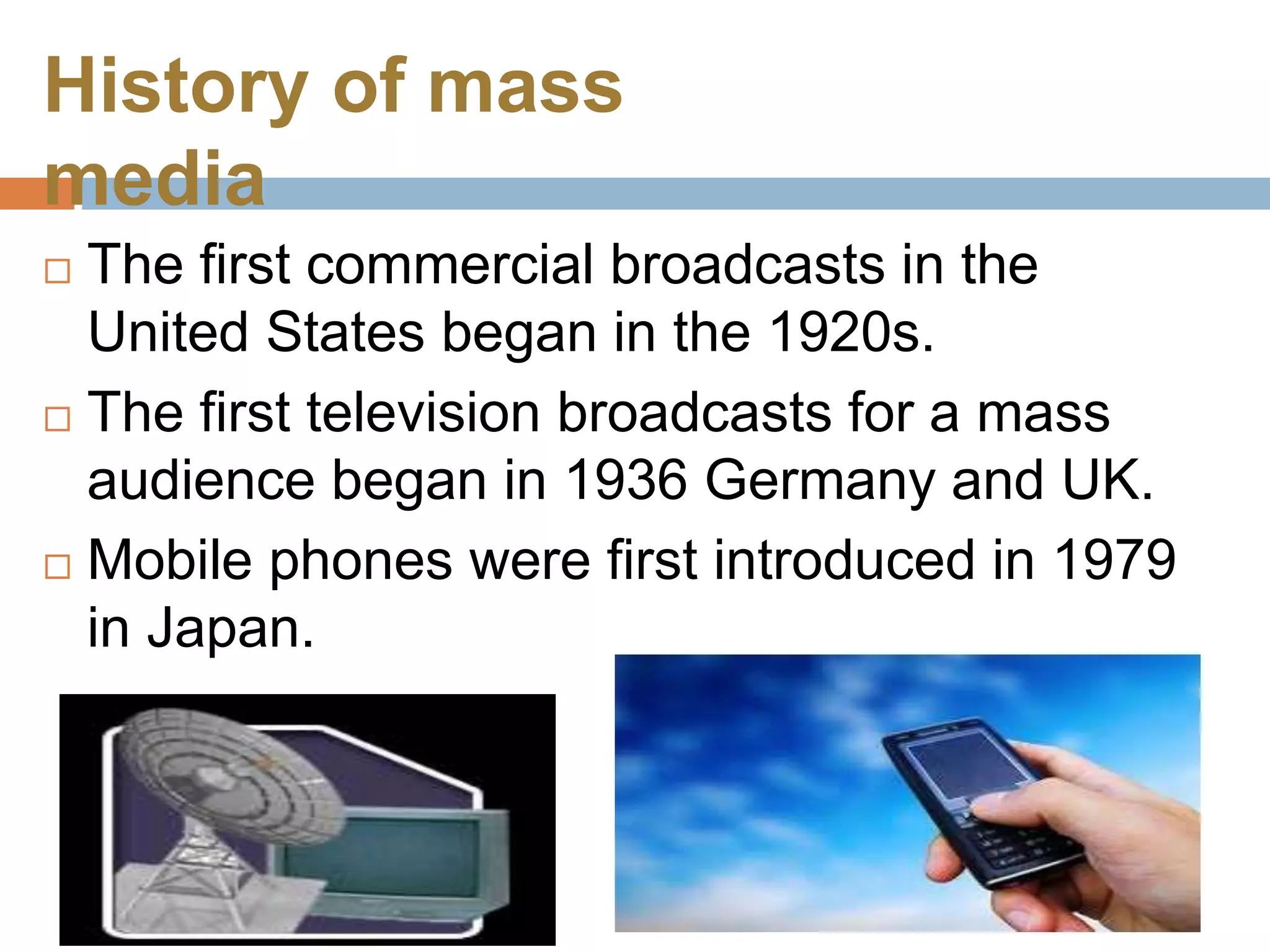
 The first commercial broadcasts in the
United States began in the 1920s.
 The first television broadcasts for a mass
audience began in 1936 Germany and UK.
 Mobile phones were first introduced in 1979
in Japan.
History of mass
media
Purposes
 Advocacy, both for business and social
concerns.
• Advertising
• Marketing
• Propaganda
• Public relations
• Political communication
 Entertainment
 Public service announcements
 News and information
 Communicating
Functions of mass media
 Inform
 Surveillance
 Service the economic system
 Hold society together
 Entertain
 Act as a community forum
 Set the agenda
 Service the political system
Functions of mass media
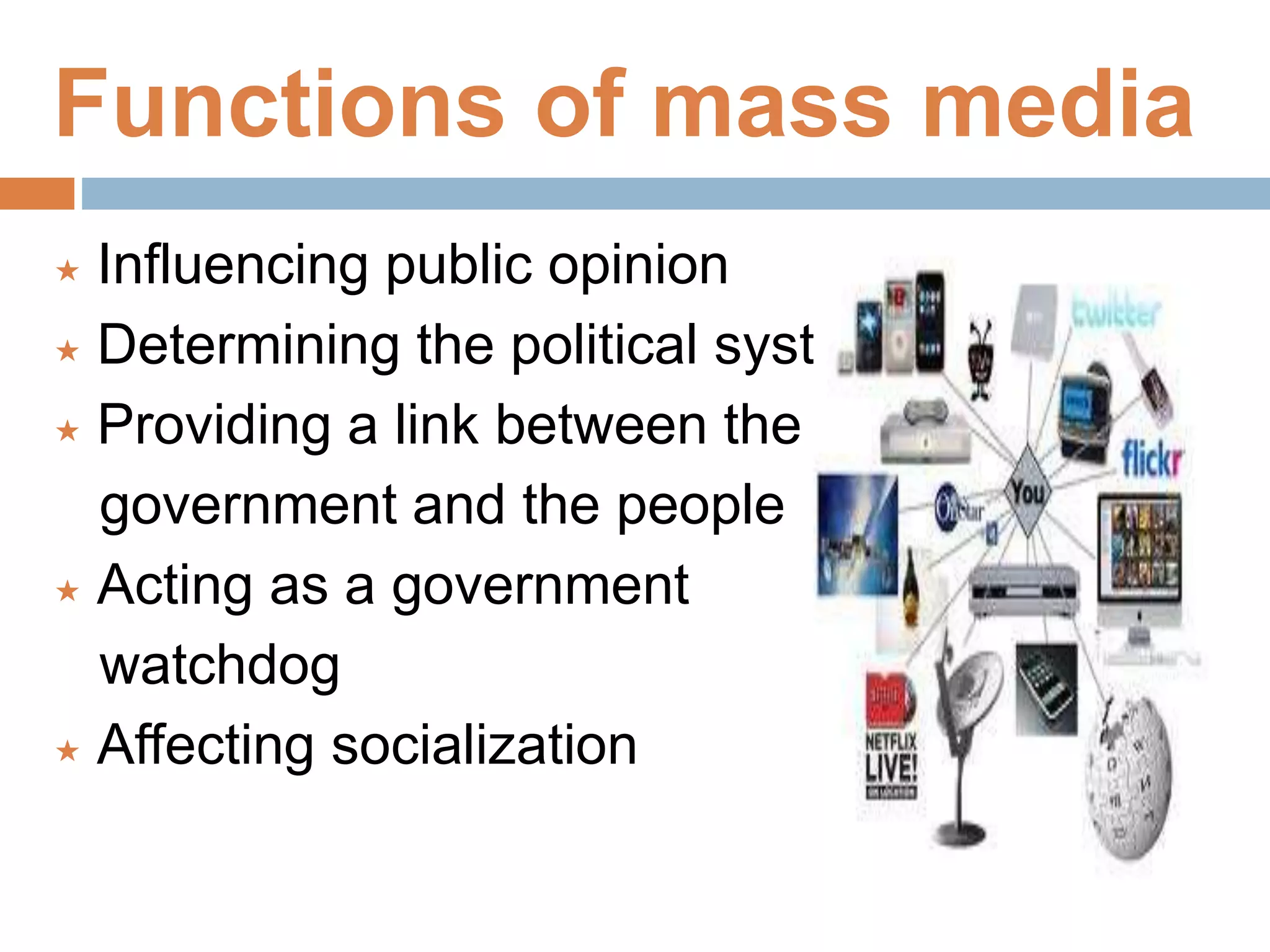
 Influencing public opinion
 Determining the political system
 Providing a link between the
government and the people
 Acting as a government
watchdog
 Affecting socialization
Types Of Mass Media
 Publishing Media
includes books, news papers and
magazine.
Types Of Mass Media
 Broadcasting Media
includes radio and television
Types Of Mass Media
 The Electronic Media
includes computers, mobile phones,
internet, ipods, CD players, tape recorders
etc.
Types Of Mass Media
 Display media
includes wall paintings, posters,
small panels, banners, small
handbills & leaflets.
Seven mass media
 Print from the late 15th century
 Recordings from the late 19th century
 Cinema from about 1900
 Radio from about 1910
 Television from about 1950
 Internet from about 1990
 Mobile phones from about 2000
Merits of Mass Media
 Target a global audience
 Newspapers and magazines are easily
accessible
 Loyal fan following
 Latest news and information
 The best forms of entertainment
 Educational purposes
 Low cost per person reached
Demerits of Mass Media
 The information reported may not be
authentic
 News can be manipulated
 Journalist or an editor may give personal
preference
 Set wrong ideals
 Unnecessary sensationalism
 Misleading messages may again divert young
minds
 A particular event or news item may receive too
much attention
 Newspapers or leaflets have a very short shelf
life
 It is less appropriate for developing skills of
informed decision making
Demerits of Mass Media
Figure 7.1
The Development of Media
Politics
Power of the Mass Media
 Overload on the audience
 Overload on the mass media
 Overload on funders and advertisers
Which of the following media do you use
most often?
13%
39%
8%
32%
8% Newspaper
TV
Radio
Internet
Magazine
Mass media

Mass media

  • 1.
  • 2.
    Definition Mass media referscollectively to all media technologies, including the Internet, television, newspapers, film and radio, which are used for mass communications, and to the organizations which control these technologies. The media used for addressing or communicating with the masses is called mass media.
  • 3.
    History of massmedia The first newspaper was printed in China 868 A.D Johannes Gutenberg, who for the first time printed a book in a printing press in 1453. The phrase "the media" began to be used in the 1920s
  • 4.
    History of massmedia  The first high-circulation newspapers arose in the eastern United States in the early 1800.  In the 1840s, the first commercial electrical telegraph was developed.  Cinema began in 1894, with the first commercial exhibition of film.
  • 5.
     The firstcommercial broadcasts in the United States began in the 1920s.  The first television broadcasts for a mass audience began in 1936 Germany and UK.  Mobile phones were first introduced in 1979 in Japan. History of mass media
  • 6.
    Purposes  Advocacy, bothfor business and social concerns. • Advertising • Marketing • Propaganda • Public relations • Political communication  Entertainment  Public service announcements  News and information  Communicating
  • 8.
    Functions of massmedia  Inform  Surveillance  Service the economic system  Hold society together  Entertain  Act as a community forum  Set the agenda  Service the political system
  • 9.
    Functions of massmedia  Influencing public opinion  Determining the political system  Providing a link between the government and the people  Acting as a government watchdog  Affecting socialization
  • 10.
    Types Of MassMedia  Publishing Media includes books, news papers and magazine.
  • 11.
    Types Of MassMedia  Broadcasting Media includes radio and television
  • 13.
    Types Of MassMedia  The Electronic Media includes computers, mobile phones, internet, ipods, CD players, tape recorders etc.
  • 15.
    Types Of MassMedia  Display media includes wall paintings, posters, small panels, banners, small handbills & leaflets.
  • 16.
    Seven mass media Print from the late 15th century  Recordings from the late 19th century  Cinema from about 1900  Radio from about 1910  Television from about 1950  Internet from about 1990  Mobile phones from about 2000
  • 17.
    Merits of MassMedia  Target a global audience  Newspapers and magazines are easily accessible  Loyal fan following  Latest news and information  The best forms of entertainment  Educational purposes  Low cost per person reached
  • 18.
    Demerits of MassMedia  The information reported may not be authentic  News can be manipulated  Journalist or an editor may give personal preference  Set wrong ideals  Unnecessary sensationalism
  • 19.
     Misleading messagesmay again divert young minds  A particular event or news item may receive too much attention  Newspapers or leaflets have a very short shelf life  It is less appropriate for developing skills of informed decision making Demerits of Mass Media
  • 20.
    Figure 7.1 The Developmentof Media Politics
  • 21.
    Power of theMass Media  Overload on the audience  Overload on the mass media  Overload on funders and advertisers
  • 22.
    Which of thefollowing media do you use most often? 13% 39% 8% 32% 8% Newspaper TV Radio Internet Magazine