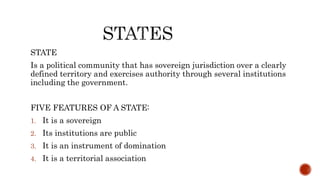
STATE
Is a political community that has sovereign jurisdiction over a clearly
defined territory and exercises authority through several institutions
including the government.
FIVE FEATURES OF A STATE:
1. It is a sovereign
2. Its institutions are public
3. It is an instrument of domination
4. It is a territorial association
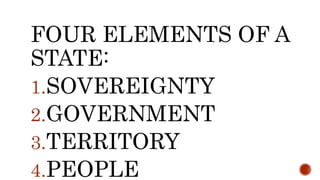
FOUR ELEMENTS OF A
STATE:
1.SOVEREIGNTY
2.GOVERNMENT
3.TERRITORY
4.PEOPLE
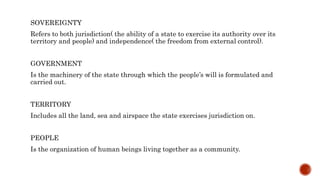
SOVEREIGNTY
Refers to both jurisdiction( the ability of a state to exercise its authority over its
territory and people) and independence( the freedom from external control).
GOVERNMENT
Is the machinery of the state through which the people’s will is formulated and
carried out.
TERRITORY
Includes all the land, sea and airspace the state exercises jurisdiction on.
PEOPLE
Is the organization of human beings living together as a community.
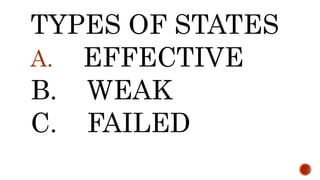
TYPES OF STATES
A. EFFECTIVE
B. WEAK
C. FAILED
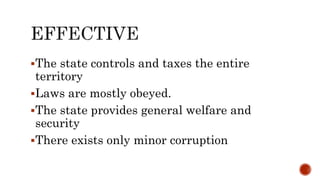
The state controls and taxes the entire
territory
Laws are mostly obeyed.
The state provides general welfare and
security
There exists only minor corruption
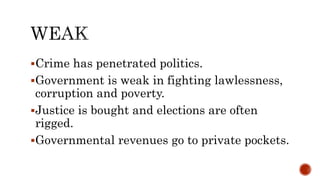
Crime has penetrated politics.
Government is weak in fighting lawlessness,
corruption and poverty.
Justice is bought and elections are often
rigged.
Governmental revenues go to private pockets.
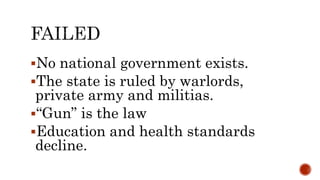
No national government exists.
The state is ruled by warlords,
private army and militias.
“Gun” is the law
Education and health standards
decline.
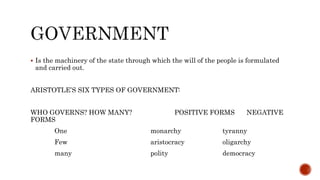
 Is the machinery of the state through which the will of the people is formulated
and carried out.
ARISTOTLE’S SIX TYPES OF GOVERNMENT:
WHO GOVERNS? HOW MANY? POSITIVE FORMS NEGATIVE
FORMS
One monarchy tyranny
Few aristocracy oligarchy
many polity democracy
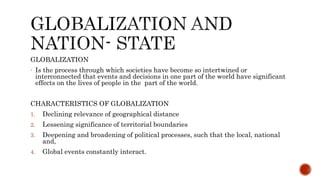
GLOBALIZATION
- Is the process through which societies have become so intertwined or
interconnected that events and decisions in one part of the world have significant
effects on the lives of people in the part of the world.
CHARACTERISTICS OF GLOBALIZATION
1. Declining relevance of geographical distance
2. Lessening significance of territorial boundaries
3. Deepening and broadening of political processes, such that the local, national
and,
4. Global events constantly interact.
FORMS OF GLOBALIZATION:
1. ECONOMIC GLOBALIZATION
2. CULTURAL GLOBALIZATION
3. POLITICAL GLOBALIZATION
The integration of the state and the
nation.
The intersection of the cultural aspect of
the nation and political aspect of the
state.

Module 4: STATES, NATION AND GLOBALIZATION

  • 2.
    STATE Is a politicalcommunity that has sovereign jurisdiction over a clearly defined territory and exercises authority through several institutions including the government. FIVE FEATURES OF A STATE: 1. It is a sovereign 2. Its institutions are public 3. It is an instrument of domination 4. It is a territorial association
  • 3.
    FOUR ELEMENTS OFA STATE: 1.SOVEREIGNTY 2.GOVERNMENT 3.TERRITORY 4.PEOPLE
  • 4.
    SOVEREIGNTY Refers to bothjurisdiction( the ability of a state to exercise its authority over its territory and people) and independence( the freedom from external control). GOVERNMENT Is the machinery of the state through which the people’s will is formulated and carried out. TERRITORY Includes all the land, sea and airspace the state exercises jurisdiction on. PEOPLE Is the organization of human beings living together as a community.
  • 5.
    TYPES OF STATES A.EFFECTIVE B. WEAK C. FAILED
  • 6.
    The state controlsand taxes the entire territory Laws are mostly obeyed. The state provides general welfare and security There exists only minor corruption
  • 7.
    Crime has penetratedpolitics. Government is weak in fighting lawlessness, corruption and poverty. Justice is bought and elections are often rigged. Governmental revenues go to private pockets.
  • 8.
    No national governmentexists. The state is ruled by warlords, private army and militias. “Gun” is the law Education and health standards decline.
  • 9.
     Is themachinery of the state through which the will of the people is formulated and carried out. ARISTOTLE’S SIX TYPES OF GOVERNMENT: WHO GOVERNS? HOW MANY? POSITIVE FORMS NEGATIVE FORMS One monarchy tyranny Few aristocracy oligarchy many polity democracy
  • 10.
    GLOBALIZATION - Is theprocess through which societies have become so intertwined or interconnected that events and decisions in one part of the world have significant effects on the lives of people in the part of the world. CHARACTERISTICS OF GLOBALIZATION 1. Declining relevance of geographical distance 2. Lessening significance of territorial boundaries 3. Deepening and broadening of political processes, such that the local, national and, 4. Global events constantly interact.
  • 11.
    FORMS OF GLOBALIZATION: 1.ECONOMIC GLOBALIZATION 2. CULTURAL GLOBALIZATION 3. POLITICAL GLOBALIZATION
  • 12.
    The integration ofthe state and the nation. The intersection of the cultural aspect of the nation and political aspect of the state.