Prayer to
St. Michael
the
Archangel
St. Michael the Archangel, defend us in
battle, be our protection against the
wickedness and snares of the devil. May
God rebuke him we humbly pray; and do
thou, O Prince of the Heavenly host, by the
power of God, cast into hell Satan and all
the evil spirits who prowl about the world
seeking the ruin of souls.
St. Michael the Archangel, pray for us.
Amen.
CONTEXT, CONTENT,
PROCESSES, AND
CONSEQUENCES OF
SOCIALIZATION
Module 5
01
Learning
Competency
Explain the context, content, processes, and
consequences of socialization
Learning Targets
1. I can state the context,
content, processes, and
consequences of
socialization. (A)
2. I can relate the context,
content, processes, and
consequences of
socialization to myself. (M)
3. I can explain the
context, content,
processes, and
consequences of
socialization. (T)

Pretest
Using our zoom poll, answer the following
questions. The questions is all about the
aspects of culture and society. You will be given
2-3 minutes to answer in our zoom poll.
tekhnologic
True False
Socialization to refer to the process by which an
individual is oriented and thought by his or her social
norms.
>
tekhnologic
True False
One of the things you can learn first is language.
>
tekhnologic
True False
Norms serves as serve as our guide in life.
>
tekhnologic
True False
One of the agents of socialization are your
parents.
>
tekhnologic
True False
Mass media cannot be an agent of socialization.
>
SOCIALIZATION
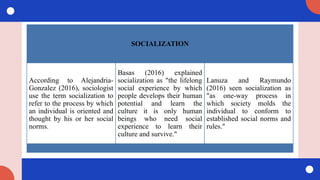
According to Alejandria-
Gonzalez (2016), sociologist
use the term socialization to
refer to the process by which
an individual is oriented and
thought by his or her social
norms.
Basas (2016) explained
socialization as "the lifelong
social experience by which
people develops their human
potential and learn the
culture it is only human
beings who need social
experience to learn their
culture and survive."
Lanuza and Raymundo
(2016) seen socialization as
"as one-way process in
which society molds the
individual to conform to
established social norms and
rules."
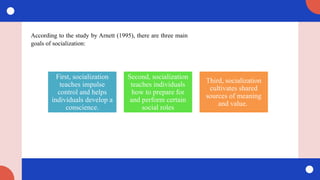
According to the study by Arnett (1995), there are three main
goals of socialization:
First, socialization
teaches impulse
control and helps
individuals develop a
conscience.
Second, socialization
teaches individuals
how to prepare for
and perform certain
social roles
Third, socialization
cultivates shared
sources of meaning
and value.
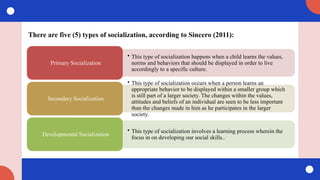
There are five (5) types of socialization, according to Sincero (2011):
• This type of socialization happens when a child learns the values,
norms and behaviors that should be displayed in order to live
accordingly to a specific culture.
Primary Socialization
• This type of socialization occurs when a person learns an
appropriate behavior to be displayed within a smaller group which
is still part of a larger society. The changes within the values,
attitudes and beliefs of an individual are seen to be less important
than the changes made in him as he participates in the larger
society.
Secondary Socialization
• This type of socialization involves a learning process wherein the
focus in on developing our social skills..
Developmental Socialization
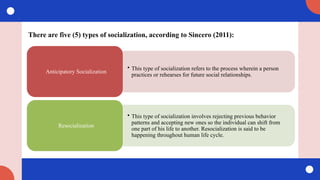
There are five (5) types of socialization, according to Sincero (2011):
• This type of socialization refers to the process wherein a person
practices or rehearses for future social relationships.
Anticipatory Socialization
• This type of socialization involves rejecting previous behavior
patterns and accepting new ones so the individual can shift from
one part of his life to another. Resocialization is said to be
happening throughout human life cycle.
Resocialization
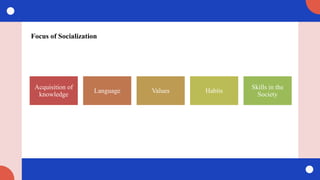
Focus of Socialization
Acquisition of
knowledge
Language Values Habits
Skills in the
Society
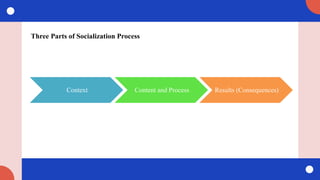
Three Parts of Socialization Process
Context Content and Process Results (Consequences)
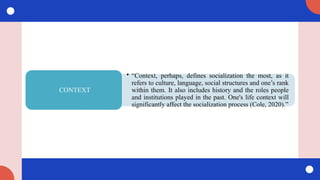
• “Context, perhaps, defines socialization the most, as it
refers to culture, language, social structures and one’s rank
within them. It also includes history and the roles people
and institutions played in the past. One's life context will
significantly affect the socialization process (Cole, 2020).”
CONTEXT
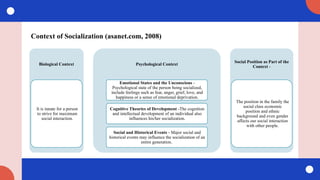
Context of Socialization (asanet.com, 2008)
Biological Context
It is innate for a person
to strive for maximum
social interaction.
Psychological Context
Emotional States and the Unconscious -
Psychological state of the person being socialized,
include feelings such as fear, anger, grief, love, and
happiness or a sense of emotional deprivation.
Cognitive Theories of Development -The cognition
and intellectual development of an individual also
influences his/her socialization.
Social and Historical Events - Major social and
historical events may influence the socialization of an
entire generation.
Social Position as Part of the
Context -
The position in the family the
social class economic
position and ethnic
background and even gender
affects our social interaction
with other people.
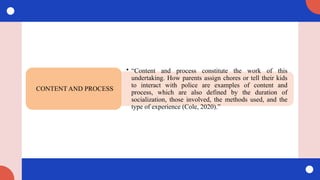
• “Content and process constitute the work of this
undertaking. How parents assign chores or tell their kids
to interact with police are examples of content and
process, which are also defined by the duration of
socialization, those involved, the methods used, and the
type of experience (Cole, 2020).”
CONTENT AND PROCESS
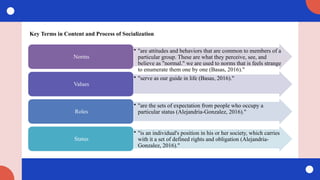
Key Terms in Content and Process of Socialization
• "are attitudes and behaviors that are common to members of a
particular group. These are what they perceive, see, and
believe as "normal." we are used to norms that is feels strange
to enumerate them one by one (Basas, 2016)."
Norms
• "serve as our guide in life (Basas, 2016)."
Values
• "are the sets of expectation from people who occupy a
particular status (Alejandria-Gonzalez, 2016)."
Roles
• "is an individual's position in his or her society, which carries
with it a set of defined rights and obligation (Alejandria-
Gonzalez, 2016)."
Status
Some Theories supporting Content and Processes of Socialization
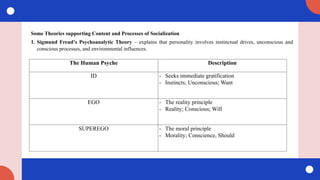
1. Sigmund Freud’s Psychoanalytic Theory – explains that personality involves instinctual drives, unconscious and
conscious processes, and environmental influences.
The Human Psyche Description
ID - Seeks immediate gratification
- Instincts; Unconscious; Want
EGO - The reality principle
- Reality; Conscious; Will
SUPEREGO - The moral principle
- Morality; Conscience, Should
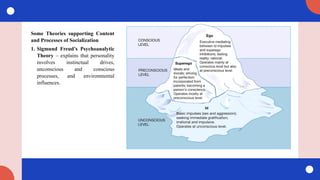
Some Theories supporting Content
and Processes of Socialization
1. Sigmund Freud’s Psychoanalytic
Theory – explains that personality
involves instinctual drives,
unconscious and conscious
processes, and environmental
influences.
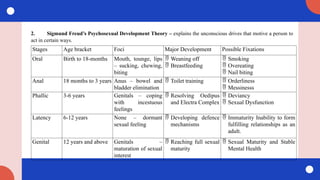
2. Sigmund Freud’s Psychosexual Development Theory – explains the unconscious drives that motive a person to
act in certain ways.
Stages Age bracket Foci Major Development Possible Fixations
Oral Birth to 18-months Mouth, tounge, lips
– sucking, chewing,
biting
 Weaning off
 Breastfeeding
 Smoking
 Overeating
 Nail biting
Anal 18 months to 3 years Anus – bowel and
bladder elimination
 Toilet training  Orderliness
 Messinesss
Phallic 3-6 years Genitals – coping
with incestuous
feelings
 Resolving Oedipus
and Electra Complex
 Deviancy
 Sexual Dysfunction
Latency 6-12 years None – dormant
sexual feeling
 Developing defence
mechanisms
 Immaturity Inability to form
fulfilling relationships as an
adult.
Genital 12 years and above Genitals –
maturation of sexual
interest
 Reaching full sexual
maturity
 Sexual Maturity and Stable
Mental Health
2. Sigmund Freud’s
Psychosexual Development Theory –
explains the unconscious drives that
motive a person to act in certain ways.
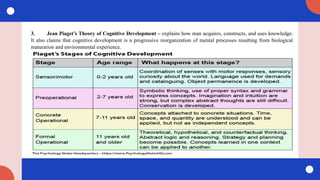
3. Jean Piaget’s Theory of Cognitive Development – explains how man acquires, constructs, and uses knowledge.
It also claims that cognitive development is a progressive reorganization of mental processes resulting from biological
maturation and environmental experience.
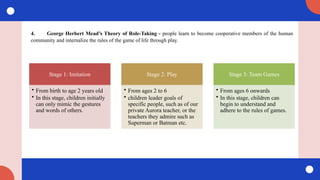
4. George Herbert Mead’s Theory of Role-Taking - people learn to become cooperative members of the human
community and internalize the rules of the game of life through play.
Stage 1: Imitation
• From birth to age 2 years old
• In this stage, children initially
can only mimic the gestures
and words of others.
Stage 2: Play
• From ages 2 to 6
• children leader goals of
specific people, such as of our
private Aurora teacher, or the
teachers they admire such as
Superman or Batman etc.
Stage 3: Team Games
• From ages 6 onwards
• In this stage, children can
begin to understand and
adhere to the rules of games.
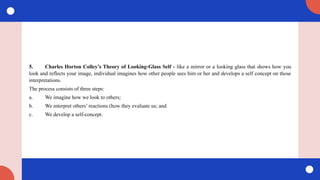
5. Charles Horton Colley’s Theory of Looking-Glass Self - like a mirror or a looking glass that shows how you
look and reflects your image, individual imagines how other people sees him or her and develops a self concept on those
interpretations.
The process consists of three steps:
a. We imagine how we look to others;
b. We interpret others’ reactions (how they evaluate us; and
c. We develop a self-concept.
• “Results are the outcome of socialization and refer to the way a
person thinks and behaves after undergoing this process. (Cole,
2020).”
RESULTS (CONSEQUENCES)
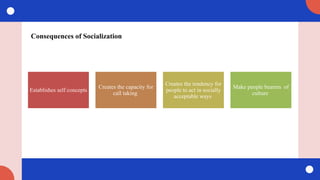
Consequences of Socialization
Establishes self concepts
Creates the capacity for
call taking
Creates the tendency for
people to act in socially
acceptable ways
Make people bearers of
culture
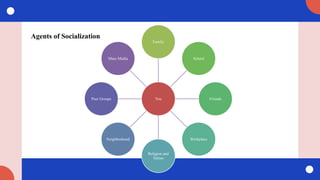
Agents of Socialization
You
Family
School
Friends
Workplace
Religion and
Values
Neighborhood
Peer Groups
Mass Media
Sources:
Alejandria-Gonzales, M.C. (2016). Understanding Culture, Society, and Politics. Makati City: Diwa Learning Systems, Inc.
Basas, R. M. A. (2016). Understanding Culture, Society, and Politics. Pasay City: JFS Publishing Services.
Cole, N. L. (2020). Understanding Socialization in Sociology. Thought.co. https://www.thoughtco.com/socialization-in-sociology-4104466
K12 Study Club (2020). UCSP 5.0 Becoming a Member of Society: Concepts, Context and Consequence of Socialization [Youtube Video].
https://www.youtube.com/watch?v=LAaBbwwtY_Y
Lanuza, G. M., and Raymundo, S. S (2016). Understanding Culture, Society, and Politics. Manila City: Rex Book Store, Inc.
Lumen Learning (nd). The Role of Socialization. Boundless Sociology. https://courses.lumenlearning.com/boundless-sociology/chapter/the-role-
of-socialization/#:~:text=Socialization%20has%20three%20primary%20goals,sources%20of%20meaning%20and%20value
Persell, C. H. (1990). Becoming a Member of Society Through Socialization. Understanding Society: An Introduction to Sociology. New York:
Harper & Row, Publishers, Inc., p. 98-107 https://www.asanet.org/sites/default/files/savvy/introtosociology/Documents/
PersellSocializationReading37.htm
Samiksha S. (nd). Socialisation: The Meaning, Features, Types, Stages and Importance.
https://www.yourarticlelibrary.com/sociology/socialisation-the-meaning-features-types-stages-and-importance/8529
Sicat, C. (2020). UCSP Module 5 Socialization Understanding Culture Society and Politics [Youtube Video]. https://www.youtube.com/watch?
v=kOlBN0Ef0tA
Sincero, S. M. (2011). Socialization. Explorable. https://explorable.com/socialization#:~:text=Types%20of%20Socialization,%2C
%20developmental%2C%20anticipatory%20and%20resocialization.&text=This%20type%20of%20socialization%20happens,accordingly
%20to%20a%20specific%20culture

Module 5 - Context_ Content, Processes, and Consequences of Socialization.pptx

  • 2.
    Prayer to St. Michael the Archangel St.Michael the Archangel, defend us in battle, be our protection against the wickedness and snares of the devil. May God rebuke him we humbly pray; and do thou, O Prince of the Heavenly host, by the power of God, cast into hell Satan and all the evil spirits who prowl about the world seeking the ruin of souls. St. Michael the Archangel, pray for us. Amen.
  • 3.
  • 4.
    Learning Competency Explain the context,content, processes, and consequences of socialization
  • 5.
    Learning Targets 1. Ican state the context, content, processes, and consequences of socialization. (A) 2. I can relate the context, content, processes, and consequences of socialization to myself. (M) 3. I can explain the context, content, processes, and consequences of socialization. (T)
  • 6.
    Pretest Using our zoompoll, answer the following questions. The questions is all about the aspects of culture and society. You will be given 2-3 minutes to answer in our zoom poll.
  • 7.
    tekhnologic True False Socialization torefer to the process by which an individual is oriented and thought by his or her social norms. >
  • 8.
    tekhnologic True False One ofthe things you can learn first is language. >
  • 9.
    tekhnologic True False Norms servesas serve as our guide in life. >
  • 10.
    tekhnologic True False One ofthe agents of socialization are your parents. >
  • 11.
    tekhnologic True False Mass mediacannot be an agent of socialization. >
  • 12.
    SOCIALIZATION According to Alejandria- Gonzalez(2016), sociologist use the term socialization to refer to the process by which an individual is oriented and thought by his or her social norms. Basas (2016) explained socialization as "the lifelong social experience by which people develops their human potential and learn the culture it is only human beings who need social experience to learn their culture and survive." Lanuza and Raymundo (2016) seen socialization as "as one-way process in which society molds the individual to conform to established social norms and rules."
  • 13.
    According to thestudy by Arnett (1995), there are three main goals of socialization: First, socialization teaches impulse control and helps individuals develop a conscience. Second, socialization teaches individuals how to prepare for and perform certain social roles Third, socialization cultivates shared sources of meaning and value.
  • 14.
    There are five(5) types of socialization, according to Sincero (2011): • This type of socialization happens when a child learns the values, norms and behaviors that should be displayed in order to live accordingly to a specific culture. Primary Socialization • This type of socialization occurs when a person learns an appropriate behavior to be displayed within a smaller group which is still part of a larger society. The changes within the values, attitudes and beliefs of an individual are seen to be less important than the changes made in him as he participates in the larger society. Secondary Socialization • This type of socialization involves a learning process wherein the focus in on developing our social skills.. Developmental Socialization
  • 15.
    There are five(5) types of socialization, according to Sincero (2011): • This type of socialization refers to the process wherein a person practices or rehearses for future social relationships. Anticipatory Socialization • This type of socialization involves rejecting previous behavior patterns and accepting new ones so the individual can shift from one part of his life to another. Resocialization is said to be happening throughout human life cycle. Resocialization
  • 16.
    Focus of Socialization Acquisitionof knowledge Language Values Habits Skills in the Society
  • 17.
    Three Parts ofSocialization Process Context Content and Process Results (Consequences)
  • 18.
    • “Context, perhaps,defines socialization the most, as it refers to culture, language, social structures and one’s rank within them. It also includes history and the roles people and institutions played in the past. One's life context will significantly affect the socialization process (Cole, 2020).” CONTEXT
  • 19.
    Context of Socialization(asanet.com, 2008) Biological Context It is innate for a person to strive for maximum social interaction. Psychological Context Emotional States and the Unconscious - Psychological state of the person being socialized, include feelings such as fear, anger, grief, love, and happiness or a sense of emotional deprivation. Cognitive Theories of Development -The cognition and intellectual development of an individual also influences his/her socialization. Social and Historical Events - Major social and historical events may influence the socialization of an entire generation. Social Position as Part of the Context - The position in the family the social class economic position and ethnic background and even gender affects our social interaction with other people.
  • 20.
    • “Content andprocess constitute the work of this undertaking. How parents assign chores or tell their kids to interact with police are examples of content and process, which are also defined by the duration of socialization, those involved, the methods used, and the type of experience (Cole, 2020).” CONTENT AND PROCESS
  • 21.
    Key Terms inContent and Process of Socialization • "are attitudes and behaviors that are common to members of a particular group. These are what they perceive, see, and believe as "normal." we are used to norms that is feels strange to enumerate them one by one (Basas, 2016)." Norms • "serve as our guide in life (Basas, 2016)." Values • "are the sets of expectation from people who occupy a particular status (Alejandria-Gonzalez, 2016)." Roles • "is an individual's position in his or her society, which carries with it a set of defined rights and obligation (Alejandria- Gonzalez, 2016)." Status
  • 22.
    Some Theories supportingContent and Processes of Socialization 1. Sigmund Freud’s Psychoanalytic Theory – explains that personality involves instinctual drives, unconscious and conscious processes, and environmental influences. The Human Psyche Description ID - Seeks immediate gratification - Instincts; Unconscious; Want EGO - The reality principle - Reality; Conscious; Will SUPEREGO - The moral principle - Morality; Conscience, Should
  • 23.
    Some Theories supportingContent and Processes of Socialization 1. Sigmund Freud’s Psychoanalytic Theory – explains that personality involves instinctual drives, unconscious and conscious processes, and environmental influences.
  • 24.
    2. Sigmund Freud’sPsychosexual Development Theory – explains the unconscious drives that motive a person to act in certain ways. Stages Age bracket Foci Major Development Possible Fixations Oral Birth to 18-months Mouth, tounge, lips – sucking, chewing, biting  Weaning off  Breastfeeding  Smoking  Overeating  Nail biting Anal 18 months to 3 years Anus – bowel and bladder elimination  Toilet training  Orderliness  Messinesss Phallic 3-6 years Genitals – coping with incestuous feelings  Resolving Oedipus and Electra Complex  Deviancy  Sexual Dysfunction Latency 6-12 years None – dormant sexual feeling  Developing defence mechanisms  Immaturity Inability to form fulfilling relationships as an adult. Genital 12 years and above Genitals – maturation of sexual interest  Reaching full sexual maturity  Sexual Maturity and Stable Mental Health
  • 25.
    2. Sigmund Freud’s PsychosexualDevelopment Theory – explains the unconscious drives that motive a person to act in certain ways.
  • 26.
    3. Jean Piaget’sTheory of Cognitive Development – explains how man acquires, constructs, and uses knowledge. It also claims that cognitive development is a progressive reorganization of mental processes resulting from biological maturation and environmental experience.
  • 27.
    4. George HerbertMead’s Theory of Role-Taking - people learn to become cooperative members of the human community and internalize the rules of the game of life through play. Stage 1: Imitation • From birth to age 2 years old • In this stage, children initially can only mimic the gestures and words of others. Stage 2: Play • From ages 2 to 6 • children leader goals of specific people, such as of our private Aurora teacher, or the teachers they admire such as Superman or Batman etc. Stage 3: Team Games • From ages 6 onwards • In this stage, children can begin to understand and adhere to the rules of games.
  • 28.
    5. Charles HortonColley’s Theory of Looking-Glass Self - like a mirror or a looking glass that shows how you look and reflects your image, individual imagines how other people sees him or her and develops a self concept on those interpretations. The process consists of three steps: a. We imagine how we look to others; b. We interpret others’ reactions (how they evaluate us; and c. We develop a self-concept.
  • 29.
    • “Results arethe outcome of socialization and refer to the way a person thinks and behaves after undergoing this process. (Cole, 2020).” RESULTS (CONSEQUENCES)
  • 30.
    Consequences of Socialization Establishesself concepts Creates the capacity for call taking Creates the tendency for people to act in socially acceptable ways Make people bearers of culture
  • 31.
    Agents of Socialization You Family School Friends Workplace Religionand Values Neighborhood Peer Groups Mass Media
  • 32.
    Sources: Alejandria-Gonzales, M.C. (2016).Understanding Culture, Society, and Politics. Makati City: Diwa Learning Systems, Inc. Basas, R. M. A. (2016). Understanding Culture, Society, and Politics. Pasay City: JFS Publishing Services. Cole, N. L. (2020). Understanding Socialization in Sociology. Thought.co. https://www.thoughtco.com/socialization-in-sociology-4104466 K12 Study Club (2020). UCSP 5.0 Becoming a Member of Society: Concepts, Context and Consequence of Socialization [Youtube Video]. https://www.youtube.com/watch?v=LAaBbwwtY_Y Lanuza, G. M., and Raymundo, S. S (2016). Understanding Culture, Society, and Politics. Manila City: Rex Book Store, Inc. Lumen Learning (nd). The Role of Socialization. Boundless Sociology. https://courses.lumenlearning.com/boundless-sociology/chapter/the-role- of-socialization/#:~:text=Socialization%20has%20three%20primary%20goals,sources%20of%20meaning%20and%20value Persell, C. H. (1990). Becoming a Member of Society Through Socialization. Understanding Society: An Introduction to Sociology. New York: Harper & Row, Publishers, Inc., p. 98-107 https://www.asanet.org/sites/default/files/savvy/introtosociology/Documents/ PersellSocializationReading37.htm Samiksha S. (nd). Socialisation: The Meaning, Features, Types, Stages and Importance. https://www.yourarticlelibrary.com/sociology/socialisation-the-meaning-features-types-stages-and-importance/8529 Sicat, C. (2020). UCSP Module 5 Socialization Understanding Culture Society and Politics [Youtube Video]. https://www.youtube.com/watch? v=kOlBN0Ef0tA Sincero, S. M. (2011). Socialization. Explorable. https://explorable.com/socialization#:~:text=Types%20of%20Socialization,%2C %20developmental%2C%20anticipatory%20and%20resocialization.&text=This%20type%20of%20socialization%20happens,accordingly %20to%20a%20specific%20culture