



Industrial Sociology
introducing
Social Stratification
WhoareinTheGroup
Moin Sarker 2534
Anika Tahsin 2526
Ariful Islam 2550
Sheikh Sadia 2539
Mohona
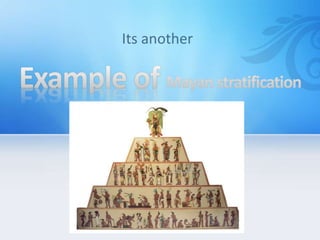
In sociology, social stratification is a concept
involving the "classification of people into
groups based on shared socio-economic
conditions ... a relational set of inequalities with
economic, social, political and ideological
dimensions.“
When differences lead to greater status,
power or privilege for some groups over
the other it is called Social Stratification.
What Is Social
Stratification
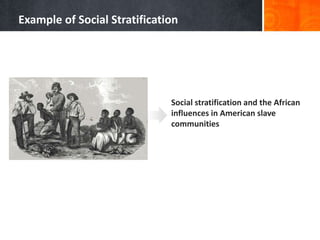
Social stratification and the African
influences in American slave
communities
Example of Social Stratification
» Social Stratification is a Characteristics of
society – not just due to individual difference
» Social Stratification Persist over generation
» Social Stratification in universal but variable
( it changes)
» Social Stratification involves both inequity and
beliefs
4 Fundamental principal
Three characteristics of stratified systems
1. The rankings apply to social categories of people who share a common
characteristic without necessarily interacting or identifying with each other. The
process of being ranked can be changed by the person being ranked.
Example: The way we rank people differently by race, gender, and social class
2. People's life experiences and opportunities depend on their social category. This
characteristic can be changed by the amount of work a person can put into their
interests.
Example: The greater advantage had by the son or daughter of a king to have a
successful life than the son or daughter of a minimum-wage factory worker,
because the king has a greater amount of resources than the factory worker. The
use of resources can influence others.
3. The ranks of different social categories change slowly over time. This has
occurred frequently in the United States ever since the American revolution.
The U.S. constitution has been altered several times to specify rights for everyone.
1. Power
2. Prestige
3. Property
It’s Based on 3 major premises
Max Weber
Max Weber was strongly influenced by
Marx's ideas, but rejected the possibility
of effective communism, arguing that it
would require an even greater level of
detrimental social control and
bureaucratization than capitalist society.
Moreover, Weber criticized
the dialectical presumption of proletariat
revolt, believing it to be unlikely.
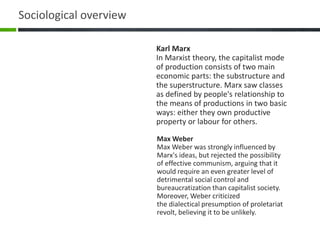
Karl Marx
In Marxist theory, the capitalist mode
of production consists of two main
economic parts: the substructure and
the superstructure. Marx saw classes
as defined by people's relationship to
the means of productions in two basic
ways: either they own productive
property or labour for others.
Sociological overview
Sociological overview ( Cont.)
• C. Wright Mills
C. Wright Mills contended that the imbalance of power in society derives
from the complete absence of countervailing powers against corporate
leaders of the power elite. Mills both incorporated and
revised Marxist ideas. While he shared Marx's recognition of a dominant
wealthy and powerful class, Mills believed that the source for that power
lay not only in the economic realm but also in the political and military
arenas.
Anthropologists have found that social stratification is not the standard
among all societies. John Gowdy writes, "Assumptions about human
behaviour that members of market societies believe to be universal,
that humans are naturally competitive and acquisitive, and that social
stratification is natural, do not apply to many hunter-gatherer peoples.
Kinship-orientation
Anthropologists identify egalitarian cultures as "kinship-oriented,"
because they appear to value social harmony more than wealth or
status. These cultures are contrasted with economically oriented
cultures (including states) in which status and material wealth are
prized, and stratification, competition, and conflict are common.
Kinship-oriented cultures actively work to prevent social hierarchies
from developing because they believe that such stratification could lead
to conflict and instability.
Anthropological overview
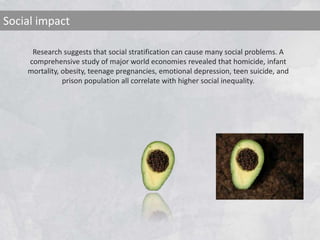
Research suggests that social stratification can cause many social problems. A
comprehensive study of major world economies revealed that homicide, infant
mortality, obesity, teenage pregnancies, emotional depression, teen suicide, and
prison population all correlate with higher social inequality.
Social impact
Social mobility
• Social mobility is the movement of individuals or groups in
social standing social position.
• It may refer to classes, ethnic groups, or entire nations, and
may measure health status, literacy, or education — but
more commonly it refers to individuals or families, and
their change in income (economic mobility).
• It also typically refers to vertical mobility—movement of
individuals or groups up (or down) from one socio-
economic level to another, often by changing jobs or
marriage; but can also refer to horizontal mobility—
movement from one position to another within the same
social level.
Social class
• Social class (or simply "class"), as in a class
society, is a set of concepts in the social
sciences and political theory centered on
models of social stratification in which people
are grouped into a set of hierarchical social
categories, the most common being the
upper, middle, and lower classes.
There are all of our presentation
?
But wait…
Is There Any Questions
View your slides from anywhere!
What’s Your Message?

Social stratification

  • 1.
  • 2.
    WhoareinTheGroup Moin Sarker 2534 AnikaTahsin 2526 Ariful Islam 2550 Sheikh Sadia 2539 Mohona
  • 3.
    In sociology, socialstratification is a concept involving the "classification of people into groups based on shared socio-economic conditions ... a relational set of inequalities with economic, social, political and ideological dimensions.“ When differences lead to greater status, power or privilege for some groups over the other it is called Social Stratification. What Is Social Stratification
  • 4.
    Social stratification andthe African influences in American slave communities Example of Social Stratification
  • 6.
    » Social Stratificationis a Characteristics of society – not just due to individual difference » Social Stratification Persist over generation » Social Stratification in universal but variable ( it changes) » Social Stratification involves both inequity and beliefs 4 Fundamental principal
  • 7.
    Three characteristics ofstratified systems 1. The rankings apply to social categories of people who share a common characteristic without necessarily interacting or identifying with each other. The process of being ranked can be changed by the person being ranked. Example: The way we rank people differently by race, gender, and social class 2. People's life experiences and opportunities depend on their social category. This characteristic can be changed by the amount of work a person can put into their interests. Example: The greater advantage had by the son or daughter of a king to have a successful life than the son or daughter of a minimum-wage factory worker, because the king has a greater amount of resources than the factory worker. The use of resources can influence others. 3. The ranks of different social categories change slowly over time. This has occurred frequently in the United States ever since the American revolution. The U.S. constitution has been altered several times to specify rights for everyone.
  • 8.
    1. Power 2. Prestige 3.Property It’s Based on 3 major premises
  • 9.
    Max Weber Max Weberwas strongly influenced by Marx's ideas, but rejected the possibility of effective communism, arguing that it would require an even greater level of detrimental social control and bureaucratization than capitalist society. Moreover, Weber criticized the dialectical presumption of proletariat revolt, believing it to be unlikely. Karl Marx In Marxist theory, the capitalist mode of production consists of two main economic parts: the substructure and the superstructure. Marx saw classes as defined by people's relationship to the means of productions in two basic ways: either they own productive property or labour for others. Sociological overview
  • 10.
    Sociological overview (Cont.) • C. Wright Mills C. Wright Mills contended that the imbalance of power in society derives from the complete absence of countervailing powers against corporate leaders of the power elite. Mills both incorporated and revised Marxist ideas. While he shared Marx's recognition of a dominant wealthy and powerful class, Mills believed that the source for that power lay not only in the economic realm but also in the political and military arenas.
  • 11.
    Anthropologists have foundthat social stratification is not the standard among all societies. John Gowdy writes, "Assumptions about human behaviour that members of market societies believe to be universal, that humans are naturally competitive and acquisitive, and that social stratification is natural, do not apply to many hunter-gatherer peoples. Kinship-orientation Anthropologists identify egalitarian cultures as "kinship-oriented," because they appear to value social harmony more than wealth or status. These cultures are contrasted with economically oriented cultures (including states) in which status and material wealth are prized, and stratification, competition, and conflict are common. Kinship-oriented cultures actively work to prevent social hierarchies from developing because they believe that such stratification could lead to conflict and instability. Anthropological overview
  • 12.
    Research suggests thatsocial stratification can cause many social problems. A comprehensive study of major world economies revealed that homicide, infant mortality, obesity, teenage pregnancies, emotional depression, teen suicide, and prison population all correlate with higher social inequality. Social impact
  • 13.
    Social mobility • Socialmobility is the movement of individuals or groups in social standing social position. • It may refer to classes, ethnic groups, or entire nations, and may measure health status, literacy, or education — but more commonly it refers to individuals or families, and their change in income (economic mobility). • It also typically refers to vertical mobility—movement of individuals or groups up (or down) from one socio- economic level to another, often by changing jobs or marriage; but can also refer to horizontal mobility— movement from one position to another within the same social level.
  • 14.
    Social class • Socialclass (or simply "class"), as in a class society, is a set of concepts in the social sciences and political theory centered on models of social stratification in which people are grouped into a set of hierarchical social categories, the most common being the upper, middle, and lower classes.
  • 15.
    There are allof our presentation
  • 16.
    ? But wait… Is ThereAny Questions View your slides from anywhere!
  • 17.

Editor's Notes

  • #2 This presentation demonstrates the new capabilities of PowerPoint and it is best viewed in Slide Show. These slides are designed to give you great ideas for the presentations you’ll create in PowerPoint 2010! For more sample templates, click the File tab, and then on the New tab, click Sample Templates.