CASTE AND CLASS
STRUCTURE
Prof. Melissa.
Introduction
• Caste and class are a mixed
phenomenon in India's rural society.
Gail Omvedt argues that there are
feudal forces in caste and as a result
of it the former landlords, jamindars
and jagirdars have come out as
capitalist peasants. It means that the
former higher castes have become
today higher classes.
Society
Society is a large grouping that
shares the same territory and is
subject to the same political
authority dominant cultural
expectations
Types of Societies
• Pre-Industrial
– Hunters and Gather
– Pastoral
– Horticulture
– Agriculture
– Fiefdom
Types of Societies
• Industrial
• Post-Industrial
Social Structure in the Macro
Level Perspective
• Social structure is a stable pattern of
social relationships that exist within a
particular group or society
• Structure is provided by status and
roles, groups, and social institutions
Social Structure in the Macro
Level Perspective
• social structure creates boundaries
that define which persons or groups
will be the insiders and which will be
the outsiders
• social marginality is the state of
being part insiders in part outsider in
the social structure
Social Structure in the Macro
Level Perspective
• social marginality results in
stigmatization
• a stigma is any physical or social
attribute or sign that shows a person's
social identity that disqualifies that
person from full social acceptance
Components of Social Structure:
Status
• A status is a socially defines position in a
group or society characterized by certain
expectations rights and duties
• Ascribed status is a social position
conferred at birth or received involuntarily
later in life
• Achieved status is a social position in
person assumes involuntarily as a result of
personal choice merit or direct effort
What is Social Stratification?
• For tens of thousands of years, humans
lived in small hunting and gathering
societies. These bands of people show
little signs of inequality. As societies
became more complex, major changes
came about, these changes elevated
certain categories of the population by
giving them more power, money, and
prestige.
• Social Stratification- a system by which a
society ranks categories of people in a
hierarchy.
• 1. Social stratification is a trait of society, not simply a
reflection of individual differences.
• Children born into wealthy families are more likely than
children born in poverty to experience good healthy,
achieve academically, succeed in life’s work and live a
long life.
• 2. Social stratification persists over generations.
• To see stratification as a trait of society rather than one of
individuals, we need to only look at how inequality persists
along generations. In all societies, parents pass their
social position on to their children.
• 3. Social stratification is universal but
variable.
• In some societies, inequality is mostly a
matter of prestige; in others, wealth or power
is the key dimension of difference. More
importantly some societies display more
inequality than others.
• 4. Social stratification involves not just
inequality but beliefs.
• Any system of inequality gives some people
more than others and the society also defines
the arrangements as fair.
Copyright
©
2011
by
Nelson
Education
Ltd
6-13
SOCIAL STRATIFICATION
• Social stratification:
 Refers to persistent patterns of social
inequality in a society
 Is perpetuated by the way wealth, power,
and prestige are distributed and passed
on from one generation to the next
 Exists in all societies*
Copyright
©
2011
by
Nelson
Education
Ltd
6-14
FEATURES OF SOCIAL
HIERARCHIES
• Status: Rank or position in a social
hierarchy
• Statuses may be:
i. Ascribed (assigned at birth), or
ii. Achieved (earned by performance)*
Copyright
©
2011
by
Nelson
Education
Ltd
6-15
TYPES OF STRATIFICATION
SYSTEMS
1. Open stratification system:
 Stratification system in which merit rather than
inheritance (ascribed characteristics) determines
social rank
 Allows for social change
• Is reflected in a meritocracy:
 Positions are achieved, not ascribed
 Characterized by equal opportunity and high
social mobility (movement up or down a social
hierarchy)*
Copyright
©
2011
by
Nelson
Education
Ltd
6-16
TYPES OF STRATIFICATION
SYSTEMS
2. Closed stratification system
 Stratification system in which inheritance rather
than merit determines social rank
 Little social change possible
• Reflected in a caste system:
 Positions are ascribed, not achieved
 Characterized by little social mobility
Kin, clan, tribe, ethnicity
• Many small-scale societies are made up of groups that take kinship,
i.e. marriage, descent and filiation as the primary principles of
membership.
• Descent groups, i.e. groups that define their membership through
descent from a common ancestor are very common in small-scale
societies. They can be patrilineal, matrilineal, or consanguineal, i.e.
descent is traced from either mother or father.
• A descent group formed from unilineal descent, and to which a
common ancestor can be traced is called a lineage.
• A descent group formed through unilineal descent, and to which a
common ancestor cannot be exactly traced, is called a clan.
• A tribe is a social division in a traditional society consisting of families
or communities linked by social, economic, religious, or blood ties,
with a common culture and dialect, typically having a recognized
leader.
• An Ethnic group is a community or population made up of people who
share a common cultural background or descent.
• Kinship, clan, tribe, ethnic groups etc
Caste and Class Systems
• A Caste System- is a social system based
on ascription, or birth.
• A pure caste system is closed because
birth alone determines one’s destiny, with
little or no opportunity for social mobility
based on effort.
Caste
• Feature of the South Asian subcontinent.
• Thought to have arisen through the transformation of ‘tribes’
in the transition to agricultural revolution.
• Elements of caste appear to have existed in the Harappan
civilization, c. 3,000 BC
• A major feature of caste is endogamy, i.e. the requirement
that people marry within their own caste, not outside it.
• Also religious and cosmological ranking associated with
caste, found in major Hindu scriptures: earliest were the
division of society into 4 varnas (colours): Brahmins,
Kshatriyas, Vaishyas and Shudras.
• 2nd century AD, a fifth category, the ati-Shudras, or
untouchables was added.
• Untouchability was outlawed by the Indian constitution, 1951.
• First, traditional caste groups have specific
occupations, so generations of a family
perform the same type of work.
• Second, maintaining a rigid social hierarchy
depends on people marrying within their own
categories; “mixed” marriages would blur the
ranking of children.
• Endogamy- marriage between people of the
same social category.
• Third, caste norms guide people to stay in
the company of “their own kind.”
• Fourth, caste systems rest on powerful
cultural beliefs.
• Caste systems exist in agrarian societies
because life long routines of agriculture
depend on a rigid sense of duty and
discipline.
The Class System
• Class System- social stratification based on both
birth and individual achievement.
• The class system categorizes people according to
their color, sex, or social background comes to be
seen as wrong in industrial and post-industrial
societies, and all people gain political rights and
roughly equal standing before the law.
• Meritocracy- social stratification based on personal
merit.
• People in industrial societies develop a broad range
of capabilities, stratification is based on “merit,” which
is the job one does and how well one does it.
Copyright
©
2011
by
Nelson
Education
Ltd
6-23
CLASS AND CLASS
STRUCTURE
• Class: Position in an economic hierarchy
occupied by individuals or families with similar
access to, or control over, material resources
(e.g., working class, professional class)
• Class structure: Relatively permanent economic
hierarchy comprising different social classes
• Socioeconomic status: Person’s general status
within an economic hierarchy, based on income,
education, and occupation*
Nations and Nationalism
• Shared heritage and historical experience the basis of a state.
• Common language, shared origin, unique customs are features
that define a sense of nationhood.
• Nationalism can often arise as a result of an ethnic movement.
• 19th century nationalisms, formed through defining themselves
as ‘one people, one language, one culture.’
• Difference between territorial nationalism versus a ‘blood’
nationalism, e.g. in Quebec.
• Monocultural nationalisms are increasingly challenged by
transnational phenomena and groups, as increasing quantities
of information, cultural knowledge and people cross ‘national’
boundaries.
• Social Mobility- change in one’s
position in the social hierarchy.
Copyright
©
2011
by
Nelson
Education
Ltd
6-25
What is Social Mobility
• Social mobility is defined as movement
from one class/status position to another
• There are 2 types:
Intra- generational – movement within one
generation e.g. a person moves from one
social class to another in the course of their
life time
Inter generational – movement between
generations e.g. a person’s father was a
Liverpool docker and he is a teacher
What is Social Mobility?
Definition: Movement from one class —or more
usually
status group—to another
Horizontal Mobility
 Movement from one position to another within
the same social level
 Ex: Changing jobs without altering occupational status
 Moving between social groups having the same social
status.
Vertical Mobility
 Movement from one social level to a higher one
(upward mobility) or a lower one (downward
mobility)
Ex: Changing Jobs or Marrying
Cultural diffusion from one
social level to another
 Adoption by one economic
class of the current fashions
or formerly current in a higher
class
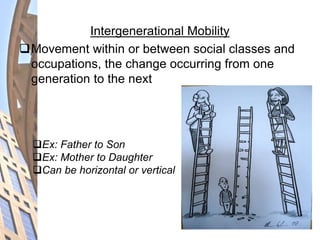
Intergenerational Mobility
Movement within or between social classes and
occupations, the change occurring from one
generation to the next
Ex: Father to Son
Ex: Mother to Daughter
Can be horizontal or vertical
Copyright
©
2011
by
Nelson
Education
Ltd
6-31
OCCUPATIONAL
MOBILITY AND STATUS
ATTAINMENT
• Occupational mobility: Moving up and down
occupational and income ladders
• Intragenerational occupational mobility: Mobility
within an individual’s lifetime
• Intergenerational occupational mobility: Process
of reaching occupation location higher or lower
than location held by parents
• Occupational status attainment: Main determinant
of status of a person’s current job is status of first
job (dependent on educational attainment)*
Conclusion
• In the Indian social system, caste is a solid structure. Caste system is also
an important identity of India. As an important institute of Indian social
system itsimpact on equality, inequality, social and economic matters is seen
for a long time. Critics consider this institute responsible for inequality and a
large class opposes it.
• Members of this class say that the caste system should break down.
• Some others say that caste system is breaking down or, in the opinion of
some other critics, the six characteristics of the traditional Hindu caste
system given by Dr. G. S. Ghurye are undergoing changes in the modern
time. On the other hand, the opinion that the caste system is going to
breaking down has not proved to be true.
• Of course,noticeable changes andmodifications have certainly been found in
the traditional Hindu caste system.
THANK YOU!

CASTE AND CLASS STRUCTURE.pptx

  • 1.
  • 2.
    Introduction • Caste andclass are a mixed phenomenon in India's rural society. Gail Omvedt argues that there are feudal forces in caste and as a result of it the former landlords, jamindars and jagirdars have come out as capitalist peasants. It means that the former higher castes have become today higher classes.
  • 3.
    Society Society is alarge grouping that shares the same territory and is subject to the same political authority dominant cultural expectations
  • 4.
    Types of Societies •Pre-Industrial – Hunters and Gather – Pastoral – Horticulture – Agriculture – Fiefdom
  • 5.
    Types of Societies •Industrial • Post-Industrial
  • 6.
    Social Structure inthe Macro Level Perspective • Social structure is a stable pattern of social relationships that exist within a particular group or society • Structure is provided by status and roles, groups, and social institutions
  • 7.
    Social Structure inthe Macro Level Perspective • social structure creates boundaries that define which persons or groups will be the insiders and which will be the outsiders • social marginality is the state of being part insiders in part outsider in the social structure
  • 8.
    Social Structure inthe Macro Level Perspective • social marginality results in stigmatization • a stigma is any physical or social attribute or sign that shows a person's social identity that disqualifies that person from full social acceptance
  • 9.
    Components of SocialStructure: Status • A status is a socially defines position in a group or society characterized by certain expectations rights and duties • Ascribed status is a social position conferred at birth or received involuntarily later in life • Achieved status is a social position in person assumes involuntarily as a result of personal choice merit or direct effort
  • 10.
    What is SocialStratification? • For tens of thousands of years, humans lived in small hunting and gathering societies. These bands of people show little signs of inequality. As societies became more complex, major changes came about, these changes elevated certain categories of the population by giving them more power, money, and prestige. • Social Stratification- a system by which a society ranks categories of people in a hierarchy.
  • 11.
    • 1. Socialstratification is a trait of society, not simply a reflection of individual differences. • Children born into wealthy families are more likely than children born in poverty to experience good healthy, achieve academically, succeed in life’s work and live a long life. • 2. Social stratification persists over generations. • To see stratification as a trait of society rather than one of individuals, we need to only look at how inequality persists along generations. In all societies, parents pass their social position on to their children.
  • 12.
    • 3. Socialstratification is universal but variable. • In some societies, inequality is mostly a matter of prestige; in others, wealth or power is the key dimension of difference. More importantly some societies display more inequality than others. • 4. Social stratification involves not just inequality but beliefs. • Any system of inequality gives some people more than others and the society also defines the arrangements as fair.
  • 13.
    Copyright © 2011 by Nelson Education Ltd 6-13 SOCIAL STRATIFICATION • Socialstratification:  Refers to persistent patterns of social inequality in a society  Is perpetuated by the way wealth, power, and prestige are distributed and passed on from one generation to the next  Exists in all societies*
  • 14.
    Copyright © 2011 by Nelson Education Ltd 6-14 FEATURES OF SOCIAL HIERARCHIES •Status: Rank or position in a social hierarchy • Statuses may be: i. Ascribed (assigned at birth), or ii. Achieved (earned by performance)*
  • 15.
    Copyright © 2011 by Nelson Education Ltd 6-15 TYPES OF STRATIFICATION SYSTEMS 1.Open stratification system:  Stratification system in which merit rather than inheritance (ascribed characteristics) determines social rank  Allows for social change • Is reflected in a meritocracy:  Positions are achieved, not ascribed  Characterized by equal opportunity and high social mobility (movement up or down a social hierarchy)*
  • 16.
    Copyright © 2011 by Nelson Education Ltd 6-16 TYPES OF STRATIFICATION SYSTEMS 2.Closed stratification system  Stratification system in which inheritance rather than merit determines social rank  Little social change possible • Reflected in a caste system:  Positions are ascribed, not achieved  Characterized by little social mobility
  • 17.
    Kin, clan, tribe,ethnicity • Many small-scale societies are made up of groups that take kinship, i.e. marriage, descent and filiation as the primary principles of membership. • Descent groups, i.e. groups that define their membership through descent from a common ancestor are very common in small-scale societies. They can be patrilineal, matrilineal, or consanguineal, i.e. descent is traced from either mother or father. • A descent group formed from unilineal descent, and to which a common ancestor can be traced is called a lineage. • A descent group formed through unilineal descent, and to which a common ancestor cannot be exactly traced, is called a clan. • A tribe is a social division in a traditional society consisting of families or communities linked by social, economic, religious, or blood ties, with a common culture and dialect, typically having a recognized leader. • An Ethnic group is a community or population made up of people who share a common cultural background or descent. • Kinship, clan, tribe, ethnic groups etc
  • 18.
    Caste and ClassSystems • A Caste System- is a social system based on ascription, or birth. • A pure caste system is closed because birth alone determines one’s destiny, with little or no opportunity for social mobility based on effort.
  • 19.
    Caste • Feature ofthe South Asian subcontinent. • Thought to have arisen through the transformation of ‘tribes’ in the transition to agricultural revolution. • Elements of caste appear to have existed in the Harappan civilization, c. 3,000 BC • A major feature of caste is endogamy, i.e. the requirement that people marry within their own caste, not outside it. • Also religious and cosmological ranking associated with caste, found in major Hindu scriptures: earliest were the division of society into 4 varnas (colours): Brahmins, Kshatriyas, Vaishyas and Shudras. • 2nd century AD, a fifth category, the ati-Shudras, or untouchables was added. • Untouchability was outlawed by the Indian constitution, 1951.
  • 20.
    • First, traditionalcaste groups have specific occupations, so generations of a family perform the same type of work. • Second, maintaining a rigid social hierarchy depends on people marrying within their own categories; “mixed” marriages would blur the ranking of children. • Endogamy- marriage between people of the same social category. • Third, caste norms guide people to stay in the company of “their own kind.” • Fourth, caste systems rest on powerful cultural beliefs.
  • 21.
    • Caste systemsexist in agrarian societies because life long routines of agriculture depend on a rigid sense of duty and discipline.
  • 22.
    The Class System •Class System- social stratification based on both birth and individual achievement. • The class system categorizes people according to their color, sex, or social background comes to be seen as wrong in industrial and post-industrial societies, and all people gain political rights and roughly equal standing before the law. • Meritocracy- social stratification based on personal merit. • People in industrial societies develop a broad range of capabilities, stratification is based on “merit,” which is the job one does and how well one does it.
  • 23.
    Copyright © 2011 by Nelson Education Ltd 6-23 CLASS AND CLASS STRUCTURE •Class: Position in an economic hierarchy occupied by individuals or families with similar access to, or control over, material resources (e.g., working class, professional class) • Class structure: Relatively permanent economic hierarchy comprising different social classes • Socioeconomic status: Person’s general status within an economic hierarchy, based on income, education, and occupation*
  • 24.
    Nations and Nationalism •Shared heritage and historical experience the basis of a state. • Common language, shared origin, unique customs are features that define a sense of nationhood. • Nationalism can often arise as a result of an ethnic movement. • 19th century nationalisms, formed through defining themselves as ‘one people, one language, one culture.’ • Difference between territorial nationalism versus a ‘blood’ nationalism, e.g. in Quebec. • Monocultural nationalisms are increasingly challenged by transnational phenomena and groups, as increasing quantities of information, cultural knowledge and people cross ‘national’ boundaries.
  • 25.
    • Social Mobility-change in one’s position in the social hierarchy. Copyright © 2011 by Nelson Education Ltd 6-25
  • 26.
    What is SocialMobility • Social mobility is defined as movement from one class/status position to another • There are 2 types: Intra- generational – movement within one generation e.g. a person moves from one social class to another in the course of their life time Inter generational – movement between generations e.g. a person’s father was a Liverpool docker and he is a teacher
  • 27.
    What is SocialMobility? Definition: Movement from one class —or more usually status group—to another
  • 28.
    Horizontal Mobility  Movementfrom one position to another within the same social level  Ex: Changing jobs without altering occupational status  Moving between social groups having the same social status.
  • 29.
    Vertical Mobility  Movementfrom one social level to a higher one (upward mobility) or a lower one (downward mobility) Ex: Changing Jobs or Marrying Cultural diffusion from one social level to another  Adoption by one economic class of the current fashions or formerly current in a higher class
  • 30.
    Intergenerational Mobility Movement withinor between social classes and occupations, the change occurring from one generation to the next Ex: Father to Son Ex: Mother to Daughter Can be horizontal or vertical
  • 31.
    Copyright © 2011 by Nelson Education Ltd 6-31 OCCUPATIONAL MOBILITY AND STATUS ATTAINMENT •Occupational mobility: Moving up and down occupational and income ladders • Intragenerational occupational mobility: Mobility within an individual’s lifetime • Intergenerational occupational mobility: Process of reaching occupation location higher or lower than location held by parents • Occupational status attainment: Main determinant of status of a person’s current job is status of first job (dependent on educational attainment)*
  • 32.
    Conclusion • In theIndian social system, caste is a solid structure. Caste system is also an important identity of India. As an important institute of Indian social system itsimpact on equality, inequality, social and economic matters is seen for a long time. Critics consider this institute responsible for inequality and a large class opposes it. • Members of this class say that the caste system should break down. • Some others say that caste system is breaking down or, in the opinion of some other critics, the six characteristics of the traditional Hindu caste system given by Dr. G. S. Ghurye are undergoing changes in the modern time. On the other hand, the opinion that the caste system is going to breaking down has not proved to be true. • Of course,noticeable changes andmodifications have certainly been found in the traditional Hindu caste system.
  • 33.

Editor's Notes