
RURAL SOCIOLOGY MSW II YEAR III SEM UNIT I RURAL COMMUNITY DEVELOPMENT
RURAL SOCIOLOGY SNO Chapters Content 1 Chapter – 1 Definition, Origin and Scope 2 Chapter – 2 Comparisons Urban & Rural Sociology 3 Chapter – 3 Indian Villages  History  Power Structures, Class Types Occupational Patterns 4 Chapter – 4 Family , Kinship System
RURAL SOCIOLOGY Chapter 1 Definition, Origin and Scope
Definition   – Rural Sociology By few foreign sociologists Chapin F. Stuart – a Study of rural population, rural social organization and rural social processes in rural society.  Senderson – Rural Sociology is the social life in rural society. Indian Sociologists : Definition by A.R. Desai is the most suitable and closer to Indian society. He observes Rural Sociology as “the science of laws of development of rural society” with the prime objective to make scientific, systematic and comprehensive study of the rural social organization, of its structure, function and objective tendencies of development  and on the basis of such studies to discover the laws of its development.
Origin Sociology of rural life in the systematic form has originated from US It is originated from the report of the Country life commission (CLC) appointed by American President, Theodore Roosevelt, in 1907 CLC was to study the rural social problems and make recommendation for improvement of rural life The finings of CLC report were presented to the members of American Sociological Society in its annual meetings
Origin This has motivated the sociologists to take up study of rural society in a massive way. A journal entitled Rural Sociology was first time launched in USA in 1935 John M. Gillette was the pioneer in writing a text book on rural sociology in 1960 Currently more than 800 Professors and research workers are engaged in developing rural sociology in US
Origin - In India Study done by Sir Henry S. Maine. The author of two books namely Ancient Law (1861) Ancient Society (1877) He wrote about Indian Villages  However the study was more on comparisons with  Teutonic and Slavonic
Scope Rural Sociology is a very young science among social sciences .  Study of Rural Life is different from urban The scientific, Systematic and comprehensive study of rural communities, to discover the law of development of rural society
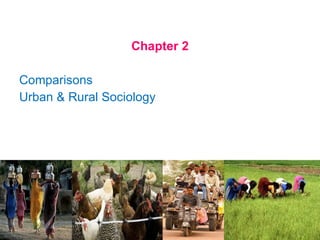
Chapter 2 Comparisons Urban & Rural Sociology
Urban Sociology Urban sociology is the sociological study of social life and human interaction in metropolitan areas. It is a normative discipline of sociology seeking to study the structures, processes, changes and problems of an urban area and by doing so providing inputs for planning and policy making.
Criteria for distinguishing  Rural / Urban communities Occupational  Environmental  Density of population Practices – Homogeneity / Heterogeneity Direction of migration Social Differentiation System of Interactions
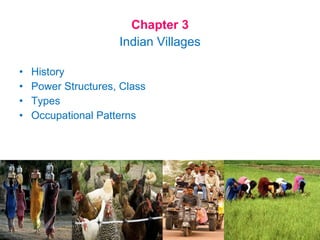
Chapter 3 Indian Villages History  Power Structures, Class Types Occupational Patterns
Indian Villages History The Indian Villages were discussed by valmiki in Ramayana and they were also referred in Mahabharata  As valmiki mentions, the smaller were called Ghosh and bigger are called Gram The Mahattar is the official at both Gram and gram called Gram Mahattar and Ghosh Mahattar Gramani is another official at village level. In ramayana when Rama killed ravana, the notes say, the gods sing praising Rama as lord and Gramani This signifies the respect to Gramani
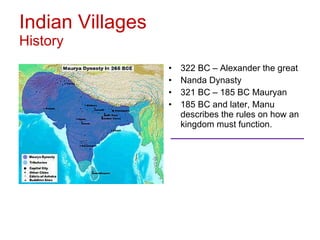
Indian Villages History 322 BC – Alexander the great Nanda Dynasty 321 BC – 185 BC Mauryan 185 BC and later, Manu describes the rules on how an kingdom must function.
Indian Villages History Manu reign:  Gramik 1 Village Dashi 10 Villages Vishanti – 20 Villages Shata Gramadhipati – 100 Villages
Indian Villages Power Structures Communities  –  Not Republic Self Governing  –  But not Democratic
Indian Villages Types Based on Transition from nomadic to settled village life Migratory Agricultural Villages – In fixed abodes, only for few months Semi Permanent Agricultural Villages – The populations live here for few years and migrate after the exhaustion of the soil  Permanent Agricultural Villages – Where people live for generations and even for centauries  Habitation Type Nucleated – The farmers stay as a single cluster. They work outside the  outside the agricultural land Dispersed – The farmers live separately on their agricultural farms
Indian Villages Types Based on Social Differentiation, Stratification, mobility and land, Ownership Peasant Joint Owners Peasant Joint Tenants Farmers/Individual owners & Tenants/Laborers Individual Farmer Tenants Employees of a private Land Owners Employees and Laborers
Chapter 4 Rural Family
Rural Sociology : Family Eminent rural sociologists have observed the rural family system very closely and have their characteristics. Greater Homogeneity Based on Peasant Household Greater Discipline and Interdependence Dominance of Family Ego Authority of the Father Closer participation in Various Activities
THE END

Rural sociology

  • 1.
    RURAL SOCIOLOGY MSWII YEAR III SEM UNIT I RURAL COMMUNITY DEVELOPMENT
  • 2.
    RURAL SOCIOLOGY SNOChapters Content 1 Chapter – 1 Definition, Origin and Scope 2 Chapter – 2 Comparisons Urban & Rural Sociology 3 Chapter – 3 Indian Villages History Power Structures, Class Types Occupational Patterns 4 Chapter – 4 Family , Kinship System
  • 3.
    RURAL SOCIOLOGY Chapter1 Definition, Origin and Scope
  • 4.
    Definition – Rural Sociology By few foreign sociologists Chapin F. Stuart – a Study of rural population, rural social organization and rural social processes in rural society. Senderson – Rural Sociology is the social life in rural society. Indian Sociologists : Definition by A.R. Desai is the most suitable and closer to Indian society. He observes Rural Sociology as “the science of laws of development of rural society” with the prime objective to make scientific, systematic and comprehensive study of the rural social organization, of its structure, function and objective tendencies of development and on the basis of such studies to discover the laws of its development.
  • 5.
    Origin Sociology ofrural life in the systematic form has originated from US It is originated from the report of the Country life commission (CLC) appointed by American President, Theodore Roosevelt, in 1907 CLC was to study the rural social problems and make recommendation for improvement of rural life The finings of CLC report were presented to the members of American Sociological Society in its annual meetings
  • 6.
    Origin This hasmotivated the sociologists to take up study of rural society in a massive way. A journal entitled Rural Sociology was first time launched in USA in 1935 John M. Gillette was the pioneer in writing a text book on rural sociology in 1960 Currently more than 800 Professors and research workers are engaged in developing rural sociology in US
  • 7.
    Origin - InIndia Study done by Sir Henry S. Maine. The author of two books namely Ancient Law (1861) Ancient Society (1877) He wrote about Indian Villages However the study was more on comparisons with Teutonic and Slavonic
  • 8.
    Scope Rural Sociologyis a very young science among social sciences . Study of Rural Life is different from urban The scientific, Systematic and comprehensive study of rural communities, to discover the law of development of rural society
  • 9.
    Chapter 2 ComparisonsUrban & Rural Sociology
  • 10.
    Urban Sociology Urbansociology is the sociological study of social life and human interaction in metropolitan areas. It is a normative discipline of sociology seeking to study the structures, processes, changes and problems of an urban area and by doing so providing inputs for planning and policy making.
  • 11.
    Criteria for distinguishing Rural / Urban communities Occupational Environmental Density of population Practices – Homogeneity / Heterogeneity Direction of migration Social Differentiation System of Interactions
  • 12.
    Chapter 3 IndianVillages History Power Structures, Class Types Occupational Patterns
  • 13.
    Indian Villages HistoryThe Indian Villages were discussed by valmiki in Ramayana and they were also referred in Mahabharata As valmiki mentions, the smaller were called Ghosh and bigger are called Gram The Mahattar is the official at both Gram and gram called Gram Mahattar and Ghosh Mahattar Gramani is another official at village level. In ramayana when Rama killed ravana, the notes say, the gods sing praising Rama as lord and Gramani This signifies the respect to Gramani
  • 14.
    Indian Villages History322 BC – Alexander the great Nanda Dynasty 321 BC – 185 BC Mauryan 185 BC and later, Manu describes the rules on how an kingdom must function.
  • 15.
    Indian Villages HistoryManu reign: Gramik 1 Village Dashi 10 Villages Vishanti – 20 Villages Shata Gramadhipati – 100 Villages
  • 16.
    Indian Villages PowerStructures Communities – Not Republic Self Governing – But not Democratic
  • 17.
    Indian Villages TypesBased on Transition from nomadic to settled village life Migratory Agricultural Villages – In fixed abodes, only for few months Semi Permanent Agricultural Villages – The populations live here for few years and migrate after the exhaustion of the soil Permanent Agricultural Villages – Where people live for generations and even for centauries Habitation Type Nucleated – The farmers stay as a single cluster. They work outside the outside the agricultural land Dispersed – The farmers live separately on their agricultural farms
  • 18.
    Indian Villages TypesBased on Social Differentiation, Stratification, mobility and land, Ownership Peasant Joint Owners Peasant Joint Tenants Farmers/Individual owners & Tenants/Laborers Individual Farmer Tenants Employees of a private Land Owners Employees and Laborers
  • 19.
  • 20.
    Rural Sociology :Family Eminent rural sociologists have observed the rural family system very closely and have their characteristics. Greater Homogeneity Based on Peasant Household Greater Discipline and Interdependence Dominance of Family Ego Authority of the Father Closer participation in Various Activities
  • 21.

Editor's Notes

  • #6 CLC is appointed because during that time there was mass poverty and economic crisis which affected American Rural Life. He was more feared because he felt if there is nothing to do now, there would be deterioration in moral life too.