The aim of this session is to:
Provide you with a brief
introduction to social theory,
Namely the Functionalist
Perspective of society.
By the end of the session:
•You should all have a basic understanding of the Functionalist
Perspective of how society works.
•Be able to define key concepts in relation to the Functionalist
Perspective.
•Critically evaluate the Functionalist perspective of the role of
social institutions in society.
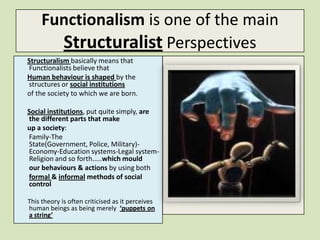
Functionalism is one of the main
Structuralist Perspectives
Structuralism basically means that
Functionalists believe that
Human behaviour is shaped by the
structures or social institutions
of the society to which we are born.
Social institutions, put quite simply, are
the different parts that make
up a society:
Family-The
State(Government, Police, Military)-
Economy-Education systems-Legal system-
Religion and so forth.....which mould
our behaviours & actions by using both
formal & informal methods of social
control
This theory is often criticised as it perceives
human beings as being merely ‘puppets on
a string’
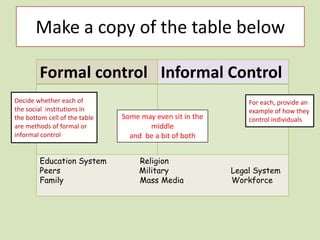
Make a copy of the table below
Formal control Informal Control
Education System Religion
Peers Military Legal System
Family Mass Media Workforce
Decide whether each of
the social institutions in
the bottom cell of the table
are methods of formal or
informal control
For each, provide an
example of how they
control individualsSome may even sit in the
middle
and be a bit of both
Functionalism continued;
Because Functionalists believe that each
Social institution works together
harmoniously, to contribute to the
smooth running of society, they
Are also known as a ‘consensus’ theory.
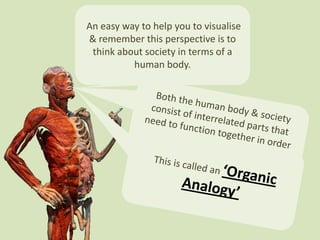
An easy way to help you to visualise
& remember this perspective is to
think about society in terms of a
human body.
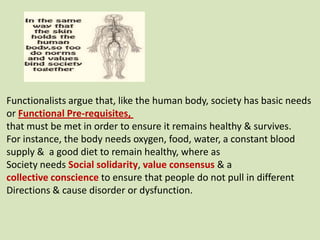
Functionalists argue that, like the human body, society has basic needs
or Functional Pre-requisites,
that must be met in order to ensure it remains healthy & survives.
For instance, the body needs oxygen, food, water, a constant blood
supply & a good diet to remain healthy, where as
Society needs Social solidarity, value consensus & a
collective conscience to ensure that people do not pull in different
Directions & cause disorder or dysfunction.
Consequently
Functionalists are interested in
how the family functions for the good
of Society & how it contributes to the
maintenance of social order & solidarity,
Which we will examine in more detail
Over the next few weeks.
The basics of Functionalism
What can you recall from our
last session in relation to the
Functionalist perspective
Or theory of society?
Aim of this session
•First quick concept match activity
•Then half hour maximum complete
organic analogy diagrams.
•Undertake reading & comprehension
Q’s
•Test one another on concepts
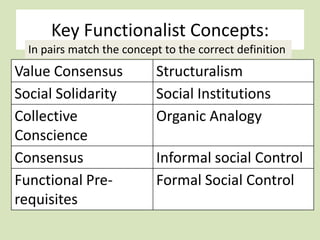
Key Functionalist Concepts:
Value Consensus Structuralism
Social Solidarity Social Institutions
Collective
Conscience
Organic Analogy
Consensus Informal social Control
Functional Pre-
requisites
Formal Social Control
In pairs match the concept to the correct definition
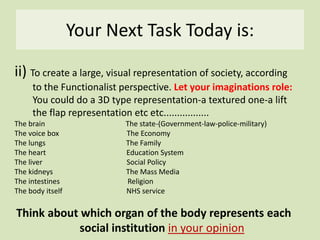
Your Next Task Today is:
ii) To create a large, visual representation of society, according
to the Functionalist perspective. Let your imaginations role:
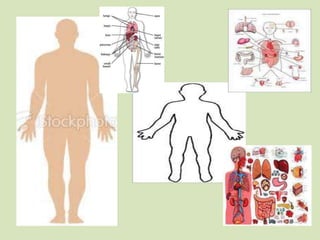
You could do a 3D type representation-a textured one-a lift
the flap representation etc etc.................
The brain The state-(Government-law-police-military)
The voice box The Economy
The lungs The Family
The heart Education System
The liver Social Policy
The kidneys The Mass Media
The intestines Religion
The body itself NHS service
Think about which organ of the body represents each
social institution in your opinion
Make a note of Your Final Tasks
a) Think about how all the social institutions support one another
and contribute to the maintenance of a value consensus-
Social solidarity- Collective Conscience-and write
a summary of these thoughts.
B) Then think critically about what would happen to
society if 2 of its’ FUNCTIONS (say; the family & the
police force) were removed or began to malfunction
(break-down).
C) For Homework learn both the definition & the spelling
of the key concepts we have looked at in relation to
Functionalism for a test on Monday 

Introduction to FUNCTIONALISM

  • 2.
    The aim ofthis session is to: Provide you with a brief introduction to social theory, Namely the Functionalist Perspective of society.
  • 3.
    By the endof the session: •You should all have a basic understanding of the Functionalist Perspective of how society works. •Be able to define key concepts in relation to the Functionalist Perspective. •Critically evaluate the Functionalist perspective of the role of social institutions in society.
  • 4.
    Functionalism is oneof the main Structuralist Perspectives Structuralism basically means that Functionalists believe that Human behaviour is shaped by the structures or social institutions of the society to which we are born. Social institutions, put quite simply, are the different parts that make up a society: Family-The State(Government, Police, Military)- Economy-Education systems-Legal system- Religion and so forth.....which mould our behaviours & actions by using both formal & informal methods of social control This theory is often criticised as it perceives human beings as being merely ‘puppets on a string’
  • 5.
    Make a copyof the table below Formal control Informal Control Education System Religion Peers Military Legal System Family Mass Media Workforce Decide whether each of the social institutions in the bottom cell of the table are methods of formal or informal control For each, provide an example of how they control individualsSome may even sit in the middle and be a bit of both
  • 6.
    Functionalism continued; Because Functionalistsbelieve that each Social institution works together harmoniously, to contribute to the smooth running of society, they Are also known as a ‘consensus’ theory.
  • 7.
    An easy wayto help you to visualise & remember this perspective is to think about society in terms of a human body.
  • 8.
    Functionalists argue that,like the human body, society has basic needs or Functional Pre-requisites, that must be met in order to ensure it remains healthy & survives. For instance, the body needs oxygen, food, water, a constant blood supply & a good diet to remain healthy, where as Society needs Social solidarity, value consensus & a collective conscience to ensure that people do not pull in different Directions & cause disorder or dysfunction.
  • 9.
    Consequently Functionalists are interestedin how the family functions for the good of Society & how it contributes to the maintenance of social order & solidarity, Which we will examine in more detail Over the next few weeks.
  • 10.
    The basics ofFunctionalism What can you recall from our last session in relation to the Functionalist perspective Or theory of society?
  • 11.
    Aim of thissession •First quick concept match activity •Then half hour maximum complete organic analogy diagrams. •Undertake reading & comprehension Q’s •Test one another on concepts
  • 12.
    Key Functionalist Concepts: ValueConsensus Structuralism Social Solidarity Social Institutions Collective Conscience Organic Analogy Consensus Informal social Control Functional Pre- requisites Formal Social Control In pairs match the concept to the correct definition
  • 13.
    Your Next TaskToday is: ii) To create a large, visual representation of society, according to the Functionalist perspective. Let your imaginations role: You could do a 3D type representation-a textured one-a lift the flap representation etc etc................. The brain The state-(Government-law-police-military) The voice box The Economy The lungs The Family The heart Education System The liver Social Policy The kidneys The Mass Media The intestines Religion The body itself NHS service Think about which organ of the body represents each social institution in your opinion

  • 15.
    Make a noteof Your Final Tasks a) Think about how all the social institutions support one another and contribute to the maintenance of a value consensus- Social solidarity- Collective Conscience-and write a summary of these thoughts. B) Then think critically about what would happen to society if 2 of its’ FUNCTIONS (say; the family & the police force) were removed or began to malfunction (break-down). C) For Homework learn both the definition & the spelling of the key concepts we have looked at in relation to Functionalism for a test on Monday 