Concept, Characteristics
and Form of
Stratification Systems
Cat
on fac
categ
layeri
called
By
hierar
social
toget
roles
Categorizing individuals or group of people based
on factors such as power, wealth. and prestige. this
categories are what we call social classes, and
layering social classes from the lowest to highest is
called social stratification.
By definition social stratification is the
hierarchical arrangement and establishment of
social categories that may evolve into social groups
together with statuses and their corresponding
roles in the society
Categorizing individuals or group of people based
on factors such as power, wealth. and prestige. this
categories are what we call social classes, and
layering social classes from the lowest to highest is
called social stratification.
By definition social stratification is the
hierarchical arrangement and establishment of
social categories that may evolve into social groups
together with statuses and their corresponding
roles in the society.
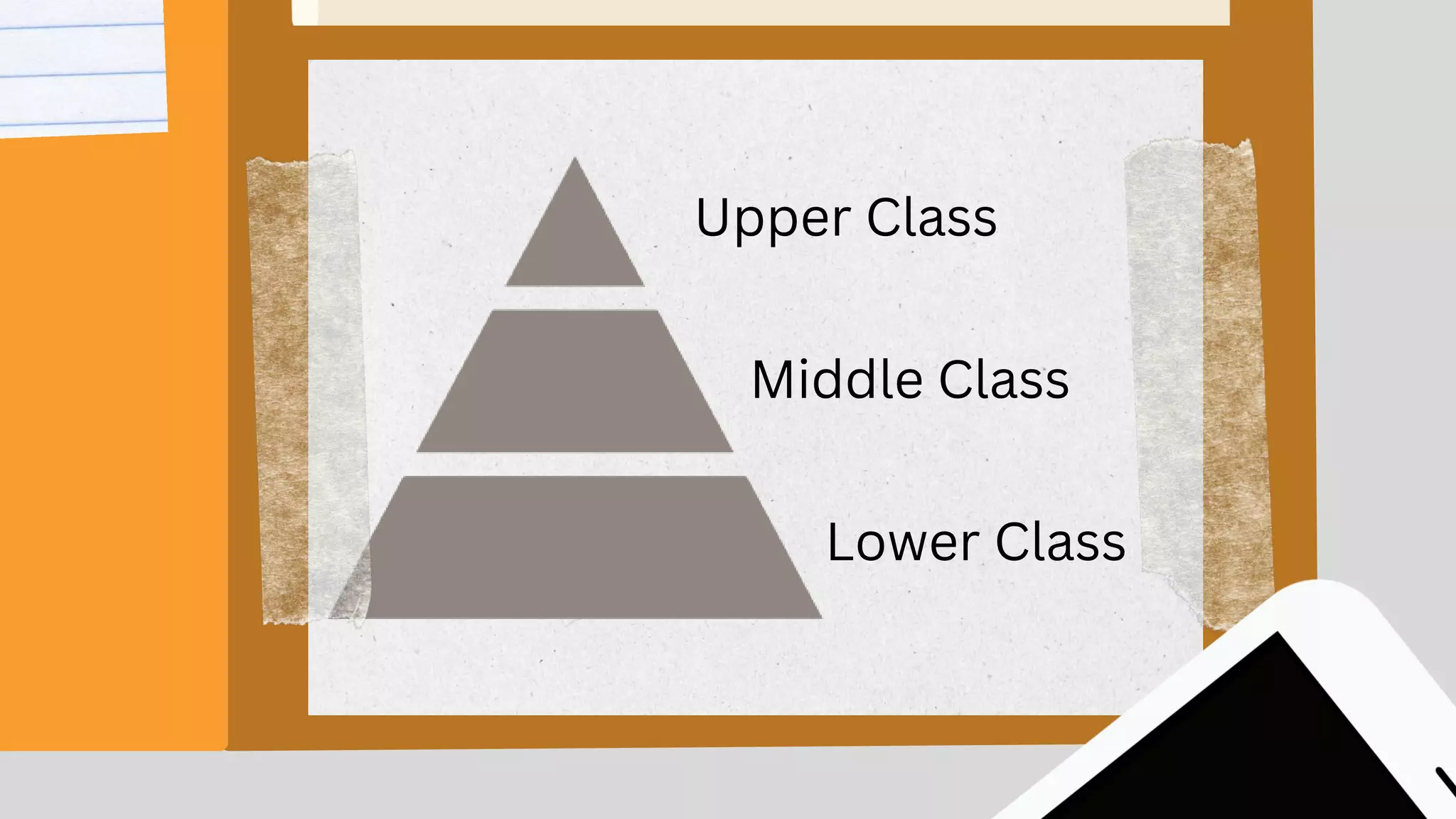
Upper Class
Middle Class
Lower Class
Let's Play a Game
Draw it Out!
1.
2.
3.
4.
5.
6.
7.
8.
9.
10
.
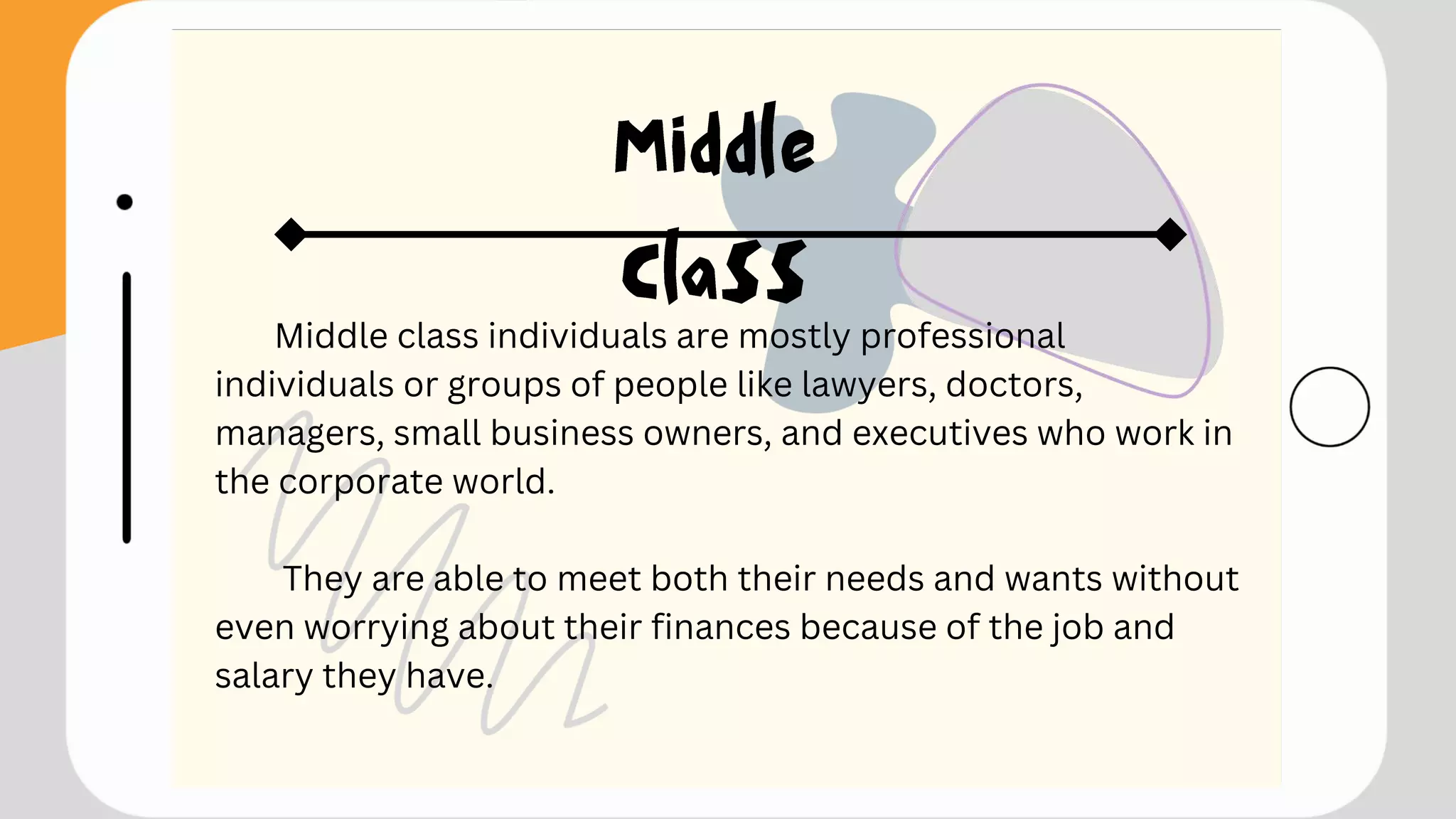
Middle class individuals are mostly professional
individuals or groups of people like lawyers, doctors,
managers, small business owners, and executives who work in
the corporate world.
They are able to meet both their needs and wants without
even worrying about their finances because of the job and
salary they have.
At the top of the pyramid is the upper class, explained by
sociologists as elite individuals or group of people that are
the most prolific and successful in their respective areas.
These people may be stockholders and investors in very
huge well-known companies from different industries here
and in abroad.
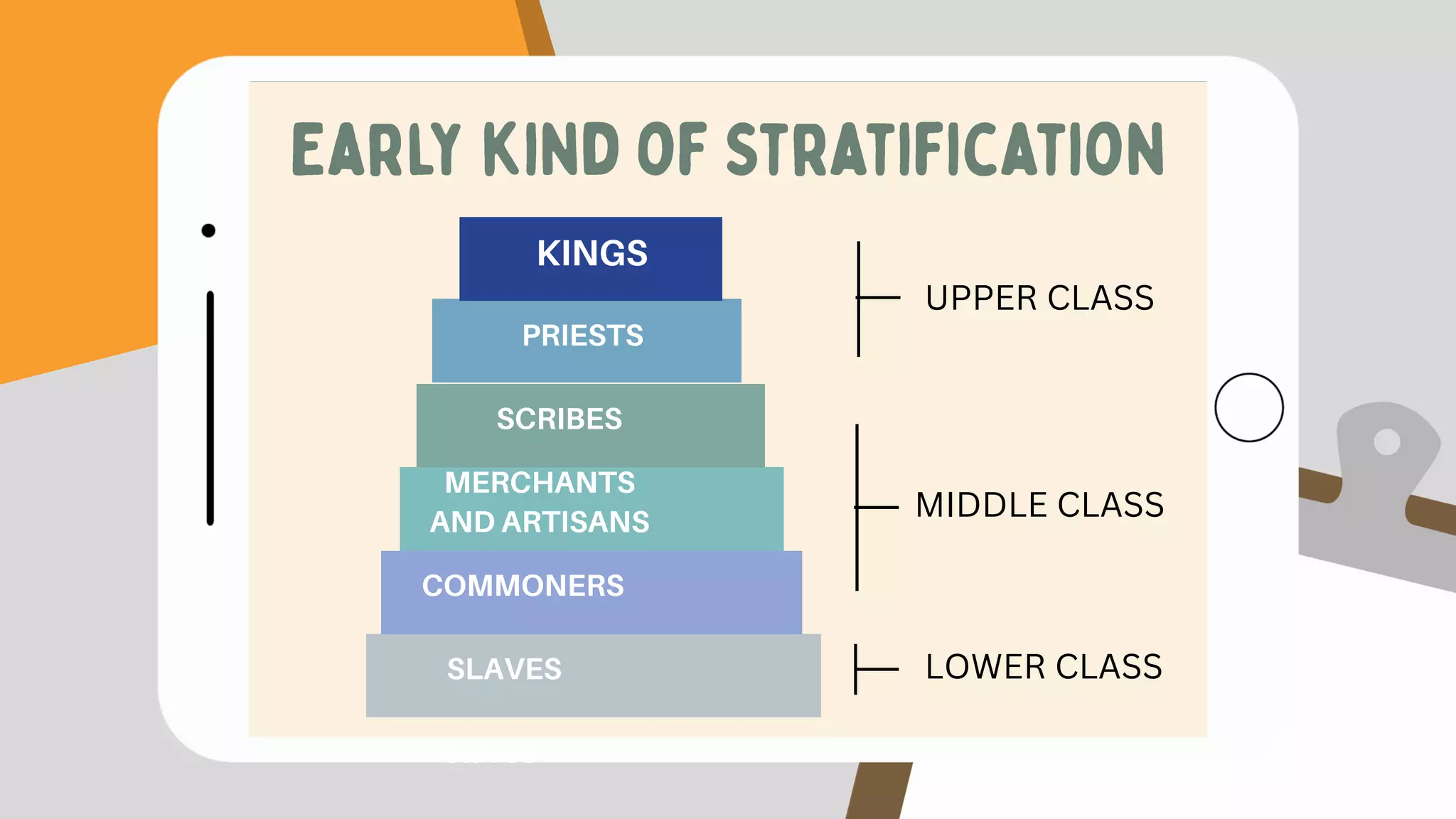
Slaves
SLAVES
COMMONERS
MERCHANTS
AND ARTISANS
SCRIBES
PRIESTS
UPPER CLASS
MIDDLE CLASS
LOWER CLASS
KINGS
Characteristics of Stratification
Systems
Characteristics of Stratification
Systems
• Universal but variable. Stratification appears in
every society, but how it divides and categorizes
people, and what the advantages and
disadvantages that come from that division -
vary from society to society.
• Not a matter of individual differences. we can
see the effects of social stratification on people
regardless of their personal choices or traits.
Characteristics of Stratification
Systems
• Persists across generations. Stratification
categorizes and rank members of society across
generations, resulting in different life chances.
People sometimes move upward or downward in
social class, which is the basic concept of social
mobility.
• A social belief. A society's belief tell us how to
categorize people, and they define inequalities of
a stratification system as being normal, or even
fair.
• In a closed system of stratification is little or no
opportunity to advance from one social class to another.
Social status is hereditary, based on a group
characteristic
• Closed class system exists when a group of people are
given different opportunities, depending on the
characteristics they were born with, such as color,
gender, or the economic situation of their parents. In a
closed class system, you are stuck at your level. You can't
marry people from other classes.
• Class System is one of the best examples of open
system of stratification and is not based solely on
ascribed status at birth alone. Instead, it combines
ascribed status and personal achievement or
achieved status in a way that allows some social
mobility. Statuses are not the same. We get different
statuses in different ways and chances.
• Some are ascribed statuses, which are assigned or
given by the society or group based on some fixed
category, without regard to a person's abilities or
performance. Examples of ascribed status are sex,
family background, race, and ethnic heritage or
wealth. A person did nothing to earn these statuses,
nor has control over these characteristics and had no
opportunity or chance to choose family, sex, and race.
On the other hand, achieved statuses are earned by
the individual. The following scenarios serve as
examples
Their role in the society
could create job
opportunities for other
social classes below them.
In fact, there are jobs not
requiring a college degree.
In this sense, those who are
not able to finish their
studies can still be hired.
Those with college degree
can be employed with a
higher paid salary and good
position in a company.
Functionalis
m
Every social class has its
purpose or role to play a part in
the society. We can't expect the
owner of a certain business
empire to do a construction
works; but instead, he will hire
someone to do it for himself. The
upper class, although they are
getting richer because they have
the capacity to exploit natural
and man-made resources simply
because they have the money.
Conflict Theory
This sociological perspective is
the opposite of the latter. Karl
Marx viewed social stratification
as creation of inequality
between the rich and the poor,
or the powerful versus the
powerless. Let's say for example:
The bourgeois capitalists owning
high-producing businesses or
factories and hire people who
work for them.
They can enjoy the luxury of life
because they earn billions of
money. However, proletariats are
the working class earned skimpy
wages and experiencing isolation
to the society. The very essence
of life is to enjoy it with loved
ones. However, working class did
not experience this joy because
they are isolated to do the labor
for long hours each day to earn
money at the end of the month.
Marx argued that proletariats
were oppressed by the money-
hungry bourgeois.
Symbolic interactionism view
social stratification on a
micro level where individuals
affect others whom they
have interacted because of
their social class status. In
most societies, people can
only interact only to those
with the same social class
status
Symbolic
Interactionism
Review
12-15-23-5-18___3-12-1-19-19
Review
13-9-4-4-12-5___3-12-1-19-
19
6-21-14-3-20-9-15-14-1-12-9-19-
13
4-15-3-20-15-
18
3-15-14-6-12-9-3-20___20-8-5-15-18-
25
3-1-19-20-5___19-25-19-20-5-
13
21-14-9-22-5-18-19-1-
12
21-16-16-5-18___3-12-1-19-
19
19-20-18-1-20-9-6-9-3-1-20-9-15-
14
15-16-5-14___3-12-1-19-
Concept, Characteristics and forms of Stratification (1).pptx

Concept, Characteristics and forms of Stratification (1).pptx

  • 2.
    Concept, Characteristics and Formof Stratification Systems
  • 4.
  • 5.
    Categorizing individuals orgroup of people based on factors such as power, wealth. and prestige. this categories are what we call social classes, and layering social classes from the lowest to highest is called social stratification. By definition social stratification is the hierarchical arrangement and establishment of social categories that may evolve into social groups together with statuses and their corresponding roles in the society
  • 6.
    Categorizing individuals orgroup of people based on factors such as power, wealth. and prestige. this categories are what we call social classes, and layering social classes from the lowest to highest is called social stratification. By definition social stratification is the hierarchical arrangement and establishment of social categories that may evolve into social groups together with statuses and their corresponding roles in the society.
  • 7.
  • 8.
  • 9.
  • 11.
    Middle class individualsare mostly professional individuals or groups of people like lawyers, doctors, managers, small business owners, and executives who work in the corporate world. They are able to meet both their needs and wants without even worrying about their finances because of the job and salary they have.
  • 12.
    At the topof the pyramid is the upper class, explained by sociologists as elite individuals or group of people that are the most prolific and successful in their respective areas. These people may be stockholders and investors in very huge well-known companies from different industries here and in abroad.
  • 13.
  • 14.
  • 15.
    Characteristics of Stratification Systems •Universal but variable. Stratification appears in every society, but how it divides and categorizes people, and what the advantages and disadvantages that come from that division - vary from society to society. • Not a matter of individual differences. we can see the effects of social stratification on people regardless of their personal choices or traits.
  • 16.
    Characteristics of Stratification Systems •Persists across generations. Stratification categorizes and rank members of society across generations, resulting in different life chances. People sometimes move upward or downward in social class, which is the basic concept of social mobility. • A social belief. A society's belief tell us how to categorize people, and they define inequalities of a stratification system as being normal, or even fair.
  • 17.
    • In aclosed system of stratification is little or no opportunity to advance from one social class to another. Social status is hereditary, based on a group characteristic • Closed class system exists when a group of people are given different opportunities, depending on the characteristics they were born with, such as color, gender, or the economic situation of their parents. In a closed class system, you are stuck at your level. You can't marry people from other classes.
  • 18.
    • Class Systemis one of the best examples of open system of stratification and is not based solely on ascribed status at birth alone. Instead, it combines ascribed status and personal achievement or achieved status in a way that allows some social mobility. Statuses are not the same. We get different statuses in different ways and chances.
  • 19.
    • Some areascribed statuses, which are assigned or given by the society or group based on some fixed category, without regard to a person's abilities or performance. Examples of ascribed status are sex, family background, race, and ethnic heritage or wealth. A person did nothing to earn these statuses, nor has control over these characteristics and had no opportunity or chance to choose family, sex, and race. On the other hand, achieved statuses are earned by the individual. The following scenarios serve as examples
  • 21.
    Their role inthe society could create job opportunities for other social classes below them. In fact, there are jobs not requiring a college degree. In this sense, those who are not able to finish their studies can still be hired. Those with college degree can be employed with a higher paid salary and good position in a company. Functionalis m Every social class has its purpose or role to play a part in the society. We can't expect the owner of a certain business empire to do a construction works; but instead, he will hire someone to do it for himself. The upper class, although they are getting richer because they have the capacity to exploit natural and man-made resources simply because they have the money.
  • 22.
    Conflict Theory This sociologicalperspective is the opposite of the latter. Karl Marx viewed social stratification as creation of inequality between the rich and the poor, or the powerful versus the powerless. Let's say for example: The bourgeois capitalists owning high-producing businesses or factories and hire people who work for them. They can enjoy the luxury of life because they earn billions of money. However, proletariats are the working class earned skimpy wages and experiencing isolation to the society. The very essence of life is to enjoy it with loved ones. However, working class did not experience this joy because they are isolated to do the labor for long hours each day to earn money at the end of the month. Marx argued that proletariats were oppressed by the money- hungry bourgeois.
  • 23.
    Symbolic interactionism view socialstratification on a micro level where individuals affect others whom they have interacted because of their social class status. In most societies, people can only interact only to those with the same social class status Symbolic Interactionism
  • 24.
  • 25.