DISCIPLINES AND IDEAS
IN SOCIAL SCIENCES
Prepared by: Ms. Mary Joy Adelfa P. Dailo, LPT
“Defining Social Sciences as the Study of Society”
✘ The social sciences have a
critical contribution to
make, in helping us
understand, imagine, and
craft a more sustainable
future for all.”
- UNESCO
Who I am
How I behave
with others.
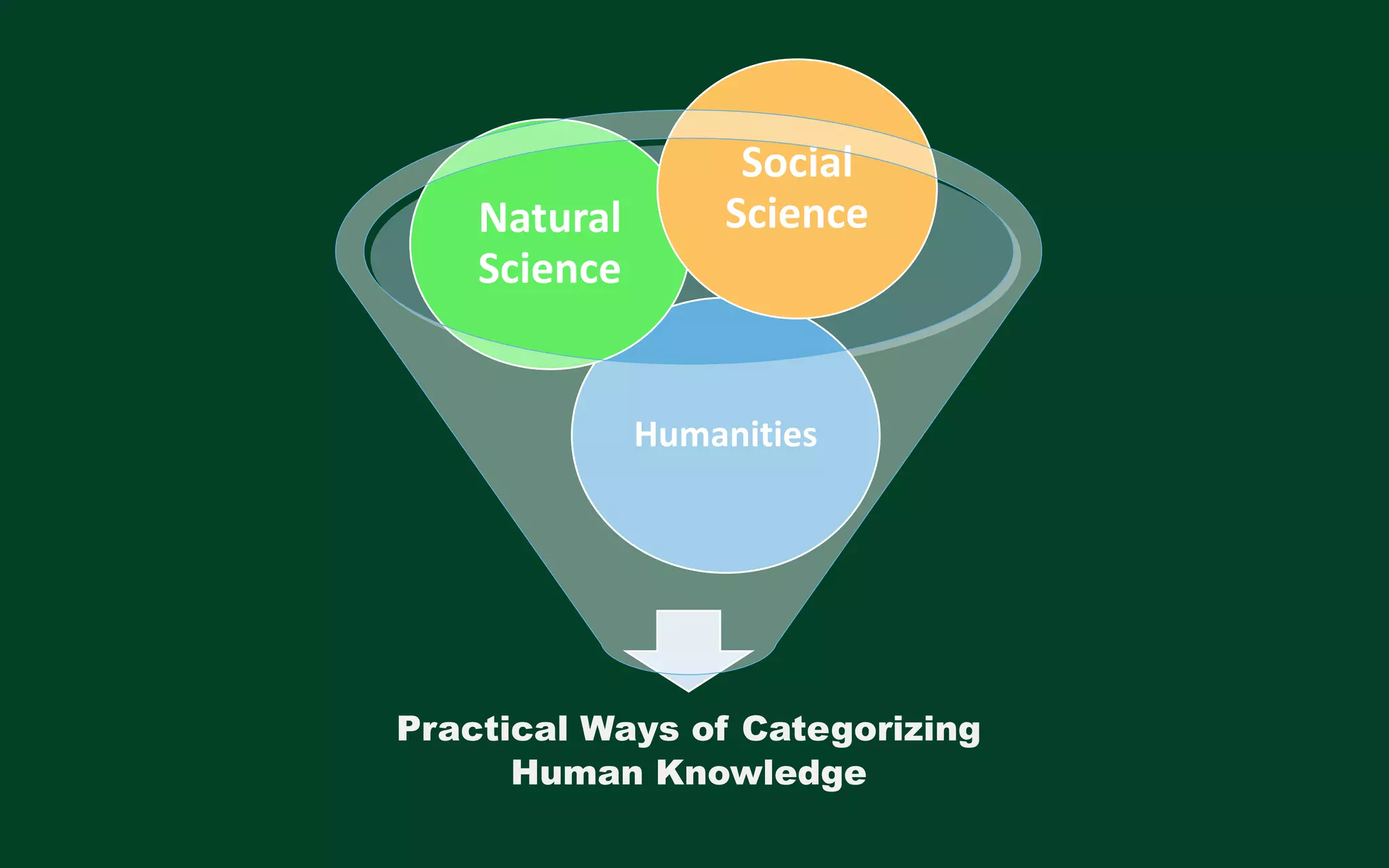
Practical Ways of Categorizing
Human Knowledge
Humanities
Natural
Science
Social
Science
What is
SOCIAL SCIENCE?
✘ Any discipline or branch of science that deals with human
behavior in its social and cultural aspects.
✘ Social science is an academic discipline concerned with
society and the relationships among individuals within a
society, which often rely primarily on empirical approaches.
✘ Social Sciences are those disciplines that study
(a) Institutions and functioning of human society and the
interpersonal relationships of individuals as members of
society;
(b) A particular phase or aspect of human society.
HISTORY OF SOCIAL SCIENCE
✘ The history of the social sciences begins in the Age of
Enlightenment after 1650.
✘ The social sciences developed from the sciences
(experimental and applied), or the systematic knowledge-
bases or prescriptive practices, relating to the social
improvement of a group of interacting entities.
HISTORY OF SOCIAL SCIENCE
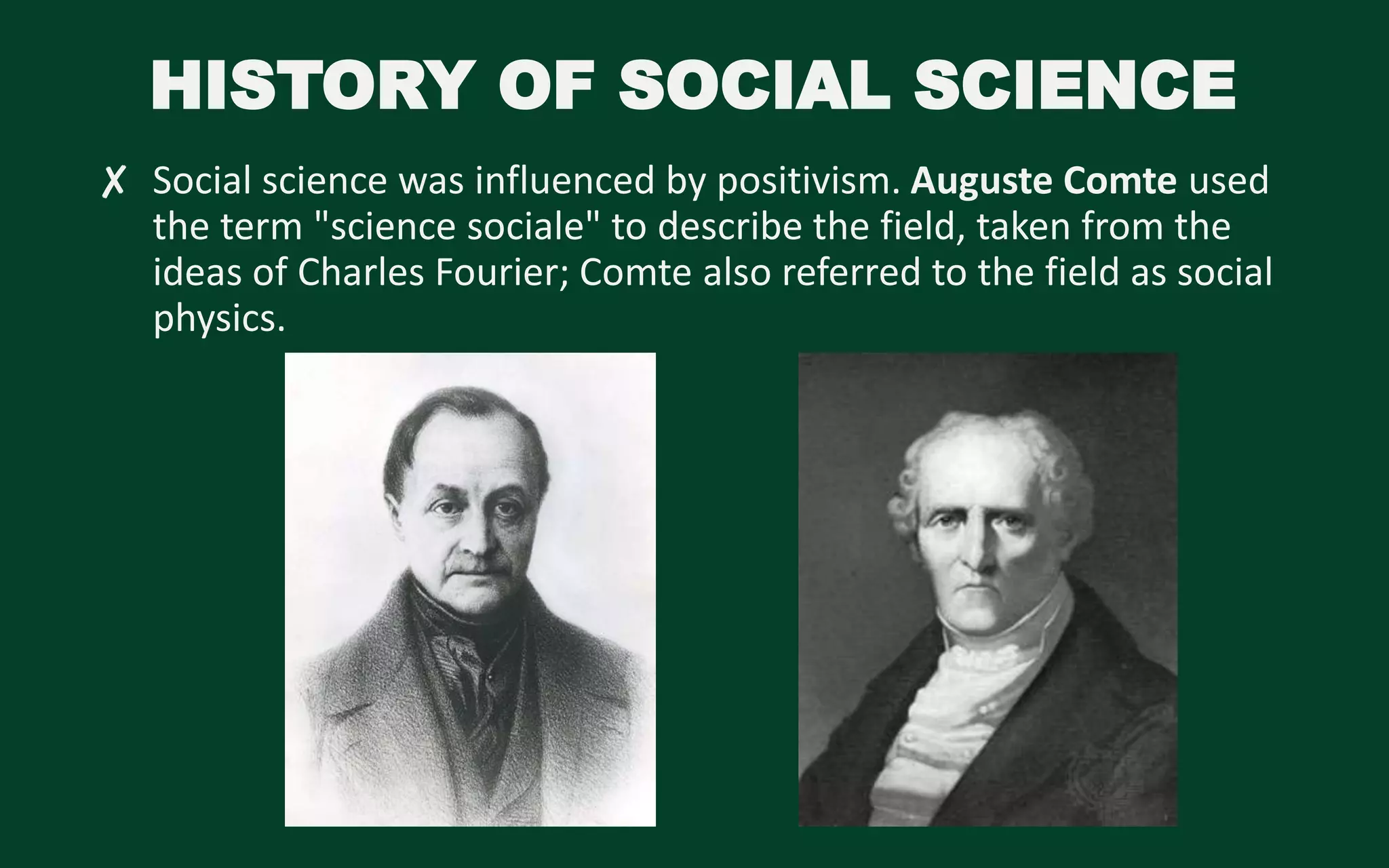
✘ Social science was influenced by positivism. Auguste Comte used
the term "science sociale" to describe the field, taken from the
ideas of Charles Fourier; Comte also referred to the field as social
physics.
HISTORY OF SOCIAL SCIENCE
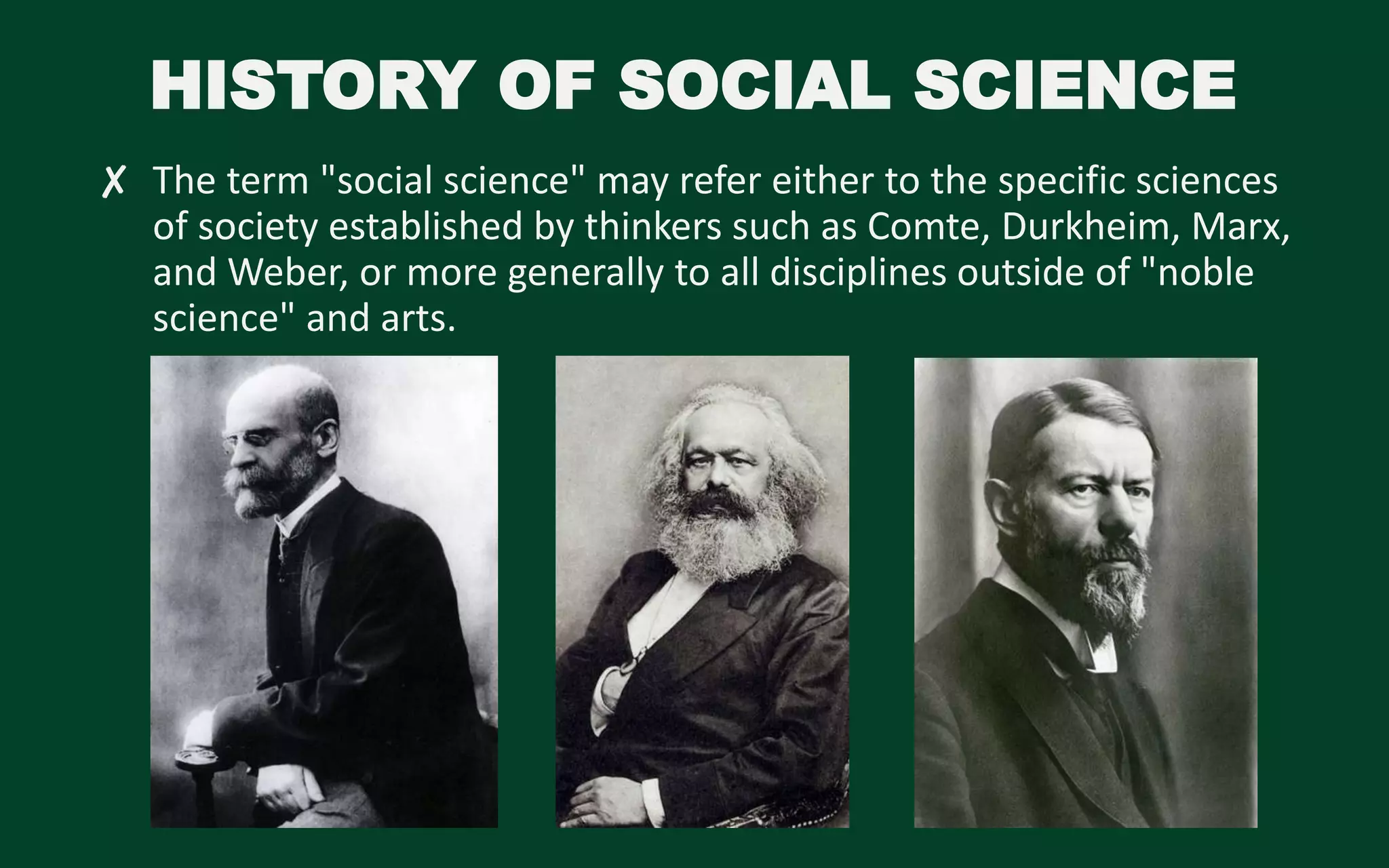
✘ The term "social science" may refer either to the specific sciences
of society established by thinkers such as Comte, Durkheim, Marx,
and Weber, or more generally to all disciplines outside of "noble
science" and arts.
Anthropology
Economics
Geography
History
Linguistics
Political Science
Psychology
Sociology
Demography
SOCIAL SCIENCE
Society
✘ Society refers to ‘a system of interrelationships which
connects individuals together’ (Giddens1990)
✘ A ‘common habitat’ or environment within which members
of a society depend on one another for survival and well-
being (Marvin Harris 1983)
✘ Society refers to a group of people who share a culture and a
territory.
✘ Socialization affects the overall cultural practices of a society
and shape one’s self-image.
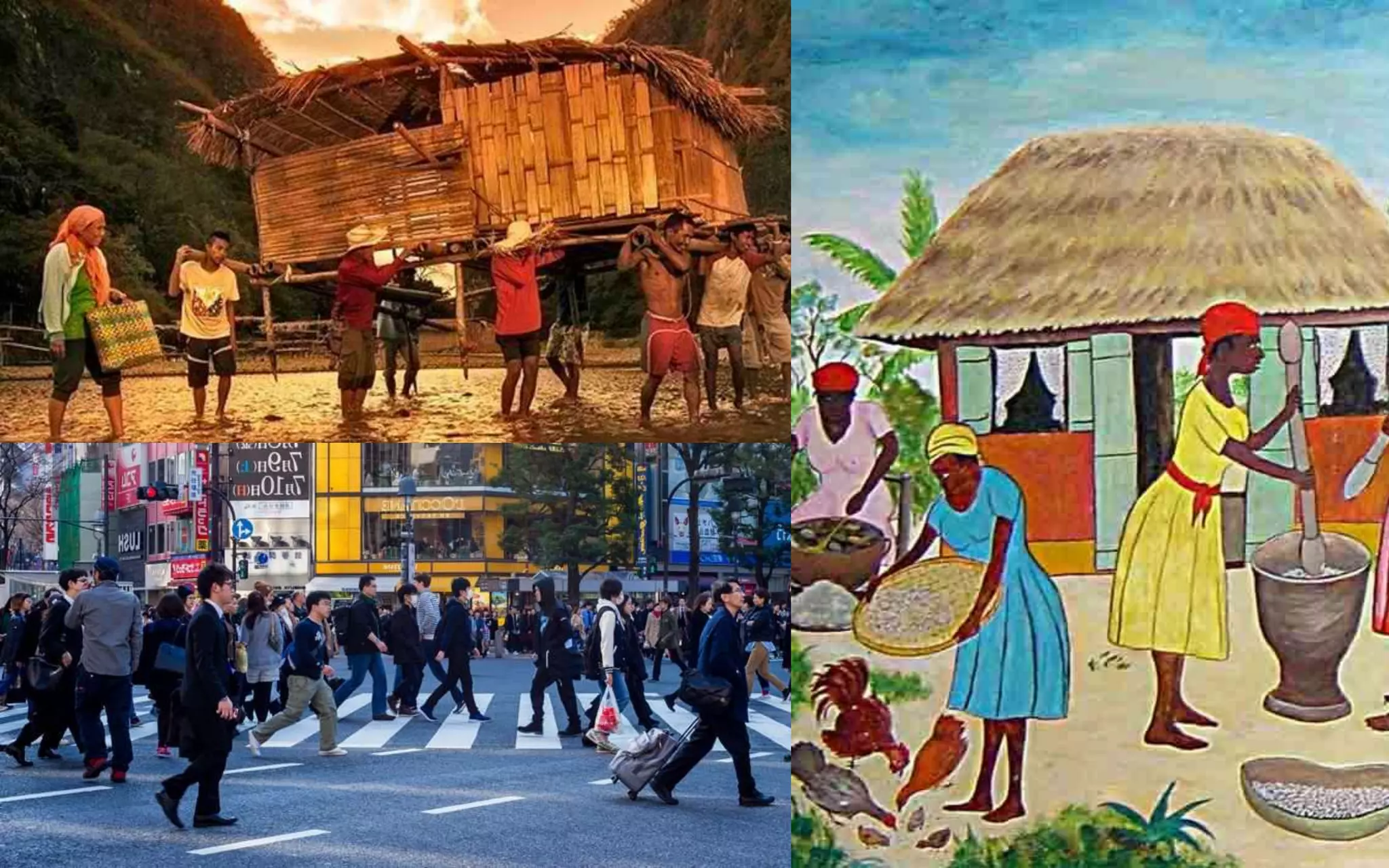
How is social science
related to society?
✘ Social sciences focus on the study of society and the
relationship among individuals within society.
What is social sciences and how can it be used to
study and understand society?
What are the roles of social science in the society?
✘ Conceptualization of the social problem - means what is the
problem affecting the society, positive or negative?
✘ Understanding the existing concepts related to the problem.
✘ Conducting the research on the problem, using scientific
methods such as inclusive sampling, classification, tabulation
and analysis then conclusion.
✘ Based on analysis and conclusion suggesting
recommendations to the problem.
✘ It is used to understand society, identify potential social
problems create an hypothesis and try and formulate
answers to those problems.
For example, our aging population.
What is
NATURAL SCIENCE?
✘ A major branch of science that deals with the description,
prediction and understanding of natural phenomena,
basically based on observational and empirical evidence.
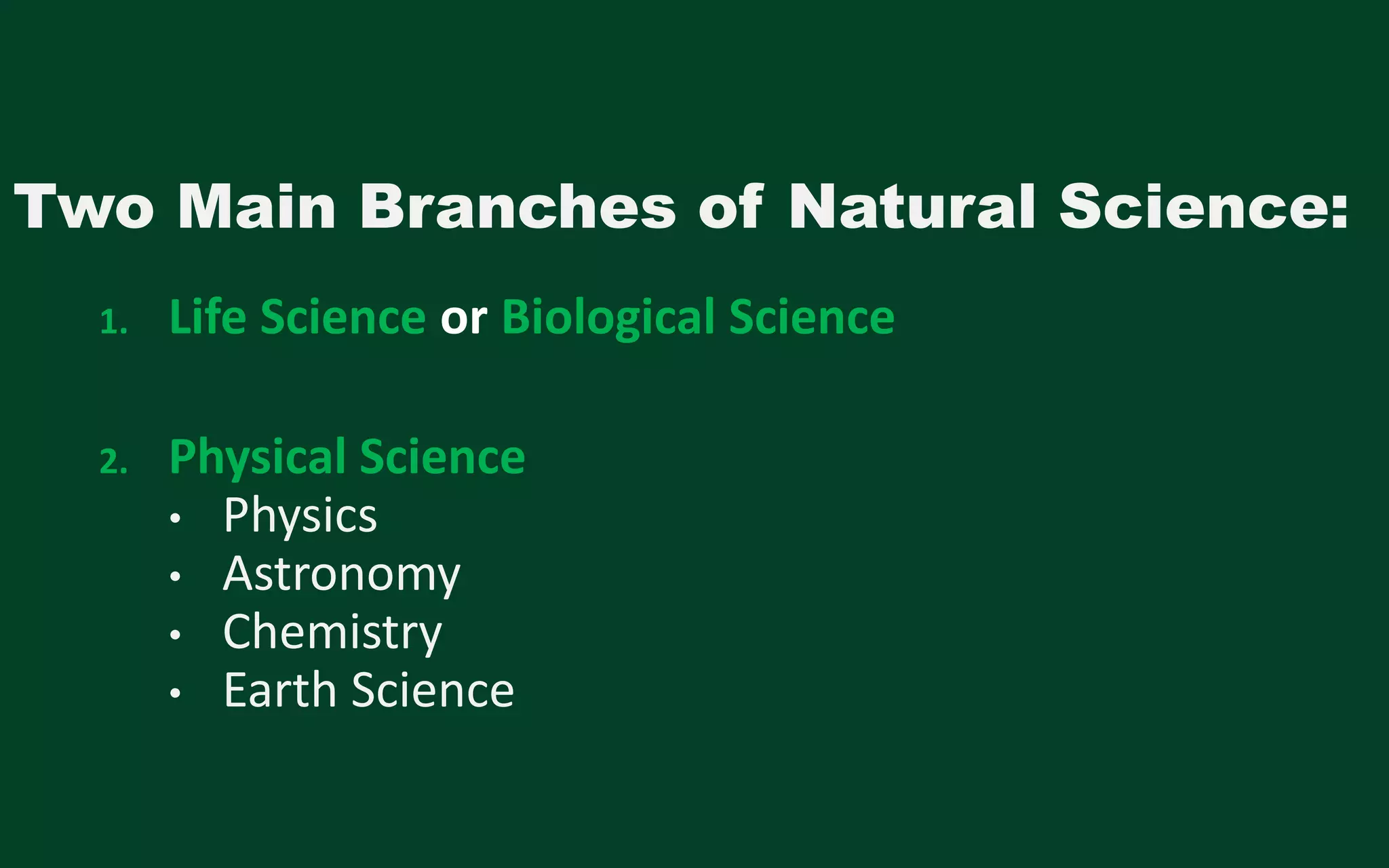
Two Main Branches of Natural Science:
1. Life Science or Biological Science
2. Physical Science
• Physics
• Astronomy
• Chemistry
• Earth Science
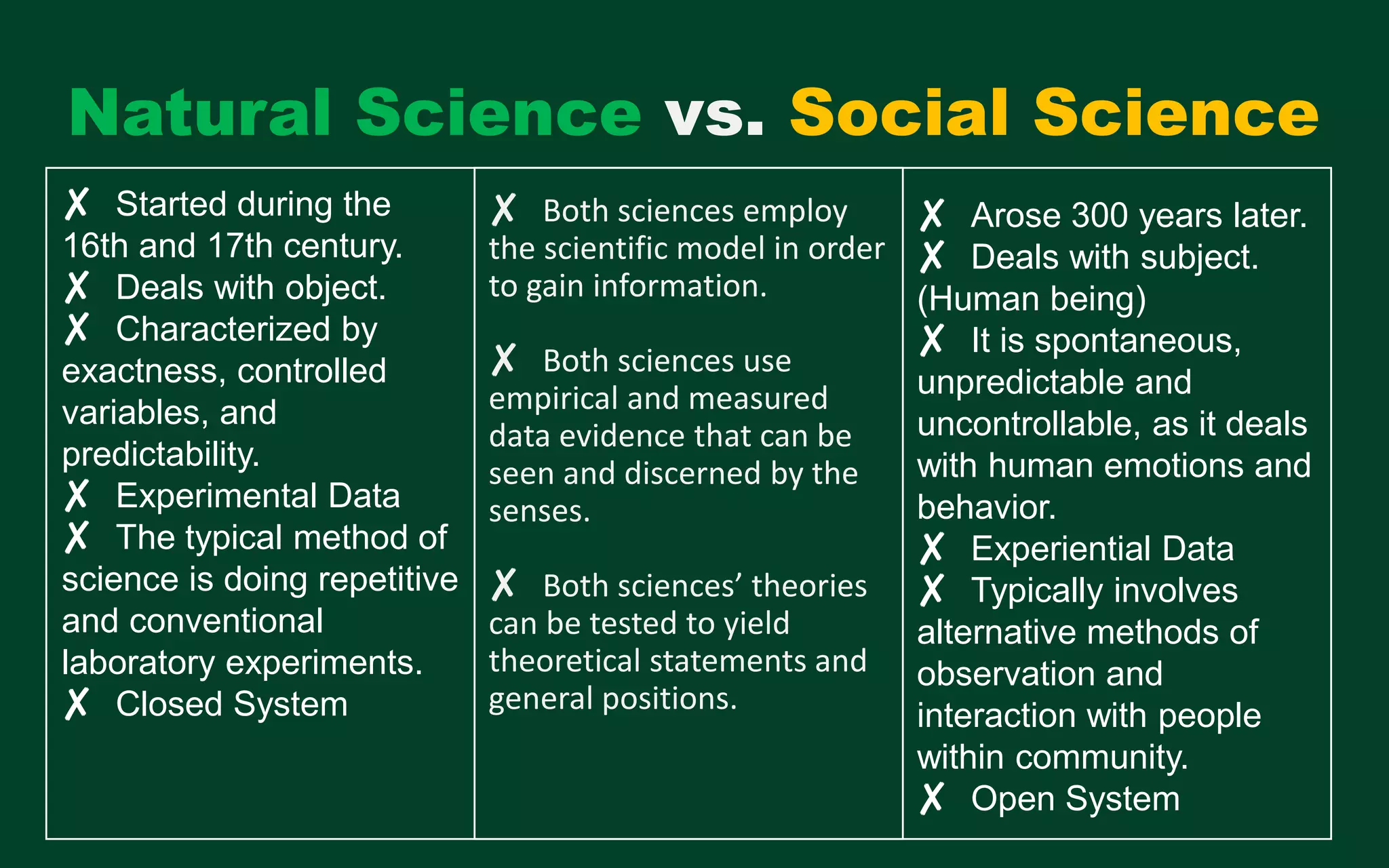
Natural Science vs. Social Science
✘ Both sciences employ
the scientific model in order
to gain information.
✘ Both sciences use
empirical and measured
data evidence that can be
seen and discerned by the
senses.
✘ Both sciences’ theories
can be tested to yield
theoretical statements and
general positions.
✘ Arose 300 years later.
✘ Deals with subject.
(Human being)
✘ It is spontaneous,
unpredictable and
uncontrollable, as it deals
with human emotions and
behavior.
✘ Experiential Data
✘ Typically involves
alternative methods of
observation and
interaction with people
within community.
✘ Open System
✘ Started during the
16th and 17th century.
✘ Deals with object.
✘ Characterized by
exactness, controlled
variables, and
predictability.
✘ Experimental Data
✘ The typical method of
science is doing repetitive
and conventional
laboratory experiments.
✘ Closed System
How natural
science can be used in our
daily lives?
What is HUMANITIES?
✘ Refers to the study of the ways in which the human
experience is processed and documented.
✘ Encompasses the field of philosophy, literature, religion, art,
music, history, and language.
Humanities vs. Social Science
✘ Both the humanities
and social science
are concerned with
human aspects like,
law, politics,
linguistics,
economics, and
psychology.
✘ Both the humanities
and social sciences
are concerned with
human lives and
nature.
✘ Influence by and
developed after the
French revolution and
the industrial
revolution.
✘ Social science deal
with more scientific
approach.
✘ Involves application of
an empirical, rational,
and objective
methodology (such as
the use of validity and
reliability test) to
present facts.
✘ Emerged in the 15th
century.
✘ Humanities involved a
more of a scientific
approach.
✘ Deemed to be more
philosophical and
concerned with
heritage and the
question of what
makes us human.
Comprise application
of an interpretative
methodology.
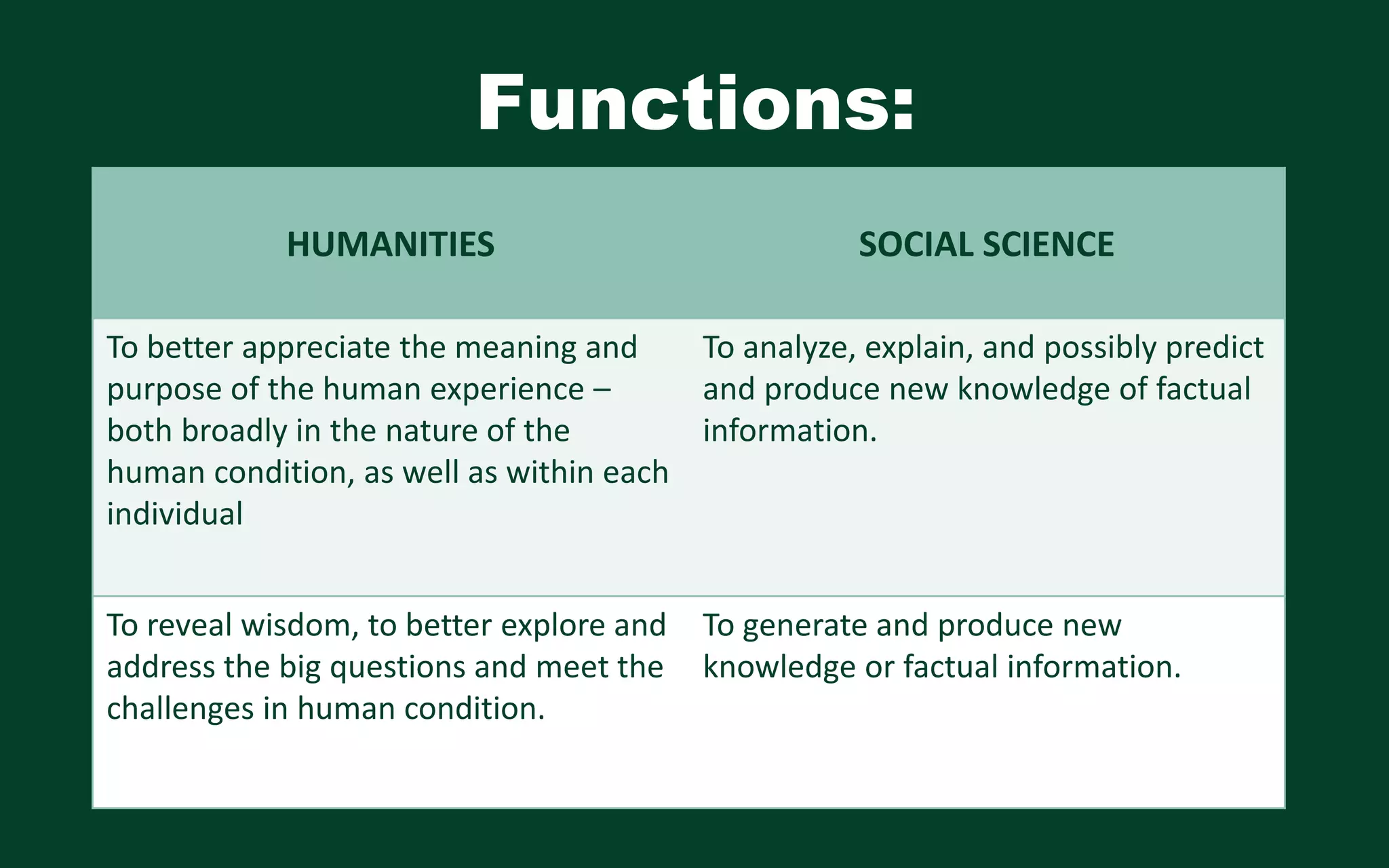
Functions:
HUMANITIES SOCIAL SCIENCE
To better appreciate the meaning and
purpose of the human experience –
both broadly in the nature of the
human condition, as well as within each
individual
To analyze, explain, and possibly predict
and produce new knowledge of factual
information.
To reveal wisdom, to better explore and
address the big questions and meet the
challenges in human condition.
To generate and produce new
knowledge or factual information.
How can humanities be applied to
our daily living?
1. What are the different cultures and
traditions in the Philippines?
2. Are cultures and traditions related to
people? If yes, how?
---

Diss lesson-1-defining-social-science-as-a-study-of-society

  • 1.
    DISCIPLINES AND IDEAS INSOCIAL SCIENCES Prepared by: Ms. Mary Joy Adelfa P. Dailo, LPT “Defining Social Sciences as the Study of Society”
  • 2.
    ✘ The socialsciences have a critical contribution to make, in helping us understand, imagine, and craft a more sustainable future for all.” - UNESCO
  • 3.
    Who I am HowI behave with others.
  • 4.
    Practical Ways ofCategorizing Human Knowledge Humanities Natural Science Social Science
  • 5.
  • 6.
    ✘ Any disciplineor branch of science that deals with human behavior in its social and cultural aspects. ✘ Social science is an academic discipline concerned with society and the relationships among individuals within a society, which often rely primarily on empirical approaches.
  • 7.
    ✘ Social Sciencesare those disciplines that study (a) Institutions and functioning of human society and the interpersonal relationships of individuals as members of society; (b) A particular phase or aspect of human society.
  • 8.
    HISTORY OF SOCIALSCIENCE ✘ The history of the social sciences begins in the Age of Enlightenment after 1650. ✘ The social sciences developed from the sciences (experimental and applied), or the systematic knowledge- bases or prescriptive practices, relating to the social improvement of a group of interacting entities.
  • 9.
    HISTORY OF SOCIALSCIENCE ✘ Social science was influenced by positivism. Auguste Comte used the term "science sociale" to describe the field, taken from the ideas of Charles Fourier; Comte also referred to the field as social physics.
  • 10.
    HISTORY OF SOCIALSCIENCE ✘ The term "social science" may refer either to the specific sciences of society established by thinkers such as Comte, Durkheim, Marx, and Weber, or more generally to all disciplines outside of "noble science" and arts.
  • 11.
  • 13.
    Society ✘ Society refersto ‘a system of interrelationships which connects individuals together’ (Giddens1990) ✘ A ‘common habitat’ or environment within which members of a society depend on one another for survival and well- being (Marvin Harris 1983) ✘ Society refers to a group of people who share a culture and a territory. ✘ Socialization affects the overall cultural practices of a society and shape one’s self-image.
  • 14.
    How is socialscience related to society?
  • 15.
    ✘ Social sciencesfocus on the study of society and the relationship among individuals within society.
  • 16.
    What is socialsciences and how can it be used to study and understand society? What are the roles of social science in the society?
  • 17.
    ✘ Conceptualization ofthe social problem - means what is the problem affecting the society, positive or negative? ✘ Understanding the existing concepts related to the problem. ✘ Conducting the research on the problem, using scientific methods such as inclusive sampling, classification, tabulation and analysis then conclusion. ✘ Based on analysis and conclusion suggesting recommendations to the problem. ✘ It is used to understand society, identify potential social problems create an hypothesis and try and formulate answers to those problems. For example, our aging population.
  • 18.
  • 19.
    ✘ A majorbranch of science that deals with the description, prediction and understanding of natural phenomena, basically based on observational and empirical evidence.
  • 20.
    Two Main Branchesof Natural Science: 1. Life Science or Biological Science 2. Physical Science • Physics • Astronomy • Chemistry • Earth Science
  • 21.
    Natural Science vs.Social Science ✘ Both sciences employ the scientific model in order to gain information. ✘ Both sciences use empirical and measured data evidence that can be seen and discerned by the senses. ✘ Both sciences’ theories can be tested to yield theoretical statements and general positions. ✘ Arose 300 years later. ✘ Deals with subject. (Human being) ✘ It is spontaneous, unpredictable and uncontrollable, as it deals with human emotions and behavior. ✘ Experiential Data ✘ Typically involves alternative methods of observation and interaction with people within community. ✘ Open System ✘ Started during the 16th and 17th century. ✘ Deals with object. ✘ Characterized by exactness, controlled variables, and predictability. ✘ Experimental Data ✘ The typical method of science is doing repetitive and conventional laboratory experiments. ✘ Closed System
  • 22.
    How natural science canbe used in our daily lives?
  • 23.
  • 24.
    ✘ Refers tothe study of the ways in which the human experience is processed and documented. ✘ Encompasses the field of philosophy, literature, religion, art, music, history, and language.
  • 25.
    Humanities vs. SocialScience ✘ Both the humanities and social science are concerned with human aspects like, law, politics, linguistics, economics, and psychology. ✘ Both the humanities and social sciences are concerned with human lives and nature. ✘ Influence by and developed after the French revolution and the industrial revolution. ✘ Social science deal with more scientific approach. ✘ Involves application of an empirical, rational, and objective methodology (such as the use of validity and reliability test) to present facts. ✘ Emerged in the 15th century. ✘ Humanities involved a more of a scientific approach. ✘ Deemed to be more philosophical and concerned with heritage and the question of what makes us human. Comprise application of an interpretative methodology.
  • 26.
    Functions: HUMANITIES SOCIAL SCIENCE Tobetter appreciate the meaning and purpose of the human experience – both broadly in the nature of the human condition, as well as within each individual To analyze, explain, and possibly predict and produce new knowledge of factual information. To reveal wisdom, to better explore and address the big questions and meet the challenges in human condition. To generate and produce new knowledge or factual information.
  • 27.
    How can humanitiesbe applied to our daily living?
  • 28.
    1. What arethe different cultures and traditions in the Philippines? 2. Are cultures and traditions related to people? If yes, how?
  • 29.