GEC 1 UNDERSTANDING THE SELF
Module 1 (Week 1 to Week 2)
 A Philosophical Journey to Discovering the Self
Prepared by: Nancy Jane D. Victorino, RPm, LPT
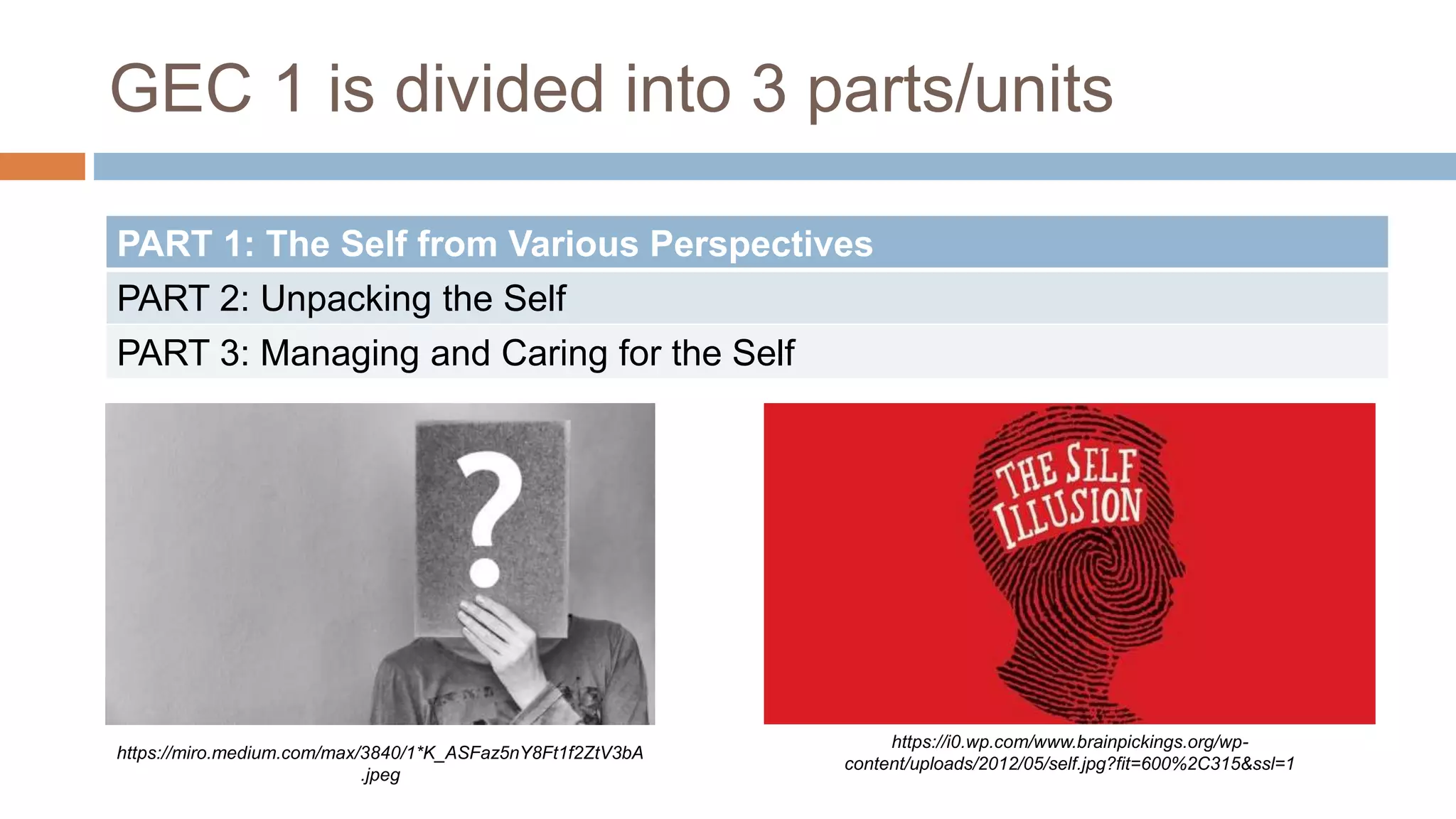
GEC 1 is divided into 3 parts/units
PART 1: The Self from Various Perspectives
PART 2: Unpacking the Self
PART 3: Managing and Caring for the Self
https://miro.medium.com/max/3840/1*K_ASFaz5nY8Ft1f2ZtV3bA
.jpeg
https://i0.wp.com/www.brainpickings.org/wp-
content/uploads/2012/05/self.jpg?fit=600%2C315&ssl=1
Main References & Where You Can Get
Them
 Martin, R., Barresi, J. (2006). The Rise and Fall of Soul and Self: An
Intellectual History of Personal Identity. Columbia University Press.
(available for download at b-ok.asia)
 Coulmas, F. (2019). Identity: A Very Short Introduction. Oxford University
Press. (available for download at b-ok.asia)
b-ok.asia
(5 downloads per day)
The Self from Various Perspectives
A Philosophical Journey to Discovering the Self –
Socrates, Plato, Augustine, Descartes, Locke, Hume,
Kant, Freud, Ryle, Churchland, Merleau-Ponty.
https://www.pinclipart.com/picdir/middle/0-
2089_arrow-clip-art-arrow-clip-art-
transparent-background.png https://dfcby4322olzt.cloudfront.net/wp-content/uploads/2014/04/basicsFeatured1.png
DISCUSSION
CILO (Course Intended Learning Outcome/s):
 Describe the different philosophical perspectives of the self
from various philosophers.
 Evaluate the importance of having different philosophical
perspectives of the self.
 Practice wider understanding of different point of views of
people based on the various philosophical perspectives.
I. From Myth to Science
https://www.kalw.org/sites/kalw/files/styles/medium/public/201606
/Self-deception.jpg
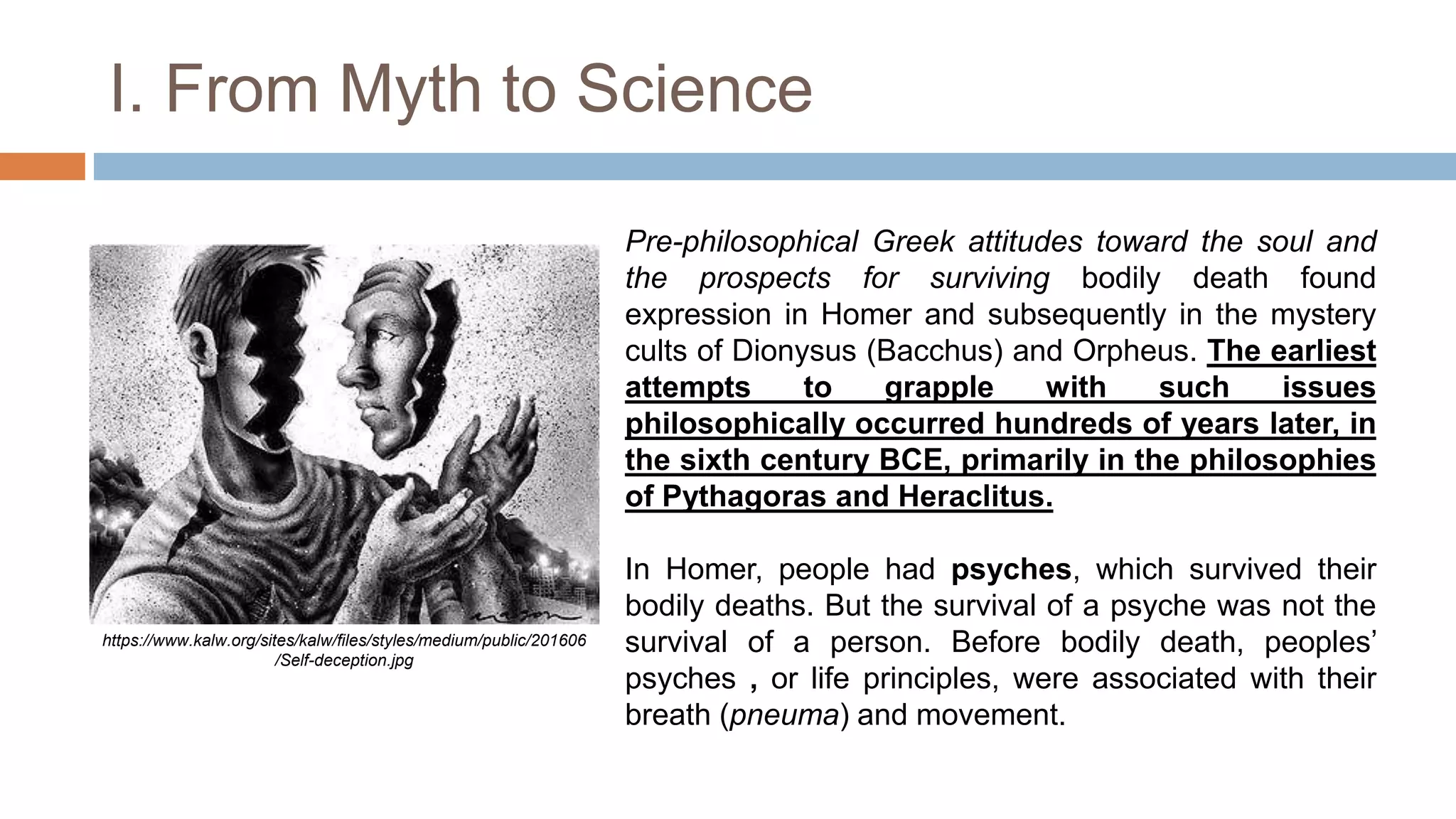
Pre-philosophical Greek attitudes toward the soul and
the prospects for surviving bodily death found
expression in Homer and subsequently in the mystery
cults of Dionysus (Bacchus) and Orpheus. The earliest
attempts to grapple with such issues
philosophically occurred hundreds of years later, in
the sixth century BCE, primarily in the philosophies
of Pythagoras and Heraclitus.
In Homer, people had psyches, which survived their
bodily deaths. But the survival of a psyche was not the
survival of a person. Before bodily death, peoples’
psyches , or life principles, were associated with their
breath (pneuma) and movement.
I. SOCRATES (470 – 399 BC) “father of western
philosophy”
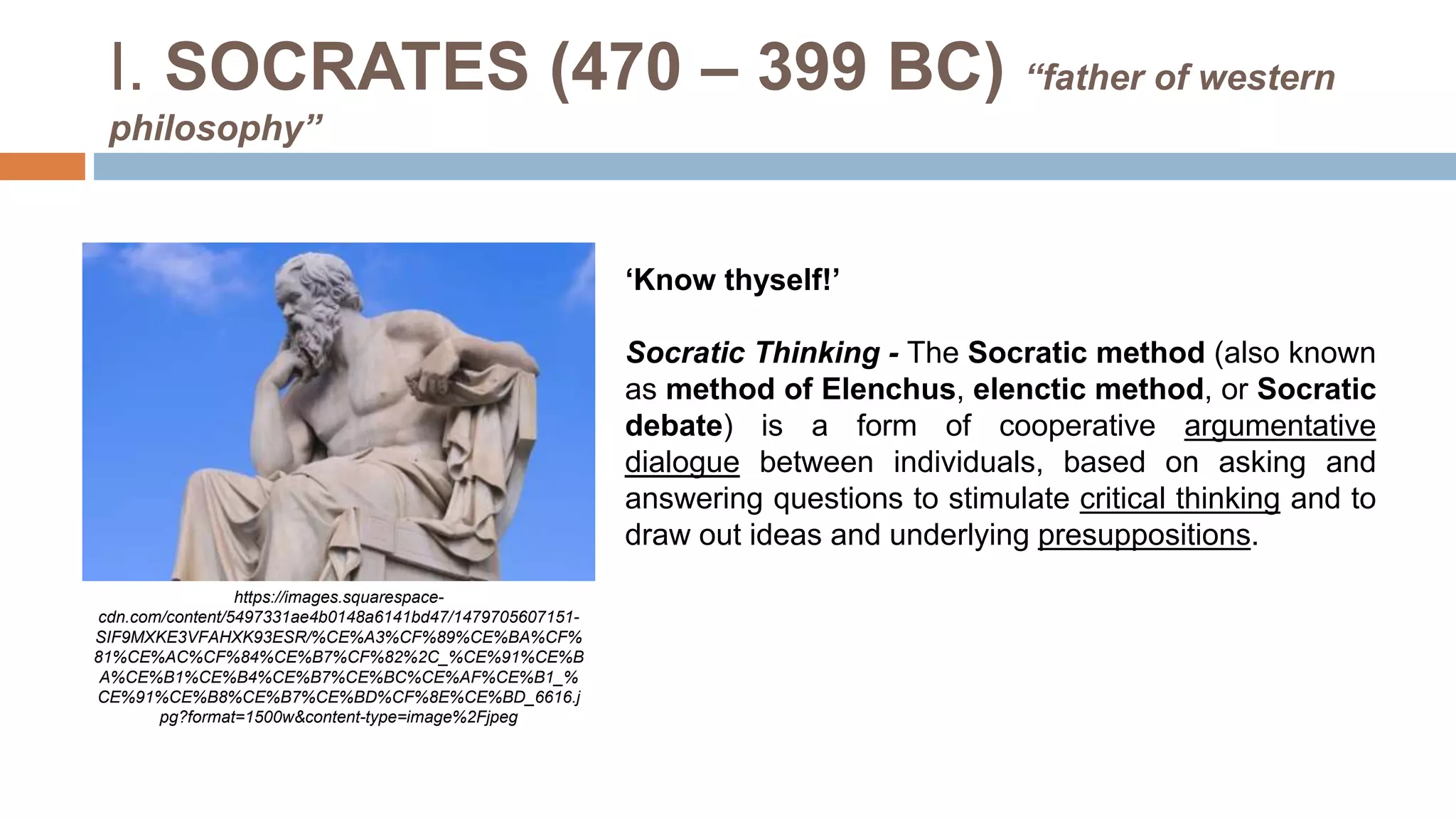
‘Know thyself!’
Socratic Thinking - The Socratic method (also known
as method of Elenchus, elenctic method, or Socratic
debate) is a form of cooperative argumentative
dialogue between individuals, based on asking and
answering questions to stimulate critical thinking and to
draw out ideas and underlying presuppositions.
https://images.squarespace-
cdn.com/content/5497331ae4b0148a6141bd47/1479705607151-
SIF9MXKE3VFAHXK93ESR/%CE%A3%CF%89%CE%BA%CF%
81%CE%AC%CF%84%CE%B7%CF%82%2C_%CE%91%CE%B
A%CE%B1%CE%B4%CE%B7%CE%BC%CE%AF%CE%B1_%
CE%91%CE%B8%CE%B7%CE%BD%CF%8E%CE%BD_6616.j
pg?format=1500w&content-type=image%2Fjpeg
I. PLATO (428 – 348 BC)
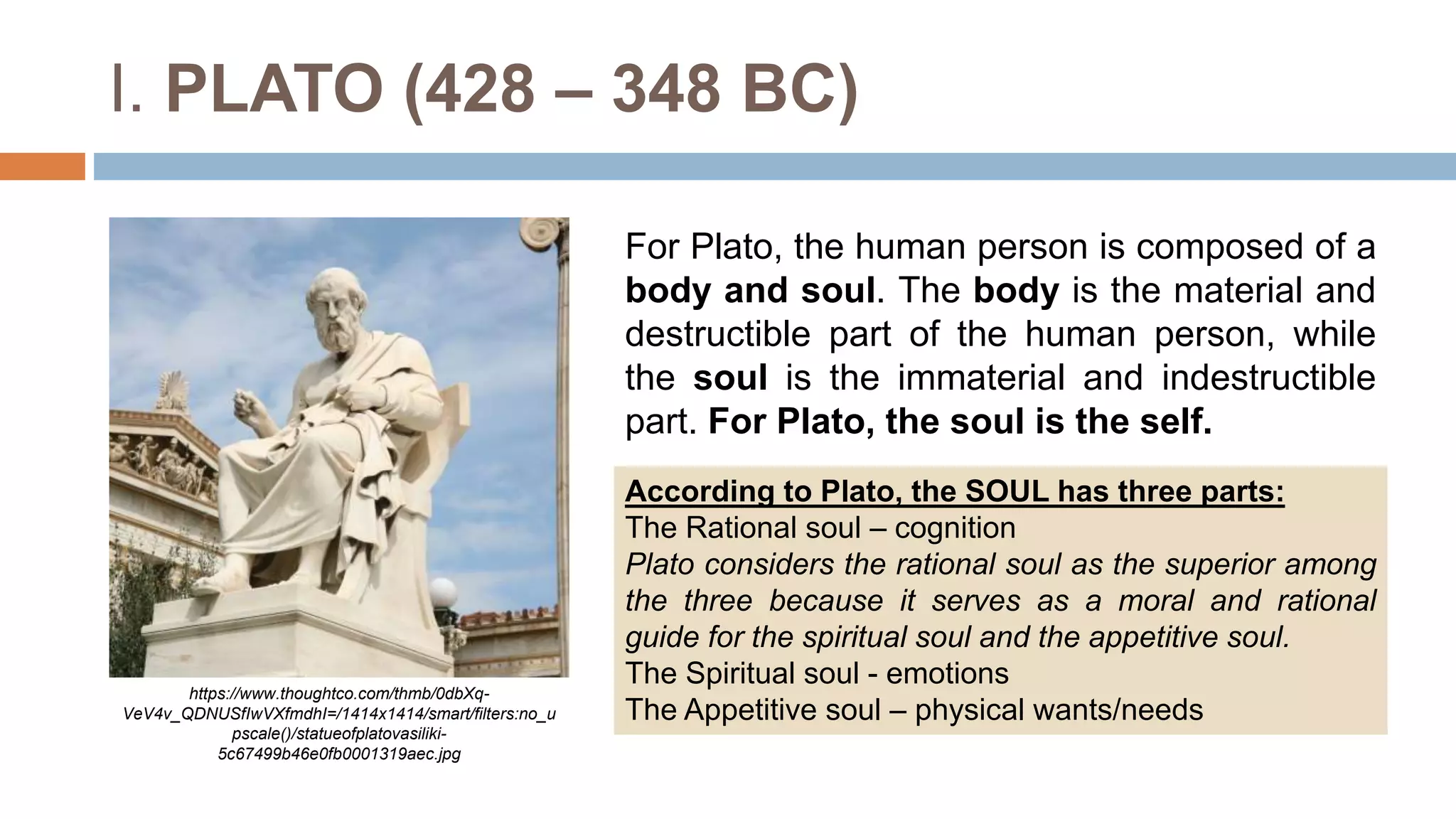
For Plato, the human person is composed of a
body and soul. The body is the material and
destructible part of the human person, while
the soul is the immaterial and indestructible
part. For Plato, the soul is the self.
https://www.thoughtco.com/thmb/0dbXq-
VeV4v_QDNUSfIwVXfmdhI=/1414x1414/smart/filters:no_u
pscale()/statueofplatovasiliki-
5c67499b46e0fb0001319aec.jpg
According to Plato, the SOUL has three parts:
The Rational soul – cognition
Plato considers the rational soul as the superior among
the three because it serves as a moral and rational
guide for the spiritual soul and the appetitive soul.
The Spiritual soul - emotions
The Appetitive soul – physical wants/needs
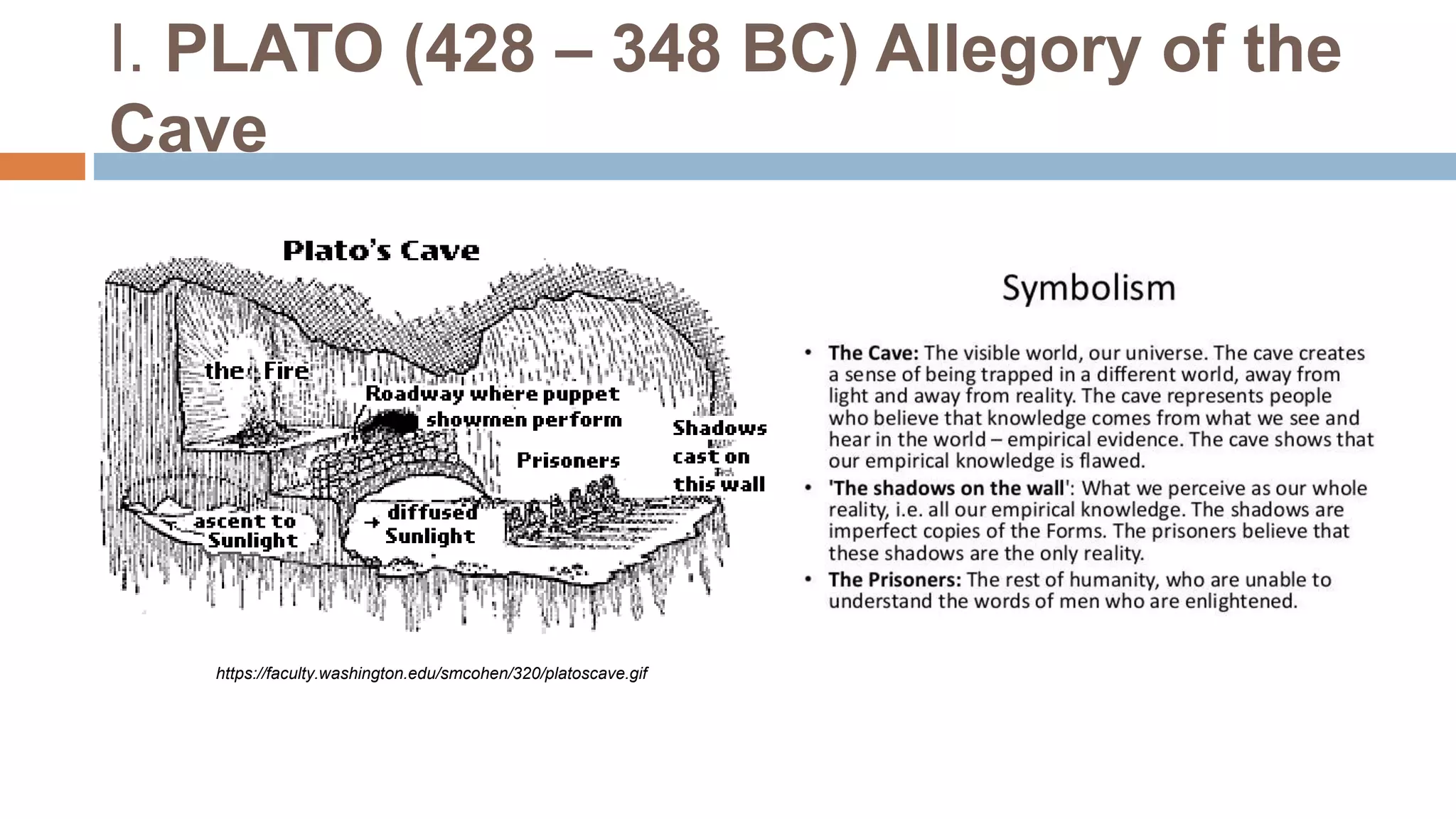
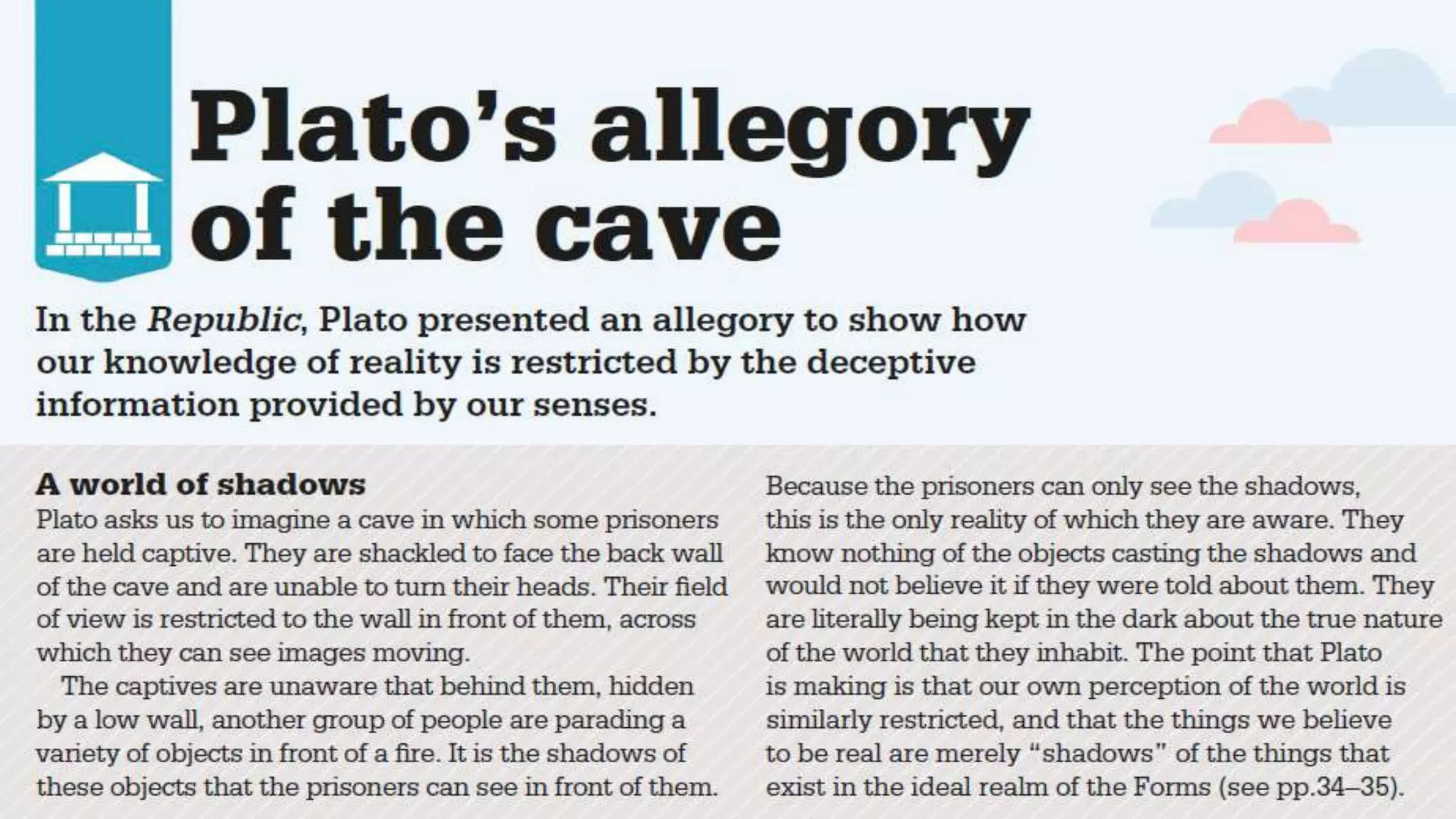
I. PLATO (428 – 348 BC) Allegory of the
Cave
https://faculty.washington.edu/smcohen/320/platoscave.gif
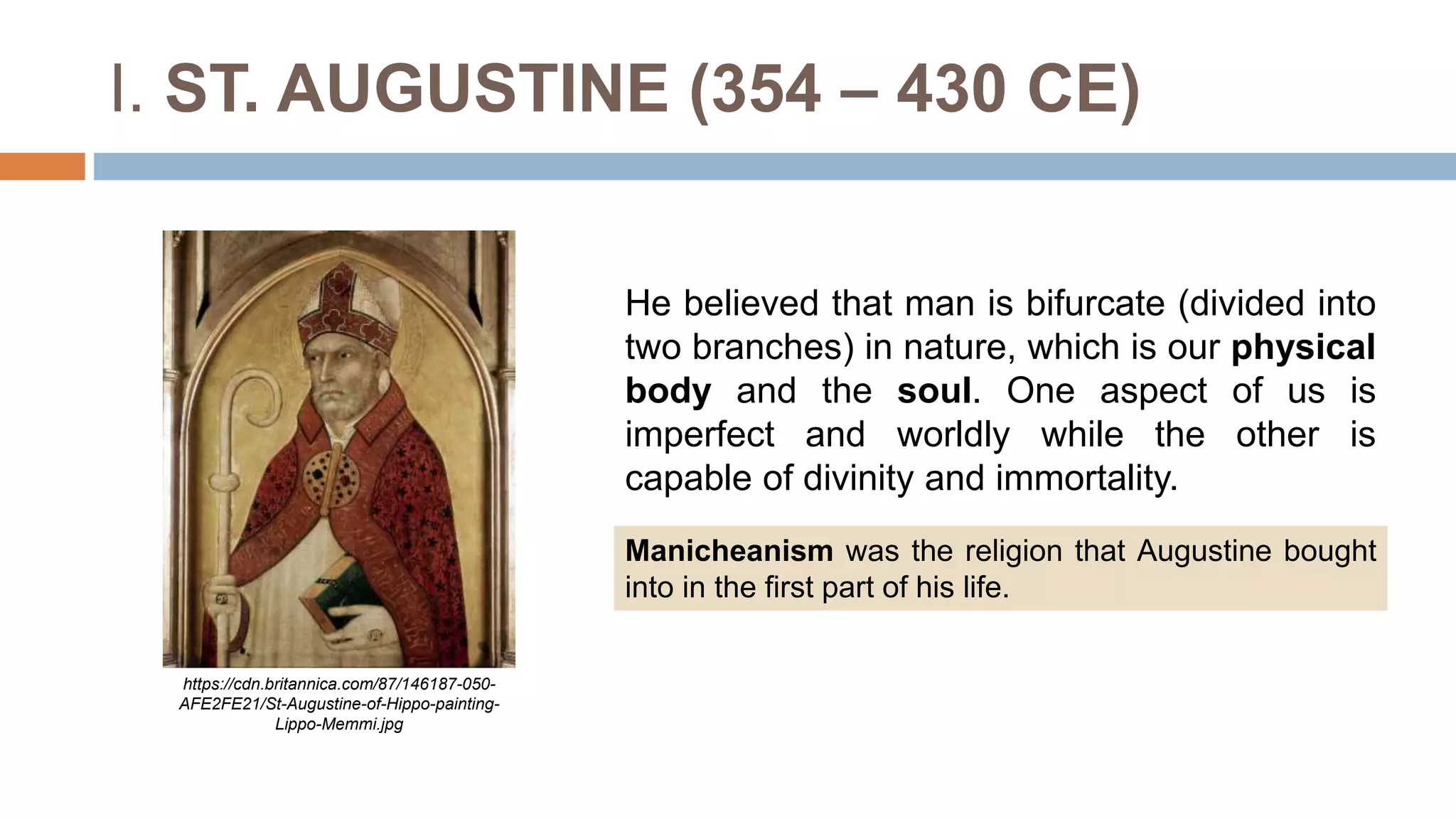
I. ST. AUGUSTINE (354 – 430 CE)
He believed that man is bifurcate (divided into
two branches) in nature, which is our physical
body and the soul. One aspect of us is
imperfect and worldly while the other is
capable of divinity and immortality.
https://cdn.britannica.com/87/146187-050-
AFE2FE21/St-Augustine-of-Hippo-painting-
Lippo-Memmi.jpg
Manicheanism was the religion that Augustine bought
into in the first part of his life.
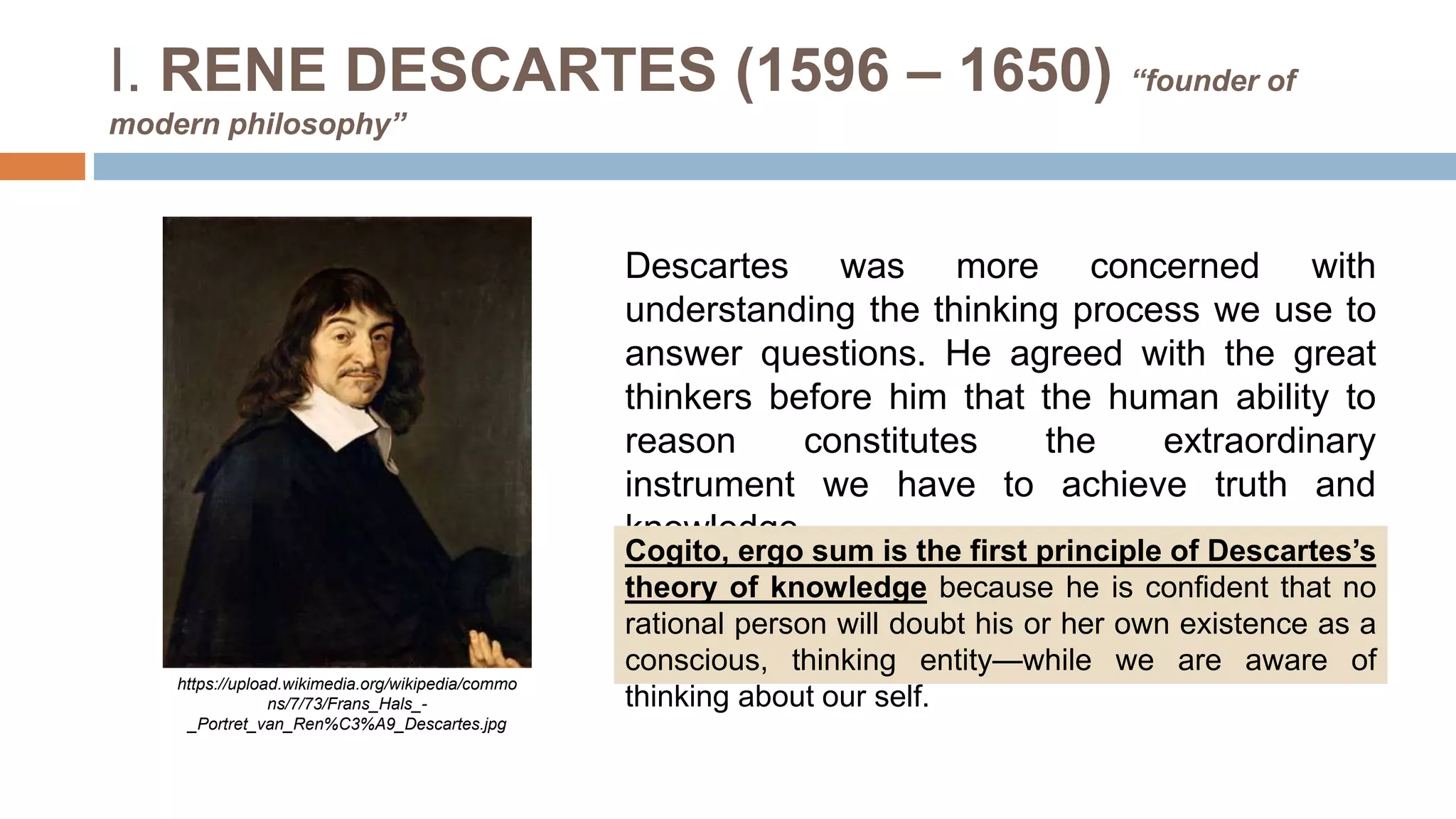
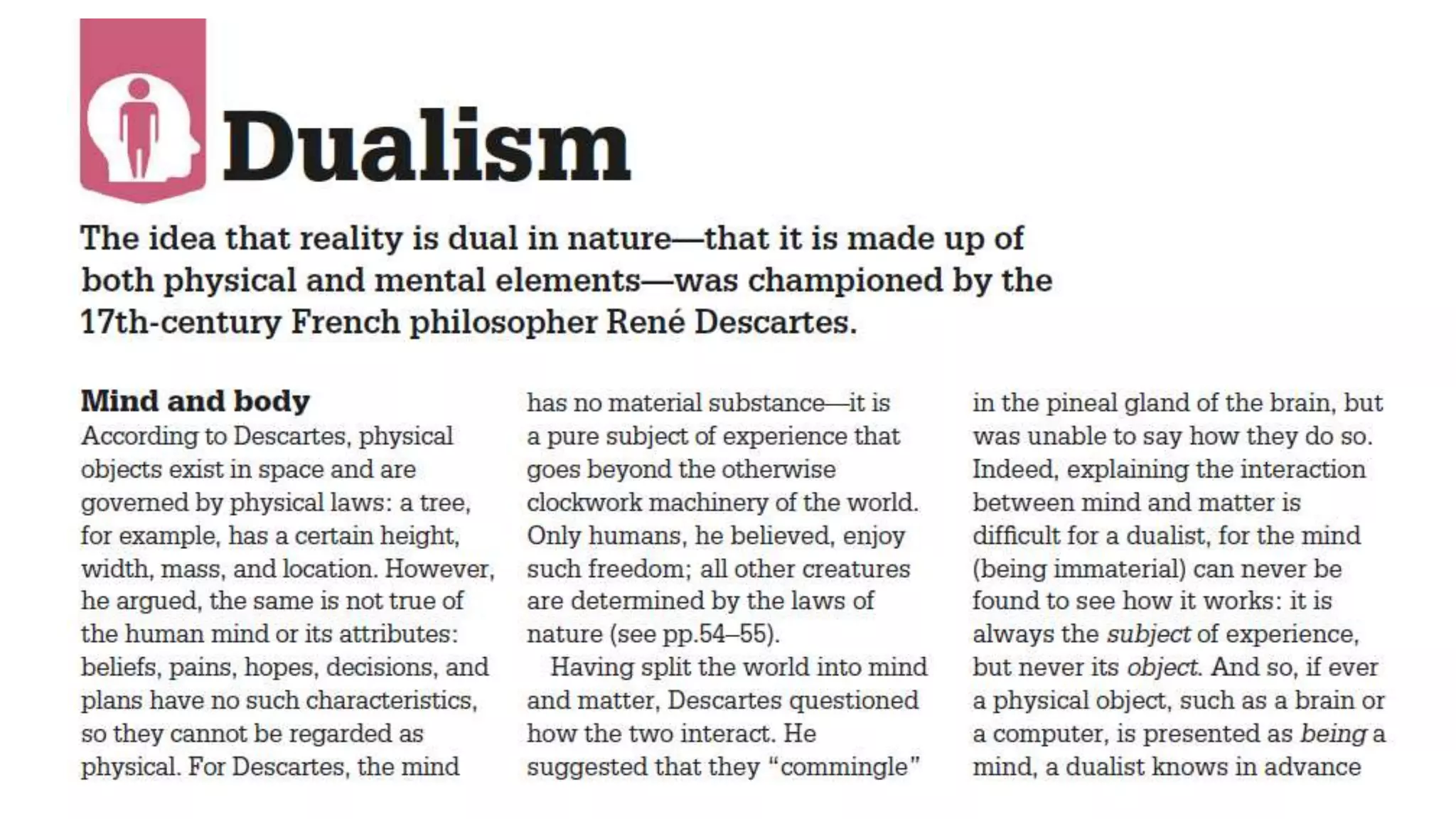
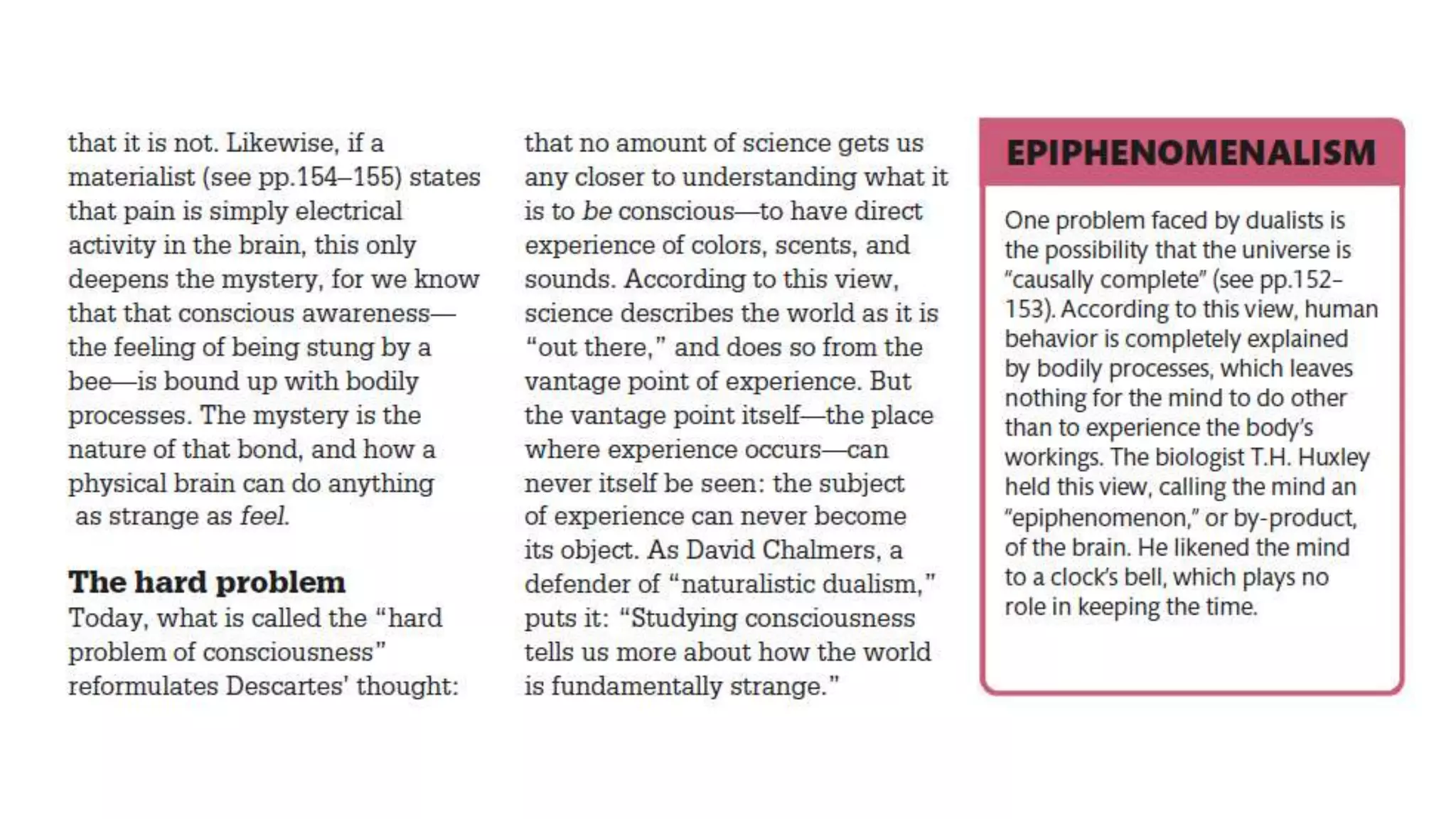
I. RENE DESCARTES (1596 – 1650) “founder of
modern philosophy”
Descartes was more concerned with
understanding the thinking process we use to
answer questions. He agreed with the great
thinkers before him that the human ability to
reason constitutes the extraordinary
instrument we have to achieve truth and
knowledge.
https://upload.wikimedia.org/wikipedia/commo
ns/7/73/Frans_Hals_-
_Portret_van_Ren%C3%A9_Descartes.jpg
Cogito, ergo sum is the first principle of Descartes’s
theory of knowledge because he is confident that no
rational person will doubt his or her own existence as a
conscious, thinking entity—while we are aware of
thinking about our self.
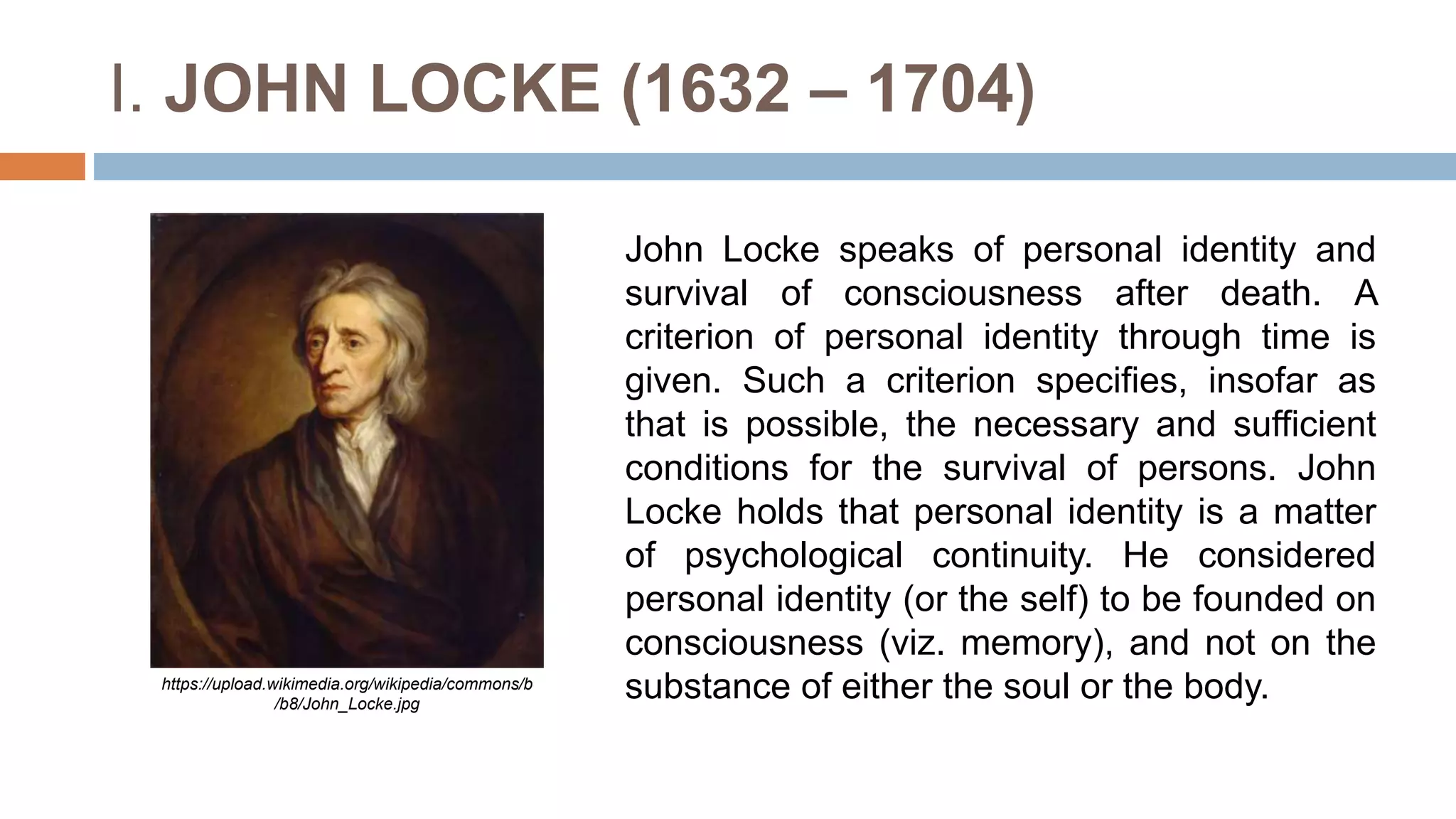
I. JOHN LOCKE (1632 – 1704)
John Locke speaks of personal identity and
survival of consciousness after death. A
criterion of personal identity through time is
given. Such a criterion specifies, insofar as
that is possible, the necessary and sufficient
conditions for the survival of persons. John
Locke holds that personal identity is a matter
of psychological continuity. He considered
personal identity (or the self) to be founded on
consciousness (viz. memory), and not on the
substance of either the soul or the body.
https://upload.wikimedia.org/wikipedia/commons/b
/b8/John_Locke.jpg
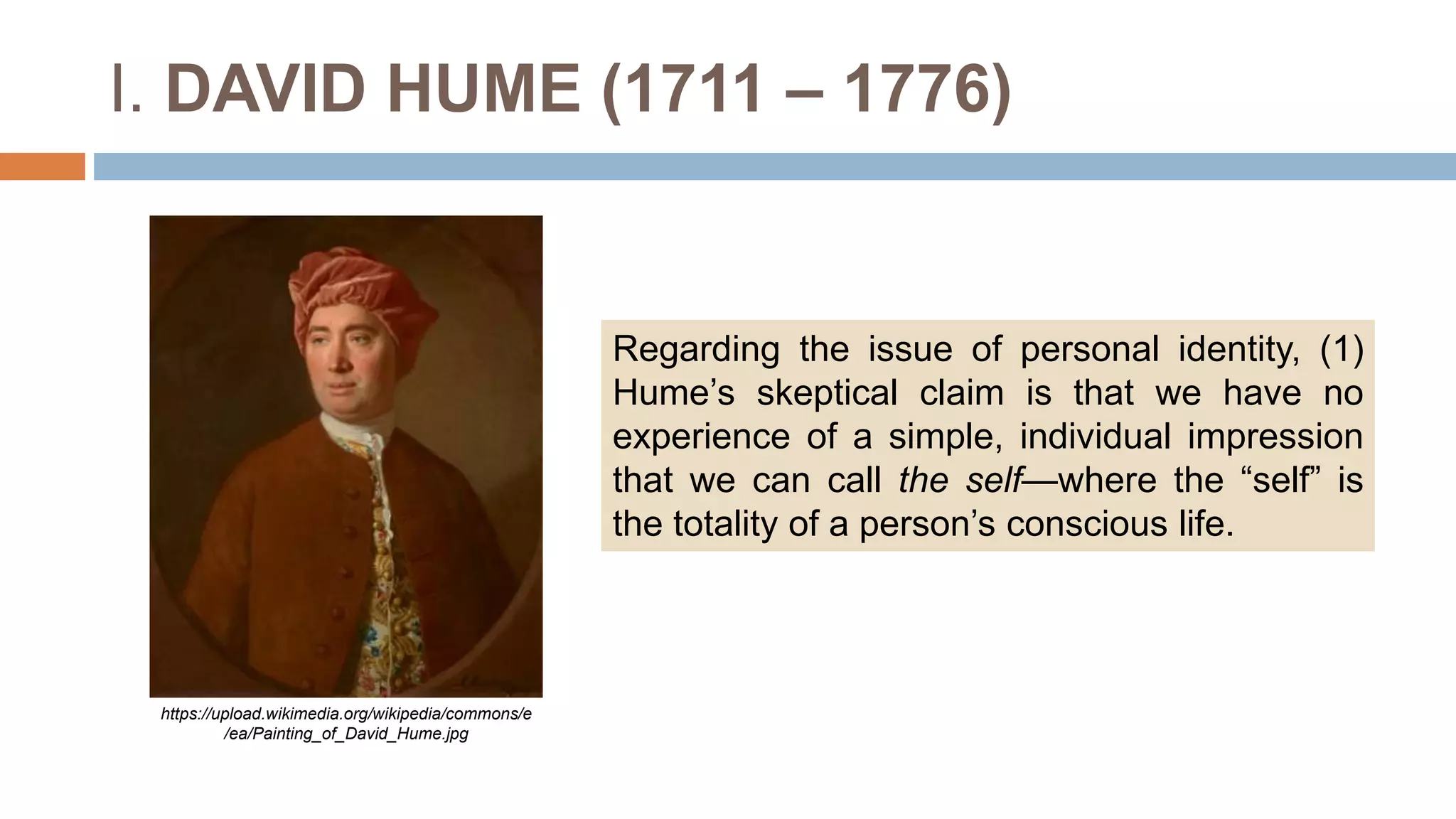
I. DAVID HUME (1711 – 1776)
Regarding the issue of personal identity, (1)
Hume’s skeptical claim is that we have no
experience of a simple, individual impression
that we can call the self—where the “self” is
the totality of a person’s conscious life.
https://upload.wikimedia.org/wikipedia/commons/e
/ea/Painting_of_David_Hume.jpg
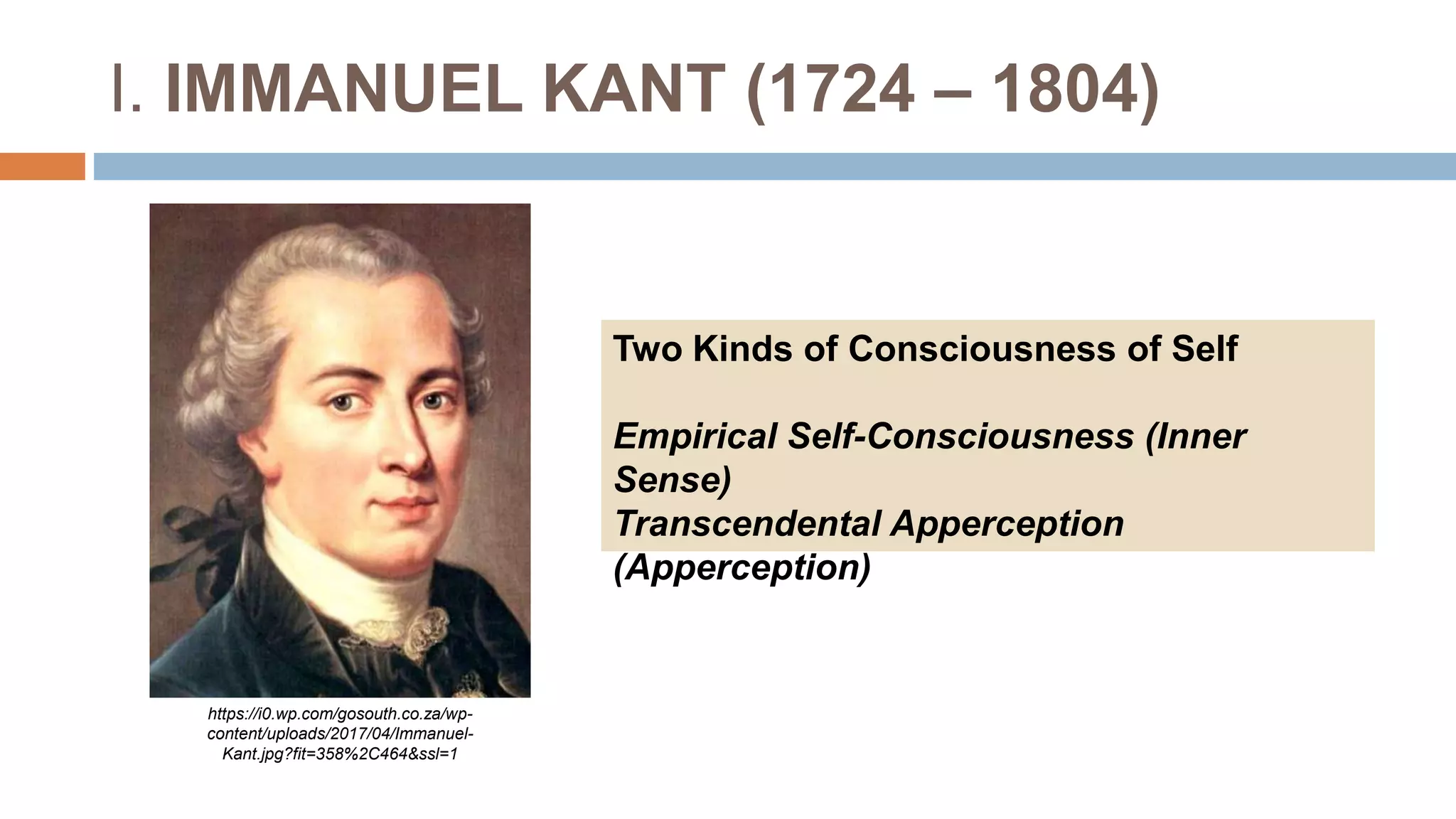
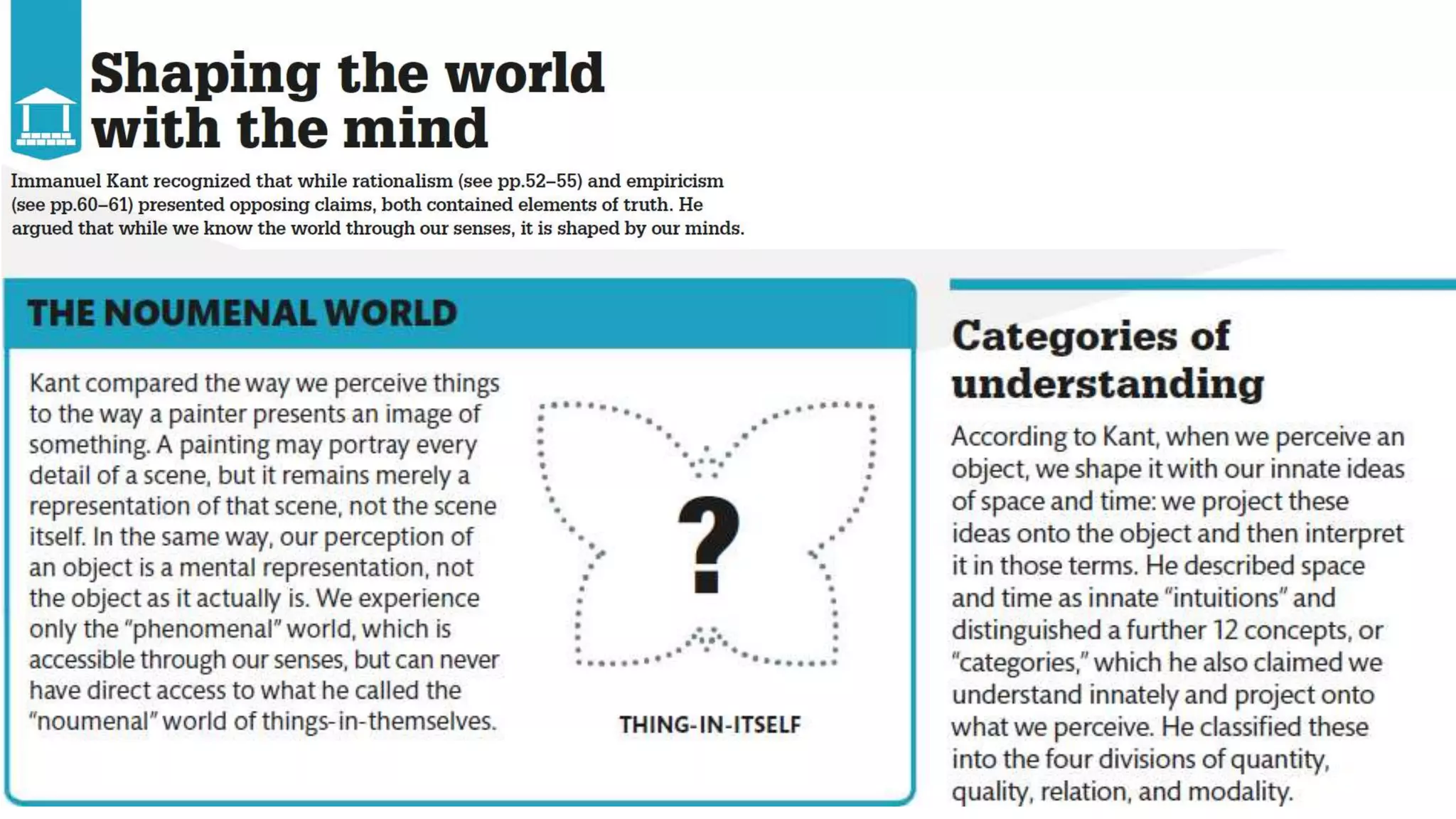
I. IMMANUEL KANT (1724 – 1804)
Two Kinds of Consciousness of Self
Empirical Self-Consciousness (Inner
Sense)
Transcendental Apperception
(Apperception)
https://i0.wp.com/gosouth.co.za/wp-
content/uploads/2017/04/Immanuel-
Kant.jpg?fit=358%2C464&ssl=1
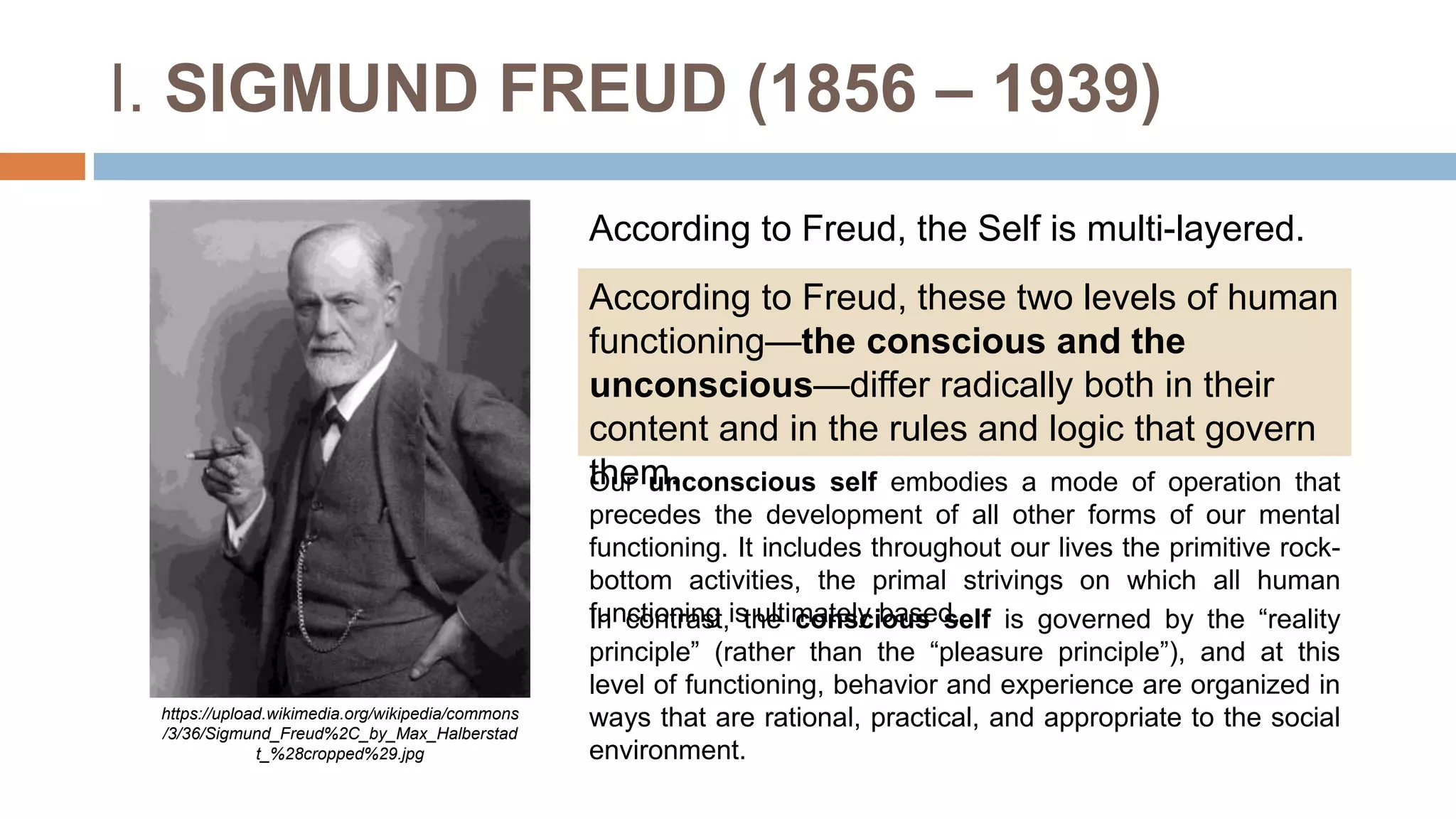
I. SIGMUND FREUD (1856 – 1939)
According to Freud, these two levels of human
functioning—the conscious and the
unconscious—differ radically both in their
content and in the rules and logic that govern
them.
https://upload.wikimedia.org/wikipedia/commons
/3/36/Sigmund_Freud%2C_by_Max_Halberstad
t_%28cropped%29.jpg
According to Freud, the Self is multi-layered.
Our unconscious self embodies a mode of operation that
precedes the development of all other forms of our mental
functioning. It includes throughout our lives the primitive rock-
bottom activities, the primal strivings on which all human
functioning is ultimately based.
In contrast, the conscious self is governed by the “reality
principle” (rather than the “pleasure principle”), and at this
level of functioning, behavior and experience are organized in
ways that are rational, practical, and appropriate to the social
environment.
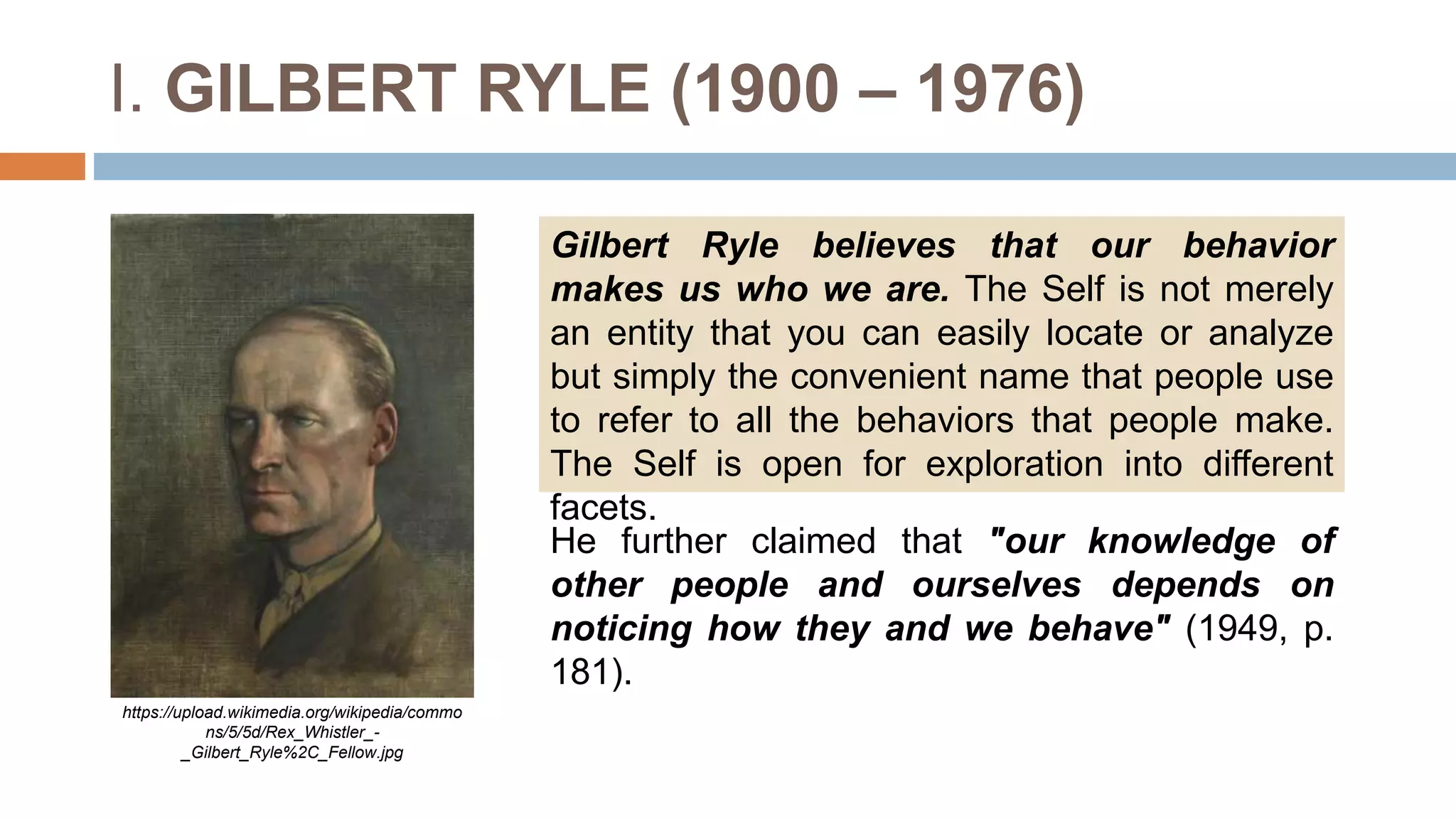
I. GILBERT RYLE (1900 – 1976)
Gilbert Ryle believes that our behavior
makes us who we are. The Self is not merely
an entity that you can easily locate or analyze
but simply the convenient name that people use
to refer to all the behaviors that people make.
The Self is open for exploration into different
facets.
https://upload.wikimedia.org/wikipedia/commo
ns/5/5d/Rex_Whistler_-
_Gilbert_Ryle%2C_Fellow.jpg
He further claimed that "our knowledge of
other people and ourselves depends on
noticing how they and we behave" (1949, p.
181).
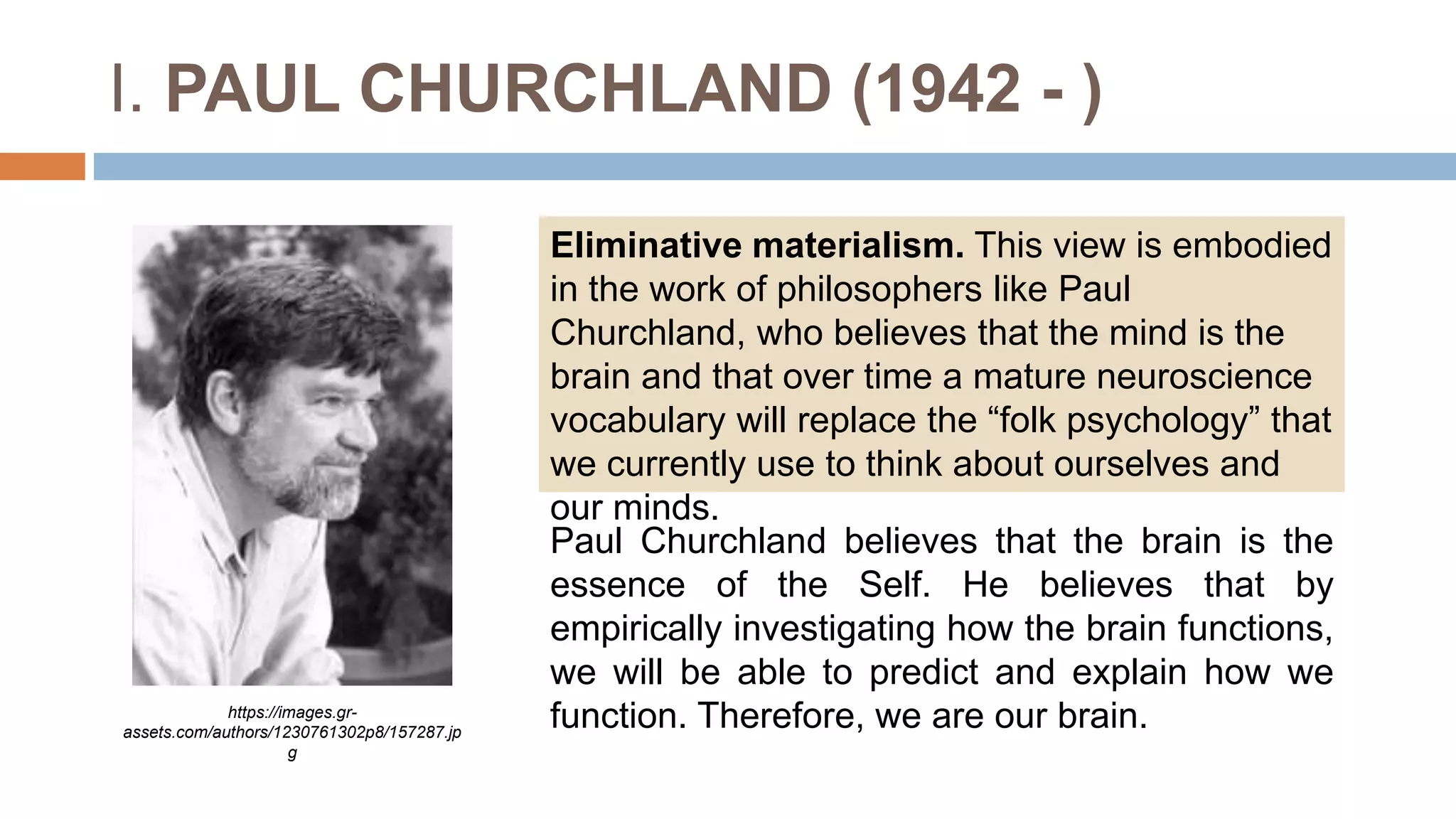
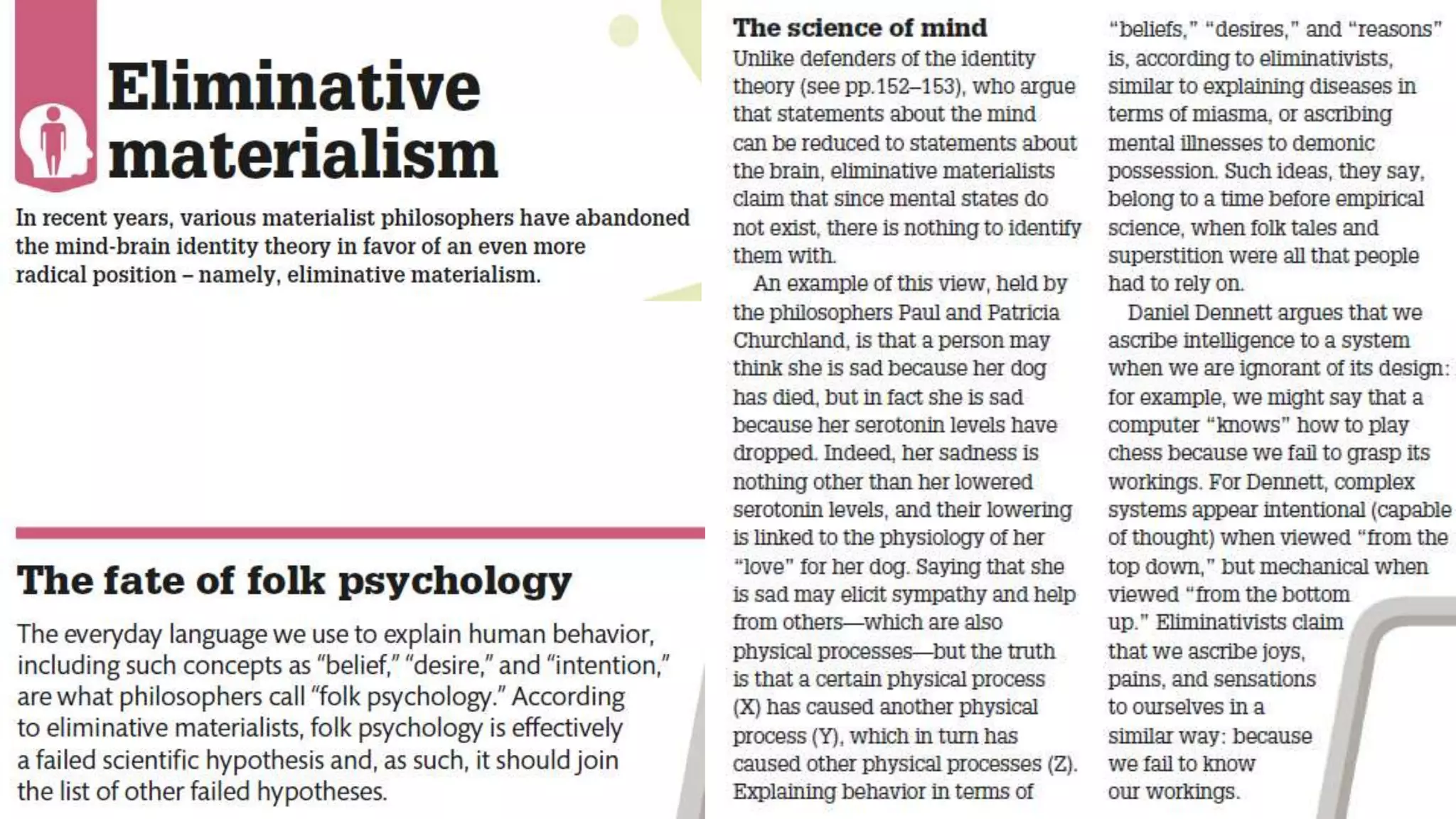
I. PAUL CHURCHLAND (1942 - )
Eliminative materialism. This view is embodied
in the work of philosophers like Paul
Churchland, who believes that the mind is the
brain and that over time a mature neuroscience
vocabulary will replace the “folk psychology” that
we currently use to think about ourselves and
our minds.
https://images.gr-
assets.com/authors/1230761302p8/157287.jp
g
Paul Churchland believes that the brain is the
essence of the Self. He believes that by
empirically investigating how the brain functions,
we will be able to predict and explain how we
function. Therefore, we are our brain.
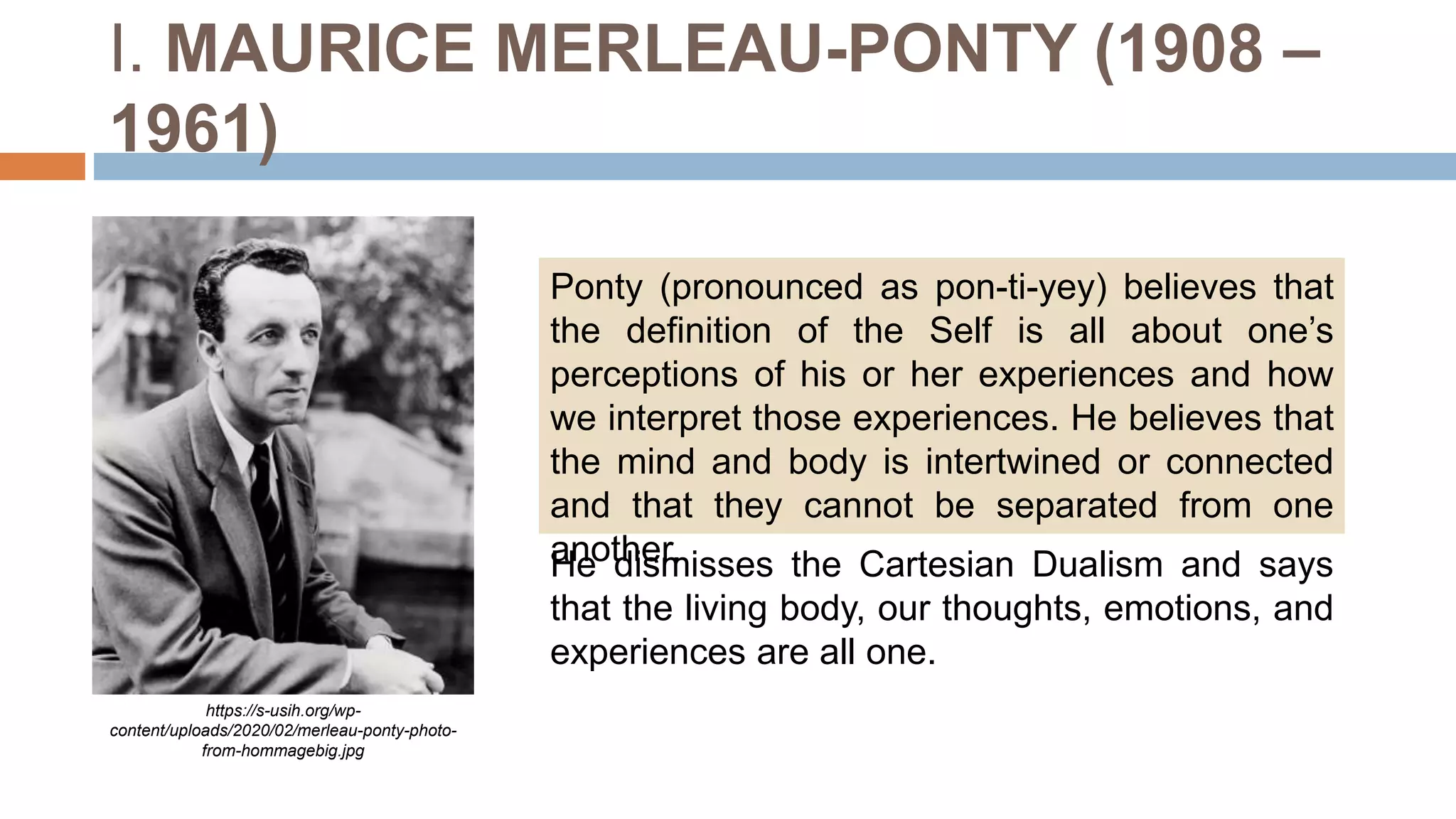
I. MAURICE MERLEAU-PONTY (1908 –
1961)
Ponty (pronounced as pon-ti-yey) believes that
the definition of the Self is all about one’s
perceptions of his or her experiences and how
we interpret those experiences. He believes that
the mind and body is intertwined or connected
and that they cannot be separated from one
another.
https://s-usih.org/wp-
content/uploads/2020/02/merleau-ponty-photo-
from-hommagebig.jpg
He dismisses the Cartesian Dualism and says
that the living body, our thoughts, emotions, and
experiences are all one.
References:
 Martin, R., Barresi, J. (2006). The Rise and Fall of Soul and Self: An Intellectual History of Personal Identity. Columbia
University Press. (available for download at b-ok.asia)
 Coulmas, F. (2019). Identity: A Very Short Introduction. Oxford University Press. (available for download at b-ok.asia)
 Socratic Method; https://en.wikipedia.org/wiki/Socratic_method; 03/07/21
 Plato’s Concept of the Self; https://philonotes.com/index.php/2020/09/10/platos-concept-of-the-self/; 03/07/21
 The Allegory of the Cave; https://faculty.washington.edu/smcohen/320/cave.htm; 03/07/21
 Saint Augustine; https://www.philosophytalk.org/blog/saint-augustine; 03/07/21
 Descartes’ Modern Perspective of the Self;
https://revelpreview.pearson.com/epubs/pearson_chaffee/OPS/xhtml/ch03_sec_04.xhtml; 03/07/21
 John Locke on Personal Identity; https://www.ncbi.nlm.nih.gov/pmc/articles/PMC3115296/; 03/07/21
 David Hume; https://iep.utm.edu/hume/; 03/07/21
 Kant: Philosophy of Mind; https://iep.utm.edu/kantmind/#SH2c; 03/07/21
 The Self is Multilayered: Freud; https://revelpreview.pearson.com/epubs/pearson_chaffee/OPS/xhtml/ch03_sec_08.xhtml;
03/07/21
 Self-Knowledge; https://www.encyclopedia.com/humanities/encyclopedias-almanacs-transcripts-and-maps/self-knowledge;
03/07/21
 The Self is the Brain: Physicalism; https://revelpreview.pearson.com/epubs/pearson_chaffee/OPS/xhtml/ch03_sec_10.xhtml;
03/07/21
https://image.freepik.com/free-vector/thank-you-cute-card-with-hand-drawn-leaves-plants_107547-179.jpg

GEC 1 Understanding the Self (Module 1: A Philosophical Journey to Discovering the Self)

  • 1.
    GEC 1 UNDERSTANDINGTHE SELF Module 1 (Week 1 to Week 2)  A Philosophical Journey to Discovering the Self Prepared by: Nancy Jane D. Victorino, RPm, LPT
  • 2.
    GEC 1 isdivided into 3 parts/units PART 1: The Self from Various Perspectives PART 2: Unpacking the Self PART 3: Managing and Caring for the Self https://miro.medium.com/max/3840/1*K_ASFaz5nY8Ft1f2ZtV3bA .jpeg https://i0.wp.com/www.brainpickings.org/wp- content/uploads/2012/05/self.jpg?fit=600%2C315&ssl=1
  • 3.
    Main References &Where You Can Get Them  Martin, R., Barresi, J. (2006). The Rise and Fall of Soul and Self: An Intellectual History of Personal Identity. Columbia University Press. (available for download at b-ok.asia)  Coulmas, F. (2019). Identity: A Very Short Introduction. Oxford University Press. (available for download at b-ok.asia) b-ok.asia (5 downloads per day)
  • 4.
    The Self fromVarious Perspectives A Philosophical Journey to Discovering the Self – Socrates, Plato, Augustine, Descartes, Locke, Hume, Kant, Freud, Ryle, Churchland, Merleau-Ponty. https://www.pinclipart.com/picdir/middle/0- 2089_arrow-clip-art-arrow-clip-art- transparent-background.png https://dfcby4322olzt.cloudfront.net/wp-content/uploads/2014/04/basicsFeatured1.png
  • 5.
    DISCUSSION CILO (Course IntendedLearning Outcome/s):  Describe the different philosophical perspectives of the self from various philosophers.  Evaluate the importance of having different philosophical perspectives of the self.  Practice wider understanding of different point of views of people based on the various philosophical perspectives.
  • 6.
    I. From Mythto Science https://www.kalw.org/sites/kalw/files/styles/medium/public/201606 /Self-deception.jpg Pre-philosophical Greek attitudes toward the soul and the prospects for surviving bodily death found expression in Homer and subsequently in the mystery cults of Dionysus (Bacchus) and Orpheus. The earliest attempts to grapple with such issues philosophically occurred hundreds of years later, in the sixth century BCE, primarily in the philosophies of Pythagoras and Heraclitus. In Homer, people had psyches, which survived their bodily deaths. But the survival of a psyche was not the survival of a person. Before bodily death, peoples’ psyches , or life principles, were associated with their breath (pneuma) and movement.
  • 7.
    I. SOCRATES (470– 399 BC) “father of western philosophy” ‘Know thyself!’ Socratic Thinking - The Socratic method (also known as method of Elenchus, elenctic method, or Socratic debate) is a form of cooperative argumentative dialogue between individuals, based on asking and answering questions to stimulate critical thinking and to draw out ideas and underlying presuppositions. https://images.squarespace- cdn.com/content/5497331ae4b0148a6141bd47/1479705607151- SIF9MXKE3VFAHXK93ESR/%CE%A3%CF%89%CE%BA%CF% 81%CE%AC%CF%84%CE%B7%CF%82%2C_%CE%91%CE%B A%CE%B1%CE%B4%CE%B7%CE%BC%CE%AF%CE%B1_% CE%91%CE%B8%CE%B7%CE%BD%CF%8E%CE%BD_6616.j pg?format=1500w&content-type=image%2Fjpeg
  • 8.
    I. PLATO (428– 348 BC) For Plato, the human person is composed of a body and soul. The body is the material and destructible part of the human person, while the soul is the immaterial and indestructible part. For Plato, the soul is the self. https://www.thoughtco.com/thmb/0dbXq- VeV4v_QDNUSfIwVXfmdhI=/1414x1414/smart/filters:no_u pscale()/statueofplatovasiliki- 5c67499b46e0fb0001319aec.jpg According to Plato, the SOUL has three parts: The Rational soul – cognition Plato considers the rational soul as the superior among the three because it serves as a moral and rational guide for the spiritual soul and the appetitive soul. The Spiritual soul - emotions The Appetitive soul – physical wants/needs
  • 9.
    I. PLATO (428– 348 BC) Allegory of the Cave https://faculty.washington.edu/smcohen/320/platoscave.gif
  • 11.
    I. ST. AUGUSTINE(354 – 430 CE) He believed that man is bifurcate (divided into two branches) in nature, which is our physical body and the soul. One aspect of us is imperfect and worldly while the other is capable of divinity and immortality. https://cdn.britannica.com/87/146187-050- AFE2FE21/St-Augustine-of-Hippo-painting- Lippo-Memmi.jpg Manicheanism was the religion that Augustine bought into in the first part of his life.
  • 13.
    I. RENE DESCARTES(1596 – 1650) “founder of modern philosophy” Descartes was more concerned with understanding the thinking process we use to answer questions. He agreed with the great thinkers before him that the human ability to reason constitutes the extraordinary instrument we have to achieve truth and knowledge. https://upload.wikimedia.org/wikipedia/commo ns/7/73/Frans_Hals_- _Portret_van_Ren%C3%A9_Descartes.jpg Cogito, ergo sum is the first principle of Descartes’s theory of knowledge because he is confident that no rational person will doubt his or her own existence as a conscious, thinking entity—while we are aware of thinking about our self.
  • 18.
    I. JOHN LOCKE(1632 – 1704) John Locke speaks of personal identity and survival of consciousness after death. A criterion of personal identity through time is given. Such a criterion specifies, insofar as that is possible, the necessary and sufficient conditions for the survival of persons. John Locke holds that personal identity is a matter of psychological continuity. He considered personal identity (or the self) to be founded on consciousness (viz. memory), and not on the substance of either the soul or the body. https://upload.wikimedia.org/wikipedia/commons/b /b8/John_Locke.jpg
  • 20.
    I. DAVID HUME(1711 – 1776) Regarding the issue of personal identity, (1) Hume’s skeptical claim is that we have no experience of a simple, individual impression that we can call the self—where the “self” is the totality of a person’s conscious life. https://upload.wikimedia.org/wikipedia/commons/e /ea/Painting_of_David_Hume.jpg
  • 21.
    I. IMMANUEL KANT(1724 – 1804) Two Kinds of Consciousness of Self Empirical Self-Consciousness (Inner Sense) Transcendental Apperception (Apperception) https://i0.wp.com/gosouth.co.za/wp- content/uploads/2017/04/Immanuel- Kant.jpg?fit=358%2C464&ssl=1
  • 23.
    I. SIGMUND FREUD(1856 – 1939) According to Freud, these two levels of human functioning—the conscious and the unconscious—differ radically both in their content and in the rules and logic that govern them. https://upload.wikimedia.org/wikipedia/commons /3/36/Sigmund_Freud%2C_by_Max_Halberstad t_%28cropped%29.jpg According to Freud, the Self is multi-layered. Our unconscious self embodies a mode of operation that precedes the development of all other forms of our mental functioning. It includes throughout our lives the primitive rock- bottom activities, the primal strivings on which all human functioning is ultimately based. In contrast, the conscious self is governed by the “reality principle” (rather than the “pleasure principle”), and at this level of functioning, behavior and experience are organized in ways that are rational, practical, and appropriate to the social environment.
  • 24.
    I. GILBERT RYLE(1900 – 1976) Gilbert Ryle believes that our behavior makes us who we are. The Self is not merely an entity that you can easily locate or analyze but simply the convenient name that people use to refer to all the behaviors that people make. The Self is open for exploration into different facets. https://upload.wikimedia.org/wikipedia/commo ns/5/5d/Rex_Whistler_- _Gilbert_Ryle%2C_Fellow.jpg He further claimed that "our knowledge of other people and ourselves depends on noticing how they and we behave" (1949, p. 181).
  • 25.
    I. PAUL CHURCHLAND(1942 - ) Eliminative materialism. This view is embodied in the work of philosophers like Paul Churchland, who believes that the mind is the brain and that over time a mature neuroscience vocabulary will replace the “folk psychology” that we currently use to think about ourselves and our minds. https://images.gr- assets.com/authors/1230761302p8/157287.jp g Paul Churchland believes that the brain is the essence of the Self. He believes that by empirically investigating how the brain functions, we will be able to predict and explain how we function. Therefore, we are our brain.
  • 27.
    I. MAURICE MERLEAU-PONTY(1908 – 1961) Ponty (pronounced as pon-ti-yey) believes that the definition of the Self is all about one’s perceptions of his or her experiences and how we interpret those experiences. He believes that the mind and body is intertwined or connected and that they cannot be separated from one another. https://s-usih.org/wp- content/uploads/2020/02/merleau-ponty-photo- from-hommagebig.jpg He dismisses the Cartesian Dualism and says that the living body, our thoughts, emotions, and experiences are all one.
  • 28.
    References:  Martin, R.,Barresi, J. (2006). The Rise and Fall of Soul and Self: An Intellectual History of Personal Identity. Columbia University Press. (available for download at b-ok.asia)  Coulmas, F. (2019). Identity: A Very Short Introduction. Oxford University Press. (available for download at b-ok.asia)  Socratic Method; https://en.wikipedia.org/wiki/Socratic_method; 03/07/21  Plato’s Concept of the Self; https://philonotes.com/index.php/2020/09/10/platos-concept-of-the-self/; 03/07/21  The Allegory of the Cave; https://faculty.washington.edu/smcohen/320/cave.htm; 03/07/21  Saint Augustine; https://www.philosophytalk.org/blog/saint-augustine; 03/07/21  Descartes’ Modern Perspective of the Self; https://revelpreview.pearson.com/epubs/pearson_chaffee/OPS/xhtml/ch03_sec_04.xhtml; 03/07/21  John Locke on Personal Identity; https://www.ncbi.nlm.nih.gov/pmc/articles/PMC3115296/; 03/07/21  David Hume; https://iep.utm.edu/hume/; 03/07/21  Kant: Philosophy of Mind; https://iep.utm.edu/kantmind/#SH2c; 03/07/21  The Self is Multilayered: Freud; https://revelpreview.pearson.com/epubs/pearson_chaffee/OPS/xhtml/ch03_sec_08.xhtml; 03/07/21  Self-Knowledge; https://www.encyclopedia.com/humanities/encyclopedias-almanacs-transcripts-and-maps/self-knowledge; 03/07/21  The Self is the Brain: Physicalism; https://revelpreview.pearson.com/epubs/pearson_chaffee/OPS/xhtml/ch03_sec_10.xhtml; 03/07/21
  • 29.