Social Network

Michel Bruley
WA - Marketing Director

Extract from various presentations: B Wellman, K Toyama, A Sharma, Teradata Aster, …

February 2012

www.decideo.fr/bruley
Social Network
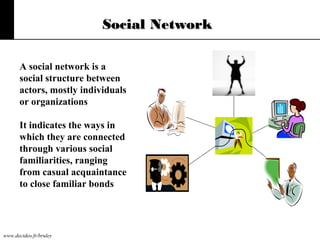
A social network is a
social structure between
actors, mostly individuals
or organizations
It indicates the ways in
which they are connected
through various social
familiarities, ranging
from casual acquaintance
to close familiar bonds

www.decideo.fr/bruley
Society as a Graph
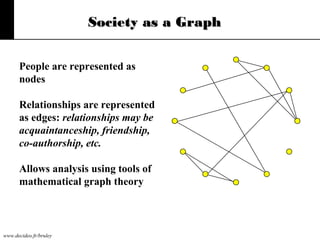
People are represented as
nodes
Relationships are represented
as edges: relationships may be
acquaintanceship, friendship,
co-authorship, etc.
Allows analysis using tools of
mathematical graph theory

www.decideo.fr/bruley
Social Network Analysis
Social network analysis [SNA] is the mapping and measuring of
relationships and flows between people, groups, organizations, computers
or other information/knowledge processing entities:

Little Boxes

www.decideo.fr/bruley

Glocalization

Networked Individualism
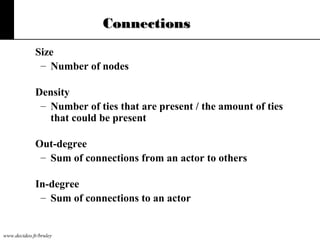
Connections
Size
– Number of nodes
Density
– Number of ties that are present / the amount of ties
that could be present
Out-degree
– Sum of connections from an actor to others
In-degree
– Sum of connections to an actor

www.decideo.fr/bruley
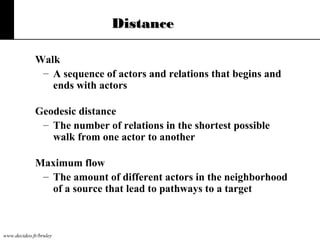
Distance
Walk
– A sequence of actors and relations that begins and
ends with actors
Geodesic distance
– The number of relations in the shortest possible
walk from one actor to another
Maximum flow
– The amount of different actors in the neighborhood
of a source that lead to pathways to a target

www.decideo.fr/bruley
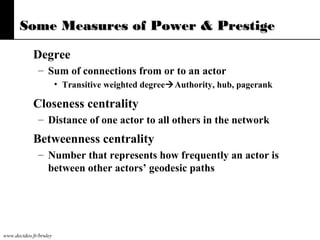
Some Measures of Power & Prestige
Degree
– Sum of connections from or to an actor
• Transitive weighted degreeAuthority, hub, pagerank

Closeness centrality
– Distance of one actor to all others in the network

Betweenness centrality
– Number that represents how frequently an actor is
between other actors’ geodesic paths

www.decideo.fr/bruley
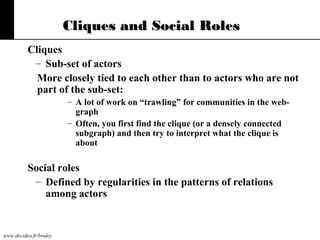
Cliques and Social Roles
Cliques
– Sub-set of actors
More closely tied to each other than to actors who are not
part of the sub-set:
– A lot of work on “trawling” for communities in the webgraph
– Often, you first find the clique (or a densely connected
subgraph) and then try to interpret what the clique is
about

Social roles
– Defined by regularities in the patterns of relations
among actors

www.decideo.fr/bruley
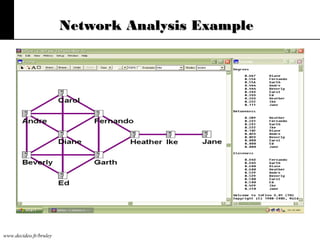
Network Analysis Example

www.decideo.fr/bruley
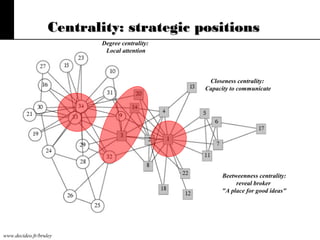
Centrality: strategic positions
Degree centrality:
Local attention

Closeness centrality:
Capacity to communicate

Beetweenness centrality:
reveal broker
"A place for good ideas"

www.decideo.fr/bruley
Social Network Analysis: what for?
To control information flow
To improve/stimulate communication
To improve network resilience
To trust
Web applications of Social Networks examples:
– Analyzing page importance (Page Rank, Authorities/Hubs)
– Discovering Communities (Finding near-cliques)
– Analyzing Trust (Propagating Trust, Using propagated trust to fight spam In Email or In Web page ranking)

www.decideo.fr/bruley
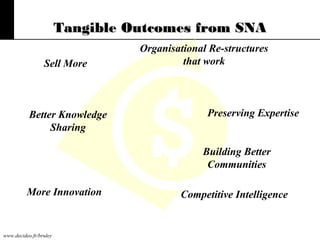
Tangible Outcomes from SNA
Sell More

Better Knowledge
Sharing

Organisational Re-structures
that work

Preserving Expertise

Building Better
Communities
More Innovation

www.decideo.fr/bruley

Competitive Intelligence
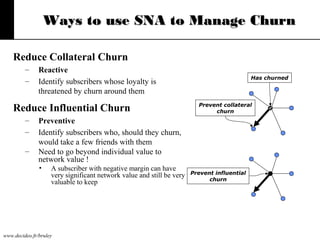
Ways to use SNA to Manage Churn
Reduce Collateral Churn
–
–

Reactive
Identify subscribers whose loyalty is
threatened by churn around them

Reduce Influential Churn
–
–
–

Has churned

Prevent collateral
churn

Preventive
Identify subscribers who, should they churn,
would take a few friends with them
Need to go beyond individual value to
network value !
•

A subscriber with negative margin can have
very significant network value and still be very
valuable to keep

www.decideo.fr/bruley

Prevent influential
churn
Cross-Sell and Technology Transfer
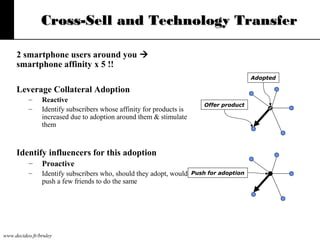
2 smartphone users around you 
smartphone affinity x 5 !!
Adopted

Leverage Collateral Adoption
–
–

Reactive
Identify subscribers whose affinity for products is
increased due to adoption around them & stimulate
them

Offer product

Identify influencers for this adoption
–

Proactive

–

Identify subscribers who, should they adopt, would
push a few friends to do the same

www.decideo.fr/bruley

Push for adoption
Acquisition – Member gets Member
Campaign Topic
Acquire New Members

Description
One of an Operator‘s major objectives is to keep (or even extend) the market position.
As the main competitors are making ground by eg. attractive tariffs or through the
acquisition of new retail partners, acquisition of new customers becomes a very important
objective.
This campaign format focuses on influencers in social communities, who are most likely to
recommend a (off-net) friend to become a new subscriber of the Operator.
The recommendation itself, as well as the subscription is incentivised for both, the subscriber
and the recommending person.

www.decideo.fr/bruley
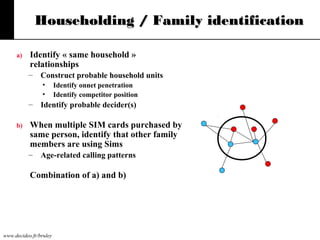
Householding / Family identification
a)

Identify « same household »
relationships
–

Construct probable household units
•
•

–
b)

Identify onnet penetration
Identify competitor position

Identify probable decider(s)

When multiple SIM cards purchased by
same person, identify that other family
members are using Sims
–

Age-related calling patterns

Combination of a) and b)

www.decideo.fr/bruley
Community Identification and
Marketing
Households / Families
a)Seasonal

workers

b)SMEs
c)Students
d)Schoolchildren

www.decideo.fr/bruley
Customer Lifestage analysis
Analysis based on identifying critical life stage events using
social network changes
a)

Going to University

b)

Moving

c)

Changing job

d)

Starting a relationship – Moving as a couple

e)

Imputing demographics

– Age related patterns in the social network

www.decideo.fr/bruley
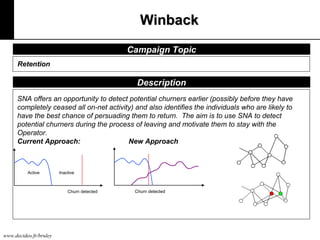
Winback
Campaign Topic
Retention

Description
SNA offers an opportunity to detect potential churners earlier (possibly before they have
completely ceased all on-net activity) and also identifies the individuals who are likely to
have the best chance of persuading them to return. The aim is to use SNA to detect
potential churners during the process of leaving and motivate them to stay with the
Operator.
Current Approach:
New Approach

Active

Inactive

Churn detected

www.decideo.fr/bruley

Churn detected
Competitor Insights
a)

Tracking dynamic changes in social networks based on competitor marketing
activities

•
•
•

Reaction and impact of mass market campaigns
Introduction of new products and tariffs
Network evolution

b)

Improved accuracy in estimating operator market share
• What does a competitor’s mass market campaigns do to the
market?

c)

Segmenting competitors’ subscribers

•

www.decideo.fr/bruley

Tracking segments based on selected SNA KPIs
Other business applications
Facilitate Pre- to Post-Migration
Identify Rotational Churners, switching between operators
Identify Internal Churners
Better customer lifecycle management by tracking customer network
dynamics over his Lifecyle with the operator
–

Networks grow and change over time. This will influence how the operator
interacts with the customer

www.decideo.fr/bruley
Teradata Aster: See the Network
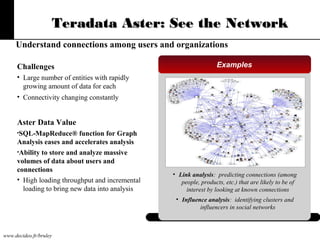
Understand connections among users and organizations
Challenges

Examples

• Large number of entities with rapidly
growing amount of data for each
• Connectivity changing constantly

Aster Data Value
•SQL-MapReduce®

function for Graph
Analysis eases and accelerates analysis
•Ability to store and analyze massive
volumes of data about users and
connections
• High loading throughput and incremental
loading to bring new data into analysis

• Link analysis: predicting connections (among
people, products, etc.) that are likely to be of
interest by looking at known connections
• Influence analysis: identifying clusters and
influencers in social networks

www.decideo.fr/bruley
Teradata Aster References
Social Network & Relationship Analysis
Select Aster Data Customers in
Digital Marketing Optimization

Analysis of user behavior,
intent, and actions across
search, ad media and web
properties, in order to
drive increased ROI.

www.decideo.fr/bruley

Big Data: Social Network Analysis

  • 1.
    Social Network Michel Bruley WA- Marketing Director Extract from various presentations: B Wellman, K Toyama, A Sharma, Teradata Aster, … February 2012 www.decideo.fr/bruley
  • 2.
    Social Network A socialnetwork is a social structure between actors, mostly individuals or organizations It indicates the ways in which they are connected through various social familiarities, ranging from casual acquaintance to close familiar bonds www.decideo.fr/bruley
  • 3.
    Society as aGraph People are represented as nodes Relationships are represented as edges: relationships may be acquaintanceship, friendship, co-authorship, etc. Allows analysis using tools of mathematical graph theory www.decideo.fr/bruley
  • 4.
    Social Network Analysis Socialnetwork analysis [SNA] is the mapping and measuring of relationships and flows between people, groups, organizations, computers or other information/knowledge processing entities: Little Boxes www.decideo.fr/bruley Glocalization Networked Individualism
  • 5.
    Connections Size – Number ofnodes Density – Number of ties that are present / the amount of ties that could be present Out-degree – Sum of connections from an actor to others In-degree – Sum of connections to an actor www.decideo.fr/bruley
  • 6.
    Distance Walk – A sequenceof actors and relations that begins and ends with actors Geodesic distance – The number of relations in the shortest possible walk from one actor to another Maximum flow – The amount of different actors in the neighborhood of a source that lead to pathways to a target www.decideo.fr/bruley
  • 7.
    Some Measures ofPower & Prestige Degree – Sum of connections from or to an actor • Transitive weighted degreeAuthority, hub, pagerank Closeness centrality – Distance of one actor to all others in the network Betweenness centrality – Number that represents how frequently an actor is between other actors’ geodesic paths www.decideo.fr/bruley
  • 8.
    Cliques and SocialRoles Cliques – Sub-set of actors More closely tied to each other than to actors who are not part of the sub-set: – A lot of work on “trawling” for communities in the webgraph – Often, you first find the clique (or a densely connected subgraph) and then try to interpret what the clique is about Social roles – Defined by regularities in the patterns of relations among actors www.decideo.fr/bruley
  • 9.
  • 10.
    Centrality: strategic positions Degreecentrality: Local attention Closeness centrality: Capacity to communicate Beetweenness centrality: reveal broker "A place for good ideas" www.decideo.fr/bruley
  • 11.
    Social Network Analysis:what for? To control information flow To improve/stimulate communication To improve network resilience To trust Web applications of Social Networks examples: – Analyzing page importance (Page Rank, Authorities/Hubs) – Discovering Communities (Finding near-cliques) – Analyzing Trust (Propagating Trust, Using propagated trust to fight spam In Email or In Web page ranking) www.decideo.fr/bruley
  • 12.
    Tangible Outcomes fromSNA Sell More Better Knowledge Sharing Organisational Re-structures that work Preserving Expertise Building Better Communities More Innovation www.decideo.fr/bruley Competitive Intelligence
  • 13.
    Ways to useSNA to Manage Churn Reduce Collateral Churn – – Reactive Identify subscribers whose loyalty is threatened by churn around them Reduce Influential Churn – – – Has churned Prevent collateral churn Preventive Identify subscribers who, should they churn, would take a few friends with them Need to go beyond individual value to network value ! • A subscriber with negative margin can have very significant network value and still be very valuable to keep www.decideo.fr/bruley Prevent influential churn
  • 14.
    Cross-Sell and TechnologyTransfer 2 smartphone users around you  smartphone affinity x 5 !! Adopted Leverage Collateral Adoption – – Reactive Identify subscribers whose affinity for products is increased due to adoption around them & stimulate them Offer product Identify influencers for this adoption – Proactive – Identify subscribers who, should they adopt, would push a few friends to do the same www.decideo.fr/bruley Push for adoption
  • 15.
    Acquisition – Membergets Member Campaign Topic Acquire New Members Description One of an Operator‘s major objectives is to keep (or even extend) the market position. As the main competitors are making ground by eg. attractive tariffs or through the acquisition of new retail partners, acquisition of new customers becomes a very important objective. This campaign format focuses on influencers in social communities, who are most likely to recommend a (off-net) friend to become a new subscriber of the Operator. The recommendation itself, as well as the subscription is incentivised for both, the subscriber and the recommending person. www.decideo.fr/bruley
  • 16.
    Householding / Familyidentification a) Identify « same household » relationships – Construct probable household units • • – b) Identify onnet penetration Identify competitor position Identify probable decider(s) When multiple SIM cards purchased by same person, identify that other family members are using Sims – Age-related calling patterns Combination of a) and b) www.decideo.fr/bruley
  • 17.
    Community Identification and Marketing Households/ Families a)Seasonal workers b)SMEs c)Students d)Schoolchildren www.decideo.fr/bruley
  • 18.
    Customer Lifestage analysis Analysisbased on identifying critical life stage events using social network changes a) Going to University b) Moving c) Changing job d) Starting a relationship – Moving as a couple e) Imputing demographics – Age related patterns in the social network www.decideo.fr/bruley
  • 19.
    Winback Campaign Topic Retention Description SNA offersan opportunity to detect potential churners earlier (possibly before they have completely ceased all on-net activity) and also identifies the individuals who are likely to have the best chance of persuading them to return. The aim is to use SNA to detect potential churners during the process of leaving and motivate them to stay with the Operator. Current Approach: New Approach Active Inactive Churn detected www.decideo.fr/bruley Churn detected
  • 20.
    Competitor Insights a) Tracking dynamicchanges in social networks based on competitor marketing activities • • • Reaction and impact of mass market campaigns Introduction of new products and tariffs Network evolution b) Improved accuracy in estimating operator market share • What does a competitor’s mass market campaigns do to the market? c) Segmenting competitors’ subscribers • www.decideo.fr/bruley Tracking segments based on selected SNA KPIs
  • 21.
    Other business applications FacilitatePre- to Post-Migration Identify Rotational Churners, switching between operators Identify Internal Churners Better customer lifecycle management by tracking customer network dynamics over his Lifecyle with the operator – Networks grow and change over time. This will influence how the operator interacts with the customer www.decideo.fr/bruley
  • 22.
    Teradata Aster: Seethe Network Understand connections among users and organizations Challenges Examples • Large number of entities with rapidly growing amount of data for each • Connectivity changing constantly Aster Data Value •SQL-MapReduce® function for Graph Analysis eases and accelerates analysis •Ability to store and analyze massive volumes of data about users and connections • High loading throughput and incremental loading to bring new data into analysis • Link analysis: predicting connections (among people, products, etc.) that are likely to be of interest by looking at known connections • Influence analysis: identifying clusters and influencers in social networks www.decideo.fr/bruley
  • 23.
    Teradata Aster References SocialNetwork & Relationship Analysis Select Aster Data Customers in Digital Marketing Optimization Analysis of user behavior, intent, and actions across search, ad media and web properties, in order to drive increased ROI. www.decideo.fr/bruley

Editor's Notes

  • #11 The centrality highlights the most important actors of the network and three definitions have been proposed by Freeman. The degree centrality considers nodes with the higher degrees (number of adjacent edges). The closeness centrality is based on the average length of the paths linking a node to others and reveals the capacity of a node to be reached. The betweenness centrality focuses on the capacity of a node to be an intermediary between any two other nodes. A network is highly dependent on actors with high betweenness centrality due to their position as intermediaries and brokers in information flow.