1
--Dr. A. Sandana Karuppan
UIT1826 – Social Network Information Analysis
Session 02 – Statistical properties of social networks
2
OVERVIEW
 The structure of SNA represented as graph. There are 2 different
properties of a graph, i.e., static(describe snapshots of graph structure)
and dynamic (Evolve the graph structure over the time).
3
PREREQUISITES
 mathematical proof technique
4
OBJECTIVE
 To understand the properties of the graph and know the conversion of
graph into matrix representation.
5
TALK OUTLINE
 Representing relation as networks
 Adding weights to edges (Direct and undirect)
6
SOCIAL NETWORKS
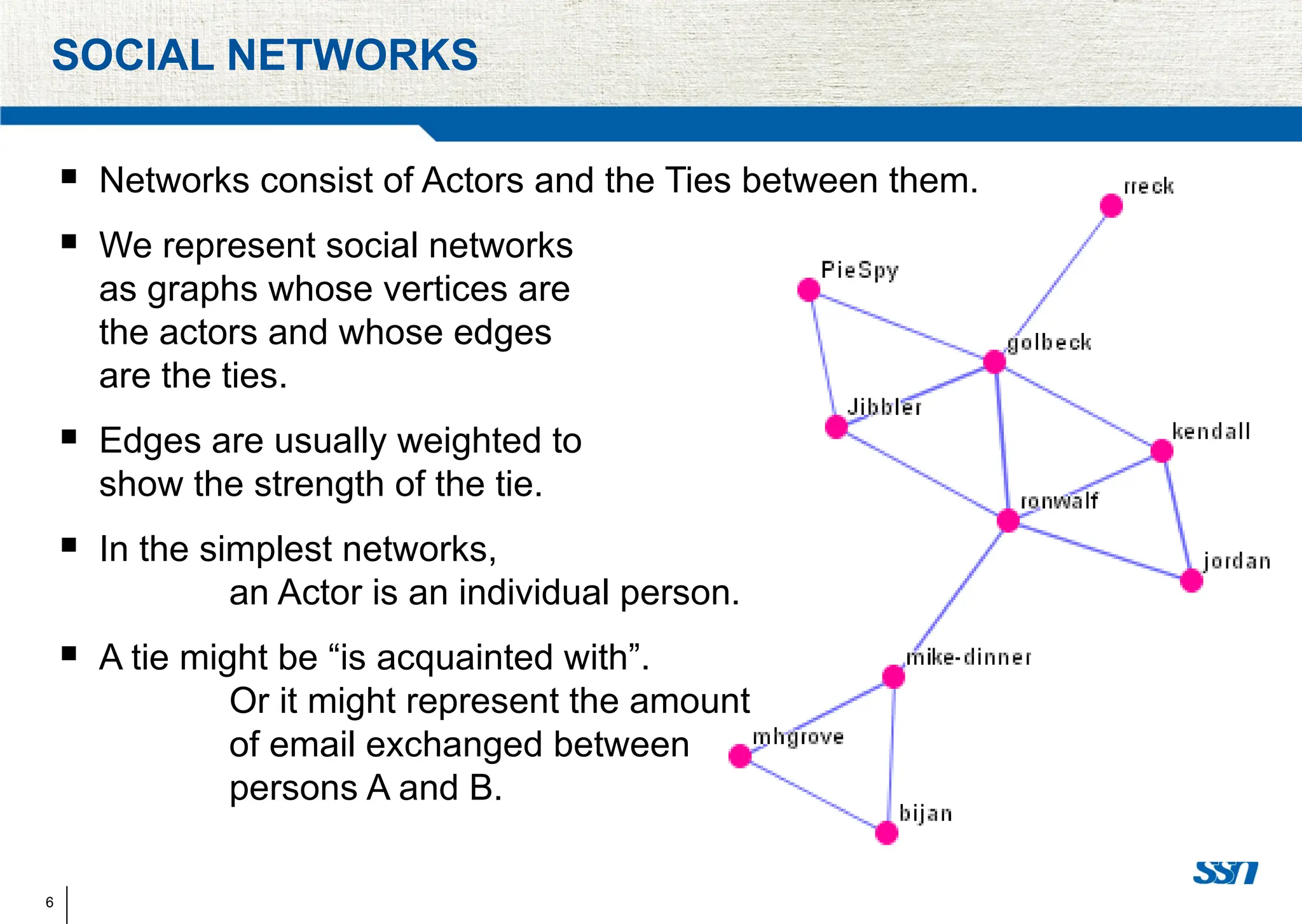
 Networks consist of Actors and the Ties between them.
 We represent social networks
as graphs whose vertices are
the actors and whose edges
are the ties.
 Edges are usually weighted to
show the strength of the tie.
 In the simplest networks,
an Actor is an individual person.
 A tie might be “is acquainted with”.
Or it might represent the amount
of email exchanged between
persons A and B.
7
SOCIAL NETWORK ANALYSIS
 Social network analysis [SNA] is the mapping and measuring of
relationships and flows between people, groups, organizations,
computers or other information/knowledge processing entities.
 The nodes in the network are the people and groups while the links
show relationships or flows between the nodes.
8
MEASURE SOCIAL NETWORK
 We measure Social Network in terms of:
1. Degree Centrality: The number of direct connections a node has.
What really matters is where those connections lead to and how they
connect the otherwise unconnected.
2. Betweenness Centrality: A node with high betweenness has great
influence over what flows in the network indicating important links and
single point of failure.
3. Closeness Centrality: The measure of closeness of a node which are
close to everyone else. The pattern of the direct and indirect ties
allows the nodes any other node in the network more quickly than
anyone else. They have the shortest paths to all others.
9
SNA PURPOSES
 Social networks have important implications for our daily lives.
 Spread of Information
 Spread of Disease
 Economics
 Marketing
 Social network analysis could be used for many activities related to
information and security informatics.
 Terrorist network analysis
10
SOCIAL NETWORK MINING
 Social network data is represented a graph
 Individuals are represented as nodes
 Nodes may have attributes to represent personal traits
 Relationships are represented as edges
 Edges may have attributes to represent relationship types
 Edges may be directed
 Common Social Network Mining tasks
 Node classification
 Link Prediction
11
THE SOCIAL NETWORK APPROACH
 The world is composed of networks - not densely-knit, tightly-bounded
groups
 Networks provide flexible means of social organization and of thinking
about social organization
 Networks have emergent properties of structure and composition
 Networks are a major source of social capital
 Networks are self-shaping and reflexive
 Networks scale up to networks of networks
12
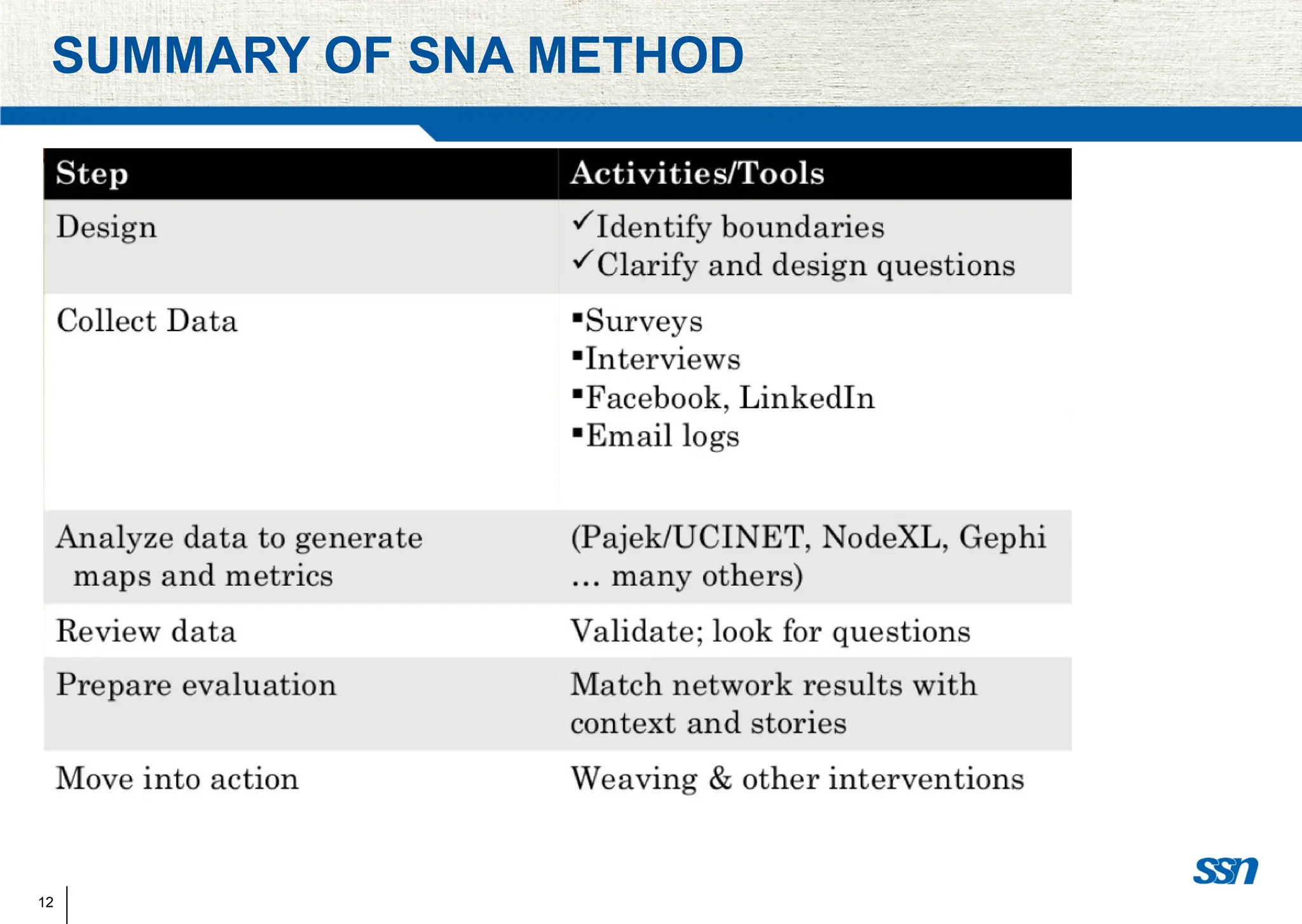
SUMMARY OF SNA METHOD
13
SNA PRACTICAL APPLICATIONS
 Businesses use SNA to analyze and improve communication flow in
their organization, or with their networks of partners and customers
 Law enforcement agencies (and the army) use SNA to identify criminal
and terrorist networks from traces of communication that they collect;
and then identify key players in these networks
 Social Network Sites like Facebook use basic elements of SNA to
identify and recommend potential friends based on friends-of-friends
 Civil society organizations use SNA to uncover conflicts of interest in
hidden connections between government bodies, lobbies and
businesses
 Network operators (telephony, cable, mobile) use SNA-like methods to
optimize the structure and capacity of their networks.
14
WHY AND WHEN TO USE SNA
 Whenever you are studying a social network, either offline or online, or when you
wish to understand how to improve the effectiveness of the network
 When you want to visualize your data so as to uncover patterns in relationships or
interactions
 When you want to follow the paths that information (or basically anything) follows in
social networks
 When you do quantitative research, although for qualitative research a network
perspective is also valuable
The range of actions and opportunities afforded to individuals are often a function of their
positions in social networks; uncovering these positions (instead of relying on common
assumptions based on their roles and functions, say as fathers, mothers, teachers, workers)
can yield more interesting and sometimes surprising results
A quantitative analysis of a social network can help you identify different types of actors in the
network or key players, whom you can focus on for your qualitative research
 SNA is clearly also useful in analyzing SNS’s, OC’s and social media in general, to
test hypotheses on online behavior and CMC, to identify the causes for
dysfunctional communities or networks, and to promote social cohesion and growth
in an online community
15
CONCEPTS
 Actor: discrete individual, corporate, or collective social units
 Relational tie: establishes a linkage between a pair of actors
 Dyad: consists of a pair of actors and the (possible) tie(s) between them
 Triad: Triples of actors and associated ties
 Subgroup: as any subset of actors, and all ties among them
 Group: is the collection of all actors on which ties are to be measured
 Relation: the collection of ties of a specific kind among members of a group
16
WORK DATA SETS
 Network data:
 variables, modes and affiliation variables
 Boundary specification and sampling:
 Population and relevant actors.
 Types of networks:
 Network can be categorized by the nature of the sets of actors and the
properties of the ties among them
 “The number of modes in a network refers to the number of distinct kinds of
social entities in the network”
17
RESEARCH TOPICS
 Statistical analysis
 Random walks and their applications
 Community detections
 Node classifications
 Social influence analysis
 Expert discovery
 Link prediction
 Security issues
 Visualization
 Data and Text mining
 Integrating sensors and multimedia information
 Social tagging.
18
SUMMARY
 SNA is not just a methodology; it is a unique perspective on how society
functions. Instead of focusing on individuals and their attributes, or on
macroscopic social structures, it centers on relations between individuals,
groups, or social institutions.
19
TEST YOUR SKILLS
 Any Queries

Social network analysis [SNA] is the mapping and measuring of relationships and flows between people, groups

  • 1.
    1 --Dr. A. SandanaKaruppan UIT1826 – Social Network Information Analysis Session 02 – Statistical properties of social networks
  • 2.
    2 OVERVIEW  The structureof SNA represented as graph. There are 2 different properties of a graph, i.e., static(describe snapshots of graph structure) and dynamic (Evolve the graph structure over the time).
  • 3.
  • 4.
    4 OBJECTIVE  To understandthe properties of the graph and know the conversion of graph into matrix representation.
  • 5.
    5 TALK OUTLINE  Representingrelation as networks  Adding weights to edges (Direct and undirect)
  • 6.
    6 SOCIAL NETWORKS  Networksconsist of Actors and the Ties between them.  We represent social networks as graphs whose vertices are the actors and whose edges are the ties.  Edges are usually weighted to show the strength of the tie.  In the simplest networks, an Actor is an individual person.  A tie might be “is acquainted with”. Or it might represent the amount of email exchanged between persons A and B.
  • 7.
    7 SOCIAL NETWORK ANALYSIS Social network analysis [SNA] is the mapping and measuring of relationships and flows between people, groups, organizations, computers or other information/knowledge processing entities.  The nodes in the network are the people and groups while the links show relationships or flows between the nodes.
  • 8.
    8 MEASURE SOCIAL NETWORK We measure Social Network in terms of: 1. Degree Centrality: The number of direct connections a node has. What really matters is where those connections lead to and how they connect the otherwise unconnected. 2. Betweenness Centrality: A node with high betweenness has great influence over what flows in the network indicating important links and single point of failure. 3. Closeness Centrality: The measure of closeness of a node which are close to everyone else. The pattern of the direct and indirect ties allows the nodes any other node in the network more quickly than anyone else. They have the shortest paths to all others.
  • 9.
    9 SNA PURPOSES  Socialnetworks have important implications for our daily lives.  Spread of Information  Spread of Disease  Economics  Marketing  Social network analysis could be used for many activities related to information and security informatics.  Terrorist network analysis
  • 10.
    10 SOCIAL NETWORK MINING Social network data is represented a graph  Individuals are represented as nodes  Nodes may have attributes to represent personal traits  Relationships are represented as edges  Edges may have attributes to represent relationship types  Edges may be directed  Common Social Network Mining tasks  Node classification  Link Prediction
  • 11.
    11 THE SOCIAL NETWORKAPPROACH  The world is composed of networks - not densely-knit, tightly-bounded groups  Networks provide flexible means of social organization and of thinking about social organization  Networks have emergent properties of structure and composition  Networks are a major source of social capital  Networks are self-shaping and reflexive  Networks scale up to networks of networks
  • 12.
  • 13.
    13 SNA PRACTICAL APPLICATIONS Businesses use SNA to analyze and improve communication flow in their organization, or with their networks of partners and customers  Law enforcement agencies (and the army) use SNA to identify criminal and terrorist networks from traces of communication that they collect; and then identify key players in these networks  Social Network Sites like Facebook use basic elements of SNA to identify and recommend potential friends based on friends-of-friends  Civil society organizations use SNA to uncover conflicts of interest in hidden connections between government bodies, lobbies and businesses  Network operators (telephony, cable, mobile) use SNA-like methods to optimize the structure and capacity of their networks.
  • 14.
    14 WHY AND WHENTO USE SNA  Whenever you are studying a social network, either offline or online, or when you wish to understand how to improve the effectiveness of the network  When you want to visualize your data so as to uncover patterns in relationships or interactions  When you want to follow the paths that information (or basically anything) follows in social networks  When you do quantitative research, although for qualitative research a network perspective is also valuable The range of actions and opportunities afforded to individuals are often a function of their positions in social networks; uncovering these positions (instead of relying on common assumptions based on their roles and functions, say as fathers, mothers, teachers, workers) can yield more interesting and sometimes surprising results A quantitative analysis of a social network can help you identify different types of actors in the network or key players, whom you can focus on for your qualitative research  SNA is clearly also useful in analyzing SNS’s, OC’s and social media in general, to test hypotheses on online behavior and CMC, to identify the causes for dysfunctional communities or networks, and to promote social cohesion and growth in an online community
  • 15.
    15 CONCEPTS  Actor: discreteindividual, corporate, or collective social units  Relational tie: establishes a linkage between a pair of actors  Dyad: consists of a pair of actors and the (possible) tie(s) between them  Triad: Triples of actors and associated ties  Subgroup: as any subset of actors, and all ties among them  Group: is the collection of all actors on which ties are to be measured  Relation: the collection of ties of a specific kind among members of a group
  • 16.
    16 WORK DATA SETS Network data:  variables, modes and affiliation variables  Boundary specification and sampling:  Population and relevant actors.  Types of networks:  Network can be categorized by the nature of the sets of actors and the properties of the ties among them  “The number of modes in a network refers to the number of distinct kinds of social entities in the network”
  • 17.
    17 RESEARCH TOPICS  Statisticalanalysis  Random walks and their applications  Community detections  Node classifications  Social influence analysis  Expert discovery  Link prediction  Security issues  Visualization  Data and Text mining  Integrating sensors and multimedia information  Social tagging.
  • 18.
    18 SUMMARY  SNA isnot just a methodology; it is a unique perspective on how society functions. Instead of focusing on individuals and their attributes, or on macroscopic social structures, it centers on relations between individuals, groups, or social institutions.
  • 19.