


Supervised vs Unsupervised vs Reinforcement Learning | Edureka
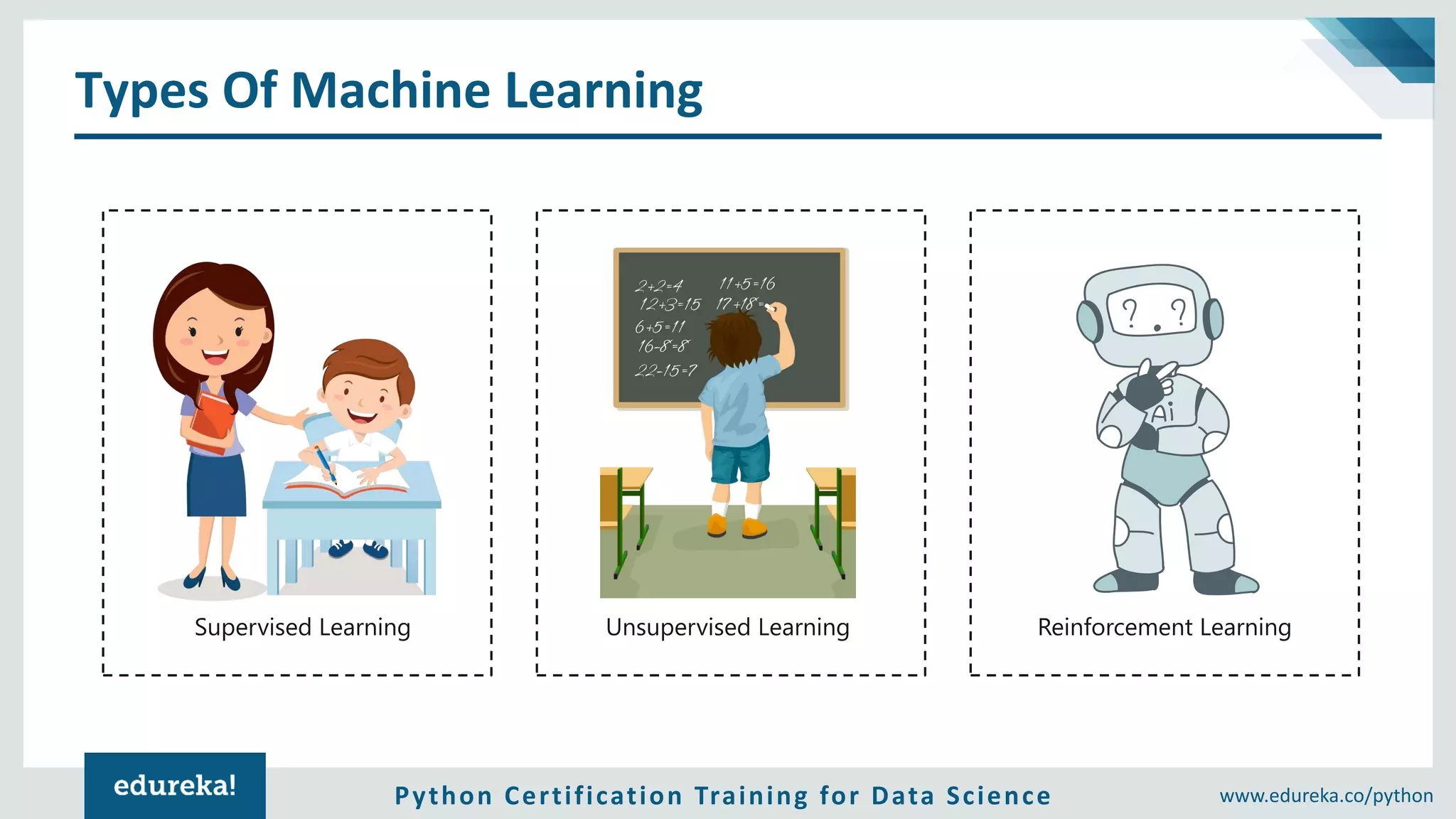
The document outlines a Python certification training program focused on data science, covering various types of machine learning: supervised, unsupervised, and reinforcement learning. It explains the definitions, approaches, training methods, and algorithms associated with each type, as well as real-world use cases such as loan approval, distance prediction, movie clustering, market basket analysis, and navigation challenges. Additionally, it highlights the importance of data warehouses for analytical needs in relation to machine learning.
Supervised vs Unsupervised vs Reinforcement Learning | Edureka
2.
Python Certification Trainingfor Data Science www.edureka.co/python
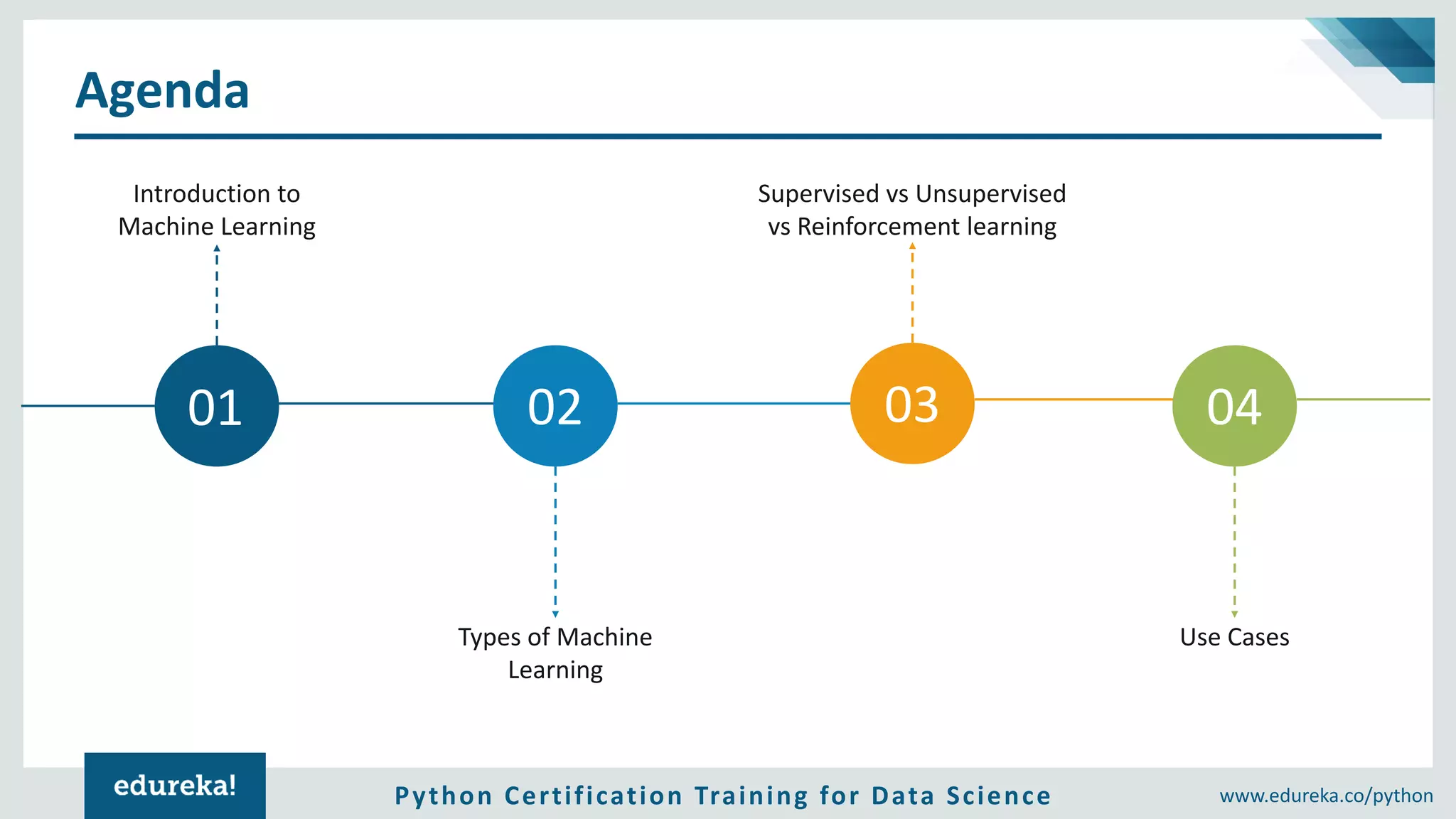
Agenda
Introduction to
Machine Learning
01 02 03
Types of Machine
Learning
Supervised vs Unsupervised
vs Reinforcement learning
04
Use Cases
Python Certification Trainingfor Data Science www.edureka.co/python
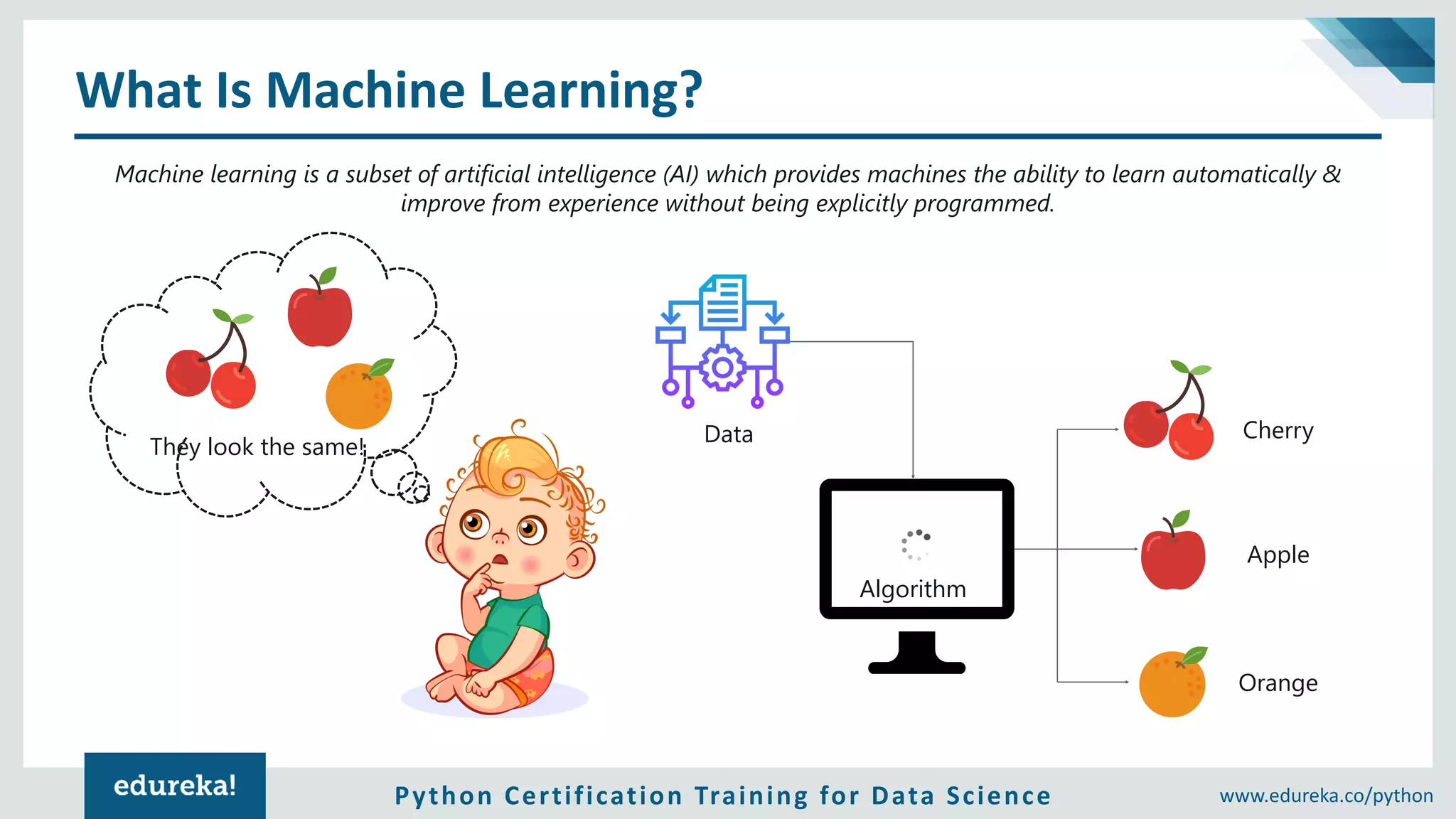
What Is Machine Learning?
Machine learning is a subset of artificial intelligence (AI) which provides machines the ability to learn automatically &
improve from experience without being explicitly programmed.
They look the same!
Cherry
Apple
Orange
Data
Algorithm
Python Certification Trainingfor Data Science www.edureka.co/python
Definition
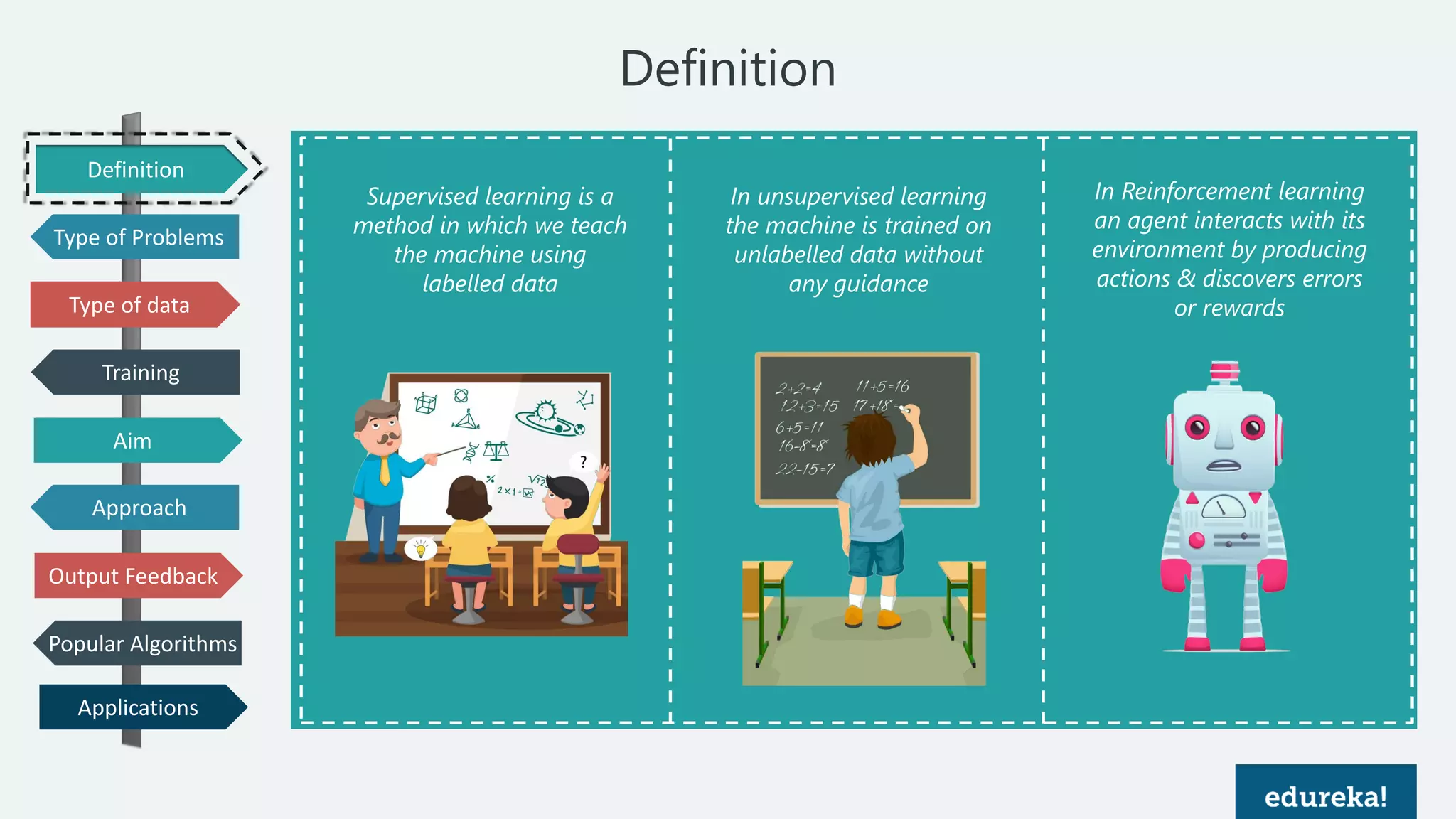
Supervised learning is a
method in which we teach
the machine using
labelled data
In unsupervised learning
the machine is trained on
unlabelled data without
any guidance
In Reinforcement learning
an agent interacts with its
environment by producing
actions & discovers errors
or rewardsType of data
Training
Aim
Output Feedback
Popular Algorithms
Applications
Type of Problems
Approach
Definition
9.
Python Certification Trainingfor Data Science www.edureka.co/python
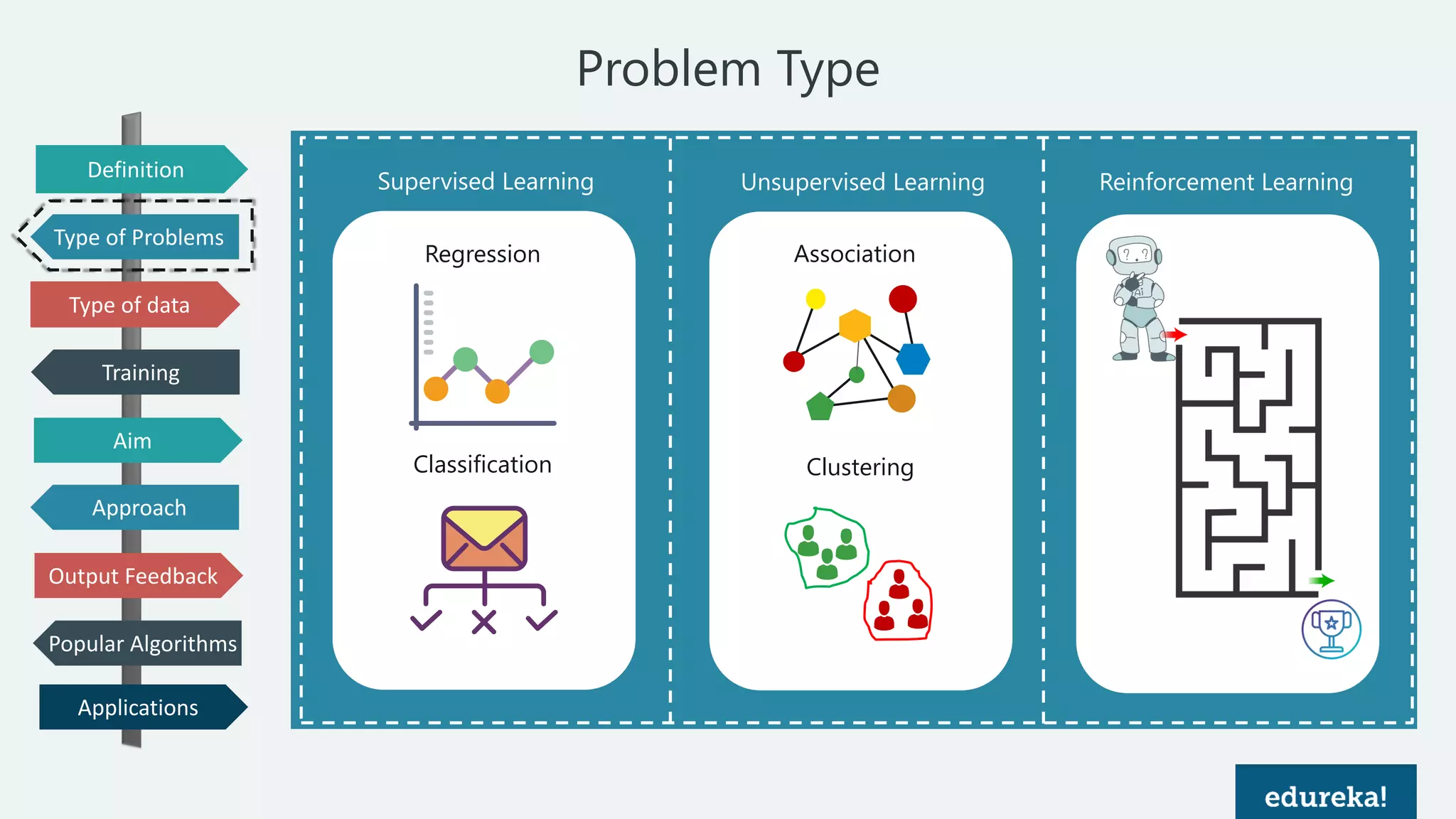
Problem Type
Regression
Classification
Supervised Learning Unsupervised Learning
Association
Clustering
Reinforcement Learning
Definition
Type of data
Training
Aim
Output Feedback
Popular Algorithms
Applications
Type of Problems
Approach
10.
Python Certification Trainingfor Data Science www.edureka.co/python
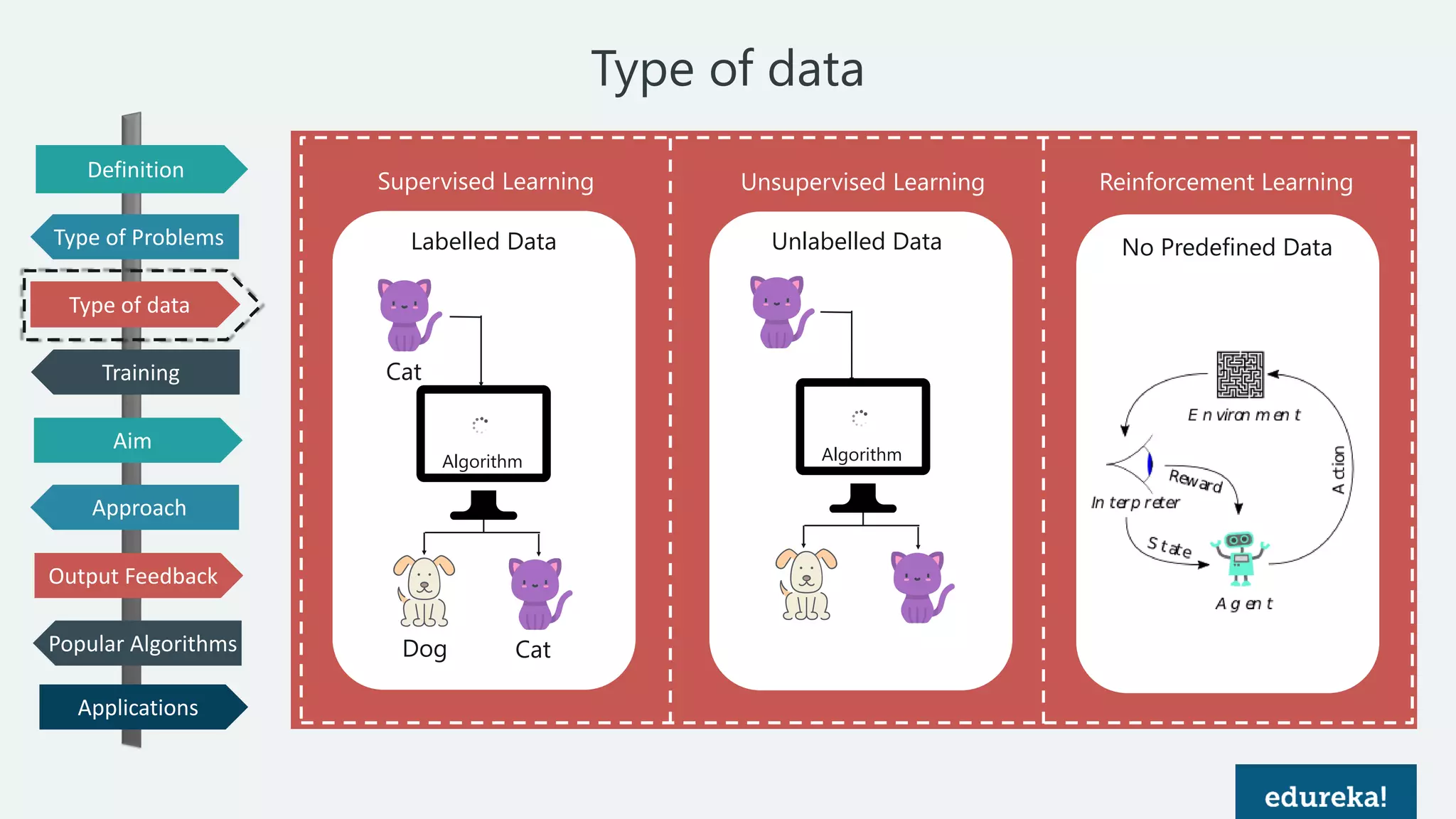
Type of data
Supervised Learning Unsupervised Learning Reinforcement Learning
Algorithm
Cat
CatDog
Labelled Data Unlabelled Data No Predefined Data
Algorithm
Definition
Type of data
Training
Aim
Output Feedback
Popular Algorithms
Applications
Type of Problems
Approach
11.
Python Certification Trainingfor Data Science www.edureka.co/python
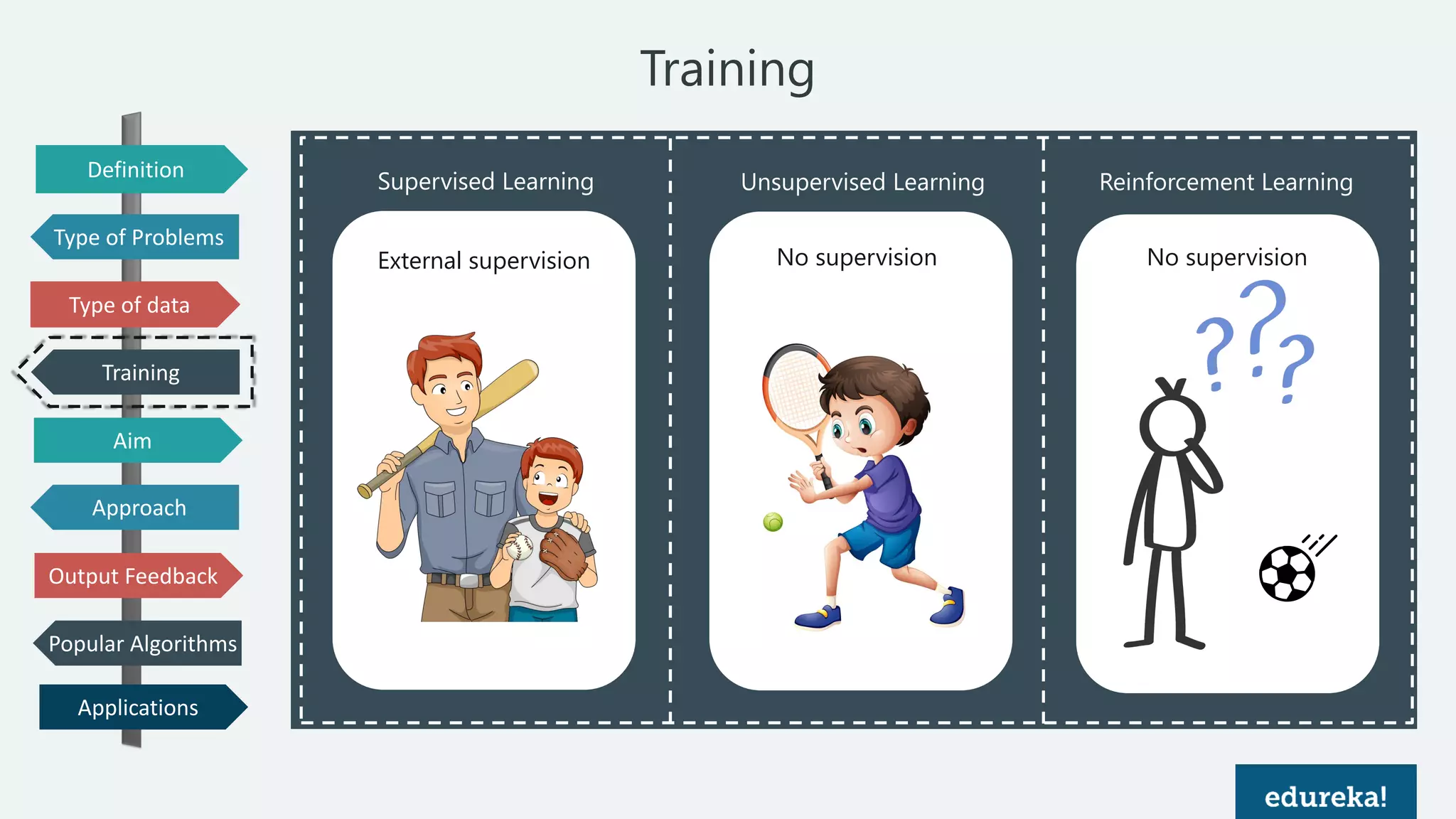
Training
Supervised Learning Unsupervised Learning Reinforcement Learning
External supervision No supervision No supervision
Definition
Type of data
Training
Aim
Output Feedback
Popular Algorithms
Applications
Type of Problems
Approach
12.
Python Certification Trainingfor Data Science www.edureka.co/python
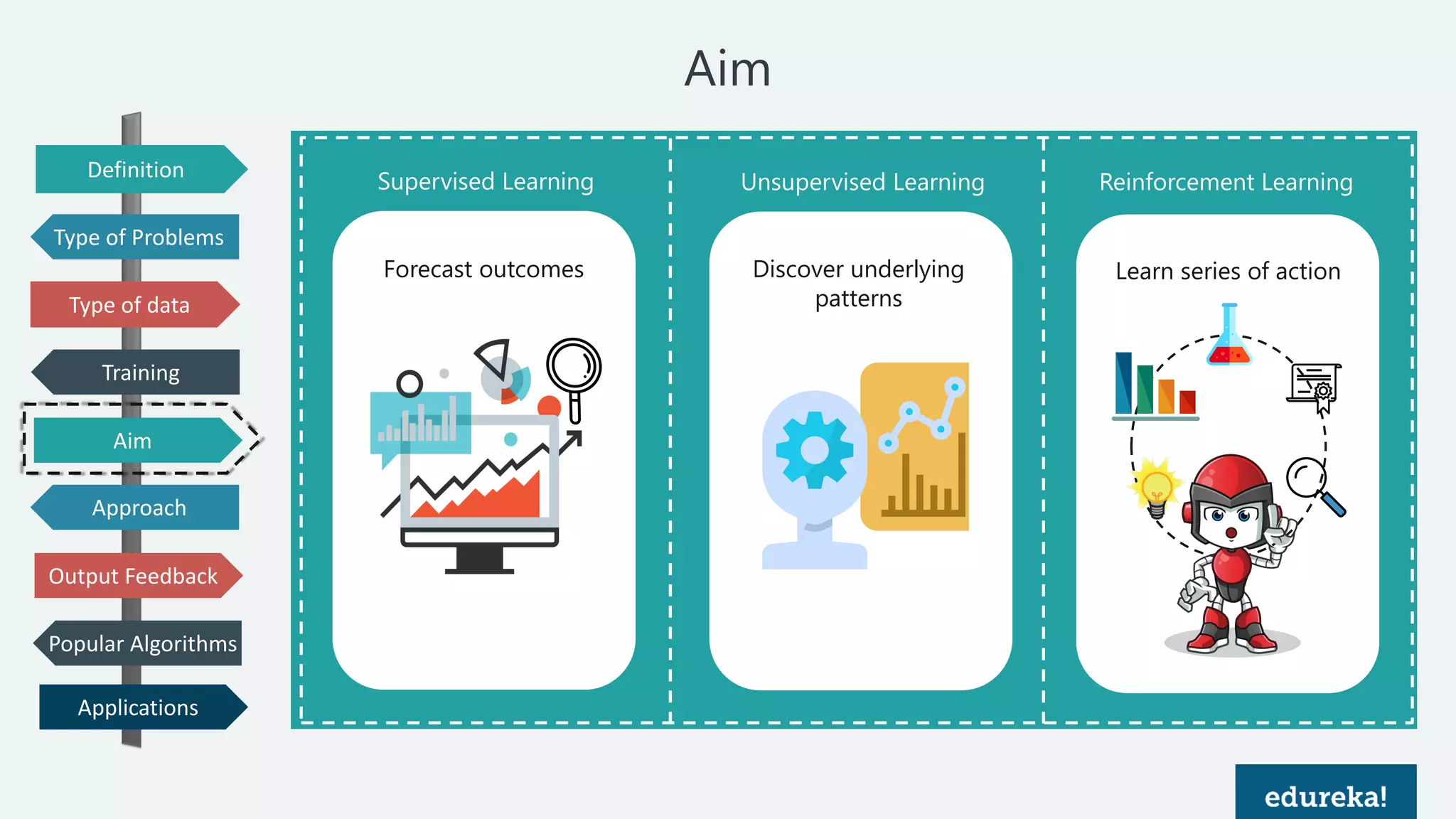
Aim
Supervised Learning Unsupervised Learning Reinforcement Learning
Forecast outcomes Discover underlying
patterns
Learn series of action
Definition
Type of data
Training
Aim
Output Feedback
Popular Algorithms
Applications
Type of Problems
Approach
13.
Python Certification Trainingfor Data Science www.edureka.co/python
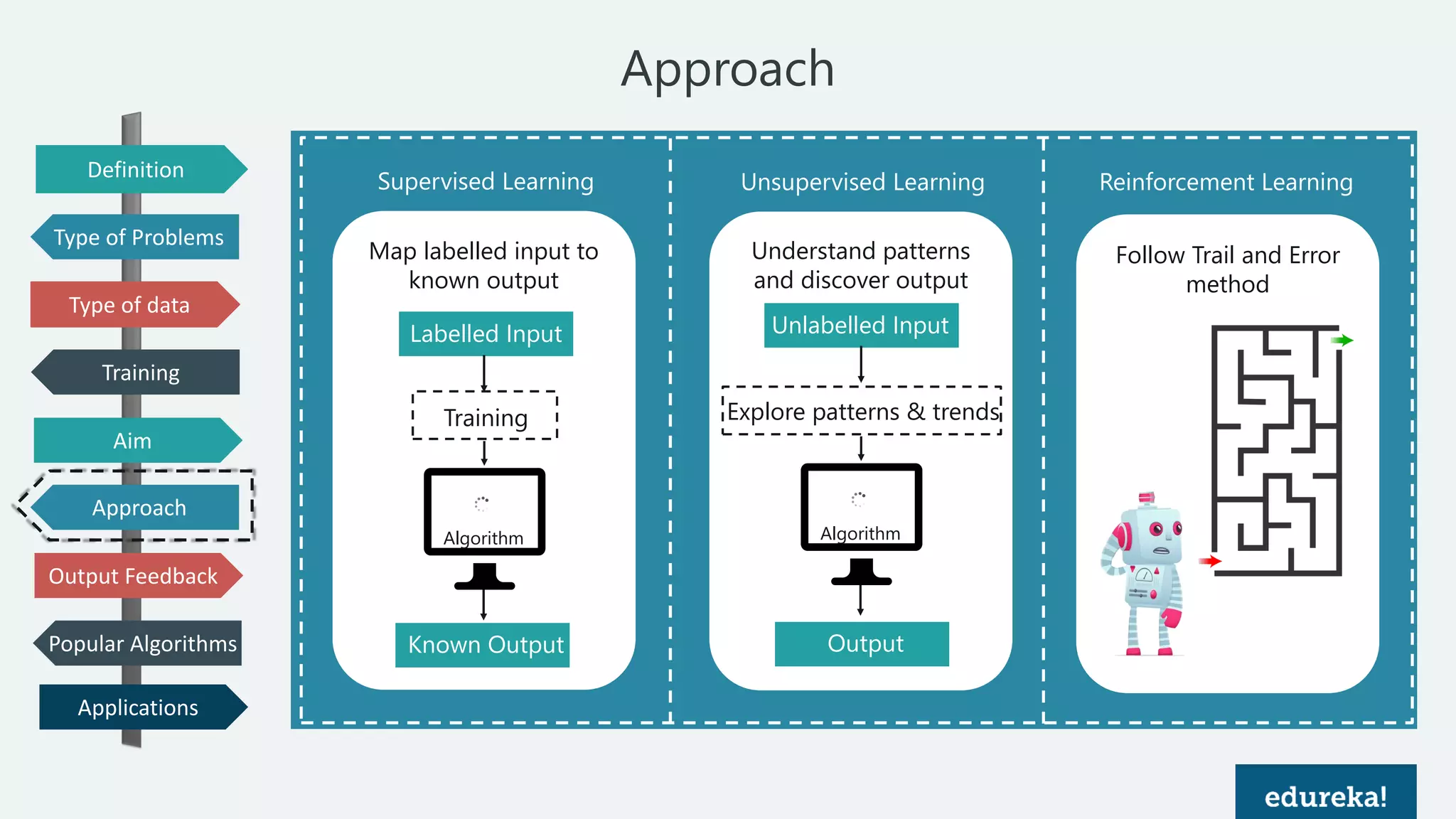
Approach
Supervised Learning Unsupervised Learning Reinforcement Learning
Labelled Input
Known Output
Map labelled input to
known output
Understand patterns
and discover output
Follow Trail and Error
method
Unlabelled Input
Explore patterns & trends
Output
Algorithm
Training
Algorithm
Definition
Type of data
Training
Aim
Output Feedback
Popular Algorithms
Applications
Type of Problems
Approach
14.
Python Certification Trainingfor Data Science www.edureka.co/python
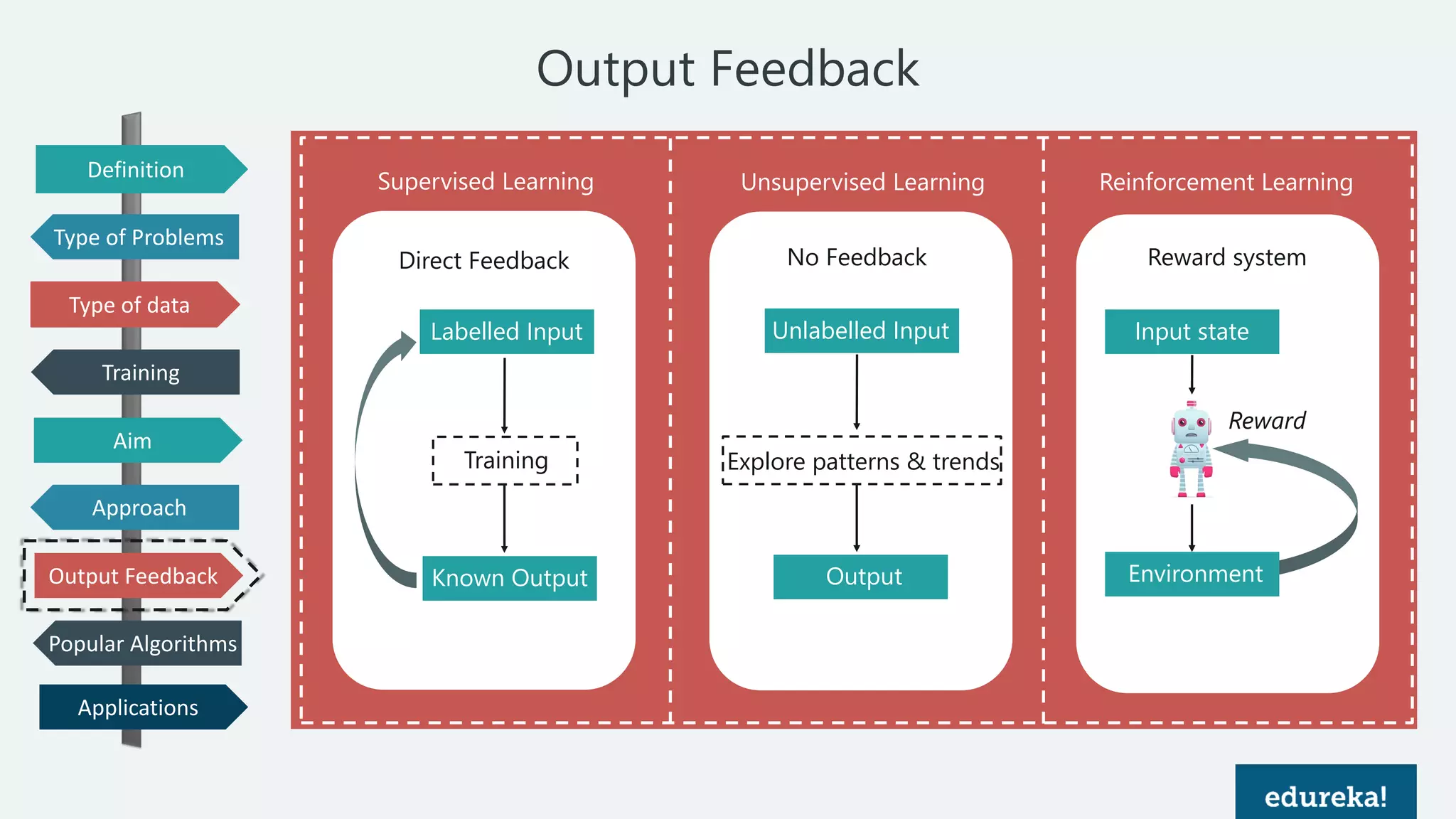
Output Feedback
Supervised Learning Unsupervised Learning Reinforcement Learning
Labelled Input
Known Output
Training
Unlabelled Input
Explore patterns & trends
Output
Input state
Environment
Reward
Direct Feedback No Feedback Reward system
Definition
Type of data
Training
Aim
Output Feedback
Popular Algorithms
Applications
Type of Problems
Approach
15.
Python Certification Trainingfor Data Science www.edureka.co/python
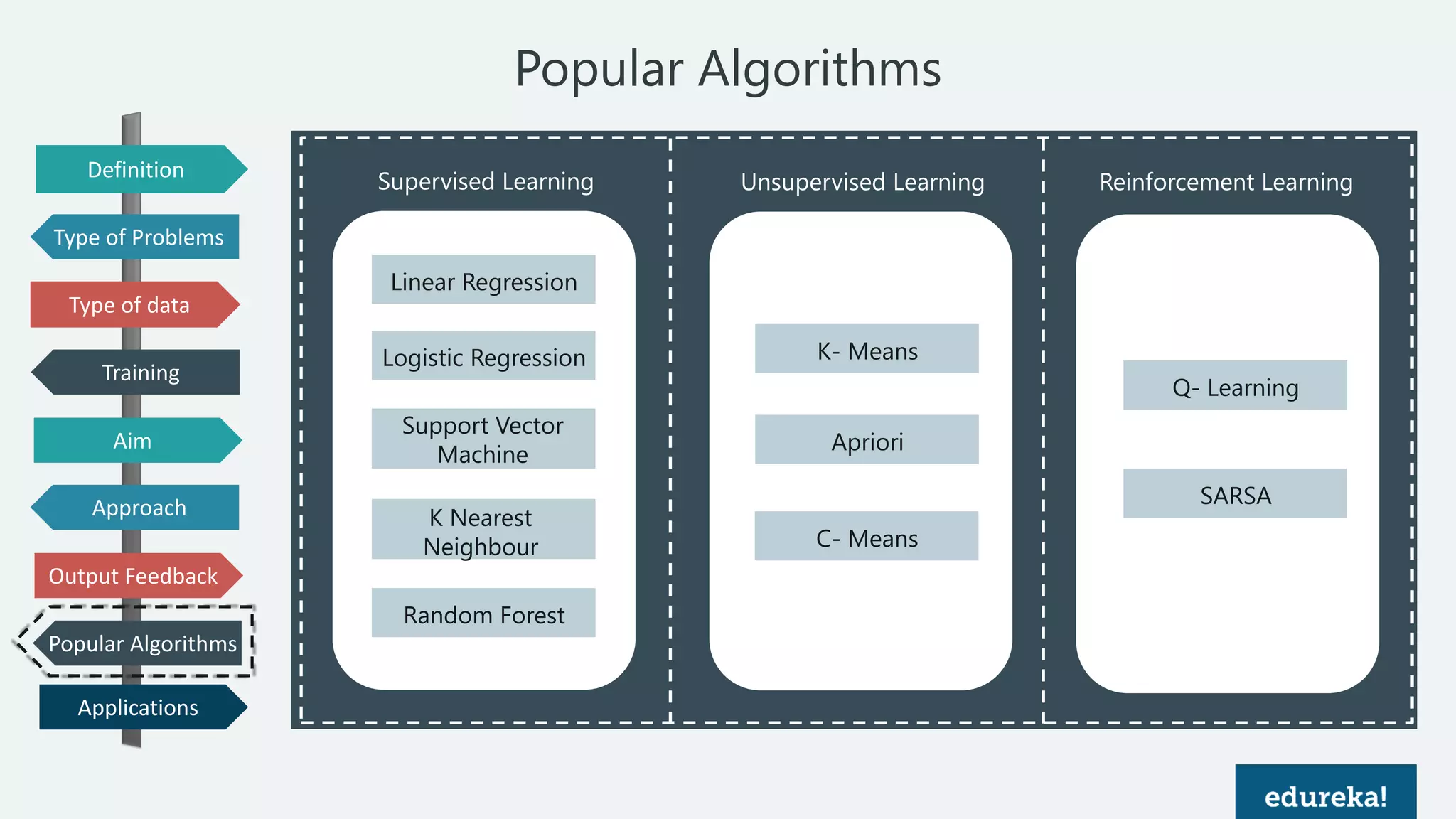
Popular Algorithms
Supervised Learning Unsupervised Learning Reinforcement Learning
Definition
Type of data
Training
Aim
Output Feedback
Popular Algorithms
Applications
Type of Problems
Approach
Linear Regression
Logistic Regression
Support Vector
Machine
K Nearest
Neighbour
Random Forest
Q- Learning
Apriori
C- Means
K- Means
SARSA
16.
Python Certification Trainingfor Data Science www.edureka.co/python
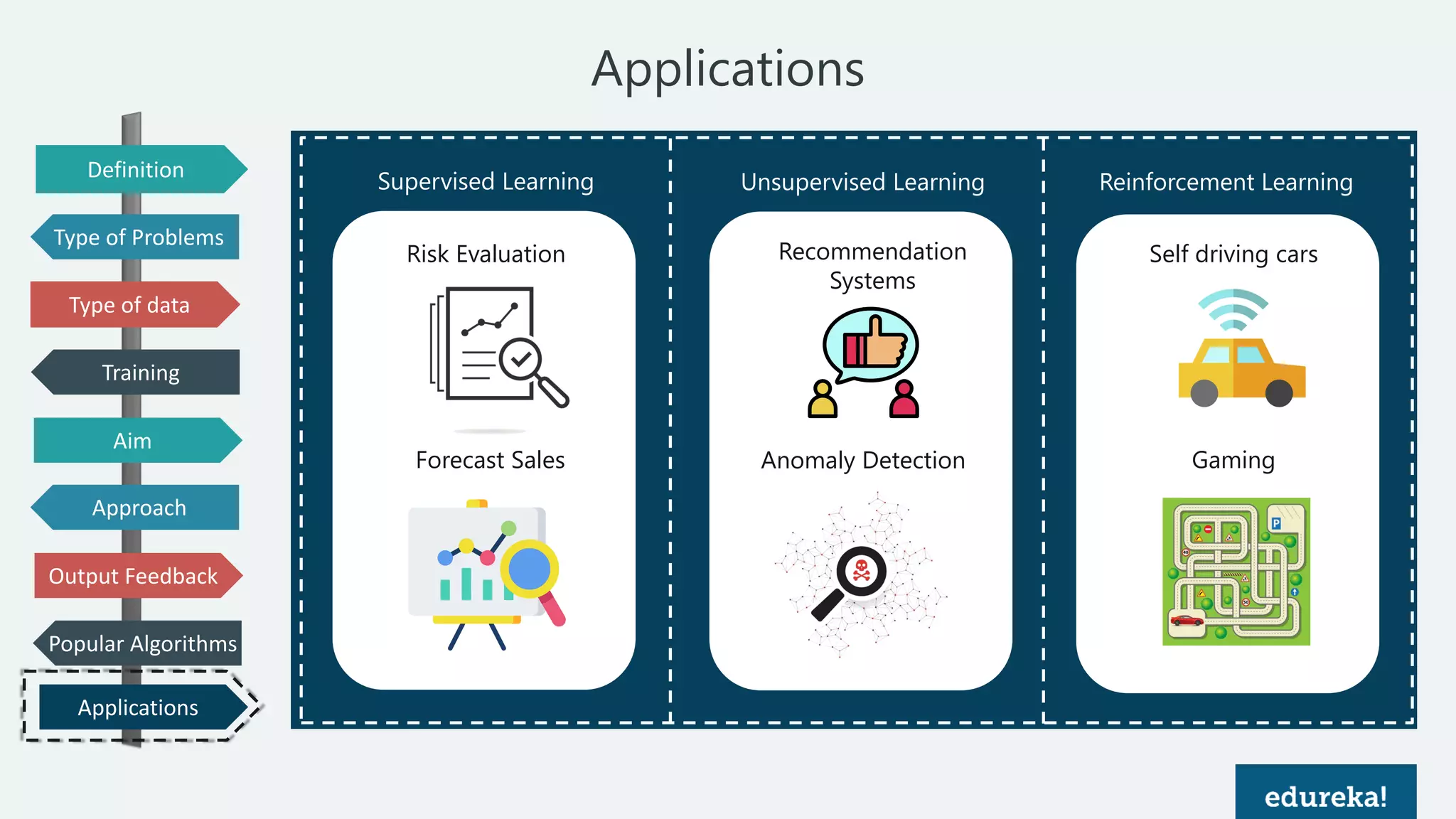
Applications
Supervised Learning Unsupervised Learning Reinforcement Learning
Risk Evaluation
Forecast Sales
Recommendation
Systems
Anomaly Detection
Self driving cars
Gaming
Definition
Type of data
Training
Aim
Output Feedback
Popular Algorithms
Applications
Type of Problems
Approach
Python Certification Trainingfor Data Science www.edureka.co/python
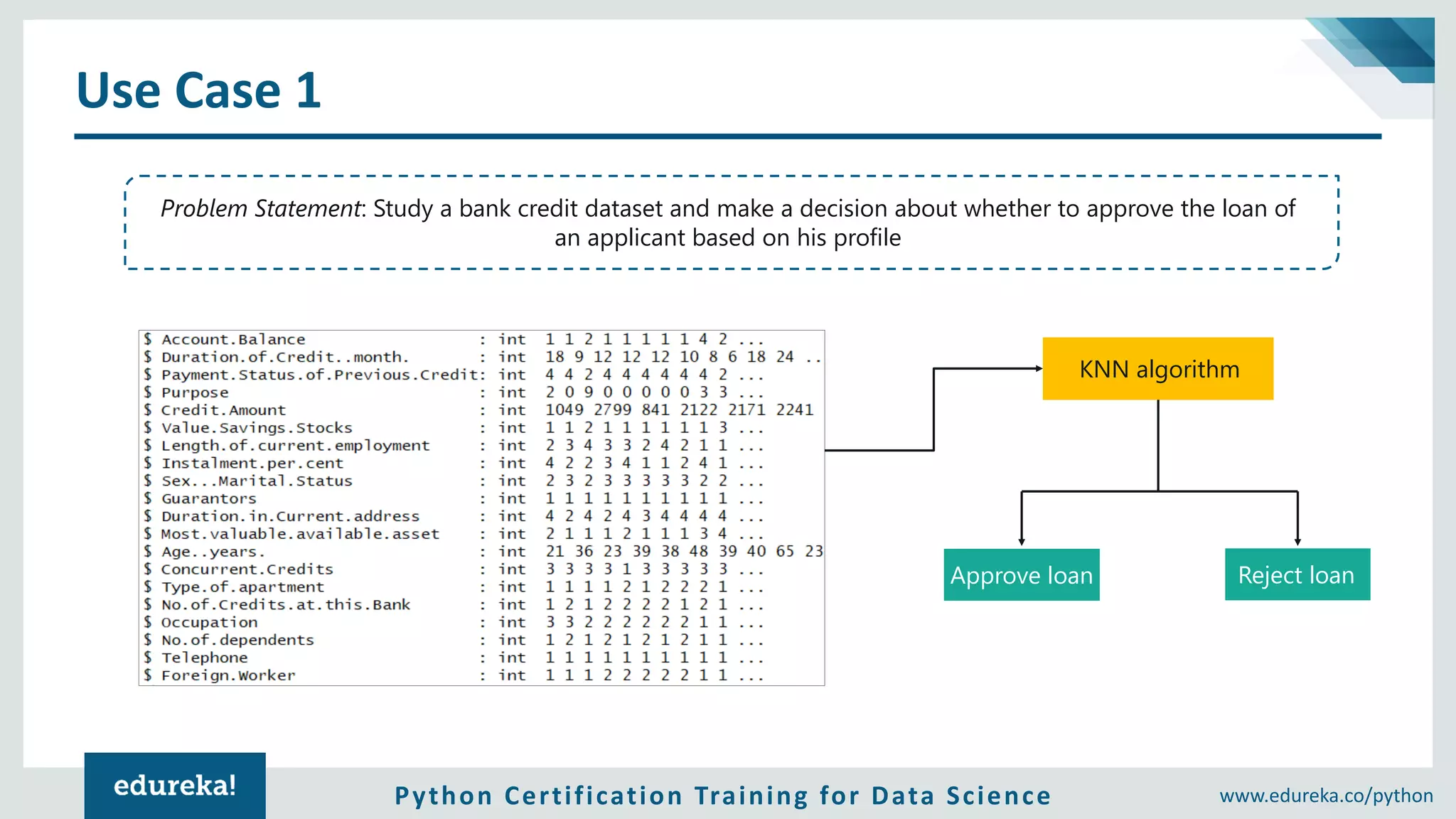
Use Case 1
Problem Statement: Study a bank credit dataset and make a decision about whether to approve the loan of
an applicant based on his profile
KNN algorithm
Approve loan Reject loan
19.
Python Certification Trainingfor Data Science www.edureka.co/python
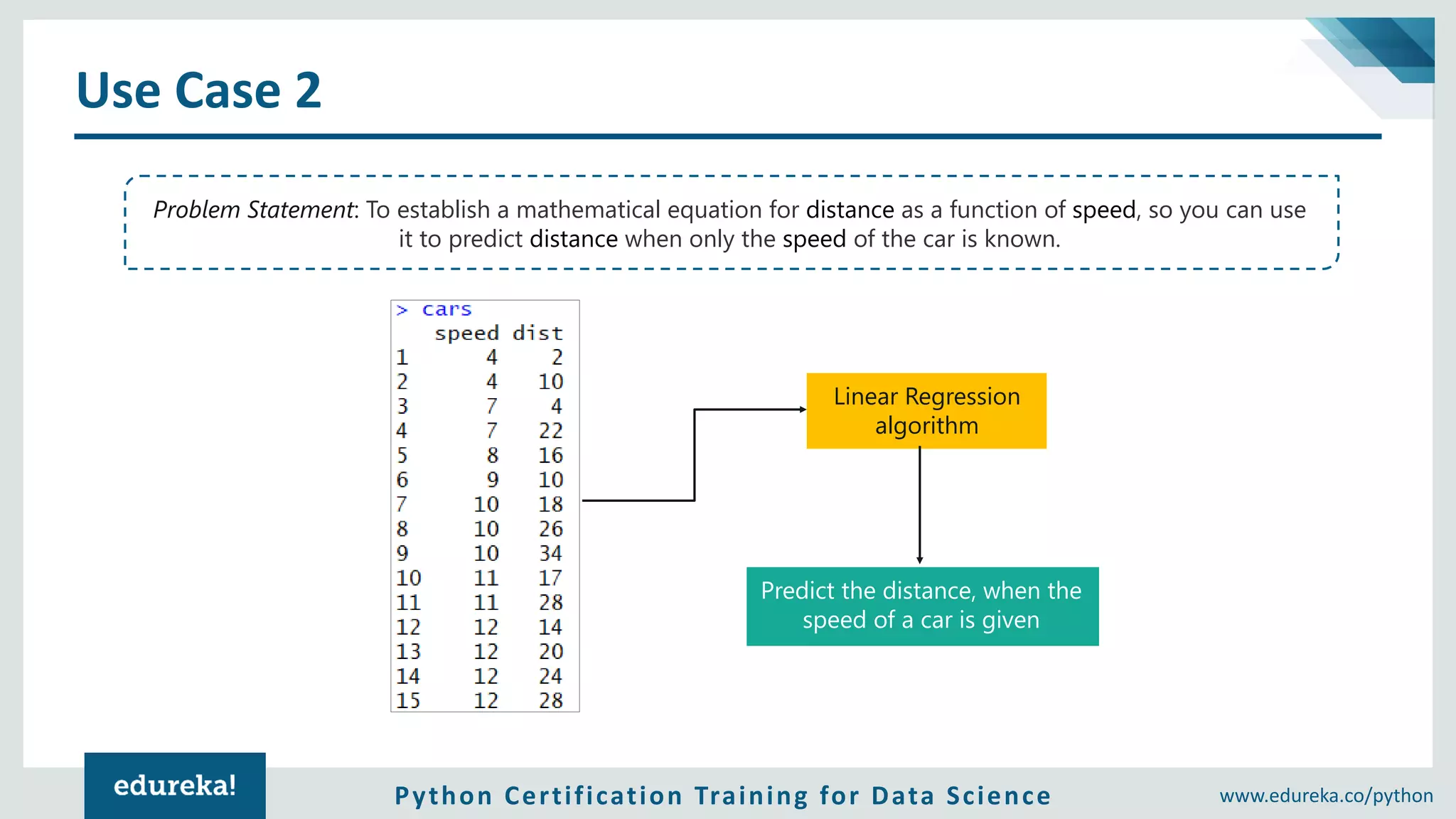
Use Case 2
Problem Statement: To establish a mathematical equation for distance as a function of speed, so you can use
it to predict distance when only the speed of the car is known.
Linear Regression
algorithm
Predict the distance, when the
speed of a car is given
20.
Python Certification Trainingfor Data Science www.edureka.co/python
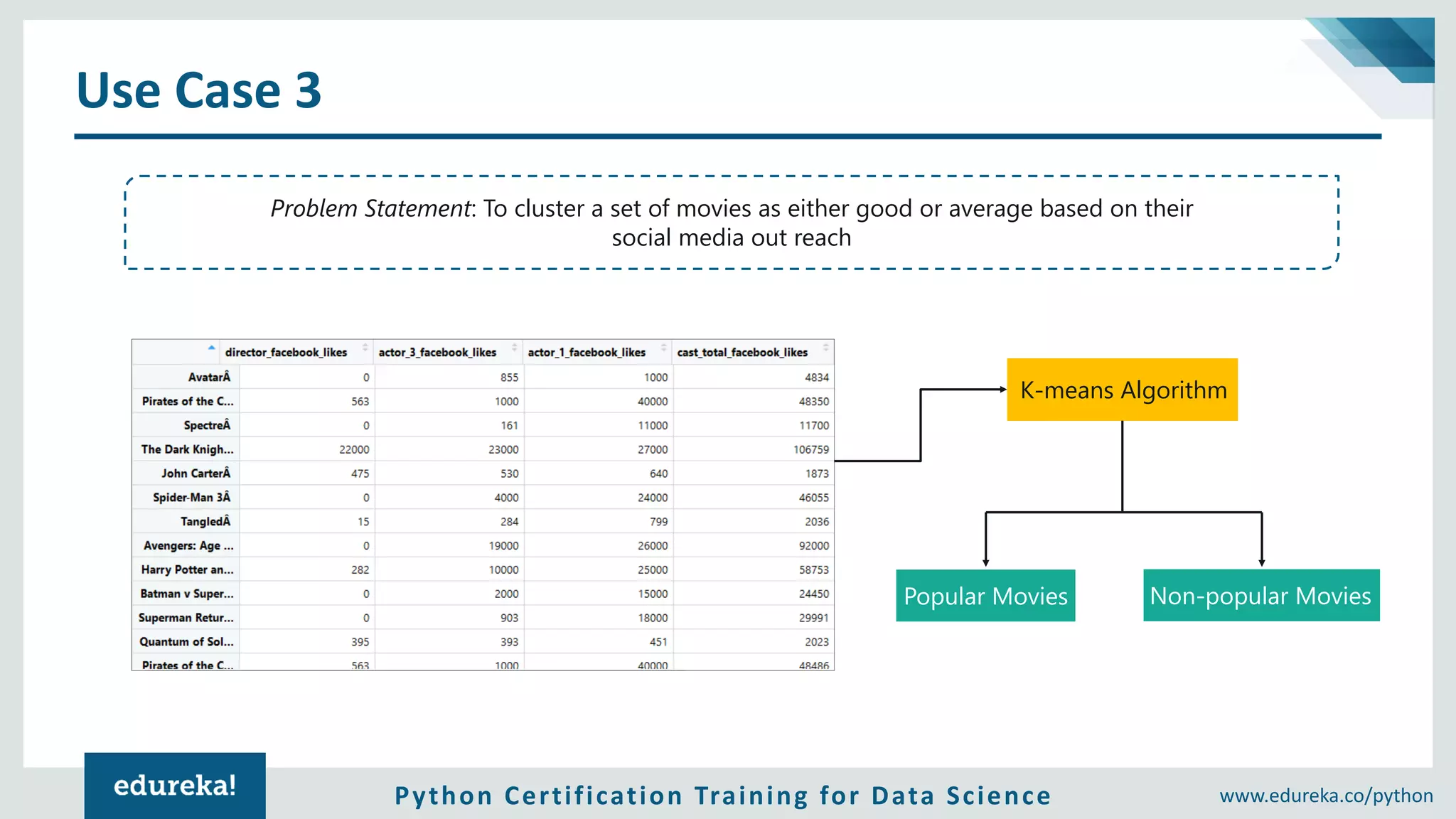
Use Case 3
Problem Statement: To cluster a set of movies as either good or average based on their
social media out reach
K-means Algorithm
Popular Movies Non-popular Movies
21.
Python Certification Trainingfor Data Science www.edureka.co/python
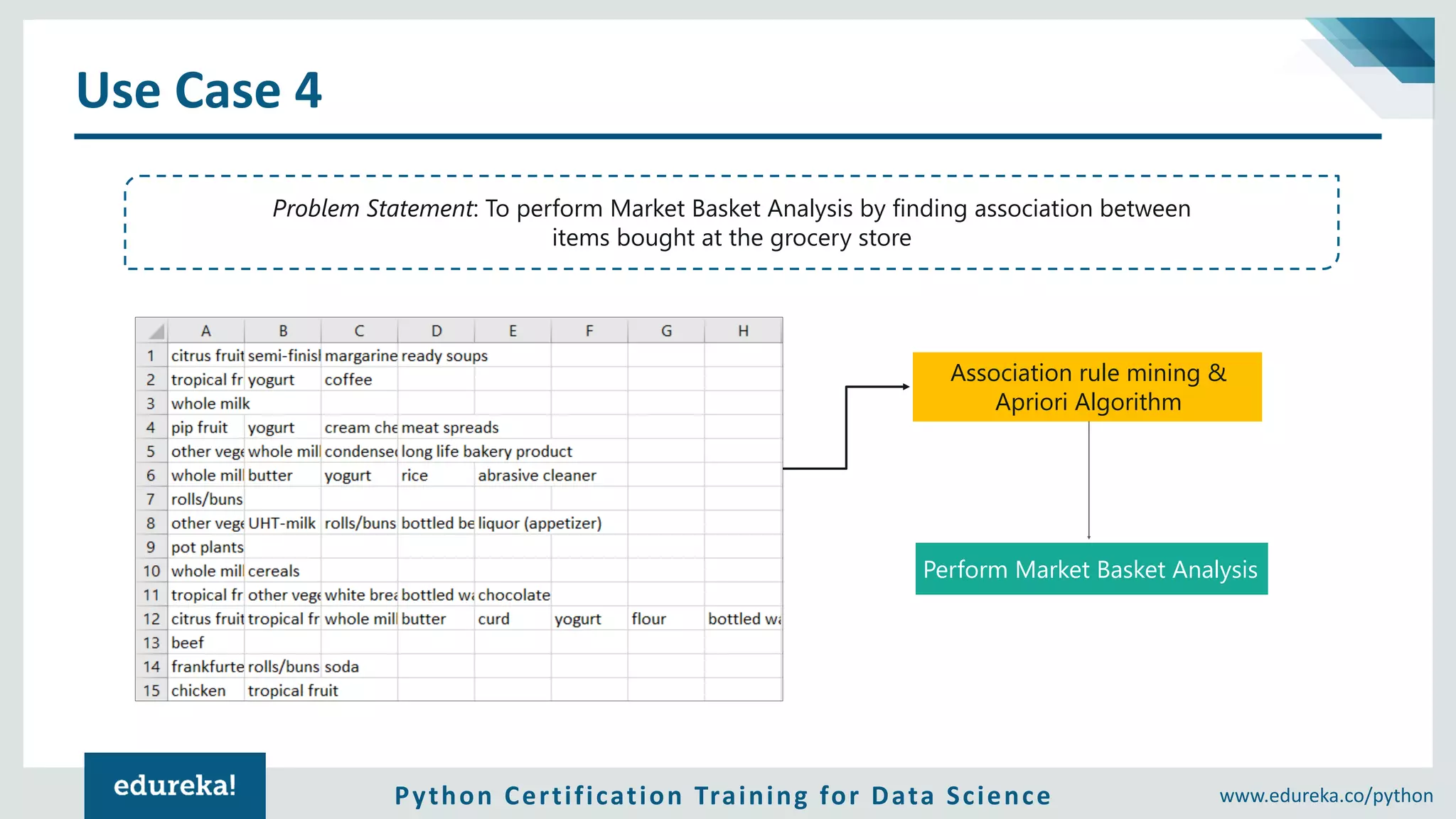
Use Case 4
Problem Statement: To perform Market Basket Analysis by finding association between
items bought at the grocery store
Association rule mining &
Apriori Algorithm
Perform Market Basket Analysis
22.
Python Certification Trainingfor Data Science www.edureka.co/python
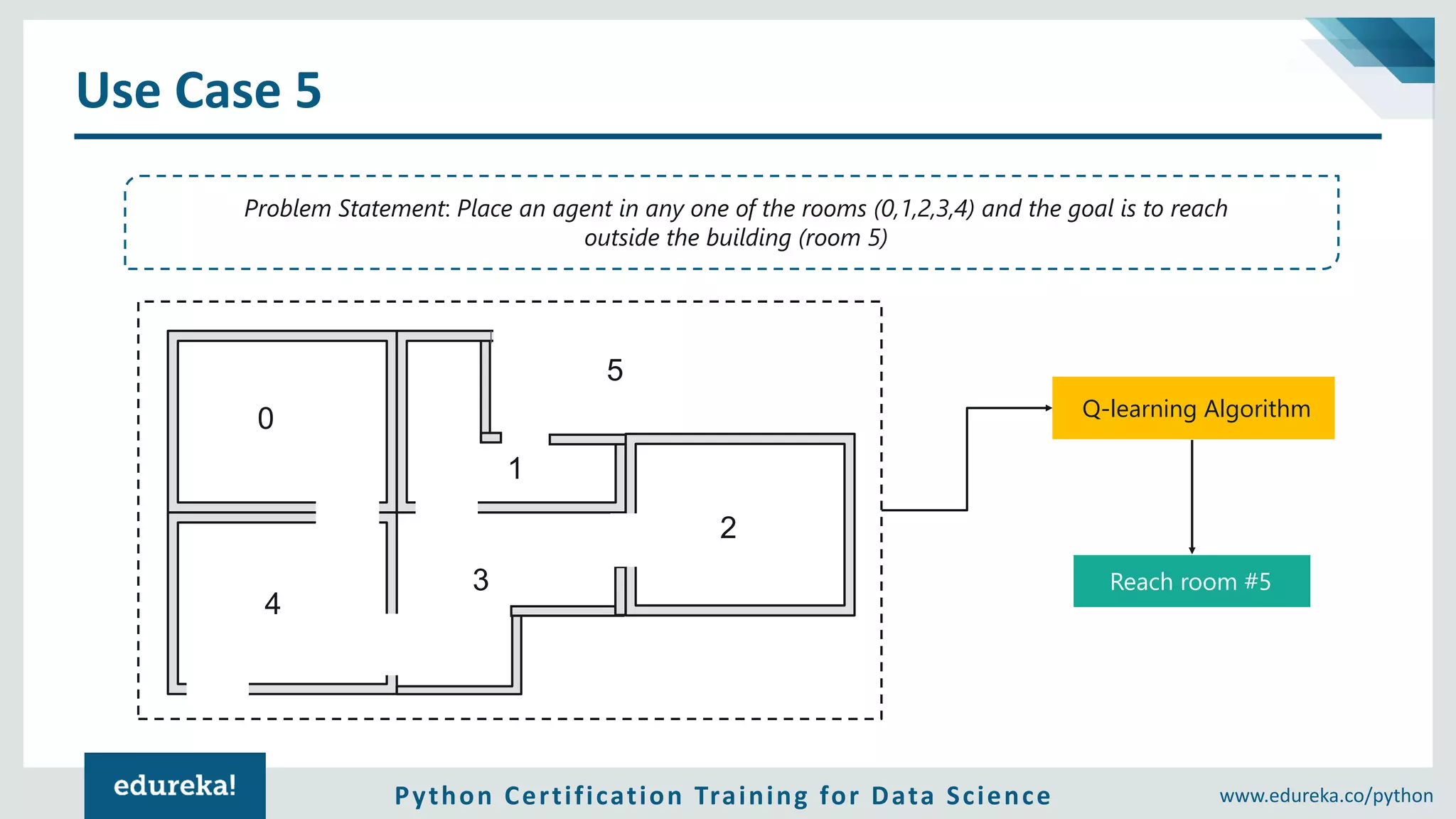
Use Case 5
Problem Statement: Place an agent in any one of the rooms (0,1,2,3,4) and the goal is to reach
outside the building (room 5)
Q-learning Algorithm
Popular Movies
0
4
3
1
2
5
Reach room #5
Python Certification Trainingfor Data Science www.edureka.co/python
WebDriver vs. IDE vs. RC
➢ Data Warehouse is like a relational database designed for analytical needs.
➢ It functions on the basis of OLAP (Online Analytical Processing).
➢ It is a central location where consolidated data from multiple locations (databases) are stored.