Presented By
PRATISTHA SINGH
-: CONTENTS :-
 What Is Sentiment Analysis?
 How Social Media Sentiment is
Measured?
 Sentiment Analysis Application Areas
 What is its need ?
 Combine Human and Machine Learning
 Technology Used
 Perspective Level of Categorization
 Limitations
 Future Scope
WHAT IS SENTIMENT ANALYSIS?
• Social Sentiment refers to the emotion behind a social mention.
• It means monitoring social media posts and discussions, then figuring out how participants are reacting.
• It involves applying natural language processing (NLP) to social mentions and determining whether the user is
responding in a positive, negative or neutral manner.
HOW SOCIAL MEDIA SENTIMENT IS
MEASURED?
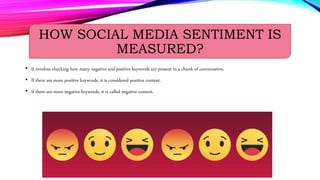
• It involves checking how many negative and positive keywords are present in a chunk of conversation.
• If there are more positive keywords, it is considered positive content.
• If there are more negative keywords, it is called negative content.
E
X
A
M
PL
E
SENTIMENT ANALYSIS APPLICATION
AREAS
WHAT IS ITS NEED?
• Improved customer service
• Prevent social media crises
• Measure the results of a social media campaign
• Monitor your competitors
• Improve your product according to your customers
needs
COMBINE HUMAN AND MACHINE
LEARNING
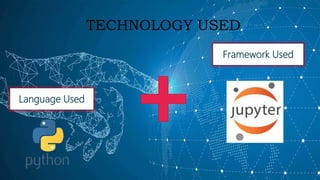
TECHNOLOGY USED
Language Used
Framework Used
PERSPECTIVE LEVEL OF
CATEGORIZATION
• Document level: The aim here is to determine the overall sentiment of an entire document. For example given a product review, the task is to determine whether
it expresses positive or negative opinions about the product. This level looks at the document as a single entity, thus it is not extensible to multiple documents.
• Sentence level: This level of analysis is very close to subjectivity classification and the task at this level is limited to the sentences and their expressed opinions.
Specifically, this level determines whether each sentence expresses a positive, negative or neutral opinion.
• Entity and aspect level: Instead of solely analyzing language constructs (e.g. documents, paragraphs, sentences), this level (a.k.a feature level) provides
finer-grained analysis for each aspect(or feature) i.e., it directly looks at the opinions for different aspects itself.
LIMITATIONS
• The use of metaphors, slang expressions, sarcasm, and irony can be difficult for an
analysis tool to read properly.
• Thus those elements can change the polarity of a result, skewing the readings and the
perception.
• Sentiment algorithms can also have difficulty analyzing results that feature product
comparisons or emojis.
• Of all sentiments, neutrality is the most difficult tone for these tools to detect
because it’s so subjective.
FUTURE SCOPE
Social Media Sentiments Analysis

Social Media Sentiments Analysis

  • 1.
  • 2.
    -: CONTENTS :- What Is Sentiment Analysis?  How Social Media Sentiment is Measured?  Sentiment Analysis Application Areas  What is its need ?  Combine Human and Machine Learning  Technology Used  Perspective Level of Categorization  Limitations  Future Scope
  • 3.
    WHAT IS SENTIMENTANALYSIS? • Social Sentiment refers to the emotion behind a social mention. • It means monitoring social media posts and discussions, then figuring out how participants are reacting. • It involves applying natural language processing (NLP) to social mentions and determining whether the user is responding in a positive, negative or neutral manner.
  • 4.
    HOW SOCIAL MEDIASENTIMENT IS MEASURED? • It involves checking how many negative and positive keywords are present in a chunk of conversation. • If there are more positive keywords, it is considered positive content. • If there are more negative keywords, it is called negative content.
  • 5.
  • 6.
  • 7.
    WHAT IS ITSNEED? • Improved customer service • Prevent social media crises • Measure the results of a social media campaign • Monitor your competitors • Improve your product according to your customers needs
  • 8.
    COMBINE HUMAN ANDMACHINE LEARNING
  • 9.
  • 10.
    PERSPECTIVE LEVEL OF CATEGORIZATION •Document level: The aim here is to determine the overall sentiment of an entire document. For example given a product review, the task is to determine whether it expresses positive or negative opinions about the product. This level looks at the document as a single entity, thus it is not extensible to multiple documents. • Sentence level: This level of analysis is very close to subjectivity classification and the task at this level is limited to the sentences and their expressed opinions. Specifically, this level determines whether each sentence expresses a positive, negative or neutral opinion. • Entity and aspect level: Instead of solely analyzing language constructs (e.g. documents, paragraphs, sentences), this level (a.k.a feature level) provides finer-grained analysis for each aspect(or feature) i.e., it directly looks at the opinions for different aspects itself.
  • 11.
    LIMITATIONS • The useof metaphors, slang expressions, sarcasm, and irony can be difficult for an analysis tool to read properly. • Thus those elements can change the polarity of a result, skewing the readings and the perception. • Sentiment algorithms can also have difficulty analyzing results that feature product comparisons or emojis. • Of all sentiments, neutrality is the most difficult tone for these tools to detect because it’s so subjective.
  • 12.