
MOBILIZATION FOR SOCIAL
INCLUSION

Dr. Xavier Úcar
Dpt. Pedagogia Sistemática y Social
http://uab.academia.edu/XavierUcar
October, 2013
Copenhague
CONTENT
1. Social cohesion and citizenship:
framework for social mobilization

a

1. The study of social mobilization

2. Social mobilization from the perspective
of social pedagogy
3. The analysis of the mobilization of
volunteer resources
Social cohesion and citizenship: a framework for
social mobilization
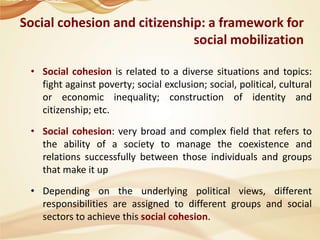
• Social cohesion is related to a diverse situations and topics:
fight against poverty; social exclusion; social, political, cultural
or economic inequality; construction of identity and
citizenship; etc.
• Social cohesion: very broad and complex field that refers to
the ability of a society to manage the coexistence and
relations successfully between those individuals and groups
that make it up
• Depending on the underlying political views, different
responsibilities are assigned to different groups and social
sectors to achieve this social cohesion.
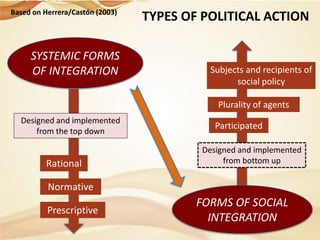
Based on Herrera/Castón (2003)

SYSTEMIC FORMS
OF INTEGRATION

TYPES OF POLITICAL ACTION

Subjects and recipients of
social policy
Plurality of agents

Designed and implemented
from the top down

Rational

Participated
Designed and implemented
from bottom up

Normative
Prescriptive

FORMS OF SOCIAL
INTEGRATION
Social cohesion and citizenship: a framework
for social mobilization
• Welfare State has been reformulated in terms of Pluralism of
Welfare or the Welfare Society
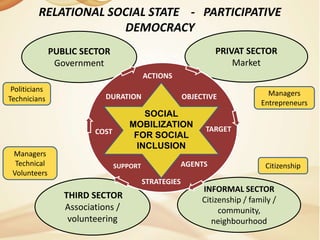
• Social cohesion can only be achieved if it is understood as a
responsibility shared by all sectors (public, private, third
sector and informal sector), and if they engage in the struggle
to achieve it.
• Relational Social State
• Clear leadership from central government that must enable
and encourage the exercise of active citizenship
THE STUDY OF SOCIAL MOBILIZATION

• The traditional core of social mobilization was the “class
struggle” today it is the “social movement” as a particular
and phenomenal subject
• Nowadays the emphasis is focused on questions relating
to the organization of social movements and specific
concerns such as “identity”, “organizational resources”
and “exclusion”
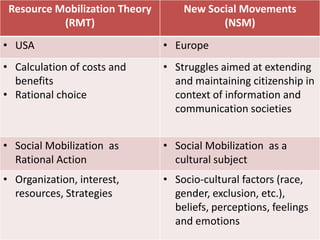
Resource Mobilization Theory
(RMT)

New Social Movements
(NSM)

• USA

• Europe

• Calculation of costs and
benefits
• Rational choice

• Struggles aimed at extending
and maintaining citizenship in
context of information and
communication societies

• Social Mobilization as
Rational Action

• Social Mobilization as a
cultural subject

• Organization, interest,
resources, Strategies

• Socio-cultural factors (race,
gender, exclusion, etc.),
beliefs, perceptions, feelings
and emotions
SOCIAL MOBILIZATION FROM THE PERSPECTIVE
OF SOCIAL PEDAGOGY

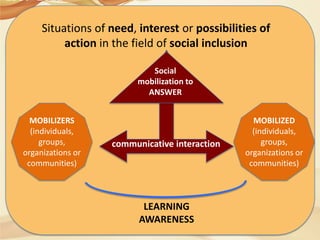
• Social mobilization as a result of a process of communication
between the mobilizers – whether these are individuals,
groups, organizations or communities - and the mobilized
• Mobilization is the individual or collective action of people,
associations or organizations that seek to respond to situations
of need, interest or possibilities of action in the field of social
inclusion.
• This communicative interaction would ideally involve a
qualitative increase in the levels of people’s awareness
(conscientization)
Situations of need, interest or possibilities of
action in the field of social inclusion
Social
mobilization to
ANSWER
MOBILIZERS
(individuals,
groups,
organizations or
communities)

communicative interaction

LEARNING
AWARENESS

MOBILIZED
(individuals,
groups,
organizations or
communities)
THE ANALYSIS OF THE MOBILIZATION OF
VOLUNTEER RESOURCES
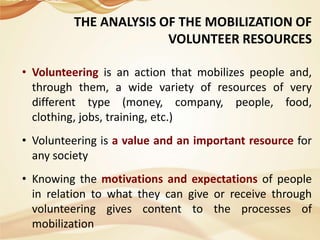
• Volunteering is an action that mobilizes people and,
through them, a wide variety of resources of very
different type (money, company, people, food,
clothing, jobs, training, etc.)
• Volunteering is a value and an important resource for
any society

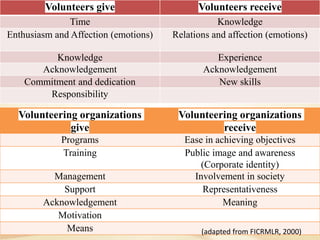
• Knowing the motivations and expectations of people
in relation to what they can give or receive through
volunteering gives content to the processes of
mobilization
Volunteers give

Volunteers receive

Time
Enthusiasm and Affection (emotions)

Knowledge
Relations and affection (emotions)

Knowledge
Acknowledgement
Commitment and dedication
Responsibility

Experience
Acknowledgement
New skills

Volunteering organizations
give

Volunteering organizations
receive

Programs
Training

Ease in achieving objectives
Public image and awareness
(Corporate identity)
Involvement in society
Representativeness
Meaning

Management
Support
Acknowledgement
Motivation
Means

(adapted from FICRMLR, 2000)
RELATIONAL SOCIAL STATE - PARTICIPATIVE
DEMOCRACY
PRIVAT SECTOR
Market

PUBLIC SECTOR
Government
ACTIONS
Politicians
Technicians

DURATION

SOCIAL
MOBILIZATION
FOR SOCIAL
INCLUSION

COST
Managers
Technical
Volunteers

OBJECTIVE

STRATEGIES

THIRD SECTOR
Associations /
volunteering

TARGET

AGENTS

SUPPORT

Managers
Entrepreneurs

Citizenship

INFORMAL SECTOR
Citizenship / family /
community,
neighbourhood
Thank you for your attention!!!

Social mobilization

  • 1.
    MOBILIZATION FOR SOCIAL INCLUSION Dr.Xavier Úcar Dpt. Pedagogia Sistemática y Social http://uab.academia.edu/XavierUcar October, 2013 Copenhague
  • 2.
    CONTENT 1. Social cohesionand citizenship: framework for social mobilization a 1. The study of social mobilization 2. Social mobilization from the perspective of social pedagogy 3. The analysis of the mobilization of volunteer resources
  • 3.
    Social cohesion andcitizenship: a framework for social mobilization • Social cohesion is related to a diverse situations and topics: fight against poverty; social exclusion; social, political, cultural or economic inequality; construction of identity and citizenship; etc. • Social cohesion: very broad and complex field that refers to the ability of a society to manage the coexistence and relations successfully between those individuals and groups that make it up • Depending on the underlying political views, different responsibilities are assigned to different groups and social sectors to achieve this social cohesion.
  • 4.
    Based on Herrera/Castón(2003) SYSTEMIC FORMS OF INTEGRATION TYPES OF POLITICAL ACTION Subjects and recipients of social policy Plurality of agents Designed and implemented from the top down Rational Participated Designed and implemented from bottom up Normative Prescriptive FORMS OF SOCIAL INTEGRATION
  • 5.
    Social cohesion andcitizenship: a framework for social mobilization • Welfare State has been reformulated in terms of Pluralism of Welfare or the Welfare Society • Social cohesion can only be achieved if it is understood as a responsibility shared by all sectors (public, private, third sector and informal sector), and if they engage in the struggle to achieve it. • Relational Social State • Clear leadership from central government that must enable and encourage the exercise of active citizenship
  • 6.
    THE STUDY OFSOCIAL MOBILIZATION • The traditional core of social mobilization was the “class struggle” today it is the “social movement” as a particular and phenomenal subject • Nowadays the emphasis is focused on questions relating to the organization of social movements and specific concerns such as “identity”, “organizational resources” and “exclusion”
  • 7.
    Resource Mobilization Theory (RMT) NewSocial Movements (NSM) • USA • Europe • Calculation of costs and benefits • Rational choice • Struggles aimed at extending and maintaining citizenship in context of information and communication societies • Social Mobilization as Rational Action • Social Mobilization as a cultural subject • Organization, interest, resources, Strategies • Socio-cultural factors (race, gender, exclusion, etc.), beliefs, perceptions, feelings and emotions
  • 8.
    SOCIAL MOBILIZATION FROMTHE PERSPECTIVE OF SOCIAL PEDAGOGY • Social mobilization as a result of a process of communication between the mobilizers – whether these are individuals, groups, organizations or communities - and the mobilized • Mobilization is the individual or collective action of people, associations or organizations that seek to respond to situations of need, interest or possibilities of action in the field of social inclusion. • This communicative interaction would ideally involve a qualitative increase in the levels of people’s awareness (conscientization)
  • 9.
    Situations of need,interest or possibilities of action in the field of social inclusion Social mobilization to ANSWER MOBILIZERS (individuals, groups, organizations or communities) communicative interaction LEARNING AWARENESS MOBILIZED (individuals, groups, organizations or communities)
  • 10.
    THE ANALYSIS OFTHE MOBILIZATION OF VOLUNTEER RESOURCES • Volunteering is an action that mobilizes people and, through them, a wide variety of resources of very different type (money, company, people, food, clothing, jobs, training, etc.) • Volunteering is a value and an important resource for any society • Knowing the motivations and expectations of people in relation to what they can give or receive through volunteering gives content to the processes of mobilization
  • 11.
    Volunteers give Volunteers receive Time Enthusiasmand Affection (emotions) Knowledge Relations and affection (emotions) Knowledge Acknowledgement Commitment and dedication Responsibility Experience Acknowledgement New skills Volunteering organizations give Volunteering organizations receive Programs Training Ease in achieving objectives Public image and awareness (Corporate identity) Involvement in society Representativeness Meaning Management Support Acknowledgement Motivation Means (adapted from FICRMLR, 2000)
  • 12.
    RELATIONAL SOCIAL STATE- PARTICIPATIVE DEMOCRACY PRIVAT SECTOR Market PUBLIC SECTOR Government ACTIONS Politicians Technicians DURATION SOCIAL MOBILIZATION FOR SOCIAL INCLUSION COST Managers Technical Volunteers OBJECTIVE STRATEGIES THIRD SECTOR Associations / volunteering TARGET AGENTS SUPPORT Managers Entrepreneurs Citizenship INFORMAL SECTOR Citizenship / family / community, neighbourhood
  • 13.
    Thank you foryour attention!!!