SOCIAL MOBILIZATION
Jeriel Reyes De Silos, MD, MPM
CM3, DLSHSI College of Medicine
What is Social Mobilization?

• Mobilization -
a Military
terminology
• To Mobilize =
prepare forces
for action
Social Mobilization
• A process of
motivating
communities to
organize in a
cohesive group
for an active
participation
towards their
own
development
Social Mobilization
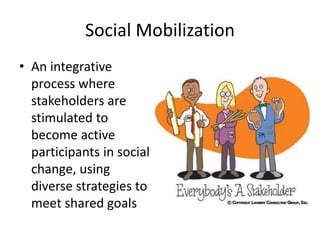
• An integrative
process where
stakeholders are
stimulated to
become active
participants in social
change, using
diverse strategies to
meet shared goals
Social Mobilization
• A comprehensive planning approach that
emphasizes
– Political coalition building
– Community action
(UNICEF, 1993; Wallack, 1989)
Social Mobilization
• The process is concerned with mobilizing
human and financial resources through five
main approaches:
1. Political Mobilization
2. Community Mobilization
3. Government Mobilization
4. Corporate Mobilization
5. Beneficiary Mobilization
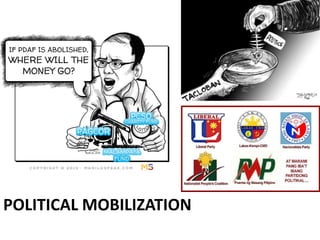
POLITICAL MOBILIZATION
Political Mobilization
• Aims at winning political and policy
commitment for a major goal and the
necessary resource allocations to realize that
goal.
• Primary method – lobbying
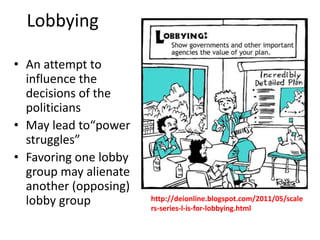
Lobbying
• An attempt to
influence the
decisions of the
politicians
• May lead to“power
struggles”
• Favoring one lobby
group may alienate
another (opposing)
lobby group http://deionline.blogspot.com/2011/05/scale
rs-series-l-is-for-lobbying.html
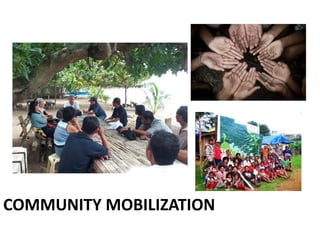
COMMUNITY MOBILIZATION
Community Mobilization
• Aims at informing and gaining the
commitment of community leaders as well as
local government agencies, Nongovernmental
organizations(NGOs), women's groups and
cooperatives.
Tips On Community Mobilization
1. Know your community well,
and understand their problems and their needs.
2. Be aware of existing health beliefs and
practices that exist in the community.
3. Always listen to community members carefully.
4. Do not rapidly introduce new interventions that
are different from existing practices and
beliefs. Take gradual steps to introduce such
practices.
Tips On Community Mobilization
5. Try to analyze community dynamics and
adjust to each situation.
6. Involve the entire community in
the program right from the beginning.
7. Give respect and importance to negative
experiences of the community, if any, and try
to minimize the negative
feelings verbally and in your actions.
GOVERNMENT MOBILIZATION
Government Mobilization
Aims at informing
and enlisting the
cooperation and help
of service providers
and other
government
organizations that
can provide direct or
indirect support.
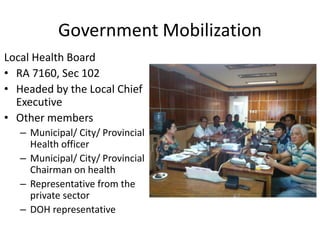
Government Mobilization
Local Health Board
• RA 7160, Sec 102
• Headed by the Local Chief
Executive
• Other members
– Municipal/ City/ Provincial
Health officer
– Municipal/ City/ Provincial
Chairman on health
– Representative from the
private sector
– DOH representative
CORPORATE MOBILIZATION
Corporate Mobilization
• aims at securing the support of national or
international companies in promoting
appropriate goals, either through the
contribution of resources or the carrying of
appropriate messages as a part of their
advertising or product labelling.
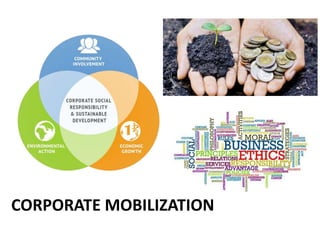
Corporate Social Responsibility (CSR)
• Refers to operating a business in a manner
that accounts for the social and environmental
impact created by the business.
– commitment to developing policies that integrate
responsible practices into daily business
operations
– reporting on progress made toward implementing
these practices.
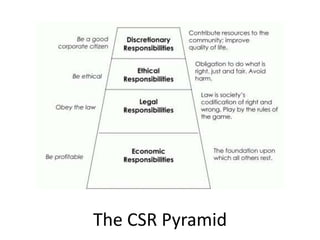
The CSR Pyramid
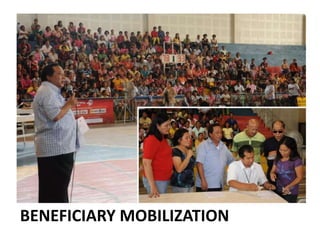
BENEFICIARY MOBILIZATION
Beneficiary Mobilization
• Aims at informing and motivating the program
beneficiaries through training programs, the
establishment of community groups and
communication
• Example: Pantawid Pamilyang Pilipino
Program (4Ps)
Pantawid Pamilyang Pilipino Program
(4Ps)
Patterned after the conditional cash transfer
scheme implemented in other developing
countries, the Pantawid Pamilya provides cash
grants to beneficiaries provided that they
comply with the set of conditions required by
the program.
Pantawid Pamilyang Pilipino Program
(4Ps)
To avail of the cash grants beneficiaries should comply with
the following conditions:
1. Pregnant women must avail pre- and post-natal care and
be attended during childbirth by a trained health
professional;
2. Parents must attend Family Development Sessions (FDS);
3. 0-5 year old children must receive regular preventive
health check-ups and vaccines;
4. 6-14 years old children must receive deworming pills
twice a year.
5. All child beneficiaries (0-18 years old) must enroll in
school and maintain a class attendance of at least 85% per
month.
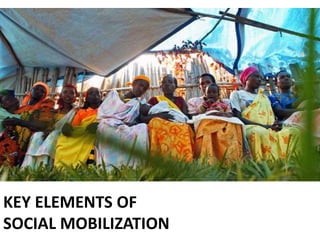
KEY ELEMENTS OF
SOCIAL MOBILIZATION
Key Elements of Social Mobilization
1. partnership building and networking
2. community participation
3. media and special events to raise public
awareness
4. advocacy to mobilize resources and effect
policy change
Partnership Building and Networking
• “Synergy” – more than the sum of its parts
• Identification of key stakeholders
• Stakeholder - group, organization, member or
system who affects or can be affected by
government policies and actions
Community Participation
• Participation is about meeting the interests of
the whole community.
• Takes into consideration the different
experiences, needs and capabilities of various
groups
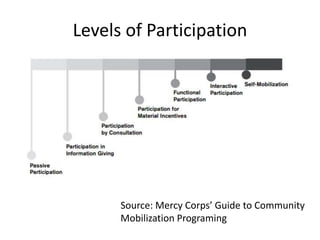
Levels of Participation
Source: Mercy Corps’ Guide to Community
Mobilization Programing
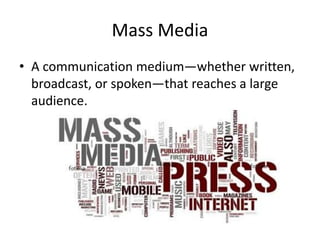
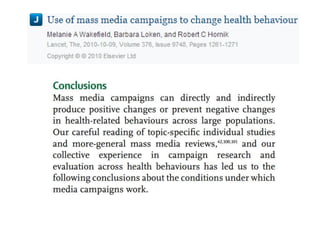
Mass Media
• A communication medium—whether written,
broadcast, or spoken—that reaches a large
audience.
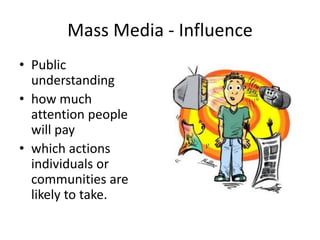
Mass Media - Influence
• Public
understanding
• how much
attention people
will pay
• which actions
individuals or
communities are
likely to take.
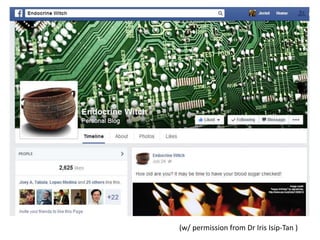
(w/ permission from Dr Iris Isip-Tan )
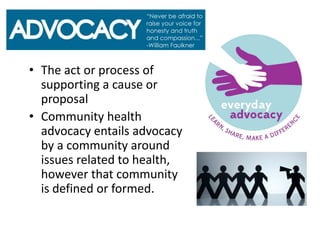
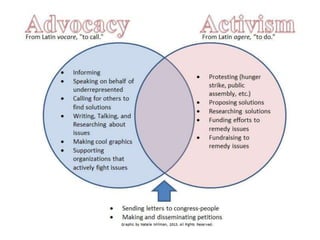
• The act or process of
supporting a cause or
proposal
• Community health
advocacy entails advocacy
by a community around
issues related to health,
however that community
is defined or formed.
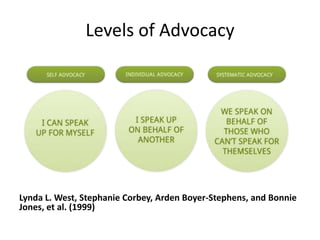
Levels of Advocacy
Lynda L. West, Stephanie Corbey, Arden Boyer-Stephens, and Bonnie
Jones, et al. (1999)
Questions???
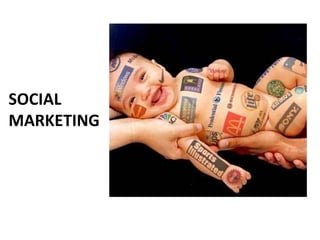
SOCIAL
MARKETING
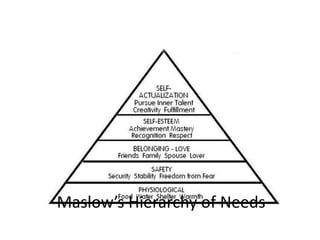
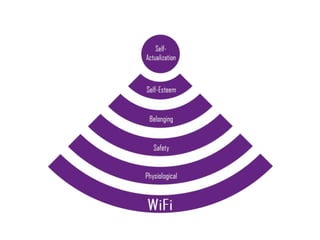
Maslow’s Hierarchy of Needs
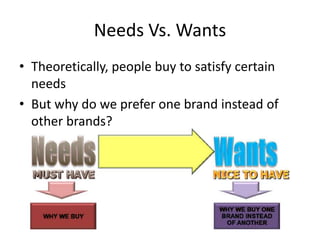
Needs Vs. Wants
• Theoretically, people buy to satisfy certain
needs
• But why do we prefer one brand instead of
other brands?
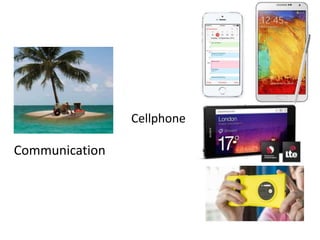
Cellphone
Communication
What Is Social Marketing?
• “…A process for influencing human behavior
on a large scale, using marketing principles for
the purpose of societal benefit rather than
commercial profit.” (W. Smith, Academy for Educational
Development)
What Social Marketing is Not?
• Not social advertising
• Not driven by organizational expert’s agendas
• Not promotion or media outreach only
• Not about coercing behaviors
– through punishment
• Not a “one approach” model
Social Marketing Concepts
• The ultimate objective of marketing is to
influence action or change behavior
• Action is undertaken whenever target
audiences believe that the benefits they
receive will be greater than the costs
they incur
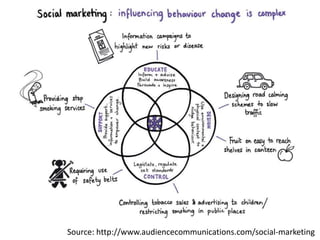
Source: http://www.audiencecommunications.com/social-marketing
Social Marketing Concepts
• INDIRECT MARKETING
– mass advertising and promotions
– special mass events and campaigns
• DIRECT MARKETING
– focused presentations
– direct mail
– personalized calls
– face to face interaction
Social Marketing Concepts
• It uses various conceptual tools, such as:
– market segmentation
– consumer research
– product concept development and testing
– directed communications
– facilitation
– incentives
– exchange theory
Social Marketing Concepts
The PROPONENT (sponsoring agency) pursues
the change goals in the belief that they will
contribute to the individual/s’ or society’s best
interests.
Social Marketing Concepts
POSITIONING defines the fit between the social
product and what target acceptors want/need in
order to satisfy the needs and do better than
others.
Social Marketing Concepts
• SOCIAL PRODUCT
– IDEA (belief, attitude, value)
– PRACTICE (behavior, action)
– PRODUCT/TANGIBLE OBJECT (e.g., contraceptives,
fortified food and drinks, environmental friendly
materials, etc.)
Questions???

Social mobilization

  • 1.
    SOCIAL MOBILIZATION Jeriel ReyesDe Silos, MD, MPM CM3, DLSHSI College of Medicine
  • 2.
    What is SocialMobilization? • Mobilization - a Military terminology • To Mobilize = prepare forces for action
  • 3.
    Social Mobilization • Aprocess of motivating communities to organize in a cohesive group for an active participation towards their own development
  • 4.
    Social Mobilization • Anintegrative process where stakeholders are stimulated to become active participants in social change, using diverse strategies to meet shared goals
  • 5.
    Social Mobilization • Acomprehensive planning approach that emphasizes – Political coalition building – Community action (UNICEF, 1993; Wallack, 1989)
  • 6.
    Social Mobilization • Theprocess is concerned with mobilizing human and financial resources through five main approaches: 1. Political Mobilization 2. Community Mobilization 3. Government Mobilization 4. Corporate Mobilization 5. Beneficiary Mobilization
  • 7.
  • 8.
    Political Mobilization • Aimsat winning political and policy commitment for a major goal and the necessary resource allocations to realize that goal. • Primary method – lobbying
  • 9.
    Lobbying • An attemptto influence the decisions of the politicians • May lead to“power struggles” • Favoring one lobby group may alienate another (opposing) lobby group http://deionline.blogspot.com/2011/05/scale rs-series-l-is-for-lobbying.html
  • 12.
  • 13.
    Community Mobilization • Aimsat informing and gaining the commitment of community leaders as well as local government agencies, Nongovernmental organizations(NGOs), women's groups and cooperatives.
  • 14.
    Tips On CommunityMobilization 1. Know your community well, and understand their problems and their needs. 2. Be aware of existing health beliefs and practices that exist in the community. 3. Always listen to community members carefully. 4. Do not rapidly introduce new interventions that are different from existing practices and beliefs. Take gradual steps to introduce such practices.
  • 15.
    Tips On CommunityMobilization 5. Try to analyze community dynamics and adjust to each situation. 6. Involve the entire community in the program right from the beginning. 7. Give respect and importance to negative experiences of the community, if any, and try to minimize the negative feelings verbally and in your actions.
  • 16.
  • 17.
    Government Mobilization Aims atinforming and enlisting the cooperation and help of service providers and other government organizations that can provide direct or indirect support.
  • 18.
    Government Mobilization Local HealthBoard • RA 7160, Sec 102 • Headed by the Local Chief Executive • Other members – Municipal/ City/ Provincial Health officer – Municipal/ City/ Provincial Chairman on health – Representative from the private sector – DOH representative
  • 19.
  • 20.
    Corporate Mobilization • aimsat securing the support of national or international companies in promoting appropriate goals, either through the contribution of resources or the carrying of appropriate messages as a part of their advertising or product labelling.
  • 21.
    Corporate Social Responsibility(CSR) • Refers to operating a business in a manner that accounts for the social and environmental impact created by the business. – commitment to developing policies that integrate responsible practices into daily business operations – reporting on progress made toward implementing these practices.
  • 22.
  • 23.
  • 24.
    Beneficiary Mobilization • Aimsat informing and motivating the program beneficiaries through training programs, the establishment of community groups and communication • Example: Pantawid Pamilyang Pilipino Program (4Ps)
  • 25.
    Pantawid Pamilyang PilipinoProgram (4Ps) Patterned after the conditional cash transfer scheme implemented in other developing countries, the Pantawid Pamilya provides cash grants to beneficiaries provided that they comply with the set of conditions required by the program.
  • 26.
    Pantawid Pamilyang PilipinoProgram (4Ps) To avail of the cash grants beneficiaries should comply with the following conditions: 1. Pregnant women must avail pre- and post-natal care and be attended during childbirth by a trained health professional; 2. Parents must attend Family Development Sessions (FDS); 3. 0-5 year old children must receive regular preventive health check-ups and vaccines; 4. 6-14 years old children must receive deworming pills twice a year. 5. All child beneficiaries (0-18 years old) must enroll in school and maintain a class attendance of at least 85% per month.
  • 27.
  • 28.
    Key Elements ofSocial Mobilization 1. partnership building and networking 2. community participation 3. media and special events to raise public awareness 4. advocacy to mobilize resources and effect policy change
  • 29.
    Partnership Building andNetworking • “Synergy” – more than the sum of its parts • Identification of key stakeholders • Stakeholder - group, organization, member or system who affects or can be affected by government policies and actions
  • 30.
    Community Participation • Participationis about meeting the interests of the whole community. • Takes into consideration the different experiences, needs and capabilities of various groups
  • 31.
    Levels of Participation Source:Mercy Corps’ Guide to Community Mobilization Programing
  • 32.
    Mass Media • Acommunication medium—whether written, broadcast, or spoken—that reaches a large audience.
  • 33.
    Mass Media -Influence • Public understanding • how much attention people will pay • which actions individuals or communities are likely to take.
  • 35.
    (w/ permission fromDr Iris Isip-Tan )
  • 36.
    • The actor process of supporting a cause or proposal • Community health advocacy entails advocacy by a community around issues related to health, however that community is defined or formed.
  • 38.
    Levels of Advocacy LyndaL. West, Stephanie Corbey, Arden Boyer-Stephens, and Bonnie Jones, et al. (1999)
  • 40.
  • 41.
  • 43.
  • 45.
    Needs Vs. Wants •Theoretically, people buy to satisfy certain needs • But why do we prefer one brand instead of other brands?
  • 46.
  • 47.
    What Is SocialMarketing? • “…A process for influencing human behavior on a large scale, using marketing principles for the purpose of societal benefit rather than commercial profit.” (W. Smith, Academy for Educational Development)
  • 48.
    What Social Marketingis Not? • Not social advertising • Not driven by organizational expert’s agendas • Not promotion or media outreach only • Not about coercing behaviors – through punishment • Not a “one approach” model
  • 49.
    Social Marketing Concepts •The ultimate objective of marketing is to influence action or change behavior • Action is undertaken whenever target audiences believe that the benefits they receive will be greater than the costs they incur
  • 50.
  • 51.
    Social Marketing Concepts •INDIRECT MARKETING – mass advertising and promotions – special mass events and campaigns • DIRECT MARKETING – focused presentations – direct mail – personalized calls – face to face interaction
  • 52.
    Social Marketing Concepts •It uses various conceptual tools, such as: – market segmentation – consumer research – product concept development and testing – directed communications – facilitation – incentives – exchange theory
  • 53.
    Social Marketing Concepts ThePROPONENT (sponsoring agency) pursues the change goals in the belief that they will contribute to the individual/s’ or society’s best interests.
  • 54.
    Social Marketing Concepts POSITIONINGdefines the fit between the social product and what target acceptors want/need in order to satisfy the needs and do better than others.
  • 55.
    Social Marketing Concepts •SOCIAL PRODUCT – IDEA (belief, attitude, value) – PRACTICE (behavior, action) – PRODUCT/TANGIBLE OBJECT (e.g., contraceptives, fortified food and drinks, environmental friendly materials, etc.)
  • 58.

Editor's Notes

  • #18 Government mobilization aims at informing and enlisting the cooperation and help of service providers and other government organizations that can provide direct or indirect support. Please take note that this is different from Political mobilization, because government mobilization targets the management aspect of the government, while political mobilization is more on dealing with the leadership aspect of the government.
  • #19 The local health board in the LGUs is an example of government mobilization. In this setup, the mayor or governor serves as the Board Chair, and not the municipal or provincial MD.
  • #20 Next is the Corporate Mobilization.
  • #21 It aims at securing the support of national or international companies in promoting appropriate goals, either through the contribution of resources or the carrying of appropriate messages as a part of their advertising or product labelling.
  • #22 One approach under the corporate mobilization is through the so-called corporate social responsibility. It refers to operating a business in a manner that accounts for the social and environmental impact created by the business. It can be in the form of: --commitment to developing policies that integrate responsible practices into daily business operations --as well as in reporting on progress made toward implementing these practices.
  • #23 It is further explained by the CSR pyramid. And as shown in the picture, the CSR pyramid is composed of 4 responsibilities.
  • #25 Beneficiary mobilization aims at informing and motivating the program beneficiaries through training programs, the establishment of community groups and communication through traditional and mass media Example: Pantawid Pamilyang Pilipino Program
  • #30 Partnership Building and Networking relies on the concept of “Synergy” – more than the sum of its parts Identification of key stakeholders is the most important activity under this.
  • #51 Social marketing can help you to change the behavior of the consumers or the patients or communities. You can use it to: 1) educate people through information campaigns. 2) design innovative methods, ideas and even policies. 3) it can help you exert a certain level of control to certain health practices by imposing limitations 4) Social marketing can help you support or reinforce positive behaviors, or even to empower change.