SOCIAL
MOBILIZATION
Central Bicol State University of Agriculture
Presented by: Marjori Anne Delos Reyes &
Pauline Marie Lozañes
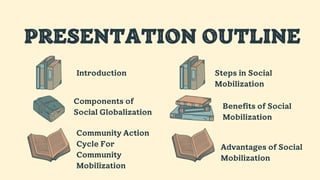
PRESENTATION OUTLINE
Introduction
Community Action
Cycle For
Community
Mobilization
Components of
Social Globalization
Benefits of Social
Mobilization
Steps in Social
Mobilization
Advantages of Social
Mobilization
• Social Mobilization is an approach
wherein the community participation is
very essential. It uses deliberate
participating processes to involve local
institutions, local leaders, community
groups, and members of the community
to organize through concerted efforts
toward a common purpose. Community
mobilization is characterized by respect
for the community and its needs.
What is Social
Mobilization ?
• It is also defined as a process of capability
buildng of deprived community people to
enable them to plan, manage and control
over their own development program. It
emphasizes self-decision of the concerned
community, self-initiated development
efforts as well as self-capacity building of the
community, empowerment of the powerless,
organization of the unorganized, and
awarenes of the unaware which are the major
elements of the social mobilization and are
the concerns of the National Service Training
Programs. (Abhiyan,2004)
COMPONENTS OF SOCIAL
MOBILIZATION
Components of Social Mobilization
The Social Mobilization’s concept is mainly based on the
development approach to empower the deprived and poor
people of rural as well as urban areas for improving their
position in life and condition in asustainable way. It is basically
guided by the following components which has an impact on
the lives of the community people directly or indirectly:
1. To achieve GROWTH in the physical, intellectual, volitional
and moral capabilities of the deprived people as persons; This
means that the people should acquire useful knowledge,
social awareness, and ability to make choices, physical
security and self-assurance.
4. ENHANCEMENT OF THE
ECOLOGICAL RESOURCE is where
the deprived people depend for their
physical security and sustenance.
5. DYNAMIC CULTURAL
INNOVATION in the values, beliefs
and norms that constitute the
blueprint for a developed society and
for the behavior of its members.
2. The complementary component is
EMPOWERMENT of deprived people
through strengthening of their
collective capabilities. This implies
bonafide leadership, solidarity, and
participatory decision –making of the
self-help groups/organization.
3. The TRANSFORMATION OF
SOCIAL INSTITUTIONS in keeping
with the principles of equity and social
justice;
The self-help organizations which can be initiated by the students in
the National Service Training Program (NSTP) can help the deprived
community to be able to lead their self-development process in the
following self-propelled manner:
1. Help in providing local mechanism for mobilizing savings of the
community and provide credit to meet their financial needs;
2. Assist in creating people’s institutions to initiate/support local
communities and groups to identify and mobilize local resources and
properly utilize external resources;
3. Help in building confidence and enhancing the capacity of community
people in promoting self-reliance; and assist in establishing a network of
community financial.
4. Assist in establishing a network of community financial Institutions
owned and democratically operated by the community people.
Therefore, Social Mobilization as expounded by Abhiyan ( 2004) in his
advocacy Program states that it is also known as a process of formation
and management of self-help organization/group (SHG) by the concerned
community people which could be led by the NSTP students.
1. Identification of the needs of the people in the
community where they are assigned;
2. Assist the people in analyzing their problems;
3. Guide the group to form and manage self-help groups
(SHG);
4. Help them on how they could develop their institutions;
5. Guide them on how they could increase access and
control over the resources; and
6. Help them plan and implement self-reliance through
small entrepreneurial activities at the community
The role of the students is as catalysts and they should do the
following:
The NSTP students should bear in mind that the sustainable
and self-propelled development of the community is
impossible unless they take charge of their development
process with their own decision-making and implementation
mechanism. It is capacitated in terms of conceptual
understanding and management and advocacy related to
knowledge, Skills and attitudes. The intervention of NSTP
students in any deprived community should provide an
appropriate environment for the formation and growth of
self-help groups to achieve their common goals.
The following guidelines could be very helpful to the NSTP
students for Social Mobilization at the grass-root level.
1. We do not develop the community people. They develop
themselves through our guidance.
2. We have to use participatory approach by involving
thecommunity people in key decisions and acquiring the
appropriate skills.
3. We work with groups and not with individuals. Hence, we
should be aware of the presence of individual differences among
the groups.
4. The groups are small and functionally specific. They have
commonalities.
5. Self-reliance in resource mobilization is very basic.
6. The initial objective of social mobilization should be looked into.
7. We think big, but help the community people to start small. The
objective is to have quick success so that cohesion and self-image can
be developed.
8. Use a process not a “blue print approach, be flexible. Emphasize a
process not events” to help the community achieve a self-propelled
sustainable development.
9. Work with 2 or more groups in the community in case conflict arises in
their line of interest/problems.
10. Educationn and training should be an on-going process which are
reflected on the needs of the organization, its purpose, etc. and required
knowledge, skills and attitude for its effective functioning.
11. Regular meetings should be conducted in order to keep group
cohesion and prevent the emergence of “we” (members) and “they”
(leaders) syndrome.
12. The NSTP students must not impose on the group; and
13. Just provide moral support and legitimacy to grassroots action for
social change.
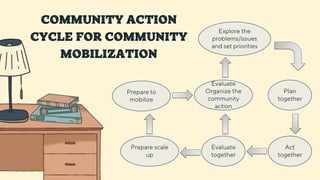
COMMUNITY ACTION
CYCLE FOR COMMUNITY
MOBILIZATION
Explore the
problems/issues
and set priorities
Plan
together
Act
together
Evaluate
together
Evaluate
Organize the
community
action
Prepare to
mobilize
Prepare scale
up
Prepare to Mobilize
1. Select identify issues and problems and define the
community.
2. Put together a community mobilization;
3. Gather information about the issues/problems;
4. Identify resources and constraints;
5. Develop a community mobilization plan; and
6. Organize your team.
Organize the Community for Action
1. Orient the community;
2 Build harmonious relationship;
3. Invite community participation; and
4. Develop a “core group” from the community.
Explore the Problems/issues and set priorities
1. Decide the objectives;
2. Explore the problems/issues
3. Analyze the problem; and
4. Set priorities for action.
Plan Together
1. Decide the objectives of the planning preparation;
2. Determine who will be involved in planning and their roles
3. Conduct and facilitate the planning session; and
4. Create community action plan.
Act together
1. Define your team’s role in accompanying community action;
2. Strengthen the community’s capacity to carry out the action plan;
3. Monitor community programs, and
4. Solve problems, trouble shoot, advise and mediate.
Evaluate Together
1. Conduct participatory evaluation;
2. Provide feedback to the community;
3. Document and share lessons learned and recommendation for
future use; and
4. Prepare to reorganize.
Steps in Social Moblization
Social mobilization will be initiated by NSTP students Who
as Community Mobilizers or Social Mobilizers.
1. NSTP students should visit the community in their settlement
and establish rapport.
2. Determine physical boundaries of the settlement with people.
3. Assist the community in holding a community meeting in coordination
with the Barangay officials and encourage the to understand the need
to organize for collective action.
4. Initially the groups should meet daily to discuss the most
pressing issues and action to be taken,
5. For a community, the appropriate number of groups would
be around 20, with coordination of the Barangay officials.
Benefits of Social Mobilization
2. Promoting Democratic
Governance. Social
Mobilization encourages
participation in decision-
making builds capacity for
participatory planning in
the community .
1. Poverty Alleviation. It
alleviates poverty. The people
are trained for self-sufficiency
through the guidance of the
NSTP students.
Benefits of Social Mobilization
4. Conflict Prevention. It
organizes people to
address common problems
and to collectively improve
their socio economic
condition in an equitable,
democratic and
transparent manner.
3. Environment. It helps
people to manage better their
natural resources and fight
against practices and
organizations that degrade
the environment.
Advantages of Community Mobilization
1. Security
2. Livelihood
3. Literacy
4. Social infrastructure
5 Housing construction
6. Physical infrastructure
7. Street lightsources
8. Health, hygiene
9. Education
10. Land
11. Water
12. Social and Culture
13. Electricity
14. Environmentsources
A community forming together collects the harvest. There
are several advantages of community mobilization that will help local
ownership and the sustainability of any program. Community
mobilization helps to motivate the people in the community where
you are assigned and encourage participation and involvement of
everyone,as well as building community capacity to identify and their
common needs which may fall under the following:
These are:
1. Create awareness on the issue.
2. Motivate the community through community
preparation, organizational development, capacity
developments and bring allies together.
3. Share information and communication.
4. Support them, provide incentives and look for some
resources.ce
There are several key steps in community mobilization. These
can come from the community itself or maybe initiated by
outsiders.
CONCLUSION
• Social Mobilization is an approach that
empowers the community people to
participate actively in the development
process through the leadership of the NSTP
students. It helps the community people to
be well-informed, empowered/proactive and
build a strong civil society that could become
a valuable partner of the government in
shaping a national development that is
equitable and sustainable.
THANK YOU FOR
LISTENING!
Don't hesitate to ask any questions!

SOCIAL MOBILIZATION (GROUP 2) (1).pptx

  • 1.
    SOCIAL MOBILIZATION Central Bicol StateUniversity of Agriculture Presented by: Marjori Anne Delos Reyes & Pauline Marie Lozañes
  • 2.
    PRESENTATION OUTLINE Introduction Community Action CycleFor Community Mobilization Components of Social Globalization Benefits of Social Mobilization Steps in Social Mobilization Advantages of Social Mobilization
  • 3.
    • Social Mobilizationis an approach wherein the community participation is very essential. It uses deliberate participating processes to involve local institutions, local leaders, community groups, and members of the community to organize through concerted efforts toward a common purpose. Community mobilization is characterized by respect for the community and its needs. What is Social Mobilization ? • It is also defined as a process of capability buildng of deprived community people to enable them to plan, manage and control over their own development program. It emphasizes self-decision of the concerned community, self-initiated development efforts as well as self-capacity building of the community, empowerment of the powerless, organization of the unorganized, and awarenes of the unaware which are the major elements of the social mobilization and are the concerns of the National Service Training Programs. (Abhiyan,2004)
  • 4.
  • 5.
    Components of SocialMobilization The Social Mobilization’s concept is mainly based on the development approach to empower the deprived and poor people of rural as well as urban areas for improving their position in life and condition in asustainable way. It is basically guided by the following components which has an impact on the lives of the community people directly or indirectly: 1. To achieve GROWTH in the physical, intellectual, volitional and moral capabilities of the deprived people as persons; This means that the people should acquire useful knowledge, social awareness, and ability to make choices, physical security and self-assurance.
  • 6.
    4. ENHANCEMENT OFTHE ECOLOGICAL RESOURCE is where the deprived people depend for their physical security and sustenance. 5. DYNAMIC CULTURAL INNOVATION in the values, beliefs and norms that constitute the blueprint for a developed society and for the behavior of its members. 2. The complementary component is EMPOWERMENT of deprived people through strengthening of their collective capabilities. This implies bonafide leadership, solidarity, and participatory decision –making of the self-help groups/organization. 3. The TRANSFORMATION OF SOCIAL INSTITUTIONS in keeping with the principles of equity and social justice;
  • 7.
    The self-help organizationswhich can be initiated by the students in the National Service Training Program (NSTP) can help the deprived community to be able to lead their self-development process in the following self-propelled manner: 1. Help in providing local mechanism for mobilizing savings of the community and provide credit to meet their financial needs; 2. Assist in creating people’s institutions to initiate/support local communities and groups to identify and mobilize local resources and properly utilize external resources;
  • 8.
    3. Help inbuilding confidence and enhancing the capacity of community people in promoting self-reliance; and assist in establishing a network of community financial. 4. Assist in establishing a network of community financial Institutions owned and democratically operated by the community people. Therefore, Social Mobilization as expounded by Abhiyan ( 2004) in his advocacy Program states that it is also known as a process of formation and management of self-help organization/group (SHG) by the concerned community people which could be led by the NSTP students.
  • 9.
    1. Identification ofthe needs of the people in the community where they are assigned; 2. Assist the people in analyzing their problems; 3. Guide the group to form and manage self-help groups (SHG); 4. Help them on how they could develop their institutions; 5. Guide them on how they could increase access and control over the resources; and 6. Help them plan and implement self-reliance through small entrepreneurial activities at the community The role of the students is as catalysts and they should do the following:
  • 10.
    The NSTP studentsshould bear in mind that the sustainable and self-propelled development of the community is impossible unless they take charge of their development process with their own decision-making and implementation mechanism. It is capacitated in terms of conceptual understanding and management and advocacy related to knowledge, Skills and attitudes. The intervention of NSTP students in any deprived community should provide an appropriate environment for the formation and growth of self-help groups to achieve their common goals.
  • 11.
    The following guidelinescould be very helpful to the NSTP students for Social Mobilization at the grass-root level. 1. We do not develop the community people. They develop themselves through our guidance. 2. We have to use participatory approach by involving thecommunity people in key decisions and acquiring the appropriate skills. 3. We work with groups and not with individuals. Hence, we should be aware of the presence of individual differences among the groups. 4. The groups are small and functionally specific. They have commonalities.
  • 12.
    5. Self-reliance inresource mobilization is very basic. 6. The initial objective of social mobilization should be looked into. 7. We think big, but help the community people to start small. The objective is to have quick success so that cohesion and self-image can be developed. 8. Use a process not a “blue print approach, be flexible. Emphasize a process not events” to help the community achieve a self-propelled sustainable development. 9. Work with 2 or more groups in the community in case conflict arises in their line of interest/problems.
  • 13.
    10. Educationn andtraining should be an on-going process which are reflected on the needs of the organization, its purpose, etc. and required knowledge, skills and attitude for its effective functioning. 11. Regular meetings should be conducted in order to keep group cohesion and prevent the emergence of “we” (members) and “they” (leaders) syndrome. 12. The NSTP students must not impose on the group; and 13. Just provide moral support and legitimacy to grassroots action for social change.
  • 14.
    COMMUNITY ACTION CYCLE FORCOMMUNITY MOBILIZATION Explore the problems/issues and set priorities Plan together Act together Evaluate together Evaluate Organize the community action Prepare to mobilize Prepare scale up
  • 15.
    Prepare to Mobilize 1.Select identify issues and problems and define the community. 2. Put together a community mobilization; 3. Gather information about the issues/problems; 4. Identify resources and constraints; 5. Develop a community mobilization plan; and 6. Organize your team. Organize the Community for Action 1. Orient the community; 2 Build harmonious relationship; 3. Invite community participation; and 4. Develop a “core group” from the community.
  • 16.
    Explore the Problems/issuesand set priorities 1. Decide the objectives; 2. Explore the problems/issues 3. Analyze the problem; and 4. Set priorities for action. Plan Together 1. Decide the objectives of the planning preparation; 2. Determine who will be involved in planning and their roles 3. Conduct and facilitate the planning session; and 4. Create community action plan.
  • 17.
    Act together 1. Defineyour team’s role in accompanying community action; 2. Strengthen the community’s capacity to carry out the action plan; 3. Monitor community programs, and 4. Solve problems, trouble shoot, advise and mediate. Evaluate Together 1. Conduct participatory evaluation; 2. Provide feedback to the community; 3. Document and share lessons learned and recommendation for future use; and 4. Prepare to reorganize.
  • 18.
    Steps in SocialMoblization Social mobilization will be initiated by NSTP students Who as Community Mobilizers or Social Mobilizers. 1. NSTP students should visit the community in their settlement and establish rapport. 2. Determine physical boundaries of the settlement with people. 3. Assist the community in holding a community meeting in coordination with the Barangay officials and encourage the to understand the need to organize for collective action. 4. Initially the groups should meet daily to discuss the most pressing issues and action to be taken, 5. For a community, the appropriate number of groups would be around 20, with coordination of the Barangay officials.
  • 19.
    Benefits of SocialMobilization 2. Promoting Democratic Governance. Social Mobilization encourages participation in decision- making builds capacity for participatory planning in the community . 1. Poverty Alleviation. It alleviates poverty. The people are trained for self-sufficiency through the guidance of the NSTP students.
  • 20.
    Benefits of SocialMobilization 4. Conflict Prevention. It organizes people to address common problems and to collectively improve their socio economic condition in an equitable, democratic and transparent manner. 3. Environment. It helps people to manage better their natural resources and fight against practices and organizations that degrade the environment.
  • 21.
    Advantages of CommunityMobilization 1. Security 2. Livelihood 3. Literacy 4. Social infrastructure 5 Housing construction 6. Physical infrastructure 7. Street lightsources 8. Health, hygiene 9. Education 10. Land 11. Water 12. Social and Culture 13. Electricity 14. Environmentsources A community forming together collects the harvest. There are several advantages of community mobilization that will help local ownership and the sustainability of any program. Community mobilization helps to motivate the people in the community where you are assigned and encourage participation and involvement of everyone,as well as building community capacity to identify and their common needs which may fall under the following:
  • 22.
    These are: 1. Createawareness on the issue. 2. Motivate the community through community preparation, organizational development, capacity developments and bring allies together. 3. Share information and communication. 4. Support them, provide incentives and look for some resources.ce There are several key steps in community mobilization. These can come from the community itself or maybe initiated by outsiders.
  • 23.
    CONCLUSION • Social Mobilizationis an approach that empowers the community people to participate actively in the development process through the leadership of the NSTP students. It helps the community people to be well-informed, empowered/proactive and build a strong civil society that could become a valuable partner of the government in shaping a national development that is equitable and sustainable.
  • 24.
    THANK YOU FOR LISTENING! Don'thesitate to ask any questions!