Community Mobilization Definition
‘a capacity building process through which
community members, groups or organizations
plan, carry out and evaluate activities on a
participatory and sustained basis either on
their own or stimulated by others’
Community Mobilization Goals
• Increasing Community, individual and group capacity to
identify, satisfy needs and promote community interest
• Promote good leadership and democratic community
level decision making
• Identify all the available resources in the community and
increase additional resources to the community
• Build on social networks to spread support, commitment
and changes in social norms and behaviors
• Identify specific groups to undertake specific problems
• Identify all the available resources in the community
• Plan the best use of resources
• Enable community to better govern themselves
Community Mobilization Principles-
Do’s & Don’ts
DON’T
• Do it all for the
community
• See professionals as
experts
• Deny ethnic and cultural
differences of
communities
• Plan mobilization alone
• Focus solely on individual
efforts
DO
• Do it with the help of
community
• Use community expertise
• Understand ethnic and
cultural differences of
communities and build on
ethnic and cultural
diversities
• Include others in planning
process
• Develop community
partnerships
Community Mobilization Principles-
• Community Mobilization requires TIME
and COMMITMENT
• Key to success is to ensure Community is
on the driving seat during the process
• Community mobilization allows a
community solve its problems through its
own efforts- key to sustained outcomes
• CM fulfills peoples right to participate and
determine their own future
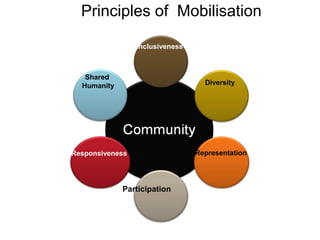
Principles of Mobilisation
Participation
RepresentationResponsiveness
Diversity
Inclusiveness
Shared
Humanity
Community Mobilization Process
•“…uniting high-risk group members to
utilize their intimate knowledge of
vulnerability to overcome the barriers
they face and realize reduced HIV risk
and greater self-reliance through their
collective action”.
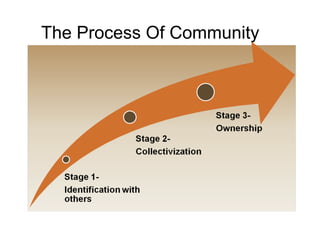
The Process Of Community
Mobilisation
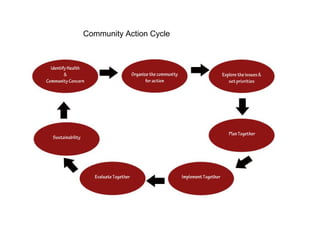
Community Action Cycle
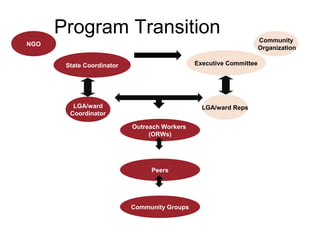
Program Transition
State Coordinator Executive Committee
LGA/ward
Coordinator
LGA/ward Reps
Outreach Workers
(ORWs)
Peers
Community Groups
NGO
Community
Organization
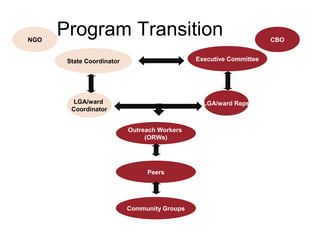
Program Transition
State Coordinator Executive Committee
LGA/ward
Coordinator
LGA/ward Reps
Outreach Workers
(ORWs)
Peers
Community Groups
NGO CBO
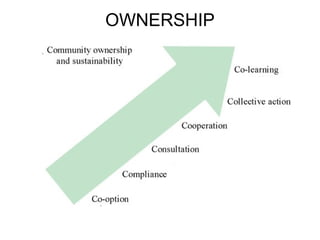
OWNERSHIP

Community mobilization and program transition

  • 1.
    Community Mobilization Definition ‘acapacity building process through which community members, groups or organizations plan, carry out and evaluate activities on a participatory and sustained basis either on their own or stimulated by others’
  • 2.
    Community Mobilization Goals •Increasing Community, individual and group capacity to identify, satisfy needs and promote community interest • Promote good leadership and democratic community level decision making • Identify all the available resources in the community and increase additional resources to the community • Build on social networks to spread support, commitment and changes in social norms and behaviors • Identify specific groups to undertake specific problems • Identify all the available resources in the community • Plan the best use of resources • Enable community to better govern themselves
  • 3.
    Community Mobilization Principles- Do’s& Don’ts DON’T • Do it all for the community • See professionals as experts • Deny ethnic and cultural differences of communities • Plan mobilization alone • Focus solely on individual efforts DO • Do it with the help of community • Use community expertise • Understand ethnic and cultural differences of communities and build on ethnic and cultural diversities • Include others in planning process • Develop community partnerships
  • 4.
    Community Mobilization Principles- •Community Mobilization requires TIME and COMMITMENT • Key to success is to ensure Community is on the driving seat during the process • Community mobilization allows a community solve its problems through its own efforts- key to sustained outcomes • CM fulfills peoples right to participate and determine their own future
  • 5.
  • 6.
    Community Mobilization Process •“…unitinghigh-risk group members to utilize their intimate knowledge of vulnerability to overcome the barriers they face and realize reduced HIV risk and greater self-reliance through their collective action”.
  • 7.
    The Process OfCommunity Mobilisation
  • 8.
  • 9.
    Program Transition State CoordinatorExecutive Committee LGA/ward Coordinator LGA/ward Reps Outreach Workers (ORWs) Peers Community Groups NGO Community Organization
  • 10.
    Program Transition State CoordinatorExecutive Committee LGA/ward Coordinator LGA/ward Reps Outreach Workers (ORWs) Peers Community Groups NGO CBO
  • 11.

Editor's Notes

  • #6 Through the course of Sankalp’s activities with FSWs in Karnataka, KHPT has gained a deep holistic understanding of their situation. The project focuses on ensuring full participation in, and ownership of, its activities related to reducing risk and vulnerabilities through a process of community mobilization. The key focus of a sustained mobilization process must be community empowerment Some of the core principles that we believe should guide this whole process are: Inclusiveness: Safeguard the interests of all sex workers. Accepting Diversity: Sex work is heterogeneous and hence needs diverse approaches Representation: Ensuring that members of all communities are represented, and that structures are democratic Participation: Ensuring participation and collective decision making by all members. Responsiveness to community needs: Responding to felt and perceived needs of the community Embracing a Shared Humanity: Working with individuals and communities to improve not only their health, but also to positively influence the wider factors that affect health and well-being
  • #7 KHPT define community mobilization….It is the process of … uniting high-risk group members to “utilize their intimate knowledge of vulnerability to overcome the barriers they face and realize reduced HIV risk and greater self-reliance through their collective action”.
  • #8 What does this process look like? KHPT describes this process as roughly falling into three main stages, Short hand terms for those key components are: Identification with others—CM begins when sex workers claim their identity and begin to see themselves as part of a group—a group that shares common concerns, experiences and needs—and a sense of community starts to develop. Recognizing common problems, sharing Safe space, sharing experiences, forming relationships is critical at this stage. Collectivization—As community grows, sex workers begin to work together to influence others and to take collective action, acting on behalf of the larger group. Visibility of the group increases, others may benefit (whether they are actively involved or not). Ownership—As SW take ownership and increasingly organize, their ability to influence others expands, they begin to negotiate and influence in an ever-widening sphere. (seat at the table, advocacy, hold gov’t accountable)
  • #10 Transition to self-governing entity: With strong governance systems in place, it’s possible to begin process of transition of CBO from dependent to self-governing entity: Regular assessment of the CBOs Prepare roadmap for each district Continue the empowerment activities where required Organizational development activities in all districts Mentoring and leadership development
  • #11 Transitioning program ownership and management means preparing CBOs to receive and manage the interventions currently supported by the state Baseline assessment Transfer implementation components and related funding to CBOs Train community members and mentors on system development (finance, constitution, HR, etc.) Train and mentor individual CBO members on specific thematic issues – outreach, advocacy monitoring, clinical issues Build negotiated linkages with external service providers