Understanding Community
Mobilization
2
What Is a Community?
• Group of people who feel that they have something in
common (people who live in the same village or area; work
together; share interests or circumstances)
• People can also belong to more than one community at the
same time
• New communities form when people find themselves in new
circumstances (people living with HIV/AIDS)
• Communities have different characteristics and needs; there
is no single model for how to do community mobilization
Source: International HIV/AIDS Alliance. All Together Now! Community Mobilisation for HIV/AIDS, 2006
Community Mobilization
• Process of generating public will by actively securing
broad consensus and social commitment among all
stakeholders for the elimination of HIV and recognizing
that HIV is one of many important community issues.
Involves all relevant segments of society:
• decision and policy-makers
• opinion leaders
• professional and religious groups
• media
• private sector
• communities
• individuals
Why Is Community Mobilization
Important?
• The long-term goal is to create public will and
commitment around HIV control and
prevention within the context of the
community.
• It is critical for sustaining HIV control efforts.
• It helps create immediacy at the community
level for a policy-related advocacy objective.
• Helps create a call for action.
5
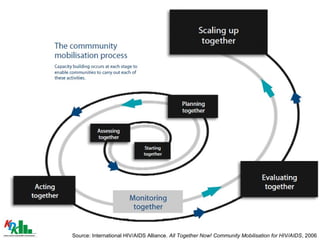
Stages in Community Mobilization:
1. Starting – identifying and involving different stakeholders and
getting organized
2. Assessing– learning more about the community and the
problems, identifying possible solutions
3. Planning – prioritizing problems and deciding how to solve them
4. Acting – taking action and implementing activities to address TB
5. Monitoring and evaluating – considering the results and impact,
and using monitoring information to adjust plans
6. Scaling up together – learning how to do more activities or
expand existing ones
Source: International HIV/AIDS Alliance. All Together Now! Community Mobilisation for HIV/AIDS, 2006
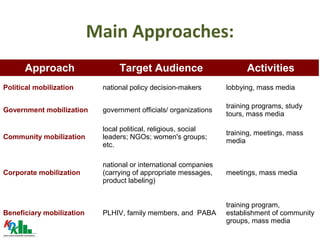
Main Approaches:
Approach Target Audience Activities
Political mobilization national policy decision-makers lobbying, mass media
Government mobilization government officials/ organizations
training programs, study
tours, mass media
Community mobilization
local political, religious, social
leaders; NGOs; women's groups;
etc.
training, meetings, mass
media
Corporate mobilization
national or international companies
(carrying of appropriate messages,
product labeling)
meetings, mass media
Beneficiary mobilization PLHIV, family members, and PABA
training program,
establishment of community
groups, mass media
8
Role of Community Mobilizer
 bringing people together
 building trust
 encouraging participation
 facilitating discussion and decision-
making
 helping things to run smoothly
9
Who Can Be a Community Mobilizer?
 There is no “ideal” community mobilizer
 People from all kinds of backgrounds can be
effective community mobilizer
 Attitudes, behaviors, and skills are more
important than who the person is or what
qualifications has
 Community members
 Positive role models
10
Community Mobilization Skills
In order to be effective, community mobilizers need to
combine a range of knowledge, attitudes, and skills:
Attitudes include:
 willingness to examine and challenge their own
assumptions, opinions and beliefs
 genuine respect for all community members
 non-judgmental and accepting approach
 understanding that different people have different
views and perspectives
 belief in community capacity to take effective action
11
Community Mobilization Skills
(continued)
 good communication skills, especially
listening
 good facilitation skills
 awareness of political, gender and
cultural issues and relationships
 ability to challenge assumptions
sensitively (e.g. about the role of
women)
12
Knowledge of:
 the community mobilization process
 the principles of community mobilization
 knowledge of HIV prevention – how it is
transmitted and prevented
 knowledge of other HIV issues (e.g. care,
support, and treatment)
 understanding of the ethical issues related to
community mobilization
Community Mobilization Skills
(continued)
13
Community Mobilization Skills
(continued)
 ability to help communities form organizations
 ability to identify capacity-building needs
among communities (e.g. leadership skills,
networking and partnership-building skills)
 ability to help communities mobilize resources
 advocacy skills
 project planning and management skills
14
Group Work:
Social Mobilization Activities
•THANK YOU

Understanding community mobilization

  • 1.
  • 2.
    2 What Is aCommunity? • Group of people who feel that they have something in common (people who live in the same village or area; work together; share interests or circumstances) • People can also belong to more than one community at the same time • New communities form when people find themselves in new circumstances (people living with HIV/AIDS) • Communities have different characteristics and needs; there is no single model for how to do community mobilization Source: International HIV/AIDS Alliance. All Together Now! Community Mobilisation for HIV/AIDS, 2006
  • 3.
    Community Mobilization • Processof generating public will by actively securing broad consensus and social commitment among all stakeholders for the elimination of HIV and recognizing that HIV is one of many important community issues. Involves all relevant segments of society: • decision and policy-makers • opinion leaders • professional and religious groups • media • private sector • communities • individuals
  • 4.
    Why Is CommunityMobilization Important? • The long-term goal is to create public will and commitment around HIV control and prevention within the context of the community. • It is critical for sustaining HIV control efforts. • It helps create immediacy at the community level for a policy-related advocacy objective. • Helps create a call for action.
  • 5.
    5 Stages in CommunityMobilization: 1. Starting – identifying and involving different stakeholders and getting organized 2. Assessing– learning more about the community and the problems, identifying possible solutions 3. Planning – prioritizing problems and deciding how to solve them 4. Acting – taking action and implementing activities to address TB 5. Monitoring and evaluating – considering the results and impact, and using monitoring information to adjust plans 6. Scaling up together – learning how to do more activities or expand existing ones Source: International HIV/AIDS Alliance. All Together Now! Community Mobilisation for HIV/AIDS, 2006
  • 6.
    Source: International HIV/AIDSAlliance. All Together Now! Community Mobilisation for HIV/AIDS, 2006
  • 7.
    Main Approaches: Approach TargetAudience Activities Political mobilization national policy decision-makers lobbying, mass media Government mobilization government officials/ organizations training programs, study tours, mass media Community mobilization local political, religious, social leaders; NGOs; women's groups; etc. training, meetings, mass media Corporate mobilization national or international companies (carrying of appropriate messages, product labeling) meetings, mass media Beneficiary mobilization PLHIV, family members, and PABA training program, establishment of community groups, mass media
  • 8.
    8 Role of CommunityMobilizer  bringing people together  building trust  encouraging participation  facilitating discussion and decision- making  helping things to run smoothly
  • 9.
    9 Who Can Bea Community Mobilizer?  There is no “ideal” community mobilizer  People from all kinds of backgrounds can be effective community mobilizer  Attitudes, behaviors, and skills are more important than who the person is or what qualifications has  Community members  Positive role models
  • 10.
    10 Community Mobilization Skills Inorder to be effective, community mobilizers need to combine a range of knowledge, attitudes, and skills: Attitudes include:  willingness to examine and challenge their own assumptions, opinions and beliefs  genuine respect for all community members  non-judgmental and accepting approach  understanding that different people have different views and perspectives  belief in community capacity to take effective action
  • 11.
    11 Community Mobilization Skills (continued) good communication skills, especially listening  good facilitation skills  awareness of political, gender and cultural issues and relationships  ability to challenge assumptions sensitively (e.g. about the role of women)
  • 12.
    12 Knowledge of:  thecommunity mobilization process  the principles of community mobilization  knowledge of HIV prevention – how it is transmitted and prevented  knowledge of other HIV issues (e.g. care, support, and treatment)  understanding of the ethical issues related to community mobilization Community Mobilization Skills (continued)
  • 13.
    13 Community Mobilization Skills (continued) ability to help communities form organizations  ability to identify capacity-building needs among communities (e.g. leadership skills, networking and partnership-building skills)  ability to help communities mobilize resources  advocacy skills  project planning and management skills
  • 14.
  • 15.