Community Mobilization
by
Prof. Dr.
Mona Aboserea
Faculty of medicine
Zagazig University
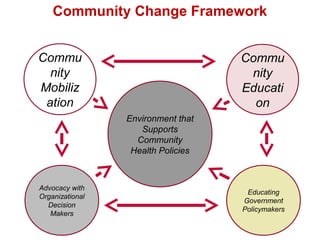
Community Change Framework
Environment that
Supports
Community
Health Policies
Commu
nity
Mobiliz
ation
Commu
nity
Educati
on
Advocacy with
Organizational
Decision
Makers
Educating
Government
Policymakers
Community Mobilization (CM)
What is community
mobilization?
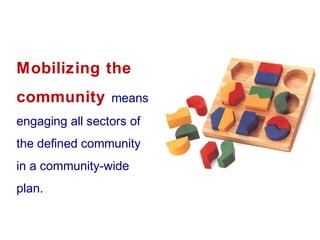
Mobilizing the
community means
engaging all sectors of
the defined community
in a community-wide
plan.
CM involves identifying
existing community groups,
engaging formal and
informal leaders and
involving service
organizations active in the
community.
Community Mobilization
A capacity-building process through which
individuals, groups, or organizations plan,
carry out, and evaluate activities on a
participatory and sustained basis to improve
their health and other needs, either on their
own initiative or stimulated by others.
Definition
Community mobilization is a dynamic process
that involves planned actions to reach, influence,
enable, and involve key segments of the
community in order to collectively create an
environment that will affect positive behavior
and bring about desired social change.
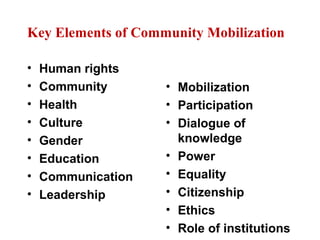
Key Elements of Community Mobilization
• Human rights
• Community
• Health
• Culture
• Gender
• Education
• Communication
• Leadership
• Mobilization
• Participation
• Dialogue of
knowledge
• Power
• Equality
• Citizenship
• Ethics
• Role of institutions
Community Mobilization
Audiences
For mobilization to be effective, messages need
to be tailored to specific audiences, including:
Women
Parents
Farmers
Local community leaders,
Youth
Etc Who else?
13
Hierarchy of roles/actions
•Attenders
• Physically present at meetings
•Learners
• Demonstrates learning about targeted topics
•Responders
• Respond to requests to take targeted action
•Actors
• Independently initiate targeted actions
•Mobilizers
• Invites others to take targeted actions
Community Mobilization
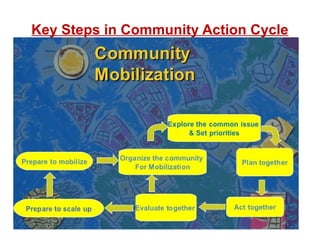
Key Steps in Community Action Cycle
Community Mobilization Steps
Step 1 - Define the
community
(geographically, politically, or demographically).
A community can be a town, city, county, or district.
It can also be a housing project, school district, or school.
.
17
Step 2 – Community profile
Know your community well.
Information is gathered over time from several
sources (1ry or 2ry sources) and with help of the
coalition .
This step helps identify different groups to
include in your coalition.
It also helps you approach your community and
solve communication problems. 18
Step 3 – Inform others
As you inform others about your coalition:
Consider who needs to know about your efforts and who
else should be invited into the group.
 Be consistent with your message to others.
 Community Mobilization takes time and energy.
 Continue with your efforts until you feel that there is
interest and there are resources for your community
group/coalition.
19
Step 4 – Obtain commitment
As community group/coalition, you would need to
establish collaboration and motivate other groups to work
together.
Develop collaborative relationships with:
• The public and private sectors
• Regional, state, and national organizations
• Academics institutions
• etc.
They can help you with capacity-building, problem-
solving, data analysis, etc. 20
5. Organize the community group/coalition (Structure,
roles, etc).
6. Organize an advisory committee.
7. Create a participant responsibility agreement and a
funds management agreement.
8. Conduct community meetings.
9. Prepare for collecting data.
Community Mobilization
Steps
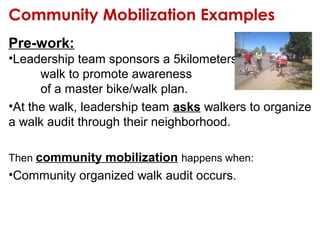
Pre-work:
•Leadership team sponsors a 5kilometers
walk to promote awareness
of a master bike/walk plan.
•At the walk, leadership team asks walkers to organize
a walk audit through their neighborhood.
Then community mobilization happens when:
•Community organized walk audit occurs.
Community Mobilization Examples
EXAMPLE
• Community mobilization in FAMILY PLANNING
PROGRAM
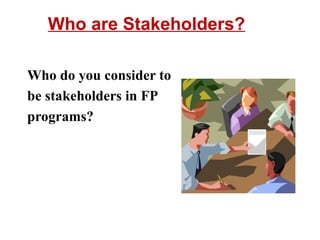
Who are Stakeholders?
Who do you consider to
be stakeholders in FP
programs?
Examples of Stakeholders
• MOH (National, Provincial/Regional, District)
• Donors, Associations
• NGO/CBO partners
• Health Facility (service providers, support staff,
outreach workers)
• Community (chiefs, religious leaders, women
leaders, community group leaders, community
resource persons and traditional health workers)
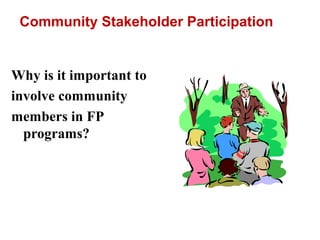
Community Stakeholder Participation
Why is it important to
involve community
members in FP
programs?
Benefits of Community Participation
• Increased ownership, support and responsibility
• More likelihood of, and sustainability for,
behavior change
• More cost-effective programming
• Better response to community needs and concerns
Benefits of Community Participation
continued:
• More culturally appropriate strategies and messages
• Increased coverage and access to information and
services
• Increased demand
• Increased advocacy for service and policy change
• Increased success (results and sustainability)
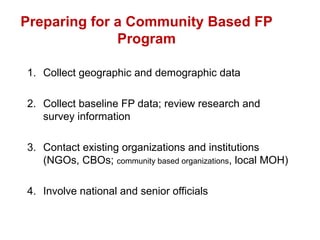
Preparing for a Community Based FP
Program
1. Collect geographic and demographic data
2. Collect baseline FP data; review research and
survey information
3. Contact existing organizations and institutions
(NGOs, CBOs; community based organizations, local MOH)
4. Involve national and senior officials
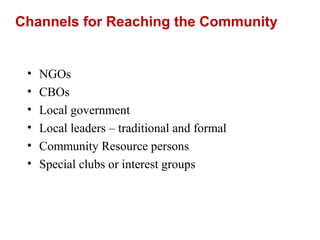
Channels for Reaching the Community
• NGOs
• CBOs
• Local government
• Local leaders – traditional and formal
• Community Resource persons
• Special clubs or interest groups
Challenges
What are some of the challenges or difficulties in
including community participation in programming?
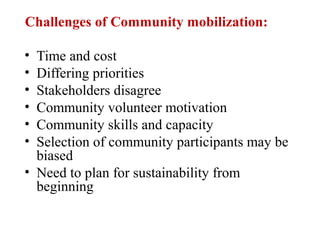
Challenges of Community mobilization:
• Time and cost
• Differing priorities
• Stakeholders disagree
• Community volunteer motivation
• Community skills and capacity
• Selection of community participants may be
biased
• Need to plan for sustainability from
beginning
Community mobilization

Community mobilization

  • 1.
    Community Mobilization by Prof. Dr. MonaAboserea Faculty of medicine Zagazig University
  • 2.
    Community Change Framework Environmentthat Supports Community Health Policies Commu nity Mobiliz ation Commu nity Educati on Advocacy with Organizational Decision Makers Educating Government Policymakers
  • 3.
    Community Mobilization (CM) Whatis community mobilization?
  • 4.
    Mobilizing the community means engagingall sectors of the defined community in a community-wide plan.
  • 5.
    CM involves identifying existingcommunity groups, engaging formal and informal leaders and involving service organizations active in the community.
  • 6.
    Community Mobilization A capacity-buildingprocess through which individuals, groups, or organizations plan, carry out, and evaluate activities on a participatory and sustained basis to improve their health and other needs, either on their own initiative or stimulated by others.
  • 7.
    Definition Community mobilization isa dynamic process that involves planned actions to reach, influence, enable, and involve key segments of the community in order to collectively create an environment that will affect positive behavior and bring about desired social change.
  • 12.
    Key Elements ofCommunity Mobilization • Human rights • Community • Health • Culture • Gender • Education • Communication • Leadership • Mobilization • Participation • Dialogue of knowledge • Power • Equality • Citizenship • Ethics • Role of institutions
  • 13.
    Community Mobilization Audiences For mobilizationto be effective, messages need to be tailored to specific audiences, including: Women Parents Farmers Local community leaders, Youth Etc Who else? 13
  • 14.
    Hierarchy of roles/actions •Attenders •Physically present at meetings •Learners • Demonstrates learning about targeted topics •Responders • Respond to requests to take targeted action •Actors • Independently initiate targeted actions •Mobilizers • Invites others to take targeted actions Community Mobilization
  • 15.
    Key Steps inCommunity Action Cycle
  • 16.
  • 17.
    Step 1 -Define the community (geographically, politically, or demographically). A community can be a town, city, county, or district. It can also be a housing project, school district, or school. . 17
  • 18.
    Step 2 –Community profile Know your community well. Information is gathered over time from several sources (1ry or 2ry sources) and with help of the coalition . This step helps identify different groups to include in your coalition. It also helps you approach your community and solve communication problems. 18
  • 19.
    Step 3 –Inform others As you inform others about your coalition: Consider who needs to know about your efforts and who else should be invited into the group.  Be consistent with your message to others.  Community Mobilization takes time and energy.  Continue with your efforts until you feel that there is interest and there are resources for your community group/coalition. 19
  • 20.
    Step 4 –Obtain commitment As community group/coalition, you would need to establish collaboration and motivate other groups to work together. Develop collaborative relationships with: • The public and private sectors • Regional, state, and national organizations • Academics institutions • etc. They can help you with capacity-building, problem- solving, data analysis, etc. 20
  • 21.
    5. Organize thecommunity group/coalition (Structure, roles, etc). 6. Organize an advisory committee. 7. Create a participant responsibility agreement and a funds management agreement. 8. Conduct community meetings. 9. Prepare for collecting data. Community Mobilization Steps
  • 22.
    Pre-work: •Leadership team sponsorsa 5kilometers walk to promote awareness of a master bike/walk plan. •At the walk, leadership team asks walkers to organize a walk audit through their neighborhood. Then community mobilization happens when: •Community organized walk audit occurs. Community Mobilization Examples
  • 23.
    EXAMPLE • Community mobilizationin FAMILY PLANNING PROGRAM
  • 24.
    Who are Stakeholders? Whodo you consider to be stakeholders in FP programs?
  • 25.
    Examples of Stakeholders •MOH (National, Provincial/Regional, District) • Donors, Associations • NGO/CBO partners • Health Facility (service providers, support staff, outreach workers) • Community (chiefs, religious leaders, women leaders, community group leaders, community resource persons and traditional health workers)
  • 26.
    Community Stakeholder Participation Whyis it important to involve community members in FP programs?
  • 27.
    Benefits of CommunityParticipation • Increased ownership, support and responsibility • More likelihood of, and sustainability for, behavior change • More cost-effective programming • Better response to community needs and concerns
  • 28.
    Benefits of CommunityParticipation continued: • More culturally appropriate strategies and messages • Increased coverage and access to information and services • Increased demand • Increased advocacy for service and policy change • Increased success (results and sustainability)
  • 29.
    Preparing for aCommunity Based FP Program 1. Collect geographic and demographic data 2. Collect baseline FP data; review research and survey information 3. Contact existing organizations and institutions (NGOs, CBOs; community based organizations, local MOH) 4. Involve national and senior officials
  • 30.
    Channels for Reachingthe Community • NGOs • CBOs • Local government • Local leaders – traditional and formal • Community Resource persons • Special clubs or interest groups
  • 31.
    Challenges What are someof the challenges or difficulties in including community participation in programming?
  • 32.
    Challenges of Communitymobilization: • Time and cost • Differing priorities • Stakeholders disagree • Community volunteer motivation • Community skills and capacity • Selection of community participants may be biased • Need to plan for sustainability from beginning