Social mobilization-I
Prof Suchitra A Rati
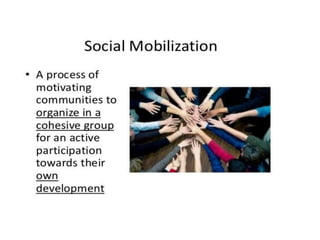
Community mobilization is a process through which action
is stimulated by a community itself, that is planned,
carried out, and evaluated by a community‟s individuals,
groups, and organizations on a participatory and
sustained basis
• to improve the health, hygiene and education levels so
as to enhance the overall standard of living in the
community.
• A group of people have transcended their differences to
meet on equal terms in order to facilitate a participatory
decision-making process.
• In other words it can be viewed as a process which
begins a dialogue among members of the community to
determine who, what, and how issues are decided, and
also to provide an avenue for everyone to participate in
decisions that affect their lives.
• Social mobilization is the task of mobilizing all
societal and personal influences on an individual
and family to prompt individual and family action
with respect to specific healthy
behaviors.
• COMBI [WHO's approach: Communication-for-
Behavioural-Impact ]
differs from traditional social mobilization in two
ways
• – Concerned with reducing the burden of a
disease
• – Concerned with achieving behavioral impact
through researching and communicating specific
messages to specific target audiences
• Social mobilization is a process to engage a
wide range of traditional, community, civil
society and opinion leaders around a common
cause or issue.
• social mobilization also engages and motivates
various partners at national and local levels to
raise awareness of and demand for a
particular development objective and to
provide sustainable, multi-faceted solutions to
broad social problems.
• Social mobilization refers to mobilization of
civilian population.
• Social mobilization is often used by grassroots-
based social movements, including
revolutionary movements, but can also
become a tool of elites and the state itself.
• The process usually takes the form of large
public gatherings such as mass meetings,
marches, parades, processions and
demonstrations.
• Those gatherings usually are part of a protest
action
Definition-
• Social mobilization is the process of bringing
together all societal and personal influences
to raise awareness of and demand for health
care, assist in the delivery of resources and
services, and cultivate sustainable individual
and community involvement.
In order to employ social mobilization, members
of institutions, community partners and
organizations, and others collaborate to reach
specific groups of people for intentional
dialogue
Aim and objectives of Social mobilization
aims to facilitate change through an
interdisciplinary approach
 To help infrastructure decision-makers
understand and cope with the challenges that
rapid technological and social change presents.
 To create a better educated public able to
recognize and support good decision-making
in the public interest.
Basic principles of social
mobilization
• Mobilizing decision-makers
including the organizational
infrastructure;
• Mobilizing communities;
• Interpersonal
communication: mobilizing
the community advocates;
• Mobilizing the media; and
• Promotional material and
Advertising.
The Seven Principles of
Community Mobilization
• Dialogue
• Capacity Building:
• Social Responsibility
• Transparency and
Accountability
• Sustainability:
• Gender:
• Do no harm:
6 Principles of Social Mobilization
• 1. Understanding the nature of caste
• 2. There are many ways to work
• 3. The ideal is to be able to work under the one
structure, but it may not be feasible and might be
counterproductive
• 4. Four approaches to working together
• 5. Internal conflicts must be avoided at any cost
• 6. In the end, it is the goal of liberation of our
people should be the most important single goal
• To shift our planet onto a sustainable
development path, SDG 17 includes an explicit
target to: “encourage and promote effective
public, public-private and civil society
partnerships, building on the experience and
resourcing strategies of partnerships
• Social mobilization is an important means to
advance sustainable development policy by
making it more responsive and accountable to
people’s needs and demands.
• Social movements often emerge from a sense
of shared grievance and injustice
The Benefits of Social Mobilisation
The benefits of social mobilisation are
listedbelow,
Poverty Alleviation
Promoting Democratic Governance
Environment
Conflict Prevention
• Communities are energized to engage and
participate in a processes, structures and activities
to achieve a common goal of poverty alleviation;
• Employ bi-directional communication to inform
and empower groups by building human capacity
in communities to fight poverty and diseases;
• Creates and increases demand for poverty
reduction interventions services;
• Greater self-awareness and social consciousness
transforms increase demand into action to access
available basic social services ( such as heath,
education, food security, social support, etc..)
which are key factors to poverty alleviation; and
• Gives a sense of ownership and self motivation
for community actions

Sociaal mobilization i

  • 1.
  • 2.
    Community mobilization isa process through which action is stimulated by a community itself, that is planned, carried out, and evaluated by a community‟s individuals, groups, and organizations on a participatory and sustained basis • to improve the health, hygiene and education levels so as to enhance the overall standard of living in the community. • A group of people have transcended their differences to meet on equal terms in order to facilitate a participatory decision-making process. • In other words it can be viewed as a process which begins a dialogue among members of the community to determine who, what, and how issues are decided, and also to provide an avenue for everyone to participate in decisions that affect their lives.
  • 3.
    • Social mobilizationis the task of mobilizing all societal and personal influences on an individual and family to prompt individual and family action with respect to specific healthy behaviors. • COMBI [WHO's approach: Communication-for- Behavioural-Impact ] differs from traditional social mobilization in two ways • – Concerned with reducing the burden of a disease • – Concerned with achieving behavioral impact through researching and communicating specific messages to specific target audiences
  • 4.
    • Social mobilizationis a process to engage a wide range of traditional, community, civil society and opinion leaders around a common cause or issue. • social mobilization also engages and motivates various partners at national and local levels to raise awareness of and demand for a particular development objective and to provide sustainable, multi-faceted solutions to broad social problems.
  • 5.
    • Social mobilizationrefers to mobilization of civilian population. • Social mobilization is often used by grassroots- based social movements, including revolutionary movements, but can also become a tool of elites and the state itself. • The process usually takes the form of large public gatherings such as mass meetings, marches, parades, processions and demonstrations. • Those gatherings usually are part of a protest action
  • 6.
    Definition- • Social mobilizationis the process of bringing together all societal and personal influences to raise awareness of and demand for health care, assist in the delivery of resources and services, and cultivate sustainable individual and community involvement. In order to employ social mobilization, members of institutions, community partners and organizations, and others collaborate to reach specific groups of people for intentional dialogue
  • 8.
    Aim and objectivesof Social mobilization aims to facilitate change through an interdisciplinary approach  To help infrastructure decision-makers understand and cope with the challenges that rapid technological and social change presents.  To create a better educated public able to recognize and support good decision-making in the public interest.
  • 9.
    Basic principles ofsocial mobilization • Mobilizing decision-makers including the organizational infrastructure; • Mobilizing communities; • Interpersonal communication: mobilizing the community advocates; • Mobilizing the media; and • Promotional material and Advertising. The Seven Principles of Community Mobilization • Dialogue • Capacity Building: • Social Responsibility • Transparency and Accountability • Sustainability: • Gender: • Do no harm:
  • 10.
    6 Principles ofSocial Mobilization • 1. Understanding the nature of caste • 2. There are many ways to work • 3. The ideal is to be able to work under the one structure, but it may not be feasible and might be counterproductive • 4. Four approaches to working together • 5. Internal conflicts must be avoided at any cost • 6. In the end, it is the goal of liberation of our people should be the most important single goal
  • 11.
    • To shiftour planet onto a sustainable development path, SDG 17 includes an explicit target to: “encourage and promote effective public, public-private and civil society partnerships, building on the experience and resourcing strategies of partnerships • Social mobilization is an important means to advance sustainable development policy by making it more responsive and accountable to people’s needs and demands. • Social movements often emerge from a sense of shared grievance and injustice
  • 12.
    The Benefits ofSocial Mobilisation The benefits of social mobilisation are listedbelow, Poverty Alleviation Promoting Democratic Governance Environment Conflict Prevention
  • 13.
    • Communities areenergized to engage and participate in a processes, structures and activities to achieve a common goal of poverty alleviation; • Employ bi-directional communication to inform and empower groups by building human capacity in communities to fight poverty and diseases; • Creates and increases demand for poverty reduction interventions services; • Greater self-awareness and social consciousness transforms increase demand into action to access available basic social services ( such as heath, education, food security, social support, etc..) which are key factors to poverty alleviation; and • Gives a sense of ownership and self motivation for community actions