Social Media for Presenting & TouringFrom Experiment to StrategyPresented by David DombroskyCarnegie Mellon’s Center for Arts Management and TechnologySeptember 29, 2010
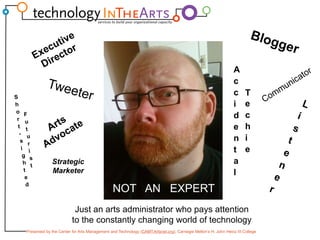
BloggerExecutive DirectorAccidental TechieShort-sighted FuturistCommunicatorTweeterListenerArts AdvocateStrategic MarketerNOT   AN   EXPERTJust an arts administrator who pays attention to the constantly changing world of technology
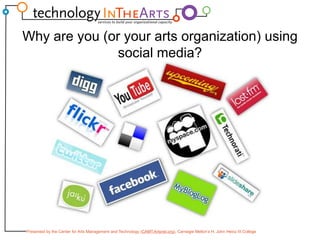
Why are you (or your arts organization) using social media?
Strategy Framework for Social MediaObjectiveTarget AudienceIntegrationCulture ChangeCapacityTools & TacticsMeasurementExperimentFramework provided by WeAreMedia
ObjectiveWhat do you want to accomplish with social media?Restate your objective so it is “SMART” – specific, measurable, attainable, realistic, and time-basedDescribe how your social media objective supports or links to a goal in your communications plan
Target AudienceWho must you reach with your social media efforts to meet your objective? Why this target group?What do they need to know about you or your organization? What will resonate with them?What social media tools are they currently using?
IntegrationHow does your social media support other components of your Internet communications plan?WebsiteOutbound CommunicationsSocialIs there an “offline” component that you need to support/connect?
Culture ChangeOnce you have an initial strategy, how do you get your organization to own it?How will you address any fears or concerns?Loss of controlDealing with negative commentsAddressing personality versus organizational voiceNot being successful, fear of failurePerception of wasted time and resourcesSuffering from information overload already, this will cause more
CapacityWho will implement your organization’s social media strategy?One individual or split duties among individuals?Team approach – multiple people sharing duties?Executive staff?  Marketing staff?  Younger staff or interns?  Artists?  Volunteers?Can you allocate a minimum of five hours per week to your strategy once you've passed the learning curve?
Tools & TacticsWhat tactics and tools best support your objectives and match your targeted audience?What tactics and tools do you have the capacity to implement?
ToolsTools are only as good as their usersLearn how to use them effectivelyWatch how others use themPractice before going proEnvision success so you can achieve itMaximize your use of each tool
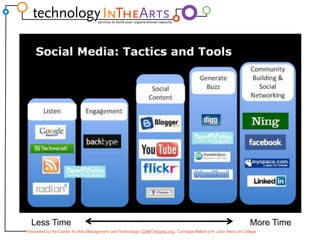
Less TimeMore Time
Tactics - ListeningWhat decisions will you link your listening to?What key words will you use?How will share or summarize what you learn from listening with others in your organization?
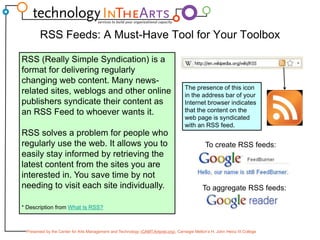
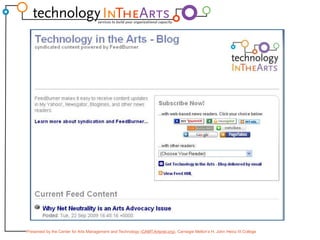
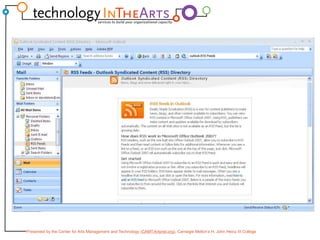
RSS Feeds: A Must-Have Tool for Your ToolboxRSS (Really Simple Syndication) is a format for delivering regularly changing web content. Many news-related sites, weblogs and other online publishers syndicate their content as an RSS Feed to whoever wants it. RSS solves a problem for people who regularly use the web. It allows you to easily stay informed by retrieving the latest content from the sites you are interested in. You save time by not needing to visit each site individually.* Description from What Is RSS?The presence of this icon in the address bar of your Internet browser indicates that the content on the web page is syndicated with an RSS feed.To create RSS feeds:To aggregate RSS feeds:
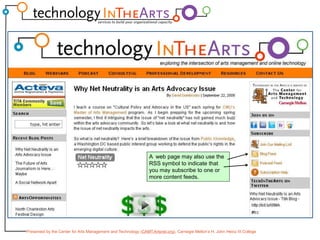
A  web page may also use the RSS symbol to indicate that you may subscribe to one or more content feeds.
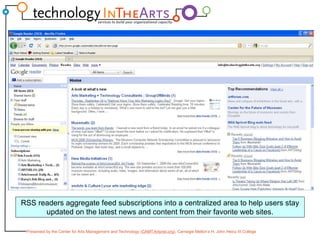
RSS readers aggregate feed subscriptions into a centralized area to help users stay updated on the latest news and content from their favorite web sites.
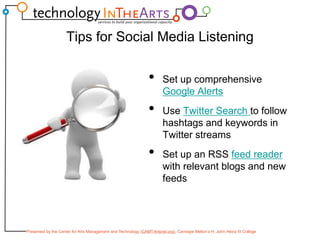
Tips for Social Media ListeningSet up comprehensive Google AlertsUse Twitter Search to follow hashtags and keywords in Twitter streamsSet up an RSS feed reader with relevant blogs and new feeds
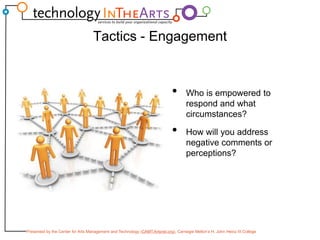
Tactics - EngagementWho is empowered to respond and what circumstances?How will you address negative comments or perceptions?
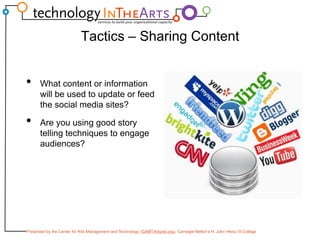
Tactics – Sharing ContentWhat content or information will be used to update or feed the social media sites?Are you using good story telling techniques to engage audiences?
Tactics – Generating BuzzHow will you “brand” your presence on sites? (Personal/Organizational)Who will implement and build relationships with influencers?How will you get fans to talk about you to their friends?What actions do you want people take when they come in contact with your buzz?
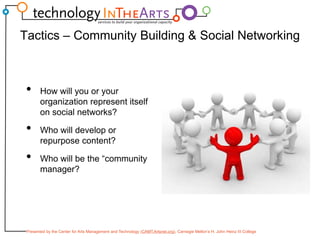
Tactics – Community Building & Social Networking How will you or your organization represent itself on social networks?Who will develop or repurpose content?Who will be the “community manager?
MeasurementWhat is your original, measurable objective?What hard data points or metrics will you use to track your objectives? How often will you track? Do you have the systems and tools set up to track efficiently?How will you harvest insights from hard data and qualitative data as the project unfolds? What questions will you ask to generate insights? Who will participate?
ExperimentWhat small piece can you implement first as a pilot?How will you learn from the pilot for your next experiment?
David Dombroskydaviddom@cmu.eduwww.twitter.com/DDombroskyTechnology in the Artswww.technologyinthearts.orginfo@technologyinthearts.orgwww.twitter.com/TechInTheArtsCenter for Arts Management & Technologyhttp://camt.artsnet.org

Social Media for Presenting and Touring

  • 1.
    Social Media forPresenting & TouringFrom Experiment to StrategyPresented by David DombroskyCarnegie Mellon’s Center for Arts Management and TechnologySeptember 29, 2010
  • 2.
    BloggerExecutive DirectorAccidental TechieShort-sightedFuturistCommunicatorTweeterListenerArts AdvocateStrategic MarketerNOT AN EXPERTJust an arts administrator who pays attention to the constantly changing world of technology
  • 3.
    Why are you(or your arts organization) using social media?
  • 4.
    Strategy Framework forSocial MediaObjectiveTarget AudienceIntegrationCulture ChangeCapacityTools & TacticsMeasurementExperimentFramework provided by WeAreMedia
  • 5.
    ObjectiveWhat do youwant to accomplish with social media?Restate your objective so it is “SMART” – specific, measurable, attainable, realistic, and time-basedDescribe how your social media objective supports or links to a goal in your communications plan
  • 6.
    Target AudienceWho mustyou reach with your social media efforts to meet your objective? Why this target group?What do they need to know about you or your organization? What will resonate with them?What social media tools are they currently using?
  • 7.
    IntegrationHow does yoursocial media support other components of your Internet communications plan?WebsiteOutbound CommunicationsSocialIs there an “offline” component that you need to support/connect?
  • 8.
    Culture ChangeOnce youhave an initial strategy, how do you get your organization to own it?How will you address any fears or concerns?Loss of controlDealing with negative commentsAddressing personality versus organizational voiceNot being successful, fear of failurePerception of wasted time and resourcesSuffering from information overload already, this will cause more
  • 9.
    CapacityWho will implementyour organization’s social media strategy?One individual or split duties among individuals?Team approach – multiple people sharing duties?Executive staff? Marketing staff? Younger staff or interns? Artists? Volunteers?Can you allocate a minimum of five hours per week to your strategy once you've passed the learning curve?
  • 10.
    Tools & TacticsWhattactics and tools best support your objectives and match your targeted audience?What tactics and tools do you have the capacity to implement?
  • 12.
    ToolsTools are onlyas good as their usersLearn how to use them effectivelyWatch how others use themPractice before going proEnvision success so you can achieve itMaximize your use of each tool
  • 13.
  • 14.
    Tactics - ListeningWhatdecisions will you link your listening to?What key words will you use?How will share or summarize what you learn from listening with others in your organization?
  • 15.
    RSS Feeds: AMust-Have Tool for Your ToolboxRSS (Really Simple Syndication) is a format for delivering regularly changing web content. Many news-related sites, weblogs and other online publishers syndicate their content as an RSS Feed to whoever wants it. RSS solves a problem for people who regularly use the web. It allows you to easily stay informed by retrieving the latest content from the sites you are interested in. You save time by not needing to visit each site individually.* Description from What Is RSS?The presence of this icon in the address bar of your Internet browser indicates that the content on the web page is syndicated with an RSS feed.To create RSS feeds:To aggregate RSS feeds:
  • 16.
    A webpage may also use the RSS symbol to indicate that you may subscribe to one or more content feeds.
  • 18.
    RSS readers aggregatefeed subscriptions into a centralized area to help users stay updated on the latest news and content from their favorite web sites.
  • 20.
    Tips for SocialMedia ListeningSet up comprehensive Google AlertsUse Twitter Search to follow hashtags and keywords in Twitter streamsSet up an RSS feed reader with relevant blogs and new feeds
  • 21.
    Tactics - EngagementWhois empowered to respond and what circumstances?How will you address negative comments or perceptions?
  • 22.
    Tactics – SharingContentWhat content or information will be used to update or feed the social media sites?Are you using good story telling techniques to engage audiences?
  • 23.
    Tactics – GeneratingBuzzHow will you “brand” your presence on sites? (Personal/Organizational)Who will implement and build relationships with influencers?How will you get fans to talk about you to their friends?What actions do you want people take when they come in contact with your buzz?
  • 24.
    Tactics – CommunityBuilding & Social Networking How will you or your organization represent itself on social networks?Who will develop or repurpose content?Who will be the “community manager?
  • 25.
    MeasurementWhat is youroriginal, measurable objective?What hard data points or metrics will you use to track your objectives? How often will you track? Do you have the systems and tools set up to track efficiently?How will you harvest insights from hard data and qualitative data as the project unfolds? What questions will you ask to generate insights? Who will participate?
  • 26.
    ExperimentWhat small piececan you implement first as a pilot?How will you learn from the pilot for your next experiment?
  • 27.
    David Dombroskydaviddom@cmu.eduwww.twitter.com/DDombroskyTechnology inthe Artswww.technologyinthearts.orginfo@technologyinthearts.orgwww.twitter.com/TechInTheArtsCenter for Arts Management & Technologyhttp://camt.artsnet.org

Editor's Notes

  • #4 Set objectives based on a clear understanding of how social media changes the feedback loop between your organization and stakeholders. The key thing that is different with setting a social media objective is that it is not about reaching a mass audience and blasting your message out, it is more about reaching the influencers, developing relationships, having a conversation, and getting insights.
  • #5 To be successful, social media requires a mix of authenticity, openness, transparency and to a certain extent giving up control.
  • #21  A Google Alert is an aggregate of the latest results from multiple sources (news, Web and blogs) into a single e-mail or RSS feed. A Web-based version of a clipping service.