


Social Media 101
using the social web to build your online
                 toolkit
                                 Aerin Guy
                            The Wellesley Institute
                                July 14, 2009
agenda
•   Intros and welcome

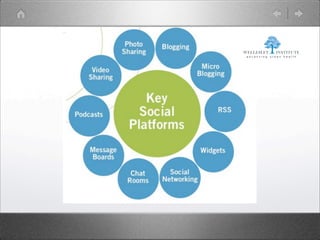
•   Overview of the Social Web

•   Basics

•   Strategy

•   Goals/Tools

•   Case Study

•   Building Capacity
Text

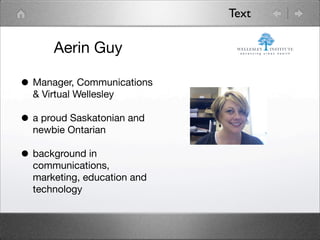
      Aerin Guy

• Manager, Communications
  & Virtual Wellesley

• a proud Saskatonian and
  newbie Ontarian

• background in
  communications,
  marketing, education and
  technology
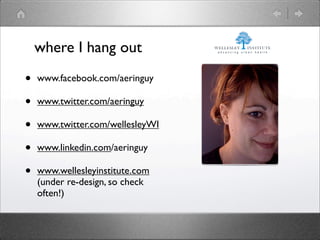
where I hang out

•   www.facebook.com/aeringuy

•   www.twitter.com/aeringuy

•   www.twitter.com/wellesleyWI

•   www.linkedin.com/aeringuy

•   www.wellesleyinstitute.com
    (under re-design, so check
    often!)
about you!

•   please introduce yourselves
    to the people at your table

•   what organization are you
    with?

•   what is your role?

•   what do you hope to get out
    of this workshop?
Overview of the
      social web

•   also known as Web 2.0 (Tim
    O’Reilly)

•   also known as the “social
    media explosion”

•   also known as the way we
    connect today
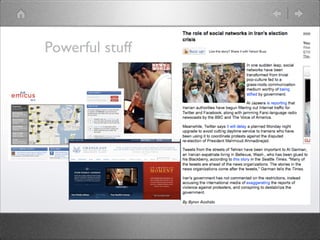
Powerful stuff
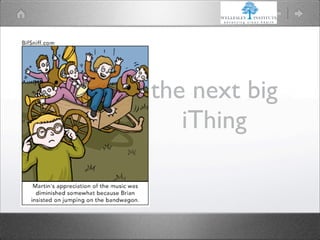
the next big
   iThing
•   introduction to social media
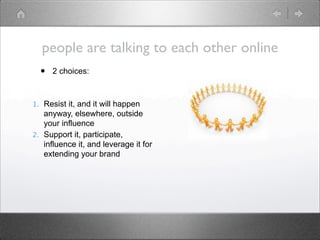
people are talking to each other online
  •   2 choices:


1. Resist it, and it will happen
   anyway, elsewhere, outside
   your influence
2. Support it, participate,
   influence it, and leverage it for
   extending your brand
The web is about
    conversations,
not top down delivery
   of information or
       messages.
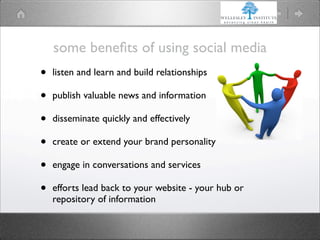
some benefits of using social media
•   listen and learn and build relationships

•   publish valuable news and information

•   disseminate quickly and effectively

•   create or extend your brand personality

•   engage in conversations and services

•   efforts lead back to your website - your hub or
    repository of information
basics
•   feeds, tags and RSS

•   blogs

•   wikis

•   twitter

•   facebook
feeds
•   feeds are based on XML
    technology
                             •   subscribers are invested
•   commonly called RSS          in your content
                                 (otherwise why would
•   Content can be               they subscribe?)
    subscribed to and sent
    when updated             •   RSS readers include
                                 Google Reader,
•   sites and content from       Bloglines, FeedReader
    sites come to you
you’ll like this demo
•   http://
    www.youtube.com/
    watch?v=0klgLsSxGsU
tags
•   tags are short keywords     •   also allows your content
    that define what your            to be classified, indexed
    online digital content is       and accessed by people,
    about                           search engines, and
                                    content aggregators
•   tagging your content
    helps others locate it      •   choose only relevant and
    more easily                     not overly generic
                                    keywords

                                •   a way to filter and
                                    categorize the web
tags
•   tags work on the same      •   extend the reference
    XML platform as RSS,           labels, associations, and
    except when tags are           search keywords by
    used to categorize             which any type of
    information on                 content can be found
    aggregator sites like
    Technorati and delicious   •   Technorati is a blog
                                   search engine organized
•   articles, news stories,        by tags (tagged by
    podcasts, photos,              users), identifying
    presentations, and video       relevancy and content
    clips can all be tagged        areas
http://www.youtube.com/watch?
        v=NN2I1pWXjXI
blogging: Be FOUND!
•   high ranking in organic search

•   at least 44% of all web interactions begin with search

•   search engines love blog headlines, as they indicate what
    can be found on the page

•   search engines also love blogs because they are frequently
    updated

•   recent + relevant = RANKING!
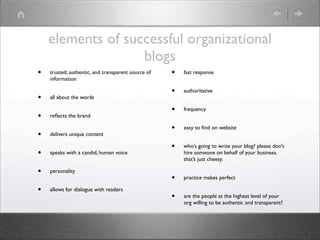
elements of successful organizational
                   blogs
•   trusted, authentic, and transparent source of   •   fast response
    information

                                                    •   authoritative
•   all about the words

                                                    •   frequency
•   reflects the brand

                                                    •   easy to find on website
•   delivers unique content

                                                    •   who’s going to write your blog? please don’t
•   speaks with a candid, human voice                   hire someone on behalf of your business.
                                                        that’s just cheesy.

•   personality
                                                    •   practice makes perfect

•   allows for dialogue with readers
                                                    •   are the people at the highest level of your
                                                        org willing to be authentic and transparent?
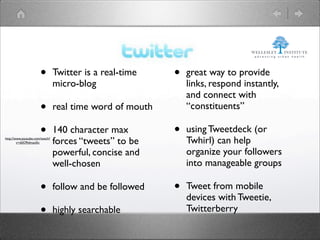
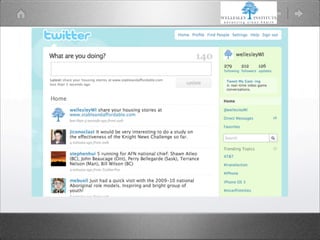
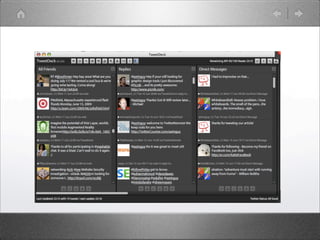
•         Twitter is a real-time    •   great way to provide
                                micro-blog                    links, respond instantly,
                                                              and connect with
                      •         real time word of mouth       “constituents”

                      •         140 character max         •   using Tweetdeck (or
http://www.youtube.com/watch?
        v=ddO9idmax0o           forces “tweets” to be         Twhirl) can help
                                powerful, concise and         organize your followers
                                well-chosen                   into manageable groups

                      •         follow and be followed    •   Tweet from mobile
                                                              devices with Tweetie,
                      •         highly searchable             Twitterberry
•   the world’s premier           •   friend-raising, not
    social networking site            fundraising

•   individual profiles            •   facebook connect

•   corporate pages               •   promote events,
                                      initiatives, community
•   fan pages
                                  •   average user age: 35
•   cause marketing
                             1.   http://www.facebook.com/
                                  pages/The-Wellesley-Institute/
video
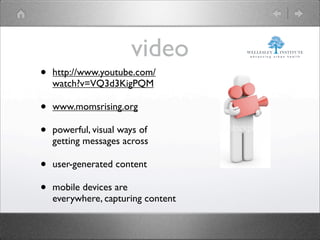
•   http://www.youtube.com/
    watch?v=VQ3d3KigPQM

•   www.momsrising.org

•   powerful, visual ways of
    getting messages across

•   user-generated content

•   mobile devices are
    everywhere, capturing content
social media as part of your communications strategy

•   baby...bathwater....no!   •   communities connect
                                  faster, more
•   segments our audiences        collaboratively, more
                                  inclusively, and more
•   build on the power of         effectively!
    networks and
    burgeoning communities    •   proliferation of sm
                                  stories in traditional
                                  media piques interest
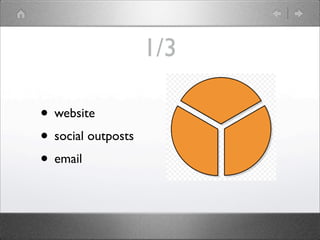
1/3

• website
• social outposts
• email
the purpose of social media is to engage with audiences in
interactive communities
    1.Genuine engagement facilitates
      a highly involved audience that
      wants to interact with “the
      brand”
    2.The more people an
      organization can interact with
      who already have strong social
      networks, the more likely it is
      that a message can be spread
      through those networks
    3. Communities of purpose
      abound on the net. Common
      thread of success? Purpose.
an experiment
    the sticky game

    (it’s fun, I promise)

    (no really, it’s fun!)
building community
•   House Social Network     •   Commercial Social
                                 Network
•   social networking
    community built on a     •   an online community
    nonprofit’s own               owned and operated by
    website. Term derived        a corporation. Popular
    from direct mail house       examples include
    lists                        Facebook, Ning,
                                 OpenSocial,
                                 CommunityZero
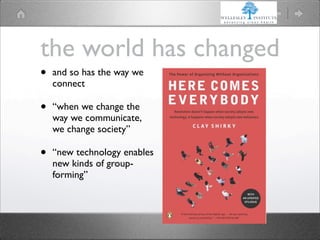
the world has changed
•   and so has the way we
    connect

•   “when we change the
    way we communicate,
    we change society”

•   “new technology enables
    new kinds of group-
    forming”
goals
•   list building            •   changing attitudes

•   galvanizing support      •   recruitment

•   education                •   fundraising

•   loyalty                  •   motivation

•   exposing                 •   organize

•   changing minds           •   info source
Causes and passions are online, but
people increasingly resist being sold to
in the communities they join. Canada’s
 Do Not Call list will soon expand to
            include email.
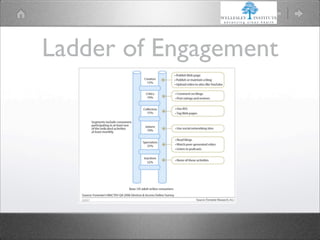
Ladder of Engagement
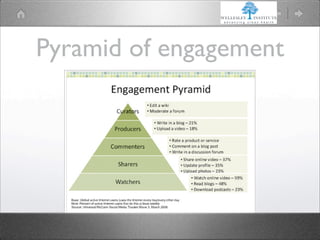
Pyramid of engagement
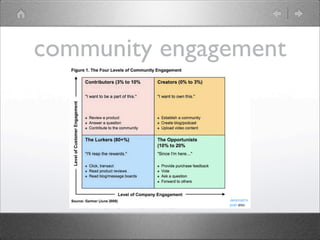
community engagement
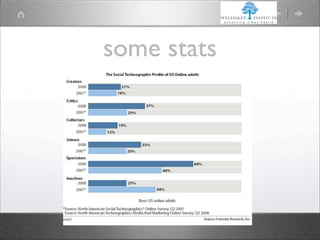
some stats
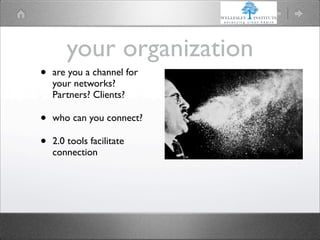
your organization
•   are you a channel for
    your networks?
    Partners? Clients?

•   who can you connect?

•   2.0 tools facilitate
    connection
baby steps
•   cost effective            •   big budget? campaign
                                  assistance & facilitation,
•   no budget? Facebook,          website redesign
    Twitter, blog, optimize
    existing website          •   many agencies will do
                                  pro-bono work for
•   wee budget? video, file        charities/NFPs
    sharing software,
    microsite                 •   sources can be
                                  craigslist, kijiji, student
                                  sites, hire an intern
these resources are key

        non-profit social network survey
http://www.nonprofitsocialnetworksurvey.com/

     2009 eNonprofits Benchmarks Study
http://www.e-benchmarksstudy.com/2009.html
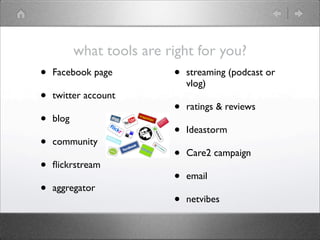
what tools are right for you?
•   Facebook page          •   streaming (podcast or
                               vlog)
•   twitter account
                           •   ratings & reviews
•   blog
                           •   Ideastorm
•   community
                           •   Care2 campaign
•   flickrstream
                           •   email
•   aggregator
                           •   netvibes
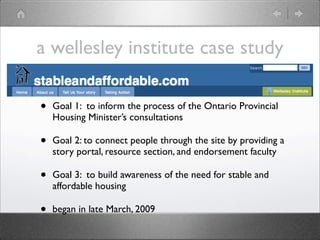
a wellesley institute case study

•   Goal 1: to inform the process of the Ontario Provincial
    Housing Minister’s consultations

•   Goal 2: to connect people through the site by providing a
    story portal, resource section, and endorsement faculty

•   Goal 3: to build awareness of the need for stable and
    affordable housing

•   began in late March, 2009
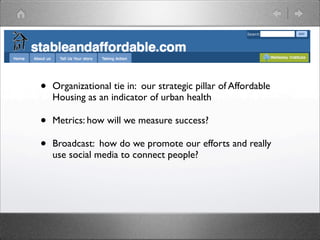
•   Organizational tie in: our strategic pillar of Affordable
    Housing as an indicator of urban health

•   Metrics: how will we measure success?

•   Broadcast: how do we promote our efforts and really
    use social media to connect people?
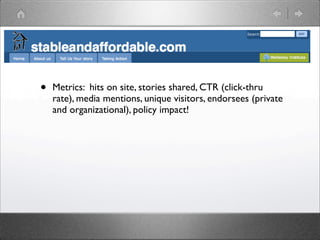
•   Metrics: hits on site, stories shared, CTR (click-thru
    rate), media mentions, unique visitors, endorsees (private
    and organizational), policy impact!
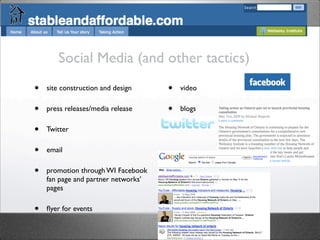
Social Media (and other tactics)
•   site construction and design     •   video

•   press releases/media release     •   blogs

•   Twitter

•   email

•   promotion through WI Facebook
    fan page and partner networks’
    pages

•   flyer for events
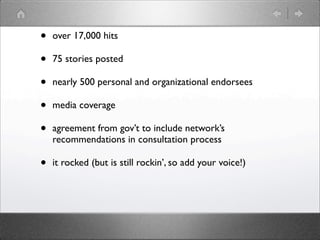
•   over 17,000 hits

•   75 stories posted

•   nearly 500 personal and organizational endorsees

•   media coverage

•   agreement from gov’t to include network’s
    recommendations in consultation process

•   it rocked (but is still rockin’, so add your voice!)
other examples
•   Kiva is a microlender
    that pairs up developing
    world lendees with
    worldwide lenders

•   recently branched into
    the US

•   all done via social web
building capacity

• can require a change in culture (digital
  natives vs digital immigrants)
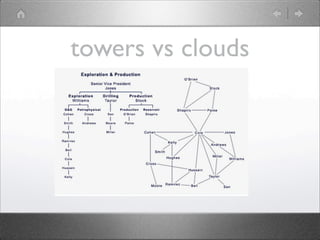
• Most NFPs are used to the “tower model”
  of working, not the “cloud”
towers vs clouds
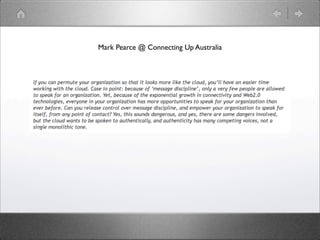
Mark Pearce @ Connecting Up Australia
Building Capacity: 5 BIG ISSUES

•   Inertia problem - most organizations were founded prior to the
    internet....they aren’t used to having control issues, intimate relationships
    with audiences, and they think they control their brands.


•   Leadership issue - often the leaders are pre-internet. Difficult to get buy-in.
    Threatened. Perhaps read a Seth Godin book once.


•   Advocate issue - who’s the squeaky wheel?


•   Silo issue - “that’s marketing’s job”. “IT handles our web stuff”


•   Fear issue - it’s all so new, and changes so quickly, budgetary responsibility
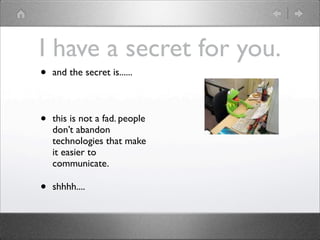
I have a secret for you.
•   and the secret is......


•   this is not a fad. people
    don’t abandon
    technologies that make
    it easier to
    communicate.

•   shhhh....
•   explore the tools you’d     •   explore your personal
    like to adopt by using          and organizational
    them in your personal           capacity
    life first

•   don’t be afraid to try or
    to fail. In social media,
    you learn by failing
    informatively (Red Cross
    Social Media Strategy)

•   develop your voice
how it can work
•   positioning. “we are the spearhead of a movement that is changing this issue.
    we are a vehicle for making change.”

•   engage leadership in new thinking. get help.

•   involve social media/coms people at management/strategic level. Obama’s
    campaign would be a good example!

•   Hire from the millennial generation. Their insight as digital natives will
    improve the strategic conversations.

•   Speak “human”. People like people. Relationships are where it’s at. Get out of
    “press release” mode.
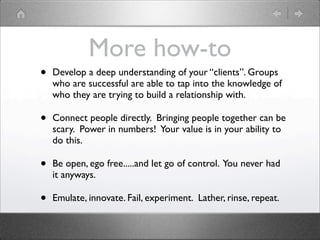
More how-to
•   Develop a deep understanding of your “clients”. Groups
    who are successful are able to tap into the knowledge of
    who they are trying to build a relationship with.

•   Connect people directly. Bringing people together can be
    scary. Power in numbers! Your value is in your ability to
    do this.

•   Be open, ego free.....and let go of control. You never had
    it anyways.

•   Emulate, innovate. Fail, experiment. Lather, rinse, repeat.
How-to.....
•   Set up a twitter account

•   Set up a ning page
question time

http://www.youtube.com/watch?v=4-lGe5MnBlY
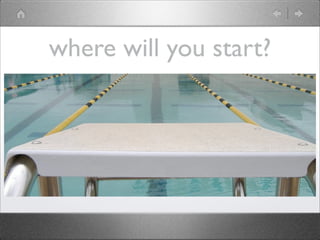
where will you start?
•

Social Media 101 July 14

  • 2.
    Social Media 101 usingthe social web to build your online toolkit Aerin Guy The Wellesley Institute July 14, 2009
  • 3.
    agenda • Intros and welcome • Overview of the Social Web • Basics • Strategy • Goals/Tools • Case Study • Building Capacity
  • 4.
    Text Aerin Guy • Manager, Communications & Virtual Wellesley • a proud Saskatonian and newbie Ontarian • background in communications, marketing, education and technology
  • 5.
    where I hangout • www.facebook.com/aeringuy • www.twitter.com/aeringuy • www.twitter.com/wellesleyWI • www.linkedin.com/aeringuy • www.wellesleyinstitute.com (under re-design, so check often!)
  • 6.
    about you! • please introduce yourselves to the people at your table • what organization are you with? • what is your role? • what do you hope to get out of this workshop?
  • 7.
    Overview of the social web • also known as Web 2.0 (Tim O’Reilly) • also known as the “social media explosion” • also known as the way we connect today
  • 8.
  • 9.
  • 10.
    introduction to social media
  • 12.
    people are talkingto each other online • 2 choices: 1. Resist it, and it will happen anyway, elsewhere, outside your influence 2. Support it, participate, influence it, and leverage it for extending your brand
  • 13.
    The web isabout conversations, not top down delivery of information or messages.
  • 15.
    some benefits ofusing social media • listen and learn and build relationships • publish valuable news and information • disseminate quickly and effectively • create or extend your brand personality • engage in conversations and services • efforts lead back to your website - your hub or repository of information
  • 16.
    basics • feeds, tags and RSS • blogs • wikis • twitter • facebook
  • 17.
    feeds • feeds are based on XML technology • subscribers are invested • commonly called RSS in your content (otherwise why would • Content can be they subscribe?) subscribed to and sent when updated • RSS readers include Google Reader, • sites and content from Bloglines, FeedReader sites come to you
  • 18.
    you’ll like thisdemo • http:// www.youtube.com/ watch?v=0klgLsSxGsU
  • 19.
    tags • tags are short keywords • also allows your content that define what your to be classified, indexed online digital content is and accessed by people, about search engines, and content aggregators • tagging your content helps others locate it • choose only relevant and more easily not overly generic keywords • a way to filter and categorize the web
  • 20.
    tags • tags work on the same • extend the reference XML platform as RSS, labels, associations, and except when tags are search keywords by used to categorize which any type of information on content can be found aggregator sites like Technorati and delicious • Technorati is a blog search engine organized • articles, news stories, by tags (tagged by podcasts, photos, users), identifying presentations, and video relevancy and content clips can all be tagged areas
  • 21.
  • 22.
    blogging: Be FOUND! • high ranking in organic search • at least 44% of all web interactions begin with search • search engines love blog headlines, as they indicate what can be found on the page • search engines also love blogs because they are frequently updated • recent + relevant = RANKING!
  • 23.
    elements of successfulorganizational blogs • trusted, authentic, and transparent source of • fast response information • authoritative • all about the words • frequency • reflects the brand • easy to find on website • delivers unique content • who’s going to write your blog? please don’t • speaks with a candid, human voice hire someone on behalf of your business. that’s just cheesy. • personality • practice makes perfect • allows for dialogue with readers • are the people at the highest level of your org willing to be authentic and transparent?
  • 24.
    Twitter is a real-time • great way to provide micro-blog links, respond instantly, and connect with • real time word of mouth “constituents” • 140 character max • using Tweetdeck (or http://www.youtube.com/watch? v=ddO9idmax0o forces “tweets” to be Twhirl) can help powerful, concise and organize your followers well-chosen into manageable groups • follow and be followed • Tweet from mobile devices with Tweetie, • highly searchable Twitterberry
  • 28.
    the world’s premier • friend-raising, not social networking site fundraising • individual profiles • facebook connect • corporate pages • promote events, initiatives, community • fan pages • average user age: 35 • cause marketing 1. http://www.facebook.com/ pages/The-Wellesley-Institute/
  • 29.
    video • http://www.youtube.com/ watch?v=VQ3d3KigPQM • www.momsrising.org • powerful, visual ways of getting messages across • user-generated content • mobile devices are everywhere, capturing content
  • 30.
    social media aspart of your communications strategy • baby...bathwater....no! • communities connect faster, more • segments our audiences collaboratively, more inclusively, and more • build on the power of effectively! networks and burgeoning communities • proliferation of sm stories in traditional media piques interest
  • 31.
    1/3 • website • socialoutposts • email
  • 32.
    the purpose ofsocial media is to engage with audiences in interactive communities 1.Genuine engagement facilitates a highly involved audience that wants to interact with “the brand” 2.The more people an organization can interact with who already have strong social networks, the more likely it is that a message can be spread through those networks 3. Communities of purpose abound on the net. Common thread of success? Purpose.
  • 33.
    an experiment the sticky game (it’s fun, I promise) (no really, it’s fun!)
  • 34.
    building community • House Social Network • Commercial Social Network • social networking community built on a • an online community nonprofit’s own owned and operated by website. Term derived a corporation. Popular from direct mail house examples include lists Facebook, Ning, OpenSocial, CommunityZero
  • 35.
    the world haschanged • and so has the way we connect • “when we change the way we communicate, we change society” • “new technology enables new kinds of group- forming”
  • 36.
    goals • list building • changing attitudes • galvanizing support • recruitment • education • fundraising • loyalty • motivation • exposing • organize • changing minds • info source
  • 37.
    Causes and passionsare online, but people increasingly resist being sold to in the communities they join. Canada’s Do Not Call list will soon expand to include email.
  • 39.
  • 40.
  • 41.
  • 42.
  • 43.
    your organization • are you a channel for your networks? Partners? Clients? • who can you connect? • 2.0 tools facilitate connection
  • 44.
    baby steps • cost effective • big budget? campaign assistance & facilitation, • no budget? Facebook, website redesign Twitter, blog, optimize existing website • many agencies will do pro-bono work for • wee budget? video, file charities/NFPs sharing software, microsite • sources can be craigslist, kijiji, student sites, hire an intern
  • 45.
    these resources arekey non-profit social network survey http://www.nonprofitsocialnetworksurvey.com/ 2009 eNonprofits Benchmarks Study http://www.e-benchmarksstudy.com/2009.html
  • 46.
    what tools areright for you? • Facebook page • streaming (podcast or vlog) • twitter account • ratings & reviews • blog • Ideastorm • community • Care2 campaign • flickrstream • email • aggregator • netvibes
  • 47.
    a wellesley institutecase study • Goal 1: to inform the process of the Ontario Provincial Housing Minister’s consultations • Goal 2: to connect people through the site by providing a story portal, resource section, and endorsement faculty • Goal 3: to build awareness of the need for stable and affordable housing • began in late March, 2009
  • 48.
    Organizational tie in: our strategic pillar of Affordable Housing as an indicator of urban health • Metrics: how will we measure success? • Broadcast: how do we promote our efforts and really use social media to connect people?
  • 49.
    Metrics: hits on site, stories shared, CTR (click-thru rate), media mentions, unique visitors, endorsees (private and organizational), policy impact!
  • 50.
    Social Media (andother tactics) • site construction and design • video • press releases/media release • blogs • Twitter • email • promotion through WI Facebook fan page and partner networks’ pages • flyer for events
  • 51.
    over 17,000 hits • 75 stories posted • nearly 500 personal and organizational endorsees • media coverage • agreement from gov’t to include network’s recommendations in consultation process • it rocked (but is still rockin’, so add your voice!)
  • 52.
    other examples • Kiva is a microlender that pairs up developing world lendees with worldwide lenders • recently branched into the US • all done via social web
  • 53.
    building capacity • canrequire a change in culture (digital natives vs digital immigrants) • Most NFPs are used to the “tower model” of working, not the “cloud”
  • 54.
  • 55.
    Mark Pearce @Connecting Up Australia
  • 56.
    Building Capacity: 5BIG ISSUES • Inertia problem - most organizations were founded prior to the internet....they aren’t used to having control issues, intimate relationships with audiences, and they think they control their brands. • Leadership issue - often the leaders are pre-internet. Difficult to get buy-in. Threatened. Perhaps read a Seth Godin book once. • Advocate issue - who’s the squeaky wheel? • Silo issue - “that’s marketing’s job”. “IT handles our web stuff” • Fear issue - it’s all so new, and changes so quickly, budgetary responsibility
  • 57.
    I have asecret for you. • and the secret is...... • this is not a fad. people don’t abandon technologies that make it easier to communicate. • shhhh....
  • 58.
    explore the tools you’d • explore your personal like to adopt by using and organizational them in your personal capacity life first • don’t be afraid to try or to fail. In social media, you learn by failing informatively (Red Cross Social Media Strategy) • develop your voice
  • 59.
    how it canwork • positioning. “we are the spearhead of a movement that is changing this issue. we are a vehicle for making change.” • engage leadership in new thinking. get help. • involve social media/coms people at management/strategic level. Obama’s campaign would be a good example! • Hire from the millennial generation. Their insight as digital natives will improve the strategic conversations. • Speak “human”. People like people. Relationships are where it’s at. Get out of “press release” mode.
  • 60.
    More how-to • Develop a deep understanding of your “clients”. Groups who are successful are able to tap into the knowledge of who they are trying to build a relationship with. • Connect people directly. Bringing people together can be scary. Power in numbers! Your value is in your ability to do this. • Be open, ego free.....and let go of control. You never had it anyways. • Emulate, innovate. Fail, experiment. Lather, rinse, repeat.
  • 61.
    How-to..... • Set up a twitter account • Set up a ning page
  • 62.
  • 63.
    where will youstart? •