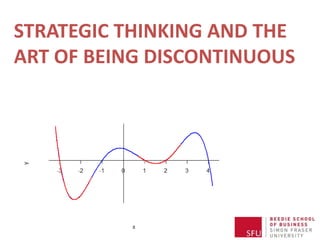
STRATEGIC THINKING AND THE
ART OF BEING DISCONTINUOUS
THE VELOCITY OF CHANGE
• Change has:
– A rate i.e., how much, how
often
– A direction i.e., more of the
same versus going in a new
direction
McCarthy I. P., Lawrence T. B., Wixted B., & Gordon B. R. 2010. A
multidimensional conceptualization of environmental velocity.
Academy of Management Review, 35(4): 604-626
Access the full paper here.
DISCONTINUOUS CHANGE
• To identify, create or cope with
discontinuous change it helps if you
have:
– The right mindset and an appetite for
weirdness
– An appropriate approach to
environmental scanning
– An ability to create or respond to
environmental ‘disruptions’
– Use and learn from escalating
experiments
ENTREPRENEURIAL THINKING
• An entrepreneur is:
– someone who identifies an
opportunity and takes action
to pursue it.
– the action involves bringing
together and organizing
resources not currently
controlled.
• Entrepreneurial thinking
underlies problem solving and
innovation
PUZZLE VERSUS QUILT MAKING
MINDSETS
Effectual Logic (mindset) Causal Logic (mindset)
THE CAUSAL MINDSET
• Good managers use causal thinking
– Starts with a desired and relatively known outcome.
– Focuses on the best means to generate that outcome.
• Efficiency and optimization of a known solution for a known
outcome
• Use existing means to attain a known end.
Saras Sarasvathy,
THE CAUSAL MINDSET
Distinguishing Characteristic:
Selecting between given means to achieve a pre-determined goal
Given
Goal
M1
M2
M3
M4
M5
Given Means
Saras Sarasvathy (2001). What makes entrepreneurs entrepreneurial? (PDF). Harvard Business
Review. p. 9. Retrieved 2014-01-26
THE PUZZLE
• Why does the puzzle demonstrate causal thinking?
– You are given an organization and fixed
resources (given means). What are these?
– You are given precise goals? What are these?
– You plan and organize. How?
– You execute. How?
– You measure progress. How?
THE EFFECTUAL MINDSET
• Good entrepreneurs use effectual thinking
• Imagining possible new ends using a given set of means
• Imagine the end, and create the means
THE EFFECTUAL MINDSET
E1
E2
E3
E4
E5
Given Means
Distinguishing Characteristic:
Imagining possible new ends using a given set of means
What are the means?
M1
M2
M3
M4
M5
Imagined Ends
Saras Sarasvathy (2001). What makes entrepreneurs entrepreneurial? (PDF). Harvard Business
Review. p. 9. Retrieved 2014-01-26
THE QUILT
• Why does the quilt demonstrate effectual
thinking?
– You do it on your own initially.
– You select and accumulate resources you like.
– The goal is broad and open.
– The product emerges over time. Don’t know
what it looks like until the end.
– Not tied to precise plans and organization.
EFFECTUAL
MINDSET
CAUSAL
MINDSET
ENVIRONMENTAL SCANNING
• Environmental scanning is monitoring and interpreting the
external environment to better understand the nature of
trends and drivers of change and their likely future impact on
your organisation.
Scanning
(Data collection)
Interpretation
(Data given meaning)
Learning
(Action taken)
Daft & Weick 1984
MODES OF SCANNING
UNDIRECTED VIEWING
Constrained interpretations.
Nonroutine, informal data.
Hunch, rumor, chance
opportunities.
ENACTING
Experimentation, testing,
coercion, invent
environment. Learn by
doing.
CONDITIONED VIEWING
Interprets within traditional
boundaries. Passive
detection. Routine, formal
data.
DISCOVERING
Formal search. Questioning,
surveys, data gathering.
Active detection.
Unanalyzable
Analyzable
ASSUMPTIONS
ABOUT
ENVIRONMENT
Passive Active
ORGANIZATIONAL INTRUSIVENESS
Daft & Weick 1984
ICEBERG MODEL
Events
Patterns
Structure
Questions
What happened
What’s been happening?
What explains this?
The water line
Actions
Knee-jerks
Analyse and
plan
Understand and
redesign
ICEBERG MODEL
• Events = scenes in a story
• What happened?
• What are some of the notable events?
• Patterns = the messages in a story
• What's been happening?
• How has performance changed over time?
• What are other important trends?
• Structure – understanding why the story happened and
what it means
• What has caused the problem/issues?
• What are some of the consequences and
opportunities?
Data and facts
Hypotheses
EXPLOITATION EXPLORATION
Follow the rules and drive out the variance
and slack.
Break the rules and promote variance and
slack.
Focus on serving existing customers and
their needs.
Serve new customers with new needs.
Manage and refine existing competences. Develop and lead new competences.
Optimize the organization for existing rules. Develop new organization system with new
rules.
Make money now. Make money later.
AMBIDEXTERITY: TWO MODES OF LEARNING
Based on the following research:
McCarthy I. P. & Gordon B. R. 2011. Achieving contextual ambidexterity in R&D
Organizations: A Management Control System Approach, R&D Management, 43(1): 240-
258
Access the full paper here.
DISRUPTIONS
Regency TR-1 — the first
transistor radio (1954)
Zenith AM/FM Tube Radio (Model G730W)
from the 1950's
HARD DRIVE EXAMPLE
CELL PHONES VS. CAMERAS
Philippe Kahn, June 1997
DISRUPTIVE INNOVATIONS
• Existing customers do not value performance attributes of the
innovation
• The innovation performs worse on certain attributes
• It appears to be financially unattractive: small markets, low profit
margins
• Difficult to predict the growth rate of the market
• Requires new manufacturing/delivery processes
• Yet a disruptive innovation can disrupt (destroy) your market and
your company.
WHAT SHOULD YOU DO
• Be Observant
– Customers won’t lead you to them.
– Less profitable than alternatives - with current business models.
– Marketing, sales and financial people will oppose or be unenthusiastic.
– Senior management will often be unaware or attach little importance
to the opportunity.
• Be Proactive
– Initial applications will be unclear. Watch for a market to emerge.
– Vulnerable markets are those which are over served in terms of
functionality and populated by large, complex, inconvenient products
and services.
– Draw a trajectories map.
COSTS REDUCE SIGNIFICANTLY OVER TIME
• Price of 1GB storage by year
• 1981 =
• 1987 =
• 1990 =
• 1994 =
• 1997 =
• 2000 =
• 2004 =
• 2012 =
$300,000
$50,000
$10,000
$1,000
$100
$10
$1
$0.10
MARSHMELLOW CHALLENGE
Source: Tom Wujec
1. Reward success and failure; punish
inaction
2. Think of some ridiculous or
impractical things to do and plan to do
them.
3. Take your past successes and forget
them
4. Hire slow learners of the
organizational code, people who make
you uncomfortable
5. Encourage people to ignore and defy
their bosses and peers
BE WEIRD
ESCALATING TESTS
Plan
Experiment
Learn
Reshape
Plan
Experiment
Learn
Reshape
STACY’S PITA CHIPS - ESCALATING MARKET TESTS
• Social work with a passion for food,
wants to open a restaurant, but……?
• Food cart sells pita bread wraps, but
the real success is ….?
• Creates Stacy’ Pita Chip Company
but how could they reach the
masses ……?
• Manufactured the chips by …….?
• Raised money by……?
BIG BELLY
ESCALATING TESTS
• We test to:
– Learn. If a picture is worth a thousand words, a prototype is
worth a thousand pictures.
– Solve disagreements. Testing helps eliminate ambiguity, assist in
ideation, and reduce miscommunication.
– Start a conversation. Tests are a great way to have a different
kind of conversation with users.
– Fail quickly and cheaply. Creating quick and dirty tests allows
you to assess ideas without investing a lot of time and money
up front.
– Manage the entrepreneurial process. Identifying a variable to
explore encourages you to break a large problem down into
smaller, testable chunks.
SUMMARY
• How you go forward
determines where you go.
– Causal vs. effectual
mindsets
– Conditioned viewing vs.
enacting
– Exploitation vs. exploration
– Planning vs. doing
– Being weird vs. being
normal
Strategic Thinking and the Art of Being Discontinuous

Strategic Thinking and the Art of Being Discontinuous

  • 1.
    STRATEGIC THINKING ANDTHE ART OF BEING DISCONTINUOUS
  • 2.
    THE VELOCITY OFCHANGE • Change has: – A rate i.e., how much, how often – A direction i.e., more of the same versus going in a new direction McCarthy I. P., Lawrence T. B., Wixted B., & Gordon B. R. 2010. A multidimensional conceptualization of environmental velocity. Academy of Management Review, 35(4): 604-626 Access the full paper here.
  • 3.
    DISCONTINUOUS CHANGE • Toidentify, create or cope with discontinuous change it helps if you have: – The right mindset and an appetite for weirdness – An appropriate approach to environmental scanning – An ability to create or respond to environmental ‘disruptions’ – Use and learn from escalating experiments
  • 4.
    ENTREPRENEURIAL THINKING • Anentrepreneur is: – someone who identifies an opportunity and takes action to pursue it. – the action involves bringing together and organizing resources not currently controlled. • Entrepreneurial thinking underlies problem solving and innovation
  • 5.
  • 6.
    MINDSETS Effectual Logic (mindset)Causal Logic (mindset)
  • 7.
    THE CAUSAL MINDSET •Good managers use causal thinking – Starts with a desired and relatively known outcome. – Focuses on the best means to generate that outcome. • Efficiency and optimization of a known solution for a known outcome • Use existing means to attain a known end. Saras Sarasvathy,
  • 8.
    THE CAUSAL MINDSET DistinguishingCharacteristic: Selecting between given means to achieve a pre-determined goal Given Goal M1 M2 M3 M4 M5 Given Means Saras Sarasvathy (2001). What makes entrepreneurs entrepreneurial? (PDF). Harvard Business Review. p. 9. Retrieved 2014-01-26
  • 9.
    THE PUZZLE • Whydoes the puzzle demonstrate causal thinking? – You are given an organization and fixed resources (given means). What are these? – You are given precise goals? What are these? – You plan and organize. How? – You execute. How? – You measure progress. How?
  • 10.
    THE EFFECTUAL MINDSET •Good entrepreneurs use effectual thinking • Imagining possible new ends using a given set of means • Imagine the end, and create the means
  • 11.
    THE EFFECTUAL MINDSET E1 E2 E3 E4 E5 GivenMeans Distinguishing Characteristic: Imagining possible new ends using a given set of means What are the means? M1 M2 M3 M4 M5 Imagined Ends Saras Sarasvathy (2001). What makes entrepreneurs entrepreneurial? (PDF). Harvard Business Review. p. 9. Retrieved 2014-01-26
  • 12.
    THE QUILT • Whydoes the quilt demonstrate effectual thinking? – You do it on your own initially. – You select and accumulate resources you like. – The goal is broad and open. – The product emerges over time. Don’t know what it looks like until the end. – Not tied to precise plans and organization.
  • 13.
  • 14.
    ENVIRONMENTAL SCANNING • Environmentalscanning is monitoring and interpreting the external environment to better understand the nature of trends and drivers of change and their likely future impact on your organisation. Scanning (Data collection) Interpretation (Data given meaning) Learning (Action taken) Daft & Weick 1984
  • 15.
    MODES OF SCANNING UNDIRECTEDVIEWING Constrained interpretations. Nonroutine, informal data. Hunch, rumor, chance opportunities. ENACTING Experimentation, testing, coercion, invent environment. Learn by doing. CONDITIONED VIEWING Interprets within traditional boundaries. Passive detection. Routine, formal data. DISCOVERING Formal search. Questioning, surveys, data gathering. Active detection. Unanalyzable Analyzable ASSUMPTIONS ABOUT ENVIRONMENT Passive Active ORGANIZATIONAL INTRUSIVENESS Daft & Weick 1984
  • 16.
    ICEBERG MODEL Events Patterns Structure Questions What happened What’sbeen happening? What explains this? The water line Actions Knee-jerks Analyse and plan Understand and redesign
  • 17.
    ICEBERG MODEL • Events= scenes in a story • What happened? • What are some of the notable events? • Patterns = the messages in a story • What's been happening? • How has performance changed over time? • What are other important trends? • Structure – understanding why the story happened and what it means • What has caused the problem/issues? • What are some of the consequences and opportunities? Data and facts Hypotheses
  • 18.
    EXPLOITATION EXPLORATION Follow therules and drive out the variance and slack. Break the rules and promote variance and slack. Focus on serving existing customers and their needs. Serve new customers with new needs. Manage and refine existing competences. Develop and lead new competences. Optimize the organization for existing rules. Develop new organization system with new rules. Make money now. Make money later. AMBIDEXTERITY: TWO MODES OF LEARNING Based on the following research: McCarthy I. P. & Gordon B. R. 2011. Achieving contextual ambidexterity in R&D Organizations: A Management Control System Approach, R&D Management, 43(1): 240- 258 Access the full paper here.
  • 19.
    DISRUPTIONS Regency TR-1 —the first transistor radio (1954) Zenith AM/FM Tube Radio (Model G730W) from the 1950's
  • 20.
  • 21.
    CELL PHONES VS.CAMERAS Philippe Kahn, June 1997
  • 22.
    DISRUPTIVE INNOVATIONS • Existingcustomers do not value performance attributes of the innovation • The innovation performs worse on certain attributes • It appears to be financially unattractive: small markets, low profit margins • Difficult to predict the growth rate of the market • Requires new manufacturing/delivery processes • Yet a disruptive innovation can disrupt (destroy) your market and your company.
  • 23.
    WHAT SHOULD YOUDO • Be Observant – Customers won’t lead you to them. – Less profitable than alternatives - with current business models. – Marketing, sales and financial people will oppose or be unenthusiastic. – Senior management will often be unaware or attach little importance to the opportunity. • Be Proactive – Initial applications will be unclear. Watch for a market to emerge. – Vulnerable markets are those which are over served in terms of functionality and populated by large, complex, inconvenient products and services. – Draw a trajectories map.
  • 24.
    COSTS REDUCE SIGNIFICANTLYOVER TIME • Price of 1GB storage by year • 1981 = • 1987 = • 1990 = • 1994 = • 1997 = • 2000 = • 2004 = • 2012 = $300,000 $50,000 $10,000 $1,000 $100 $10 $1 $0.10
  • 25.
  • 27.
    1. Reward successand failure; punish inaction 2. Think of some ridiculous or impractical things to do and plan to do them. 3. Take your past successes and forget them 4. Hire slow learners of the organizational code, people who make you uncomfortable 5. Encourage people to ignore and defy their bosses and peers BE WEIRD
  • 28.
  • 29.
    STACY’S PITA CHIPS- ESCALATING MARKET TESTS • Social work with a passion for food, wants to open a restaurant, but……? • Food cart sells pita bread wraps, but the real success is ….? • Creates Stacy’ Pita Chip Company but how could they reach the masses ……? • Manufactured the chips by …….? • Raised money by……?
  • 30.
  • 31.
    ESCALATING TESTS • Wetest to: – Learn. If a picture is worth a thousand words, a prototype is worth a thousand pictures. – Solve disagreements. Testing helps eliminate ambiguity, assist in ideation, and reduce miscommunication. – Start a conversation. Tests are a great way to have a different kind of conversation with users. – Fail quickly and cheaply. Creating quick and dirty tests allows you to assess ideas without investing a lot of time and money up front. – Manage the entrepreneurial process. Identifying a variable to explore encourages you to break a large problem down into smaller, testable chunks.
  • 32.
    SUMMARY • How yougo forward determines where you go. – Causal vs. effectual mindsets – Conditioned viewing vs. enacting – Exploitation vs. exploration – Planning vs. doing – Being weird vs. being normal