CONFRONTING
INDIFFERENCE TOWARDS
TRUTH
#Luiss.MasterClass
Professor Ian P. McCarthy
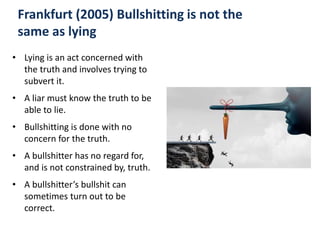
Frankfurt (2005) Bullshitting is not the
same as lying
• Lying is an act concerned with
the truth and involves trying to
subvert it.
• A liar must know the truth to be
able to lie.
• Bullshitting is done with no
concern for the truth.
• A bullshitter has no regard for,
and is not constrained by, truth.
• A bullshitter’s bullshit can
sometimes turn out to be
correct.
What is bullshit?
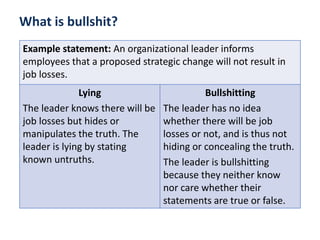
Example statement: An organizational leader informs
employees that a proposed strategic change will not result in
job losses.
Lying
The leader knows there will be
job losses but hides or
manipulates the truth. The
leader is lying by stating
known untruths.
Bullshitting
The leader has no idea
whether there will be job
losses or not, and is thus not
hiding or concealing the truth.
The leader is bullshitting
because they neither know
nor care whether their
statements are true or false.
What is bullshit?
• In 2018, the U.S. President
erroneously told the Canadian
Prime Minister that the United
States had a trade deficit with
Canada.
• The U.S. President later
admitted that he had no idea if
there was a deficit.
• This freedom from truth means
that leaders can say whatever it
takes to further their agenda
Bullshit antecedents and receptivity
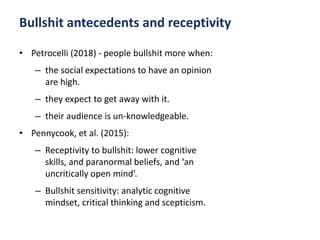
• Petrocelli (2018) - people bullshit more when:
– the social expectations to have an opinion
are high.
– they expect to get away with it.
– their audience is un-knowledgeable.
• Pennycook, et al. (2015):
– Receptivity to bullshit: lower cognitive
skills, and paranormal beliefs, and ‘an
uncritically open mind’.
– Bullshit sensitivity: analytic cognitive
mindset, critical thinking and scepticism.
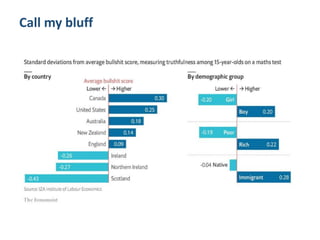
Call my bluff
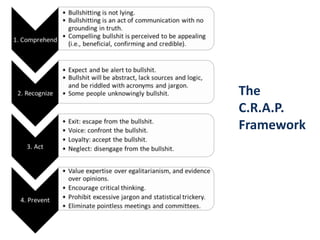
The
C.R.A.P.
Framework
1. Don’t confuse bullshit with lying and
others forms of misrepresentation.
2. Don’t forget that bullshit is often
appealing and sometimes turns out to
be true.
3. Don’t forget that people knowingly
and unknowingly bullshit.
4. Don't listen and read with an
uncritically open mind.
5. Don’t be afraid to say “I don’t know”
and “I don’t understand”.
Five don’ts
1. Do call for or question logic and evidence, while
rejecting anecdotes.
2. Do be alert to inconsistencies, biases and vague
and jargon-filled statements.
3. Do proportion your belief to the availability of
evidence and its veracity.
4. Do prohibit excessive jargon, statistical trickery,
and pointless meetings and committees.
5. Do understand and adjust how colleagues ‘act’
toward bullshit.
Five dos
Thank you

Masterclass: Confronting indifference to truth

  • 1.
  • 4.
    Frankfurt (2005) Bullshittingis not the same as lying • Lying is an act concerned with the truth and involves trying to subvert it. • A liar must know the truth to be able to lie. • Bullshitting is done with no concern for the truth. • A bullshitter has no regard for, and is not constrained by, truth. • A bullshitter’s bullshit can sometimes turn out to be correct.
  • 5.
    What is bullshit? Examplestatement: An organizational leader informs employees that a proposed strategic change will not result in job losses. Lying The leader knows there will be job losses but hides or manipulates the truth. The leader is lying by stating known untruths. Bullshitting The leader has no idea whether there will be job losses or not, and is thus not hiding or concealing the truth. The leader is bullshitting because they neither know nor care whether their statements are true or false.
  • 6.
    What is bullshit? •In 2018, the U.S. President erroneously told the Canadian Prime Minister that the United States had a trade deficit with Canada. • The U.S. President later admitted that he had no idea if there was a deficit. • This freedom from truth means that leaders can say whatever it takes to further their agenda
  • 7.
    Bullshit antecedents andreceptivity • Petrocelli (2018) - people bullshit more when: – the social expectations to have an opinion are high. – they expect to get away with it. – their audience is un-knowledgeable. • Pennycook, et al. (2015): – Receptivity to bullshit: lower cognitive skills, and paranormal beliefs, and ‘an uncritically open mind’. – Bullshit sensitivity: analytic cognitive mindset, critical thinking and scepticism.
  • 8.
  • 9.
  • 10.
    1. Don’t confusebullshit with lying and others forms of misrepresentation. 2. Don’t forget that bullshit is often appealing and sometimes turns out to be true. 3. Don’t forget that people knowingly and unknowingly bullshit. 4. Don't listen and read with an uncritically open mind. 5. Don’t be afraid to say “I don’t know” and “I don’t understand”. Five don’ts
  • 11.
    1. Do callfor or question logic and evidence, while rejecting anecdotes. 2. Do be alert to inconsistencies, biases and vague and jargon-filled statements. 3. Do proportion your belief to the availability of evidence and its veracity. 4. Do prohibit excessive jargon, statistical trickery, and pointless meetings and committees. 5. Do understand and adjust how colleagues ‘act’ toward bullshit. Five dos
  • 12.