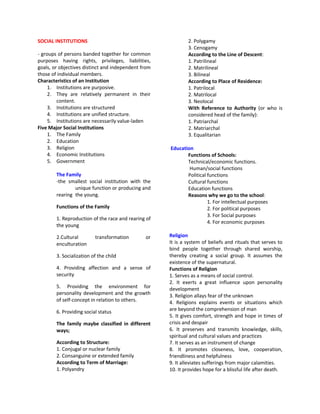
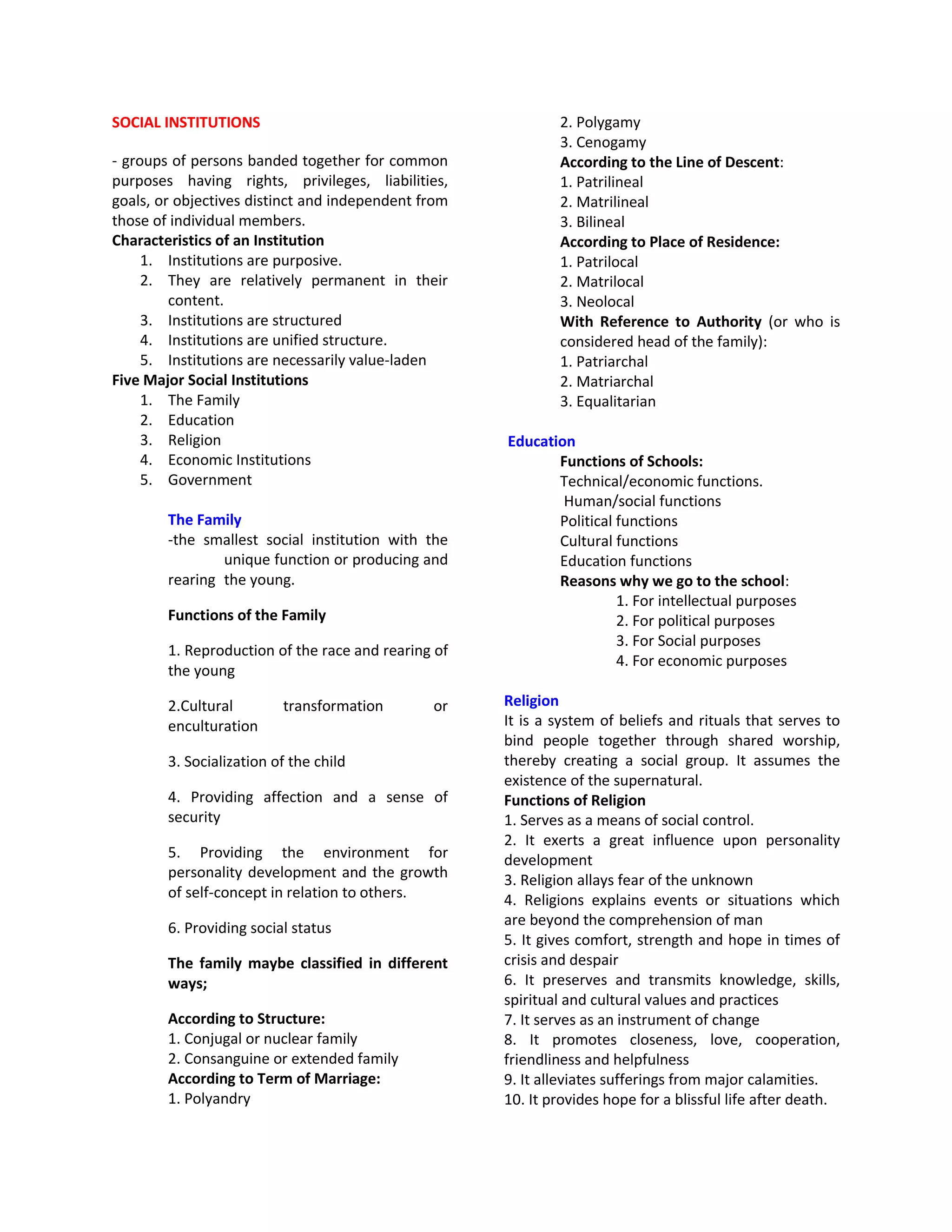
SOCIAL INSTITUTIONS                                          2. Polygamy
                                                             3. Cenogamy
- groups of persons banded together for common               According to the Line of Descent:
purposes having rights, privileges, liabilities,             1. Patrilineal
goals, or objectives distinct and independent from           2. Matrilineal
those of individual members.                                 3. Bilineal
Characteristics of an Institution                            According to Place of Residence:
     1. Institutions are purposive.                          1. Patrilocal
     2. They are relatively permanent in their               2. Matrilocal
         content.                                            3. Neolocal
     3. Institutions are structured                          With Reference to Authority (or who is
     4. Institutions are unified structure.                  considered head of the family):
     5. Institutions are necessarily value-laden             1. Patriarchal
Five Major Social Institutions                               2. Matriarchal
     1. The Family                                           3. Equalitarian
     2. Education
     3. Religion                                     Education
     4. Economic Institutions                               Functions of Schools:
     5. Government                                          Technical/economic functions.
                                                             Human/social functions
        The Family                                          Political functions
        -the smallest social institution with the           Cultural functions
                unique function or producing and            Education functions
        rearing the young.                                  Reasons why we go to the school:
                                                                      1. For intellectual purposes
        Functions of the Family                                       2. For political purposes
                                                                      3. For Social purposes
        1. Reproduction of the race and rearing of
                                                                      4. For economic purposes
        the young

        2.Cultural        transformation       or    Religion
        enculturation                                It is a system of beliefs and rituals that serves to
                                                     bind people together through shared worship,
        3. Socialization of the child                thereby creating a social group. It assumes the
                                                     existence of the supernatural.
        4. Providing affection and a sense of        Functions of Religion
        security                                     1. Serves as a means of social control.
                                                     2. It exerts a great influence upon personality
        5. Providing the environment for             development
        personality development and the growth       3. Religion allays fear of the unknown
        of self-concept in relation to others.       4. Religions explains events or situations which
        6. Providing social status                   are beyond the comprehension of man
                                                     5. It gives comfort, strength and hope in times of
        The family maybe classified in different     crisis and despair
        ways;                                        6. It preserves and transmits knowledge, skills,
                                                     spiritual and cultural values and practices
        According to Structure:                      7. It serves as an instrument of change
        1. Conjugal or nuclear family                8. It promotes closeness, love, cooperation,
        2. Consanguine or extended family            friendliness and helpfulness
        According to Term of Marriage:               9. It alleviates sufferings from major calamities.
        1. Polyandry                                 10. It provides hope for a blissful life after death.
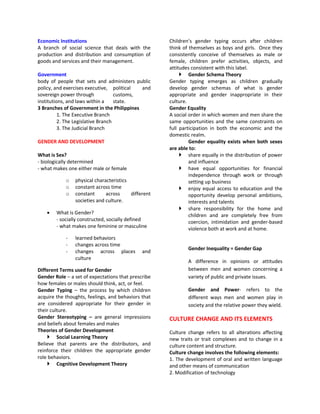
Economic Institutions                                Children’s gender typing occurs after children
A branch of social science that deals with the       think of themselves as boys and girls. Once they
production and distribution and consumption of       consistently conceive of themselves as male or
goods and services and their management.             female, children prefer activities, objects, and
                                                     attitudes consistent with this label.
Government                                                 Gender Schema Theory
body of people that sets and administers public      Gender typing emerges as children gradually
policy, and exercises executive, political   and     develop gender schemas of what is gender
sovereign power through             customs,         appropriate and gender inappropriate in their
institutions, and laws within a     state.           culture.
3 Branches of Government in the Philippines          Gender Equality
          1. The Executive Branch                    A social order in which women and men share the
          2. The Legislative Branch                  same opportunities and the same constraints on
          3. The Judicial Branch                     full participation in both the economic and the
                                                     domestic realm.
GENDER AND DEVELOPMENT                                        Gender equality exists when both sexes
                                                     are able to:
What is Sex?                                               share equally in the distribution of power
- biologically determined                                     and influence
- what makes one either male or female                     have equal opportunities for financial
                                                              independence through work or through
            o   physical characteristics                      setting up business
            o   constant across time                       enjoy equal access to education and the
            o   constant      across     different            opportunity develop personal ambitions,
                societies and culture.                        interests and talents
                                                           share responsibility for the home and
        What is Gender?                                       children and are completely free from
        - socially constructed, socially defined              coercion, intimidation and gender-based
        - what makes one feminine or masculine                violence both at work and at home.
            -   learned behaviors
            -   changes across time
                                                             Gender Inequality = Gender Gap
            -   changes across places         and
                culture
                                                             A difference in opinions or attitudes
Different Terms used for Gender                              between men and women concerning a
Gender Role – a set of expectations that prescribe           variety of public and private issues.
how females or males should think, act, or feel.
Gender Typing – the process by which children                Gender and Power- refers to the
acquire the thoughts, feelings, and behaviors that           different ways men and women play in
are considered appropriate for their gender in               society and the relative power they wield.
their culture.
Gender Stereotyping – are general impressions        CULTURE CHANGE AND ITS ELEMENTS
and beliefs about females and males
Theories of Gender Development                       Culture change refers to all alterations affecting
     Social Learning Theory                         new traits or trait complexes and to change in a
Believe that parents are the distributors, and       culture content and structure.
reinforce their children the appropriate gender      Culture change involves the following elements:
role behaviors.                                      1. The development of oral and written language
     Cognitive Development Theory                   and other means of communication
                                                     2. Modification of technology
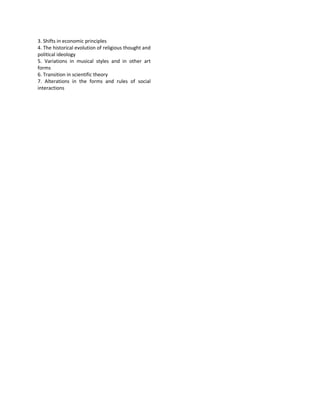
3. Shifts in economic principles
4. The historical evolution of religious thought and
political ideology
5. Variations in musical styles and in other art
forms
6. Transition in scientific theory
7. Alterations in the forms and rules of social
interactions

Social institutions

  • 1.
    SOCIAL INSTITUTIONS 2. Polygamy 3. Cenogamy - groups of persons banded together for common According to the Line of Descent: purposes having rights, privileges, liabilities, 1. Patrilineal goals, or objectives distinct and independent from 2. Matrilineal those of individual members. 3. Bilineal Characteristics of an Institution According to Place of Residence: 1. Institutions are purposive. 1. Patrilocal 2. They are relatively permanent in their 2. Matrilocal content. 3. Neolocal 3. Institutions are structured With Reference to Authority (or who is 4. Institutions are unified structure. considered head of the family): 5. Institutions are necessarily value-laden 1. Patriarchal Five Major Social Institutions 2. Matriarchal 1. The Family 3. Equalitarian 2. Education 3. Religion Education 4. Economic Institutions Functions of Schools: 5. Government Technical/economic functions. Human/social functions The Family Political functions -the smallest social institution with the Cultural functions unique function or producing and Education functions rearing the young. Reasons why we go to the school: 1. For intellectual purposes Functions of the Family 2. For political purposes 3. For Social purposes 1. Reproduction of the race and rearing of 4. For economic purposes the young 2.Cultural transformation or Religion enculturation It is a system of beliefs and rituals that serves to bind people together through shared worship, 3. Socialization of the child thereby creating a social group. It assumes the existence of the supernatural. 4. Providing affection and a sense of Functions of Religion security 1. Serves as a means of social control. 2. It exerts a great influence upon personality 5. Providing the environment for development personality development and the growth 3. Religion allays fear of the unknown of self-concept in relation to others. 4. Religions explains events or situations which 6. Providing social status are beyond the comprehension of man 5. It gives comfort, strength and hope in times of The family maybe classified in different crisis and despair ways; 6. It preserves and transmits knowledge, skills, spiritual and cultural values and practices According to Structure: 7. It serves as an instrument of change 1. Conjugal or nuclear family 8. It promotes closeness, love, cooperation, 2. Consanguine or extended family friendliness and helpfulness According to Term of Marriage: 9. It alleviates sufferings from major calamities. 1. Polyandry 10. It provides hope for a blissful life after death.
  • 2.
    Economic Institutions Children’s gender typing occurs after children A branch of social science that deals with the think of themselves as boys and girls. Once they production and distribution and consumption of consistently conceive of themselves as male or goods and services and their management. female, children prefer activities, objects, and attitudes consistent with this label. Government  Gender Schema Theory body of people that sets and administers public Gender typing emerges as children gradually policy, and exercises executive, political and develop gender schemas of what is gender sovereign power through customs, appropriate and gender inappropriate in their institutions, and laws within a state. culture. 3 Branches of Government in the Philippines Gender Equality 1. The Executive Branch A social order in which women and men share the 2. The Legislative Branch same opportunities and the same constraints on 3. The Judicial Branch full participation in both the economic and the domestic realm. GENDER AND DEVELOPMENT Gender equality exists when both sexes are able to: What is Sex?  share equally in the distribution of power - biologically determined and influence - what makes one either male or female  have equal opportunities for financial independence through work or through o physical characteristics setting up business o constant across time  enjoy equal access to education and the o constant across different opportunity develop personal ambitions, societies and culture. interests and talents  share responsibility for the home and What is Gender? children and are completely free from - socially constructed, socially defined coercion, intimidation and gender-based - what makes one feminine or masculine violence both at work and at home. - learned behaviors - changes across time Gender Inequality = Gender Gap - changes across places and culture A difference in opinions or attitudes Different Terms used for Gender between men and women concerning a Gender Role – a set of expectations that prescribe variety of public and private issues. how females or males should think, act, or feel. Gender Typing – the process by which children Gender and Power- refers to the acquire the thoughts, feelings, and behaviors that different ways men and women play in are considered appropriate for their gender in society and the relative power they wield. their culture. Gender Stereotyping – are general impressions CULTURE CHANGE AND ITS ELEMENTS and beliefs about females and males Theories of Gender Development Culture change refers to all alterations affecting  Social Learning Theory new traits or trait complexes and to change in a Believe that parents are the distributors, and culture content and structure. reinforce their children the appropriate gender Culture change involves the following elements: role behaviors. 1. The development of oral and written language  Cognitive Development Theory and other means of communication 2. Modification of technology
  • 3.
    3. Shifts ineconomic principles 4. The historical evolution of religious thought and political ideology 5. Variations in musical styles and in other art forms 6. Transition in scientific theory 7. Alterations in the forms and rules of social interactions