Max Weber
Dr. Syed Mehdi Abbas Zaidi
Associate Professor
Department of Sociology
Shia PG College, Lucknow
Max Weber (21 April 1864 - 14 June
1920)
 Full name Maximilian Karl Emil Weber.
 Max Weber was the great German sociologist and political
economist.
 He worked in the field of economics sociology, history, law,
politics and philosophy at the university of Berlin, Vienna
and university of Munich.
 His ideas would profoundly influence social theory and
social research.
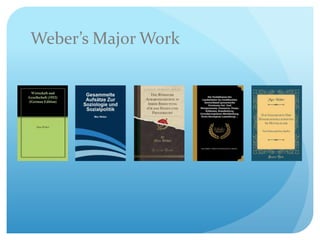
Weber’s Major Work
Ideal Type
 An ideal type is an analytical construct that serves the
investigator as a measuring rod to ascertain similarities as
well as deviations in concrete cases. It provide the basic
method for comparative study.
 An ideal type is not meant to be a moral ideal. There can be an
ideal type of a brothel or a chapel.
 It is not a statistical average
 Average Protestants in a given region or at a give time may be quite
different from ideal typical
 Protestants Used to develop hypotheses
Three Levels of Ideal Type
 Three levels of Ideal Types are:
 First are the ideal types rooted in historical particularities,
such as the “western city,” “the Protestant Ethic,” or
“modern capitalism,” which refer to phenomena that
appear only in specific historical periods and in particular
cultural areas.
 Second kind involves abstract elements of social reality--
such concepts as “bureaucracy” or “feudalism”--that may be
found in a variety of historical and cultural contexts.
Continuum
 Finally, there is a third kind of ideal type. . .”rationalizing
reconstructions of a particular kind of behavior. According
to Weber, all propositions in economic theory, for example,
fall into this category. They all refer to ways in which man
would behave were they actuated by purely economic
motives, were they purely economic men.
Social Action
 “Social action means taking steps to change the things that
are wrong in our society and introducing new ideas and
processes for doing things better in the future.”
 Max Weber conceived of sociology as a comprehensive
science of social action.
 Max Weber began with the idea of social action to make of
sociology a scientific enquiry.
 Thus the idea of action is central to Max Weber’s sociology.
Characteristics of Social Action
 The significant characteristics of Weber’s ideas are
following.
 Social action may be influenced by an action of past,
present or future.
 Social action presupposes the existence of other individual
and some action by him.
 Necessity of subjective meaning.
 It is oriented in its course.
Types of Social Action
 There are four types of Social Action:
1. Zweckrational
2. Wertrational
3. Traditional
4. Affectual
1. Zweckrational
 This type of social action is goal oriented and the motive of
the goal is derived from the desires of actor.
 However, the goal should be realistic and actor should have
means which are required to achieve the goal.
 For example, an individual may want highest score in the class,
however, to accomplish that goal, he has to work hard and give
more time to study and do not let his emotions come in a way
of accomplishing his goal. If he does not give time to his
studies and yet want to score high in class then his goal and
mean of achieving it is considered to be irrational or
unrealistic.
2. Wertrational
 In it value rational social action, goal and means of
achieving end is derived and determined by values.
 This type of social action is also considered to be rational
however, the rationality of that action is justified by the
actor from his set of beliefs, which may be aesthetic,
religious, constitutional, and based on profession policy.
 For example, individuals who are in the following professions,
Police, clergy and lawyers are supposed to choose goals and
means to accomplishing it, under a particular code and rules,
which efficiency and effectiveness cannot be questioned by
them.
3. Traditional
 Traditional social action is derived from the customs of
society.
 For example if someone eat food with their bare hands and
someone asks why are you not eating with fork and knife? If
he/she replies that, my ancestor used to eat with bare hands
that’s why I am eating too that way, such social action will
come into the category of traditional social action.
4. Affectual
 Such social action is motivated by the emotions of
individual.
 This type of social action is considered to be the most
irrational action.
 For example, if a football player gets angry during a match and
in that moment of anger, he hits opponent team player, he
knows that such action will weaken their team position and
may affect his career, despite knowing the consequences he
hits the player.
 That’s reason why “weber” called it the most irrational social
action.
Verstehen
 This approach was developed by late 19th-century
sociologists Max Weber and Wilhelm Dilthey, who saw the
flaws in trying to research a culture in the same way natural
scientists researched the natural world.
 Verstehen is a German word meaning to 'understand in a
deep way' that also refers to an approach within sociology.
 In this approach, when a researcher aims to understand
another person's experience, he can try to put himself in
the other person's shoes.
Continuum
 He can do this by learning from the other person, through
conversations and interactions that give the researcher
greater insight.
 Interpretive sociology differs from positivist sociology in
three ways:
 It deals with the meaning attached to behavior, unlike
positivist sociology which focuses on action;
 It sees reality as being constructed by people, unlike positivist
sociology which sees an objective reality "out there;" and
 It relies on qualitative data, unlike positivist sociology which
tends to make use of quantitative data.
Power and Authority
 Power
 Ability to impose one’s will onto another.
 Associated with personality
 Authority
 Legitimate power to give orders, make decisions, and enforce
obedience
 Associated with social positions
Types of Authority
 There are three types of authority, these are:
 Rational-legal authority
 Authority may be based on rational grounds and anchored in
impersonal rules that have been legally enacted or
contractually established.
 Traditional authority
 Based on the belief in the sanctity of tradition, of “the eternal
yesterday.” It is not codified in impersonal rules, but inheres in
particular persons who may either inherit it or be invested
with it by a higher authority.
Continuum
 Charismatic authority
 Rests on the appeal of leaders who claim allegiance because of
their extraordinary virtuosity, whether ethical, heroic, or
religious.
Bureaucracy
 Bureaucracy Formal organization of the officialdom of
large-scale enterprise (e.g., government, military,
economic, religious, educational), the ideal-type of such as
organization characterized by:
 Clearly defined division of labor
 Rationality (i.e., a business-like attention to implementing
goals of the organization)
 Impersonal application of rules
 Routinization of tasks to the degree that personnel are easily
replaceable
Continuum
 This bureaucratic coordination of the actions of large
numbers of people has become the dominant structural
feature of modern forms of organization.
 Only through this organizational device has large-scale
planning, both for the modern state and the modern
economy, become possible.
 Yet Weber also noted the dysfunctions of bureaucracy. Its
major advantage, the calculability of results, also causes
depersonalization. It is difficult to deal with individual
cases.
The Protestant Ethics and the Spirit
of Capitalism
 The Protestant Ethic and the Spirit of Capitalism is part of
an exercise in historical hypothesis testing in which Weber
constructed a logical experiment using ideal types as
conceptual tools.
 Occupational statistics in those nations of mixed religious
composition seemed to show that those in higher
socioeconomic positions were overwhelmingly Protestant.
 Weber was not attempting to prove a relationship between
Protestantism and economic success (that was a given), but
rather to explain the relationship.
Continuum
 Study of Religion Weber developed a historical ideal type
called Spirit of Capitalism.
 This ideal type has four components:
 Work is valued as an end in itself
 Trade and profit are indicators of personal virtue
 A methodically organized life governed by reason indicates a
righteous state of being
 Delayed gratification is a virtue
Continuum
 Weber focused on the Calvinist’s form or Protestantism.
 Calvinist’s theology/doctrine had four consequences on the
Spirit of Capitalism:
 Predestination
 Lack of certainty of salvation created inner loneliness and
isolation.
 People looked for signs of being among the elect
 Absolute duty to consider themselves chosen
 Intense worldly activity creates self-confidence
Continuum
 All believers were expected to lead methodical and ascetic lives
unencumbered by irrational emotions, superstitions, or desires
of the flesh.
Reference
 Ritzer, George- Sociological Theory
 Turner J.H.- The Structure of Sociological Theory
Thank You

Max weber

  • 1.
    Max Weber Dr. SyedMehdi Abbas Zaidi Associate Professor Department of Sociology Shia PG College, Lucknow
  • 2.
    Max Weber (21April 1864 - 14 June 1920)  Full name Maximilian Karl Emil Weber.  Max Weber was the great German sociologist and political economist.  He worked in the field of economics sociology, history, law, politics and philosophy at the university of Berlin, Vienna and university of Munich.  His ideas would profoundly influence social theory and social research.
  • 3.
  • 4.
    Ideal Type  Anideal type is an analytical construct that serves the investigator as a measuring rod to ascertain similarities as well as deviations in concrete cases. It provide the basic method for comparative study.  An ideal type is not meant to be a moral ideal. There can be an ideal type of a brothel or a chapel.  It is not a statistical average  Average Protestants in a given region or at a give time may be quite different from ideal typical  Protestants Used to develop hypotheses
  • 5.
    Three Levels ofIdeal Type  Three levels of Ideal Types are:  First are the ideal types rooted in historical particularities, such as the “western city,” “the Protestant Ethic,” or “modern capitalism,” which refer to phenomena that appear only in specific historical periods and in particular cultural areas.  Second kind involves abstract elements of social reality-- such concepts as “bureaucracy” or “feudalism”--that may be found in a variety of historical and cultural contexts.
  • 6.
    Continuum  Finally, thereis a third kind of ideal type. . .”rationalizing reconstructions of a particular kind of behavior. According to Weber, all propositions in economic theory, for example, fall into this category. They all refer to ways in which man would behave were they actuated by purely economic motives, were they purely economic men.
  • 7.
    Social Action  “Socialaction means taking steps to change the things that are wrong in our society and introducing new ideas and processes for doing things better in the future.”  Max Weber conceived of sociology as a comprehensive science of social action.  Max Weber began with the idea of social action to make of sociology a scientific enquiry.  Thus the idea of action is central to Max Weber’s sociology.
  • 8.
    Characteristics of SocialAction  The significant characteristics of Weber’s ideas are following.  Social action may be influenced by an action of past, present or future.  Social action presupposes the existence of other individual and some action by him.  Necessity of subjective meaning.  It is oriented in its course.
  • 9.
    Types of SocialAction  There are four types of Social Action: 1. Zweckrational 2. Wertrational 3. Traditional 4. Affectual
  • 10.
    1. Zweckrational  Thistype of social action is goal oriented and the motive of the goal is derived from the desires of actor.  However, the goal should be realistic and actor should have means which are required to achieve the goal.  For example, an individual may want highest score in the class, however, to accomplish that goal, he has to work hard and give more time to study and do not let his emotions come in a way of accomplishing his goal. If he does not give time to his studies and yet want to score high in class then his goal and mean of achieving it is considered to be irrational or unrealistic.
  • 11.
    2. Wertrational  Init value rational social action, goal and means of achieving end is derived and determined by values.  This type of social action is also considered to be rational however, the rationality of that action is justified by the actor from his set of beliefs, which may be aesthetic, religious, constitutional, and based on profession policy.  For example, individuals who are in the following professions, Police, clergy and lawyers are supposed to choose goals and means to accomplishing it, under a particular code and rules, which efficiency and effectiveness cannot be questioned by them.
  • 12.
    3. Traditional  Traditionalsocial action is derived from the customs of society.  For example if someone eat food with their bare hands and someone asks why are you not eating with fork and knife? If he/she replies that, my ancestor used to eat with bare hands that’s why I am eating too that way, such social action will come into the category of traditional social action.
  • 13.
    4. Affectual  Suchsocial action is motivated by the emotions of individual.  This type of social action is considered to be the most irrational action.  For example, if a football player gets angry during a match and in that moment of anger, he hits opponent team player, he knows that such action will weaken their team position and may affect his career, despite knowing the consequences he hits the player.  That’s reason why “weber” called it the most irrational social action.
  • 14.
    Verstehen  This approachwas developed by late 19th-century sociologists Max Weber and Wilhelm Dilthey, who saw the flaws in trying to research a culture in the same way natural scientists researched the natural world.  Verstehen is a German word meaning to 'understand in a deep way' that also refers to an approach within sociology.  In this approach, when a researcher aims to understand another person's experience, he can try to put himself in the other person's shoes.
  • 15.
    Continuum  He cando this by learning from the other person, through conversations and interactions that give the researcher greater insight.  Interpretive sociology differs from positivist sociology in three ways:  It deals with the meaning attached to behavior, unlike positivist sociology which focuses on action;  It sees reality as being constructed by people, unlike positivist sociology which sees an objective reality "out there;" and  It relies on qualitative data, unlike positivist sociology which tends to make use of quantitative data.
  • 16.
    Power and Authority Power  Ability to impose one’s will onto another.  Associated with personality  Authority  Legitimate power to give orders, make decisions, and enforce obedience  Associated with social positions
  • 17.
    Types of Authority There are three types of authority, these are:  Rational-legal authority  Authority may be based on rational grounds and anchored in impersonal rules that have been legally enacted or contractually established.  Traditional authority  Based on the belief in the sanctity of tradition, of “the eternal yesterday.” It is not codified in impersonal rules, but inheres in particular persons who may either inherit it or be invested with it by a higher authority.
  • 18.
    Continuum  Charismatic authority Rests on the appeal of leaders who claim allegiance because of their extraordinary virtuosity, whether ethical, heroic, or religious.
  • 19.
    Bureaucracy  Bureaucracy Formalorganization of the officialdom of large-scale enterprise (e.g., government, military, economic, religious, educational), the ideal-type of such as organization characterized by:  Clearly defined division of labor  Rationality (i.e., a business-like attention to implementing goals of the organization)  Impersonal application of rules  Routinization of tasks to the degree that personnel are easily replaceable
  • 20.
    Continuum  This bureaucraticcoordination of the actions of large numbers of people has become the dominant structural feature of modern forms of organization.  Only through this organizational device has large-scale planning, both for the modern state and the modern economy, become possible.  Yet Weber also noted the dysfunctions of bureaucracy. Its major advantage, the calculability of results, also causes depersonalization. It is difficult to deal with individual cases.
  • 21.
    The Protestant Ethicsand the Spirit of Capitalism  The Protestant Ethic and the Spirit of Capitalism is part of an exercise in historical hypothesis testing in which Weber constructed a logical experiment using ideal types as conceptual tools.  Occupational statistics in those nations of mixed religious composition seemed to show that those in higher socioeconomic positions were overwhelmingly Protestant.  Weber was not attempting to prove a relationship between Protestantism and economic success (that was a given), but rather to explain the relationship.
  • 22.
    Continuum  Study ofReligion Weber developed a historical ideal type called Spirit of Capitalism.  This ideal type has four components:  Work is valued as an end in itself  Trade and profit are indicators of personal virtue  A methodically organized life governed by reason indicates a righteous state of being  Delayed gratification is a virtue
  • 23.
    Continuum  Weber focusedon the Calvinist’s form or Protestantism.  Calvinist’s theology/doctrine had four consequences on the Spirit of Capitalism:  Predestination  Lack of certainty of salvation created inner loneliness and isolation.  People looked for signs of being among the elect  Absolute duty to consider themselves chosen  Intense worldly activity creates self-confidence
  • 24.
    Continuum  All believerswere expected to lead methodical and ascetic lives unencumbered by irrational emotions, superstitions, or desires of the flesh.
  • 25.
    Reference  Ritzer, George-Sociological Theory  Turner J.H.- The Structure of Sociological Theory
  • 26.