Institutions and the Social
Grouping in Society
Josefino Tulabing Larena Jr. ,AB, CPS,CPE,MPA
Learning Outcomes
 Develop a comprehensive
understanding of the meaning
,characteristics and nature of social
institutions
 Explain the classification and
relevance of social institutions
 Discuss the institutional system s a
total integration in the culture
What is Social Institution?
Is a social structures and social
mechanisms of social order and
cooperation that govern the behavior
of its members.
Is a group of social positions,
connected by social relations,
performing a social role.
Any institution in a society that works
to socialize the group of people in it.
Characteristics of an Institution
Palispis ( 2015)
Institutions are purposive.
Relatively permanent in content.
Institutions are structured.
Institutions are a unified structure.
Institutions are necessarily value-laden.
Functions of an Institutions
1. Institutions simplify social behavior for the
individual person.
2. Provide ready-made forms of social
relations and social roles for individual.
3. Act as agencies of coordination and stability
for the total culture.
4. Control behavior.
Major Social Institutions
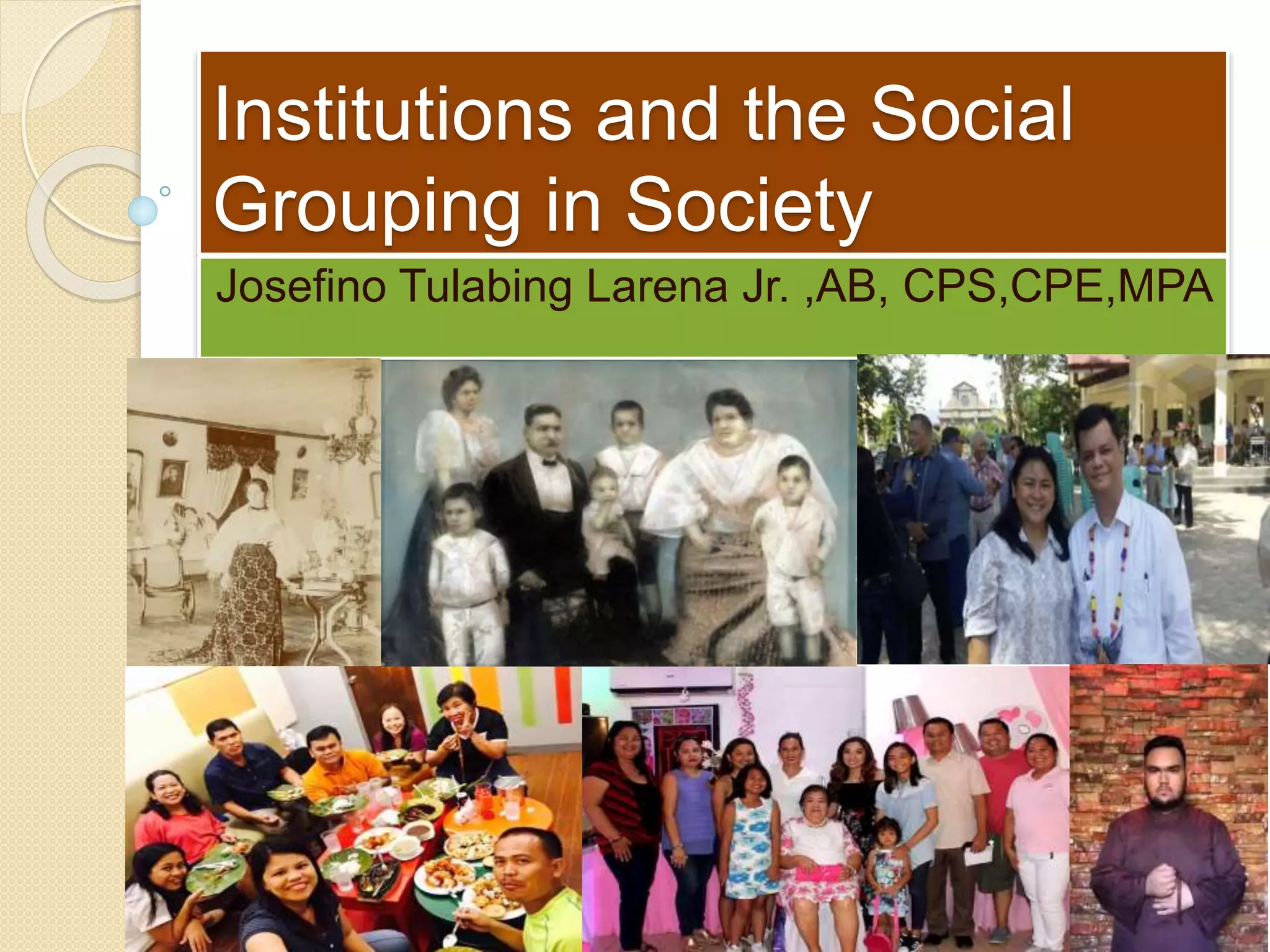
The Family
Education
Religion
Economic Institutions
Government as a Social Institution
The Family
The Family
The smallest social institution with the unique
function or producing and rearing the young.
It is the basic unit of Philippine society and
the educational system where the child
begins to learn his ABC.
The basic agent of socialization because it is
here where the individual develops values,
behaviors, and ways of life through
interaction with members of the family (Vega,
2004).
Characteristic of the Filipino Family
The family is closely knit and has strong
family ties.
The Filipino family is usually extended one
and therefore, big.
In the Filipino family, kinship ties are
extended to include the “compadre” or
sponsors.
Functions of the Family
1. Reproduction of the race and rearing of the
young.
2. Cultural transmission or enculturation.
3. Socialization of the child.
4. Providing affection and a sense of security.
5. Providing the environment for personality
development and the growth of self-concept in
relation to others.
6. Providing social status.
Kinds of Family
…according to STRUCTURE
b. Consanguine or Extended Family
-consist of married couple, their parents,
siblings, grandparents, uncles, aunts, and
cousins.
a.Conjugal or Nuclear Family
-the primary or elementary family
consisting of husband, wife and children.
…according to DESCENT
a. Patrilocal
-when the newly married couple lives with
the parents of the husband.
b. Matrilocal
- when the newly married couple lives with
the parents of the wife.
c. Neolocal
- when the newly married pair maintains a
separate household and live by themselves.
…according to AUTHORITY
a. Partriarchal
- when the father is considered the head
and plays a dominant role.
b. Matriarchal
- when the mother or female is the head
and makes the major decisions.
c. Equalitarian
- when both father and mother share in
making decisions and are equal in
authority.
EDUCATION
Education…
 a form of learning in which
the knowledge, skills, and habits of a group
of people are transferred from one
generation to the next through teaching,
training, or research.
What are the functions of Schools?
Mcnergney & Herbert(2001)
-described the school as first and foremost a
social institution, that is , an established
organization having an identifiable structure
and a set of functions meant to preserve and
extend social order.
School is the place for the contemplation of
reality, and our task as a teacher , in simplest
terms, is to show this reality to our students,
who are naturally eager about them.
Intellectual Purposes…
…to teach basic cognitive skills such as reading,
writing, and mathematics; to transmit specific
knowledge.
Political Purposes…
…to inculcate allegiance to the existing
political order(patriotism).
…to prepare citizens who will participate in the
political order.
…to assimilate diverse cultural groups into
political order.
…and to teach children the basic laws of
Social Purpose…
…to socialize children into the various
roles, behavior, and values of society.
Economic Purpose…
…to prepare students for their later
occupational roles, and to select, train,
and allocate individuals into the
division of labor.
Multiple Functions of Schools
 Technical- Economic
 Human/ Social
 Political
 Cultural
 Education
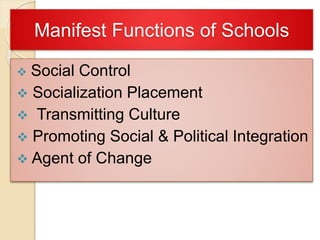
Manifest Functions of Schools
 Social Control
 Socialization Placement
 Transmitting Culture
 Promoting Social & Political Integration
 Agent of Change
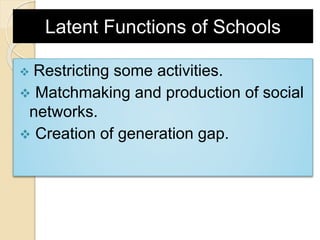
Latent Functions of Schools
 Restricting some activities.
 Matchmaking and production of social
networks.
 Creation of generation gap.
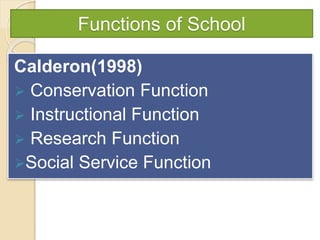
Functions of School
Calderon(1998)
 Conservation Function
 Instructional Function
 Research Function
Social Service Function
MARRIAGE
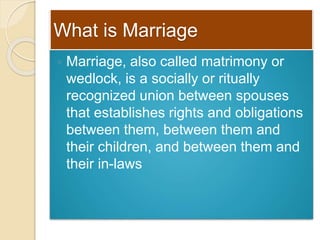
What is Marriage
 Marriage, also called matrimony or
wedlock, is a socially or ritually
recognized union between spouses
that establishes rights and obligations
between them, between them and
their children, and between them and
their in-laws
Monogamy
 Monogamy is a form of marriage in
which an individual has only one
spouse during their lifetime or at any
one time (serial monogamy)
Serial monogamy
 Governments that support monogamy,
may allow easy divorce. In a number
of Western countries divorce rates
approach 50%. Those who remarry do
so on average 3 times. Divorce and
remarriage can thus result in "serial
monogamy", i.e. multiple marriages
but only one legal spouse at a time.
Polygamy
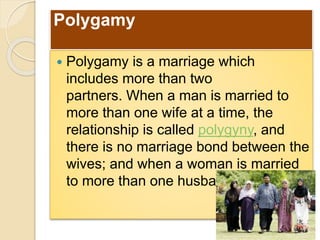
 Polygamy is a marriage which
includes more than two
partners. When a man is married to
more than one wife at a time, the
relationship is called polygyny, and
there is no marriage bond between the
wives; and when a woman is married
to more than one husband at a time,
Polyandry
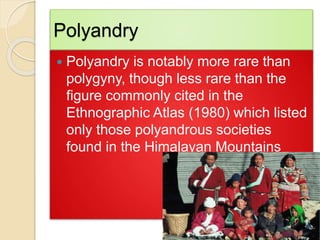
 Polyandry is notably more rare than
polygyny, though less rare than the
figure commonly cited in the
Ethnographic Atlas (1980) which listed
only those polyandrous societies
found in the Himalayan Mountains
Plural marriage
 Group marriage (also known as multi-
lateral marriage) is a form of
polyamory in which more than two
persons form a family unit, with all the
members of the group marriage being
considered to be married to all the
other members of the group marriage,
and all members of the marriage
share parental responsibility for any
children arising from the marriage
Child marriage
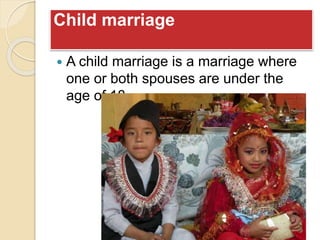
 A child marriage is a marriage where
one or both spouses are under the
age of 18
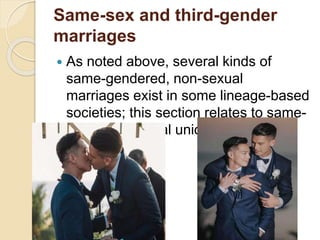
Same-sex and third-gender
marriages
 As noted above, several kinds of
same-gendered, non-sexual
marriages exist in some lineage-based
societies; this section relates to same-
gendered sexual unions.
RELIGION
What is RELIGION?
 is a system of beliefs and rituals that
serves to bind people together through
shared worship, thereby creating a
social group.
 set of beliefs and practices that pertain
to a sacred or supernatural realm that
guides human behavior and gives
meaning to life among a community of
believers.
Characteristics of Religion
 Belief in a deity.
 A doctrine of salvation.
 A code of conduct.
 Religious rituals.
Functions of Religion
Calderon(1998)
1. Serves as a means of social control.
2. Exerts a great influence upon personality
development.
3. Allays fear of unknown.
4. Explains events or situations which are
beyond comprehension of man.
5. Gives man comfort, strength and hope in
times of crisis and despair.
6. It preserves and transmit
knowledge, skills, spiritual, and cultural
values and practices.
7. It serves as an instrument of
change.
8. Promotes closeness, love,
cooperation, friendliness and
helpfulness.
9. Alleviates sufferings from major
calamities.
10. It provides hope for a blissful life
Three Elements of Religion
 Sacred and profane.
 Legitimation of norms.
 Rituals.
 Religious community.
Economic
Institutions
Microeconomics
 Concerned with the specific economic units
of parts that makes an economic system
and the relationship between those parts.
 Emphasis is placed on understanding the
behavior of individual firms, industries,
households, and ways in which such
entities interact.
(Spencer, 1980; Javier,2002)
Macroeconomics
 Concerned with the economy as a whole,
or large segments of it.
 It focuses on such problems as the role of
unemployment, the changing level of
prices, the nation’s total output of goods
and services, and the ways in which
government raises and spends money.
GOVERNMENT
as a SOCIAL
INSTITUTION
Government…
 Is the institution which solves conflicts that
are public in nature and involve more than a
few people.
 The SC defines government as the
institution by which an independent society
makes and carries out those rules of action
which are necessary to enable men to live
in a social state, or which are imposed upon
the people for that society by those who
possess the power or authority of
prescribing them.
Three Branches of Government
Executive
Legislative
Judicial
Thanks &
God
bless

Social Institutions in Society

  • 1.
    Institutions and theSocial Grouping in Society Josefino Tulabing Larena Jr. ,AB, CPS,CPE,MPA
  • 2.
    Learning Outcomes  Developa comprehensive understanding of the meaning ,characteristics and nature of social institutions  Explain the classification and relevance of social institutions  Discuss the institutional system s a total integration in the culture
  • 3.
    What is SocialInstitution? Is a social structures and social mechanisms of social order and cooperation that govern the behavior of its members. Is a group of social positions, connected by social relations, performing a social role. Any institution in a society that works to socialize the group of people in it.
  • 4.
    Characteristics of anInstitution Palispis ( 2015) Institutions are purposive. Relatively permanent in content. Institutions are structured. Institutions are a unified structure. Institutions are necessarily value-laden.
  • 5.
    Functions of anInstitutions 1. Institutions simplify social behavior for the individual person. 2. Provide ready-made forms of social relations and social roles for individual. 3. Act as agencies of coordination and stability for the total culture. 4. Control behavior.
  • 6.
    Major Social Institutions TheFamily Education Religion Economic Institutions Government as a Social Institution
  • 7.
  • 8.
    The Family The smallestsocial institution with the unique function or producing and rearing the young. It is the basic unit of Philippine society and the educational system where the child begins to learn his ABC. The basic agent of socialization because it is here where the individual develops values, behaviors, and ways of life through interaction with members of the family (Vega, 2004).
  • 9.
    Characteristic of theFilipino Family The family is closely knit and has strong family ties. The Filipino family is usually extended one and therefore, big. In the Filipino family, kinship ties are extended to include the “compadre” or sponsors.
  • 10.
    Functions of theFamily 1. Reproduction of the race and rearing of the young. 2. Cultural transmission or enculturation. 3. Socialization of the child. 4. Providing affection and a sense of security. 5. Providing the environment for personality development and the growth of self-concept in relation to others. 6. Providing social status.
  • 11.
  • 12.
    …according to STRUCTURE b.Consanguine or Extended Family -consist of married couple, their parents, siblings, grandparents, uncles, aunts, and cousins. a.Conjugal or Nuclear Family -the primary or elementary family consisting of husband, wife and children.
  • 13.
    …according to DESCENT a.Patrilocal -when the newly married couple lives with the parents of the husband. b. Matrilocal - when the newly married couple lives with the parents of the wife. c. Neolocal - when the newly married pair maintains a separate household and live by themselves.
  • 14.
    …according to AUTHORITY a.Partriarchal - when the father is considered the head and plays a dominant role. b. Matriarchal - when the mother or female is the head and makes the major decisions. c. Equalitarian - when both father and mother share in making decisions and are equal in authority.
  • 16.
  • 17.
    Education…  a formof learning in which the knowledge, skills, and habits of a group of people are transferred from one generation to the next through teaching, training, or research.
  • 18.
    What are thefunctions of Schools? Mcnergney & Herbert(2001) -described the school as first and foremost a social institution, that is , an established organization having an identifiable structure and a set of functions meant to preserve and extend social order. School is the place for the contemplation of reality, and our task as a teacher , in simplest terms, is to show this reality to our students, who are naturally eager about them.
  • 19.
    Intellectual Purposes… …to teachbasic cognitive skills such as reading, writing, and mathematics; to transmit specific knowledge. Political Purposes… …to inculcate allegiance to the existing political order(patriotism). …to prepare citizens who will participate in the political order. …to assimilate diverse cultural groups into political order. …and to teach children the basic laws of
  • 20.
    Social Purpose… …to socializechildren into the various roles, behavior, and values of society. Economic Purpose… …to prepare students for their later occupational roles, and to select, train, and allocate individuals into the division of labor.
  • 21.
    Multiple Functions ofSchools  Technical- Economic  Human/ Social  Political  Cultural  Education
  • 22.
    Manifest Functions ofSchools  Social Control  Socialization Placement  Transmitting Culture  Promoting Social & Political Integration  Agent of Change
  • 23.
    Latent Functions ofSchools  Restricting some activities.  Matchmaking and production of social networks.  Creation of generation gap.
  • 24.
    Functions of School Calderon(1998) Conservation Function  Instructional Function  Research Function Social Service Function
  • 25.
  • 26.
    What is Marriage Marriage, also called matrimony or wedlock, is a socially or ritually recognized union between spouses that establishes rights and obligations between them, between them and their children, and between them and their in-laws
  • 27.
    Monogamy  Monogamy isa form of marriage in which an individual has only one spouse during their lifetime or at any one time (serial monogamy)
  • 28.
    Serial monogamy  Governmentsthat support monogamy, may allow easy divorce. In a number of Western countries divorce rates approach 50%. Those who remarry do so on average 3 times. Divorce and remarriage can thus result in "serial monogamy", i.e. multiple marriages but only one legal spouse at a time.
  • 29.
    Polygamy  Polygamy isa marriage which includes more than two partners. When a man is married to more than one wife at a time, the relationship is called polygyny, and there is no marriage bond between the wives; and when a woman is married to more than one husband at a time,
  • 30.
    Polyandry  Polyandry isnotably more rare than polygyny, though less rare than the figure commonly cited in the Ethnographic Atlas (1980) which listed only those polyandrous societies found in the Himalayan Mountains
  • 31.
    Plural marriage  Groupmarriage (also known as multi- lateral marriage) is a form of polyamory in which more than two persons form a family unit, with all the members of the group marriage being considered to be married to all the other members of the group marriage, and all members of the marriage share parental responsibility for any children arising from the marriage
  • 32.
    Child marriage  Achild marriage is a marriage where one or both spouses are under the age of 18
  • 33.
    Same-sex and third-gender marriages As noted above, several kinds of same-gendered, non-sexual marriages exist in some lineage-based societies; this section relates to same- gendered sexual unions.
  • 34.
  • 35.
    What is RELIGION? is a system of beliefs and rituals that serves to bind people together through shared worship, thereby creating a social group.  set of beliefs and practices that pertain to a sacred or supernatural realm that guides human behavior and gives meaning to life among a community of believers.
  • 36.
    Characteristics of Religion Belief in a deity.  A doctrine of salvation.  A code of conduct.  Religious rituals.
  • 37.
    Functions of Religion Calderon(1998) 1.Serves as a means of social control. 2. Exerts a great influence upon personality development. 3. Allays fear of unknown. 4. Explains events or situations which are beyond comprehension of man. 5. Gives man comfort, strength and hope in times of crisis and despair.
  • 38.
    6. It preservesand transmit knowledge, skills, spiritual, and cultural values and practices. 7. It serves as an instrument of change. 8. Promotes closeness, love, cooperation, friendliness and helpfulness. 9. Alleviates sufferings from major calamities. 10. It provides hope for a blissful life
  • 39.
    Three Elements ofReligion  Sacred and profane.  Legitimation of norms.  Rituals.  Religious community.
  • 40.
  • 41.
    Microeconomics  Concerned withthe specific economic units of parts that makes an economic system and the relationship between those parts.  Emphasis is placed on understanding the behavior of individual firms, industries, households, and ways in which such entities interact. (Spencer, 1980; Javier,2002)
  • 42.
    Macroeconomics  Concerned withthe economy as a whole, or large segments of it.  It focuses on such problems as the role of unemployment, the changing level of prices, the nation’s total output of goods and services, and the ways in which government raises and spends money.
  • 43.
  • 44.
    Government…  Is theinstitution which solves conflicts that are public in nature and involve more than a few people.  The SC defines government as the institution by which an independent society makes and carries out those rules of action which are necessary to enable men to live in a social state, or which are imposed upon the people for that society by those who possess the power or authority of prescribing them.
  • 45.
    Three Branches ofGovernment Executive Legislative Judicial
  • 47.