SOC 451
Globalization of Culture and
Communication
Asst. Prof. Fatma Altınbaş Sarıgül
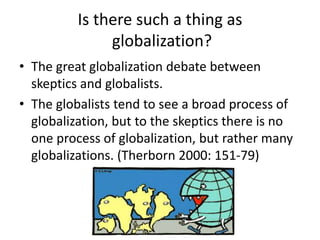
Is there such a thing as
globalization?
• The great globalization debate between
skeptics and globalists.
• The globalists tend to see a broad process of
globalization, but to the skeptics there is no
one process of globalization, but rather many
globalizations. (Therborn 2000: 151-79)
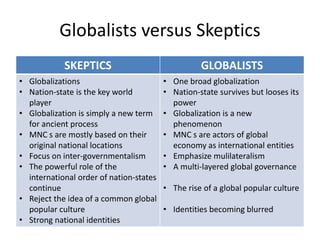
Globalists versus Skeptics
SKEPTICS GLOBALISTS
• Globalizations
• Nation-state is the key world
player
• Globalization is simply a new term
for ancient process
• MNC s are mostly based on their
original national locations
• Focus on inter-governmentalism
• The powerful role of the
international order of nation-states
continue
• Reject the idea of a common global
popular culture
• Strong national identities
• One broad globalization
• Nation-state survives but looses its
power
• Globalization is a new
phenomenon
• MNC s are actors of global
economy as international entities
• Emphasize mulilateralism
• A multi-layered global governance
• The rise of a global popular culture
• Identities becoming blurred
When did globalization begin?
Five different ideologies about the origin of globalization.
1. Hardwired: Globalization stems from a basic human
urge for a better life.
2. Cycles: Globalization goes on cycles and there
happened to be other globalizations in the past.
3. Epochs: There are set of epochs for explaining the
origins of globalization. (read pg 37-38)
4. Events: There are specific events that can be seen as
the origin of globalization. (read pg39)
5. Momentous changes: US becoming global leader
after WWII, the emergence of MNCs., The end of cold
war (demise of Soviet Union)
Globalizations
• Economic
• Political
• Cultural
• Religion
• Science
• Health and Medicine
• Sport
• Education
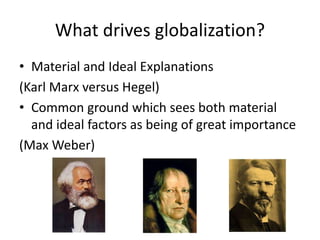
What drives globalization?
• Material and Ideal Explanations
(Karl Marx versus Hegel)
• Common ground which sees both material
and ideal factors as being of great importance
(Max Weber)
Is globalization inexorable?
• Widespread view in academic work:
Globalization is inevitable.
• While it is true that people may often be
overwhelmed by such large-scale changes,
they always retain the ability to act singly and
collectively to modify, if not prevent, such
changes. (Ritzer, 49)
• Globalization from above-Globalization from below
Process that is created and
disseminated by large-scale forces,
especially in the North and imposed
especially on the South
Individual actors or groups of people,
opposing and acting to oppose
globalization.
Globaphilia and Globaphobia
• Globaphilia: Emphasis on the positive aspects
of globalization, especially greater economic
success and the spread of democracy
• Globaphobia: Emphasis on the negative
aspects of globalization, especially for the less
well-off parts of the globe.
• Globaphilia supporters believe that; the
‘losers’ (The South part of the World) will also
have economic gains if they become patient,
globalization increase democracy, the spread
of civil society occurs,
Globaphilia and Globaphobia
• Globaphobia supporters believe that;
capitalism is the driven ideology of
globalization, immigration and outsourcing
effects life standards of worker class
negatively in US and Europe, globalization
works for the benefit of the North and the
elites, increases American hegemony, serves
the benefits of the ‘haves’ while
disadvantaging the ‘have nots’, it leads to
greater global inequality.
Globalization, as a problem..
• The source of the problem is the mere
existence of nearly 200 sovereign states in the
world today. More important are the
differences in those states in terms of how
well they are run, especially how well they run
the economy. It is this difference among and
between states that is the source of inequality
among individuals across the globe.
(Ritzer, 55)
• How is globalization different from
modernity? Explain the continuing debate
over that issue?
Soc 451, 2nd class
Soc 451, 2nd class
Soc 451, 2nd class
Soc 451, 2nd class

Soc 451, 2nd class

  • 1.
    SOC 451 Globalization ofCulture and Communication Asst. Prof. Fatma Altınbaş Sarıgül
  • 2.
    Is there sucha thing as globalization? • The great globalization debate between skeptics and globalists. • The globalists tend to see a broad process of globalization, but to the skeptics there is no one process of globalization, but rather many globalizations. (Therborn 2000: 151-79)
  • 3.
    Globalists versus Skeptics SKEPTICSGLOBALISTS • Globalizations • Nation-state is the key world player • Globalization is simply a new term for ancient process • MNC s are mostly based on their original national locations • Focus on inter-governmentalism • The powerful role of the international order of nation-states continue • Reject the idea of a common global popular culture • Strong national identities • One broad globalization • Nation-state survives but looses its power • Globalization is a new phenomenon • MNC s are actors of global economy as international entities • Emphasize mulilateralism • A multi-layered global governance • The rise of a global popular culture • Identities becoming blurred
  • 4.
    When did globalizationbegin? Five different ideologies about the origin of globalization. 1. Hardwired: Globalization stems from a basic human urge for a better life. 2. Cycles: Globalization goes on cycles and there happened to be other globalizations in the past. 3. Epochs: There are set of epochs for explaining the origins of globalization. (read pg 37-38) 4. Events: There are specific events that can be seen as the origin of globalization. (read pg39) 5. Momentous changes: US becoming global leader after WWII, the emergence of MNCs., The end of cold war (demise of Soviet Union)
  • 5.
    Globalizations • Economic • Political •Cultural • Religion • Science • Health and Medicine • Sport • Education
  • 6.
    What drives globalization? •Material and Ideal Explanations (Karl Marx versus Hegel) • Common ground which sees both material and ideal factors as being of great importance (Max Weber)
  • 7.
    Is globalization inexorable? •Widespread view in academic work: Globalization is inevitable. • While it is true that people may often be overwhelmed by such large-scale changes, they always retain the ability to act singly and collectively to modify, if not prevent, such changes. (Ritzer, 49) • Globalization from above-Globalization from below Process that is created and disseminated by large-scale forces, especially in the North and imposed especially on the South Individual actors or groups of people, opposing and acting to oppose globalization.
  • 8.
    Globaphilia and Globaphobia •Globaphilia: Emphasis on the positive aspects of globalization, especially greater economic success and the spread of democracy • Globaphobia: Emphasis on the negative aspects of globalization, especially for the less well-off parts of the globe. • Globaphilia supporters believe that; the ‘losers’ (The South part of the World) will also have economic gains if they become patient, globalization increase democracy, the spread of civil society occurs,
  • 9.
    Globaphilia and Globaphobia •Globaphobia supporters believe that; capitalism is the driven ideology of globalization, immigration and outsourcing effects life standards of worker class negatively in US and Europe, globalization works for the benefit of the North and the elites, increases American hegemony, serves the benefits of the ‘haves’ while disadvantaging the ‘have nots’, it leads to greater global inequality.
  • 10.
    Globalization, as aproblem.. • The source of the problem is the mere existence of nearly 200 sovereign states in the world today. More important are the differences in those states in terms of how well they are run, especially how well they run the economy. It is this difference among and between states that is the source of inequality among individuals across the globe. (Ritzer, 55)
  • 11.
    • How isglobalization different from modernity? Explain the continuing debate over that issue?