Globalizati
                     on
International Marketing 4th assignment
Globalization

By:
Mohamed Khalifa Ibrahim
ESLSCA – MBA – 28 May 2011
What is globalization?

 • Is it the integration of economic, political, and cultural systems
  across the globe?


 • Or is it Americanization of world culture and United States
  dominance of world affairs?
  Or perhaps, the "McDonaldization," of the world


 • Is globalization a force for economic growth, prosperity, and
  democratic freedom?


 • Or is it a force for environmental devastation, exploitation of
  the developing world, and suppression of human rights?
Which is the real world?
Definition

Definitions are categorized to three main frames
    1. The positive frame points to the potential gains and
        benefits of globalization.
    2. The neutral frame portrays globalization as a natural,
        evolutionary, and largely inevitable development. This
        discourse, which is associated with the financial
        community, avoids making moral judgments.
    3. The negative frame points out the increasing potential for
        economic crisis, the threat to the livelihoods of workers,
        and the growing income inequality caused by
        globalization. This frame also includes discourse which is
        primarily concerned with the negative impact of
        globalization in the third World.
Definition

 " Globalization is a widely-used term that can be defined in a number of different
 ways, but when used in an economic context, it refers to the reduction and
 removal of barriers between national borders in order to facilitate the flow of
 goods, capital, services and labor.
                                United Nations Economic and Social Commission for Western Asia “ESCWA”


  “Globalization refers to the growing economic interdependence of countries
 worldwide through the increasing volume and variety of cross border transactions
 in goods and services and of international capital flows, and also through the
 more rapid and widespread diffusion of technology.”
                                                                            International Monetary Fund

 Globalization is the acceleration and intensification of interaction and integration
 among the people, companies, and governments of different nations.
                                                               The American Forum for Global Education


 “Globalization is a process that encompasses the causes, course, and
 consequences of transnational and transcultural integration of human and non-
 human activities.”
                                                                      Geneva Centre for Security Policy
Definition

“Globalization can be defined as a set of economic, social, technological, political
and cultural structures and processes arising from the changing character of the
production, consumption and trade of goods and assets that comprise the base of
the international political economy.”

                                 United Nations Educational, Scientific and Cultural Organization (UNESCO)


“Globalization – the growing integration of economies and societies around the
world.”
                                                                                    The World Bank Group


 “Globalization refers above all to a dynamic and multidimensional process of
economic integration whereby national resources become more and more
internationally mobile while national economies become increasingly
interdependent.”
                                   The Organization for Economic Co-operation and Development (OECD)
Definition

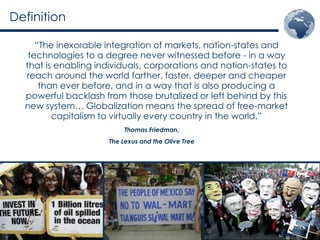
     “The inexorable integration of markets, nation-states and
   technologies to a degree never witnessed before - in a way
  that is enabling individuals, corporations and nation-states to
  reach around the world farther, faster, deeper and cheaper
      than ever before, and in a way that is also producing a
  powerful backlash from those brutalized or left behind by this
  new system… Globalization means the spread of free-market
         capitalism to virtually every country in the world.”
                           Thomas Friedman,
                      The Lexus and the Olive Tree
Globalization encompasses

    •   Internationalization (trade & investment)
    •   Liberalization (freeing markets)
    •   Universalization (cultural interchange)
    •   Westernization (Western cultural dominance)

Sources of Globalization
    •   Internationalization of Economic Activity (Trade & Finance)
    •   Global Liberalization (Domestic and International )
    •   Technological Changes (IT Revolution in speed and Cost)
    •   Improvements in Transportation (Containerized Shipping)
    •   Globalized Production Structures (Stateless Corporations)

                                                                 Pro
                                           Anti groups are       globalization
    Globalization      Globalization
1                   2 is relentless    3   fighting          4   has facts to
    is inevitable                          physically only       back up that it
                                                                 is a good thing.
Effect of Globalization

 • Industrial – emergence of worldwide production markets and broader access
   to a range of foreign products for consumers and companies. Particularly
   movement of material and goods between and within national boundaries.
   International trade in manufactured goods has increased more than 100 times
   (from $95 billion to $12 trillion) since 1955. China's trade with Africa rose
   sevenfold during 2000–07 alone.
 • Financial – emergence of worldwide financial markets and better access to
   external financing for borrowers. By the early part of the 21st century more
   than $1.5 trillion in national currencies were traded daily to support the
   expanded levels of trade and investment.
 • Economic – realization of a global common market, based on the freedom of
   exchange of goods and capital.
 • Job Market – competition in a global job market. In the past, the economic
   fate of workers was tied to the fate of national economies. With the advent of
   the information age and improvements in communication, this is no longer
   the case.
Effect of Globalization

Political – some use "globalization" to mean the creation of a world government
which regulates the relationships among governments and guarantees the rights
arising from social and economic globalization. Politically, the United States has
enjoyed a position of power among the world powers, in part because of its
strong and wealthy economy.

Cultural – growth of cross-cultural contacts; advent of new categories of
consciousness and identities which embodies cultural diffusion, the desire to
increase one's standard of living and enjoy foreign products and ideas, adopt
new technology and practices, and participate in a "world culture".

Social – development of the system of non-governmental organizations as main
agents of global public policy, including humanitarian aid and developmental
efforts.
Effect of Globalization

Technical - Development of a Global Information System, global
telecommunications infrastructure and greater trans-border data flow, using such
technologies as the Internet, communication satellites, submarine fiber optic
cable, and wireless telephones. Increase in the number of standards applied
globally; e.g., copyright laws, patents and world trade agreements.
Legal/Ethical - The creation of the international criminal court and international
justice movements. Crime importation and raising awareness of global crime-
fighting efforts and cooperation. The emergence of Global administrative law.
Religious - The spread and increased interrelations of various religious groups,
ideas, and practices and their ideas of the meanings and values of particular
spaces and the anti-islam movements in the west.
Pro-globalization

Theories suggest that globalization leads to efficient use of
resources and benefits all who are involved.

According to libertarians, globalization will help the whole world
to deal with crises like unemployment and poverty. It will help us
to raise the global economy only when the involved power blocks
have mutual trust and respect for each other’s opinion.
Globalization and democracy should go hand in hand. It should
be pure business with no colonialist designs. The way we have
developed in the last 10 years, globalization seems to have given
us good returns.
Globalization has made the life of the third world citizen
completely a different story. There are so many foreign
companies that have made way to Orient and have made India
a brand name all over the world.
Pro-globalization

The pros of Globalization are many and they are as follows:
 Now there is a worldwide market for the companies and for the
  people there is more access to products of different countries.
 There is a steady cash flow into the developing countries, which
  gradually decrease the dollar difference.
 Due to the presence of a worldwide market, there is an
  increase in the production sector and there are lots of options
  for the companies now.
 Gradually there is a world power that is being created instead
  of compartmentalized power sectors. Politics is merging and
  decisions that are being taken, are actually beneficial for
  people allover the world.
 There is more influx of information between two countries, which
  do not have anything in common between them.
Pro-globalization

 There is cultural intermingling and each other is trying to know
  about the other’s cultural preferences and in the process of
  doing so, we are actually coming across things that we like and
  in the course of time adopt it.
 Since we share financial interests, corporate and governments
  are trying to sort out ecological problems for each other.
 Socially we have become more open and tolerant towards
  each other and they who live in the other part of the world are
  not aliens as we always thought. There are examples like now
  Indian girls work in call centers and work nights, which was a
  taboo even two years back. We are celebrating Valentine’s
  Day, watching the Idol series, Fear factor, the Indian version Big
  Brother.
 There is a lot of technological development that we have
  undergone over the years. There are fewer brain drains since
  Asians are working in their own country though for a foreign
  company but are earning foreign exchange for their country.
Anti- Globalization

 There are cons which are as follows:
 It is true that Europeans are losing jobs and that is posing a
  problem for them since the companies are outsourcing work to
  the Asian countries since the cost of labor is low and profits the
  company considerably.
 There is immense pressure on the employed Europeans who are
  always under the threat of the business being outsourced.
 Corporates are building up units in other countries equally well
  equipped as they have done at their own country, thus
  transferring the quality to other countries.
 There are some experts who think that globalization; along with
  the positive aspects is also leading to the incursion of negatives
  like communicable diseases and social degeneration.
Anti- Globalization

 There is also a threat of corporates ruling the world because
  there is a lot of power, which is invested in them due to
  globalization.
 For nations that are at the receiver’s end are also giving up the
  reins in the ends of a foreign company which might again lead
  to a sophisticated form of colonization.
 Millions of others fear losing their jobs, especially at those
  companies operating under competitive pressure.
 Workers face pay-cut demands from employers, which often
  threaten to export jobs.
 Service and white-collar jobs are increasingly vulnerable to
  operations moving offshore.
 U.S. employees can lose their comparative advantage when
  companies build advanced factories in low-wage countries,
  making them as productive as those at home.
Thank you

Globalization

  • 1.
    Globalizati on International Marketing 4th assignment Globalization By: Mohamed Khalifa Ibrahim ESLSCA – MBA – 28 May 2011
  • 2.
    What is globalization? • Is it the integration of economic, political, and cultural systems across the globe? • Or is it Americanization of world culture and United States dominance of world affairs? Or perhaps, the "McDonaldization," of the world • Is globalization a force for economic growth, prosperity, and democratic freedom? • Or is it a force for environmental devastation, exploitation of the developing world, and suppression of human rights?
  • 3.
    Which is thereal world?
  • 4.
    Definition Definitions are categorizedto three main frames 1. The positive frame points to the potential gains and benefits of globalization. 2. The neutral frame portrays globalization as a natural, evolutionary, and largely inevitable development. This discourse, which is associated with the financial community, avoids making moral judgments. 3. The negative frame points out the increasing potential for economic crisis, the threat to the livelihoods of workers, and the growing income inequality caused by globalization. This frame also includes discourse which is primarily concerned with the negative impact of globalization in the third World.
  • 5.
    Definition " Globalizationis a widely-used term that can be defined in a number of different ways, but when used in an economic context, it refers to the reduction and removal of barriers between national borders in order to facilitate the flow of goods, capital, services and labor. United Nations Economic and Social Commission for Western Asia “ESCWA” “Globalization refers to the growing economic interdependence of countries worldwide through the increasing volume and variety of cross border transactions in goods and services and of international capital flows, and also through the more rapid and widespread diffusion of technology.” International Monetary Fund Globalization is the acceleration and intensification of interaction and integration among the people, companies, and governments of different nations. The American Forum for Global Education “Globalization is a process that encompasses the causes, course, and consequences of transnational and transcultural integration of human and non- human activities.” Geneva Centre for Security Policy
  • 6.
    Definition “Globalization can bedefined as a set of economic, social, technological, political and cultural structures and processes arising from the changing character of the production, consumption and trade of goods and assets that comprise the base of the international political economy.” United Nations Educational, Scientific and Cultural Organization (UNESCO) “Globalization – the growing integration of economies and societies around the world.” The World Bank Group “Globalization refers above all to a dynamic and multidimensional process of economic integration whereby national resources become more and more internationally mobile while national economies become increasingly interdependent.” The Organization for Economic Co-operation and Development (OECD)
  • 7.
    Definition “The inexorable integration of markets, nation-states and technologies to a degree never witnessed before - in a way that is enabling individuals, corporations and nation-states to reach around the world farther, faster, deeper and cheaper than ever before, and in a way that is also producing a powerful backlash from those brutalized or left behind by this new system… Globalization means the spread of free-market capitalism to virtually every country in the world.” Thomas Friedman, The Lexus and the Olive Tree
  • 8.
    Globalization encompasses • Internationalization (trade & investment) • Liberalization (freeing markets) • Universalization (cultural interchange) • Westernization (Western cultural dominance) Sources of Globalization • Internationalization of Economic Activity (Trade & Finance) • Global Liberalization (Domestic and International ) • Technological Changes (IT Revolution in speed and Cost) • Improvements in Transportation (Containerized Shipping) • Globalized Production Structures (Stateless Corporations) Pro Anti groups are globalization Globalization Globalization 1 2 is relentless 3 fighting 4 has facts to is inevitable physically only back up that it is a good thing.
  • 9.
    Effect of Globalization • Industrial – emergence of worldwide production markets and broader access to a range of foreign products for consumers and companies. Particularly movement of material and goods between and within national boundaries. International trade in manufactured goods has increased more than 100 times (from $95 billion to $12 trillion) since 1955. China's trade with Africa rose sevenfold during 2000–07 alone. • Financial – emergence of worldwide financial markets and better access to external financing for borrowers. By the early part of the 21st century more than $1.5 trillion in national currencies were traded daily to support the expanded levels of trade and investment. • Economic – realization of a global common market, based on the freedom of exchange of goods and capital. • Job Market – competition in a global job market. In the past, the economic fate of workers was tied to the fate of national economies. With the advent of the information age and improvements in communication, this is no longer the case.
  • 10.
    Effect of Globalization Political– some use "globalization" to mean the creation of a world government which regulates the relationships among governments and guarantees the rights arising from social and economic globalization. Politically, the United States has enjoyed a position of power among the world powers, in part because of its strong and wealthy economy. Cultural – growth of cross-cultural contacts; advent of new categories of consciousness and identities which embodies cultural diffusion, the desire to increase one's standard of living and enjoy foreign products and ideas, adopt new technology and practices, and participate in a "world culture". Social – development of the system of non-governmental organizations as main agents of global public policy, including humanitarian aid and developmental efforts.
  • 11.
    Effect of Globalization Technical- Development of a Global Information System, global telecommunications infrastructure and greater trans-border data flow, using such technologies as the Internet, communication satellites, submarine fiber optic cable, and wireless telephones. Increase in the number of standards applied globally; e.g., copyright laws, patents and world trade agreements. Legal/Ethical - The creation of the international criminal court and international justice movements. Crime importation and raising awareness of global crime- fighting efforts and cooperation. The emergence of Global administrative law. Religious - The spread and increased interrelations of various religious groups, ideas, and practices and their ideas of the meanings and values of particular spaces and the anti-islam movements in the west.
  • 12.
    Pro-globalization Theories suggest thatglobalization leads to efficient use of resources and benefits all who are involved. According to libertarians, globalization will help the whole world to deal with crises like unemployment and poverty. It will help us to raise the global economy only when the involved power blocks have mutual trust and respect for each other’s opinion. Globalization and democracy should go hand in hand. It should be pure business with no colonialist designs. The way we have developed in the last 10 years, globalization seems to have given us good returns. Globalization has made the life of the third world citizen completely a different story. There are so many foreign companies that have made way to Orient and have made India a brand name all over the world.
  • 13.
    Pro-globalization The pros ofGlobalization are many and they are as follows:  Now there is a worldwide market for the companies and for the people there is more access to products of different countries.  There is a steady cash flow into the developing countries, which gradually decrease the dollar difference.  Due to the presence of a worldwide market, there is an increase in the production sector and there are lots of options for the companies now.  Gradually there is a world power that is being created instead of compartmentalized power sectors. Politics is merging and decisions that are being taken, are actually beneficial for people allover the world.  There is more influx of information between two countries, which do not have anything in common between them.
  • 14.
    Pro-globalization  There iscultural intermingling and each other is trying to know about the other’s cultural preferences and in the process of doing so, we are actually coming across things that we like and in the course of time adopt it.  Since we share financial interests, corporate and governments are trying to sort out ecological problems for each other.  Socially we have become more open and tolerant towards each other and they who live in the other part of the world are not aliens as we always thought. There are examples like now Indian girls work in call centers and work nights, which was a taboo even two years back. We are celebrating Valentine’s Day, watching the Idol series, Fear factor, the Indian version Big Brother.  There is a lot of technological development that we have undergone over the years. There are fewer brain drains since Asians are working in their own country though for a foreign company but are earning foreign exchange for their country.
  • 15.
    Anti- Globalization  Thereare cons which are as follows:  It is true that Europeans are losing jobs and that is posing a problem for them since the companies are outsourcing work to the Asian countries since the cost of labor is low and profits the company considerably.  There is immense pressure on the employed Europeans who are always under the threat of the business being outsourced.  Corporates are building up units in other countries equally well equipped as they have done at their own country, thus transferring the quality to other countries.  There are some experts who think that globalization; along with the positive aspects is also leading to the incursion of negatives like communicable diseases and social degeneration.
  • 16.
    Anti- Globalization  Thereis also a threat of corporates ruling the world because there is a lot of power, which is invested in them due to globalization.  For nations that are at the receiver’s end are also giving up the reins in the ends of a foreign company which might again lead to a sophisticated form of colonization.  Millions of others fear losing their jobs, especially at those companies operating under competitive pressure.  Workers face pay-cut demands from employers, which often threaten to export jobs.  Service and white-collar jobs are increasingly vulnerable to operations moving offshore.  U.S. employees can lose their comparative advantage when companies build advanced factories in low-wage countries, making them as productive as those at home.
  • 17.