GLOBAL POLITICAL
STRUCTURES AND PROCESSES
Prepared by:
MR. ANTONIO T. DELGADO
LESSON OUTLINE
I. On Political Flows
II. The Nation-State
III. Threats to the Nation-State
IV. In Defense of the Nation-State
V. “Imagined Community”
VI. Changes in Global Nation-State Relations
VII. United Nations
VIII.Global Governance
IX. Civil Society
2
On Political Flows
Political Flows
▪Global flow of people poses a direct threat to the nation-state
▪Dwindling oil and water supplies threaten to lead to riots
▪Inability of the nation-state to control economic flows
dominated by MNCs
▪Environmental problems are very likely to be destabilizing
politically
4
Political Flows
▪Borderless diseases pose a danger to political structures.
▪War, especially those on the losing side.
▪Global inequalities, especially the profound and growing
North–South split
▪Terrorism
5
The Nation-State
7
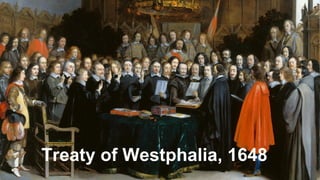
Treaty of Westphalia, 1648
The Nation-State
▪Treaty of Westphalia - instituted an international system
which recognized sovereign states at its core. The treaty was
widely interpreted as giving states the right to political self-
determination, to be considered equal from a legal point of
view, and as prohibiting them from intervening in the affairs of
other sovereign states.
8
The Nation-State
▪The nation-state has two basic components – “nation” and
“state.”
▪nation – refers to a social group that is linked through
common descent, culture, language, or territorial contiguity
▪national identity – the fluid and dynamic form of collective
identity, founded upon a community’s subjective belief that
the members of the community share a set of characteristics
that make them different from other groups
9
10
The Nation-State
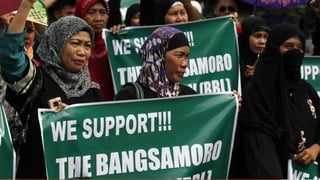
▪nationalism – a doctrine and/or political movement that
seeks to make the nation the basis of a political structure,
especially a state.
▪state – organizational structure outside other socioeconomic
hierarchies with relatively autonomous office-holders.
▫Four elements: population, territory, government, sovereignty
11
The Nation-State
▪nation-state – can therefore be seen as an integration of the
sub-groups that define themselves as a nation with the
organizational structure of the state.
12
Threats to the Nation-State
A. Global Flows
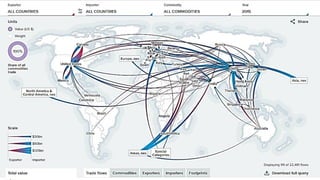
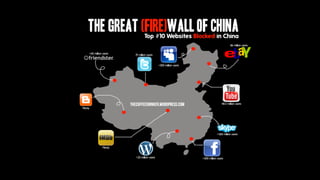
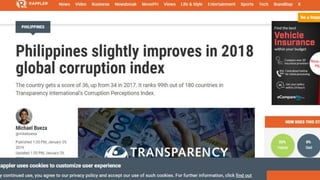
▪The uncomfortable truth is that, in terms of the global
economy, nation-states have become little more than bit
actors. (Ohmae, 1996)
14
15
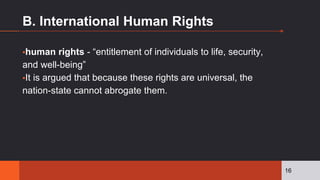
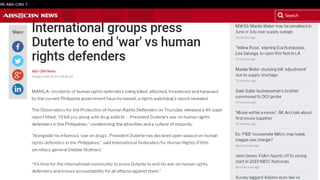
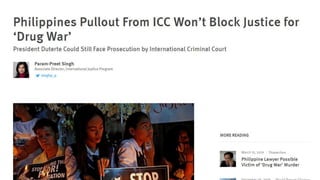
B. International Human Rights
▪human rights - “entitlement of individuals to life, security,
and well-being”
▪It is argued that because these rights are universal, the
nation-state cannot abrogate them.
16
17
18
C. “Shadows of War”
▪Shadows of war - “the complex sets of cross-state
economic and political linkages that move outside formally
recognized state-based channels”.
▪Example: black market
19
20
21
22
In Defense of the Nation-State
▪There are at least some who contest the position taken
above. A variety of arguments are made including that the
nation-state continues to be the major player on the global
stage, that it retains at least some power in the face of
globalization, that nation-states vary greatly in their efficacy in
the face of globalization, and that the rumors of the demise of
the nation-state are greatly exaggerated.
24
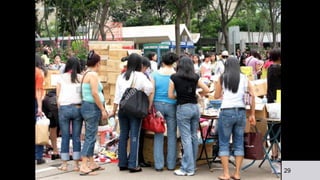
“Imagined Community”
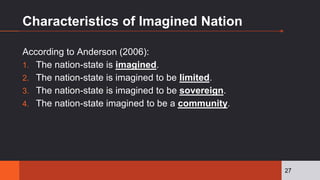
Characteristics of Imagined Nation
According to Anderson (2006):
1. The nation-state is imagined.
2. The nation-state is imagined to be limited.
3. The nation-state is imagined to be sovereign.
4. The nation-state imagined to be a community.
27
28
29
Changes in Global
Nation-State Relations
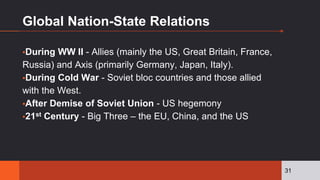
Global Nation-State Relations
▪During WW II - Allies (mainly the US, Great Britain, France,
Russia) and Axis (primarily Germany, Japan, Italy).
▪During Cold War - Soviet bloc countries and those allied
with the West.
▪After Demise of Soviet Union - US hegemony
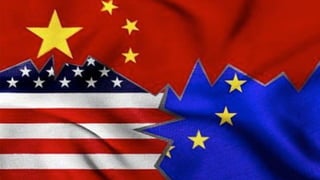
▪21st Century - Big Three – the EU, China, and the US
31
32
United Nations
United Nations
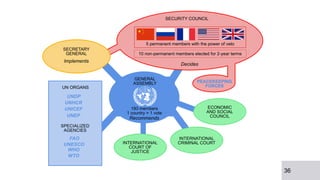
▪It is the premier global organization in the realm of politics.
▪It is organized on the basis of nation-states.
▪It has 193 members and 2 non-member observer states.
▪Security Council - is responsible for the maintenance of
international peace and security
▪General Assembly - is the UN’s main deliberative body
35
36
A. United Nations Conference on Trade
and Development (UNCTAD)
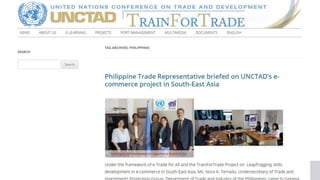
▪UNCTAD was created in 1964 by the UN General Assembly
primarily to improve the economic situation of less developed
nations, as well as to improve the nature of their relationship
to the developed nations.
37
38
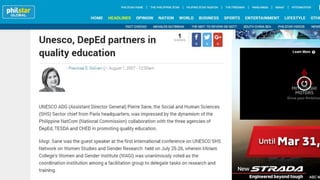
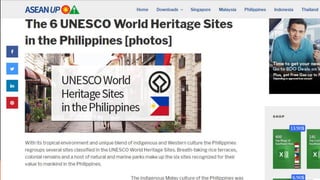
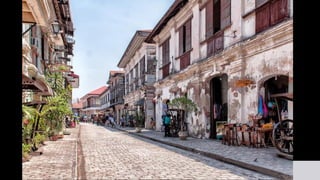
B. United Nations Educational, Scientific,
and Cultural Organization (UNESCO)
▪With headquarters in Paris, UNESCO has been in existence
since 1946. Its primary focus is in the areas of “education, the
natural and social sciences, and culture.”
39
40
41
42
43
44
C. International Atomic Energy Agency
(IAEA )
▪It is not controlled by the UN, but it does report to both the
General Assembly and the Security Council.
▪The IAEA is the world’s “watchdog” on nuclear issues.
45
46
47
48
Global Governance
Global Governance
▪It refers to the rule making efforts to sustain cooperation in
order to address global problems or concerns.
50
51
52
Civil Society
Civil Society
▪It is the process through which individuals negotiate, argue,
struggle against, or agree with each other and with those in
authority.
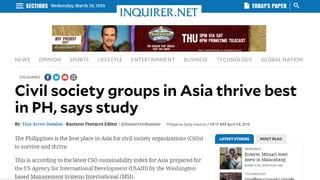
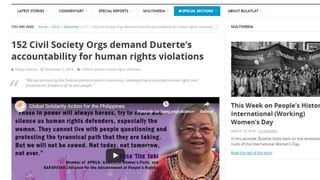
▪Global civil society – global, non-governmental, pluralistic
form of society composed of interlinked social processes
oriented to civility.
54
55
56
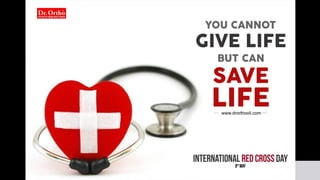
International non-governmental
organizations (INGOs)
▪INGOs are international not-for-profit organizations that
perform public functions but are not established or run by
nation-states.
57
58
59
60
61
62
63
THANKS!
ANY QUESTIONS?
You can find me at:
▪ www.facebook.com/kazekage15
REFERENCES
1. George Ritzer (2011), Globalization: The Essentials,
Wiley-Blackwell
64

Global Political Structures and Processes

  • 1.
    GLOBAL POLITICAL STRUCTURES ANDPROCESSES Prepared by: MR. ANTONIO T. DELGADO
  • 2.
    LESSON OUTLINE I. OnPolitical Flows II. The Nation-State III. Threats to the Nation-State IV. In Defense of the Nation-State V. “Imagined Community” VI. Changes in Global Nation-State Relations VII. United Nations VIII.Global Governance IX. Civil Society 2
  • 3.
  • 4.
    Political Flows ▪Global flowof people poses a direct threat to the nation-state ▪Dwindling oil and water supplies threaten to lead to riots ▪Inability of the nation-state to control economic flows dominated by MNCs ▪Environmental problems are very likely to be destabilizing politically 4
  • 5.
    Political Flows ▪Borderless diseasespose a danger to political structures. ▪War, especially those on the losing side. ▪Global inequalities, especially the profound and growing North–South split ▪Terrorism 5
  • 6.
  • 7.
  • 8.
    The Nation-State ▪Treaty ofWestphalia - instituted an international system which recognized sovereign states at its core. The treaty was widely interpreted as giving states the right to political self- determination, to be considered equal from a legal point of view, and as prohibiting them from intervening in the affairs of other sovereign states. 8
  • 9.
    The Nation-State ▪The nation-statehas two basic components – “nation” and “state.” ▪nation – refers to a social group that is linked through common descent, culture, language, or territorial contiguity ▪national identity – the fluid and dynamic form of collective identity, founded upon a community’s subjective belief that the members of the community share a set of characteristics that make them different from other groups 9
  • 10.
  • 11.
    The Nation-State ▪nationalism –a doctrine and/or political movement that seeks to make the nation the basis of a political structure, especially a state. ▪state – organizational structure outside other socioeconomic hierarchies with relatively autonomous office-holders. ▫Four elements: population, territory, government, sovereignty 11
  • 12.
    The Nation-State ▪nation-state –can therefore be seen as an integration of the sub-groups that define themselves as a nation with the organizational structure of the state. 12
  • 13.
    Threats to theNation-State
  • 14.
    A. Global Flows ▪Theuncomfortable truth is that, in terms of the global economy, nation-states have become little more than bit actors. (Ohmae, 1996) 14
  • 15.
  • 16.
    B. International HumanRights ▪human rights - “entitlement of individuals to life, security, and well-being” ▪It is argued that because these rights are universal, the nation-state cannot abrogate them. 16
  • 17.
  • 18.
  • 19.
    C. “Shadows ofWar” ▪Shadows of war - “the complex sets of cross-state economic and political linkages that move outside formally recognized state-based channels”. ▪Example: black market 19
  • 20.
  • 21.
  • 22.
  • 23.
    In Defense ofthe Nation-State
  • 24.
    ▪There are atleast some who contest the position taken above. A variety of arguments are made including that the nation-state continues to be the major player on the global stage, that it retains at least some power in the face of globalization, that nation-states vary greatly in their efficacy in the face of globalization, and that the rumors of the demise of the nation-state are greatly exaggerated. 24
  • 26.
  • 27.
    Characteristics of ImaginedNation According to Anderson (2006): 1. The nation-state is imagined. 2. The nation-state is imagined to be limited. 3. The nation-state is imagined to be sovereign. 4. The nation-state imagined to be a community. 27
  • 28.
  • 29.
  • 30.
  • 31.
    Global Nation-State Relations ▪DuringWW II - Allies (mainly the US, Great Britain, France, Russia) and Axis (primarily Germany, Japan, Italy). ▪During Cold War - Soviet bloc countries and those allied with the West. ▪After Demise of Soviet Union - US hegemony ▪21st Century - Big Three – the EU, China, and the US 31
  • 32.
  • 33.
  • 35.
    United Nations ▪It isthe premier global organization in the realm of politics. ▪It is organized on the basis of nation-states. ▪It has 193 members and 2 non-member observer states. ▪Security Council - is responsible for the maintenance of international peace and security ▪General Assembly - is the UN’s main deliberative body 35
  • 36.
  • 37.
    A. United NationsConference on Trade and Development (UNCTAD) ▪UNCTAD was created in 1964 by the UN General Assembly primarily to improve the economic situation of less developed nations, as well as to improve the nature of their relationship to the developed nations. 37
  • 38.
  • 39.
    B. United NationsEducational, Scientific, and Cultural Organization (UNESCO) ▪With headquarters in Paris, UNESCO has been in existence since 1946. Its primary focus is in the areas of “education, the natural and social sciences, and culture.” 39
  • 40.
  • 41.
  • 42.
  • 43.
  • 44.
  • 45.
    C. International AtomicEnergy Agency (IAEA ) ▪It is not controlled by the UN, but it does report to both the General Assembly and the Security Council. ▪The IAEA is the world’s “watchdog” on nuclear issues. 45
  • 46.
  • 47.
  • 48.
  • 49.
  • 50.
    Global Governance ▪It refersto the rule making efforts to sustain cooperation in order to address global problems or concerns. 50
  • 51.
  • 52.
  • 53.
  • 54.
    Civil Society ▪It isthe process through which individuals negotiate, argue, struggle against, or agree with each other and with those in authority. ▪Global civil society – global, non-governmental, pluralistic form of society composed of interlinked social processes oriented to civility. 54
  • 55.
  • 56.
  • 57.
    International non-governmental organizations (INGOs) ▪INGOsare international not-for-profit organizations that perform public functions but are not established or run by nation-states. 57
  • 58.
  • 59.
  • 60.
  • 61.
  • 62.
  • 63.
    63 THANKS! ANY QUESTIONS? You canfind me at: ▪ www.facebook.com/kazekage15
  • 64.
    REFERENCES 1. George Ritzer(2011), Globalization: The Essentials, Wiley-Blackwell 64