SOC 451
Global Culture and Cultural Flows
Asst. Prof. Fatma Altınbaş Sarıgül
GLOBAL CULTURE
• Culture exists increasingly in digitized forms.
• The internet permits global downloading and
sharing of digitized cultural forms such as movies,
videos, music, books, newspapers, photos and so
on.
• Those who see themselves as part of the same
culture can contact through e-mail, skype, social
media.
• Eventhough there is easiness of sharing culture,
there are still barriers to its flow, the lack of
access to the internet.
CULTURAL DIFFERENTIALISM
• It emphasizes lasting differences among and
between cultures largely unaffected by
globalization.
• This is not to say that culture is unaffected by
globalization, but it is to say that at their core
they are largely unaffected by it; they remain
much as they always have been.
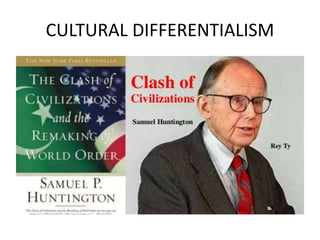
• The most famous supporter of this theory is
Samuel Huntington.
CULTURAL DIFFERENTIALISM
Huntington differentiates world civilizations:
Sinic (Chinese)
Japan (Far Easterns)
Hindu
Islamic
Orthodox (centered in Russia)
Western Europe
North America (along with Australia, New Zealand)
Latin America
Africa
Huntington argues:
The decline of west, Rise of Asian societies
Resurgence of Islam
Huntington foresees:
Dangerous clashes between the West, Islam and Sinic.
RELIGION AND GLOBALIZATION
• This relationship is quite ancient since religion
globalized before virtually anything else.
• ISLAM- Its universalistic ideas led to the belief
that they had to be diffused throughout the
world.
• HINDUISM
• BUDDHISM
• CHRISTIANITY- still growing fast
• JUDAISM
• MORMONISM
CULTURAL HYBRIDIZATION
• It emphasizes the mixing of cultures as a result
of globalization and the production, out of the
integration of the global and the local, of new
and unique hybrid cultures that are not
reducible to either local or global culture.
GLOCALIZATION: The interpenetration of the
global and the local resulting in unique
outcomes in different geographic areas.
CULTURAL HYBRIDIZATION
5 global flows: ethnoscapes
mediascapes
technoscapes
financescapes
ideoscapes
CULTURAL CONVERGENCE
• It is based on the idea that globalization tends to
lead to increasing sameness throughout the
world.
• Supporters of this perspective see cultures
changing, sometimes radically, as a result of
globalization, specifically flows of global culture
and the relative weakness of barriers to those
flows.
CULTURAL IMPERIALISM: It indicates that one or
more cultures are imposing themselves on other
cultures thereby destroying local culture.
CULTURAL CONVERGENCE
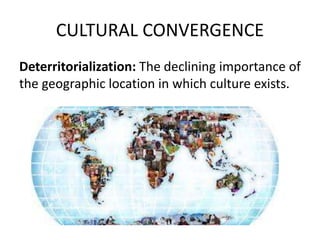
Deterritorialization: The declining importance of
the geographic location in which culture exists.
WORLD CULTURE
• A distinctive theoretical approach to convergence
in general, and cultural convergence in particular,
is known as world culture theory.
• As a result, there is striking amount of structural
isomorphism throughout the world as a result of
the spread of these models.
• World culture scholars describe the world in
terms of an enactment of culture.
• Culture is seen as shaping the state system, state
organizations like schools, firms and individual
citizenship and identity throughout the world.
CULTURAL HOMOGENIZATION
• McDonaldization
Soc 451, 7th class
Soc 451, 7th class
Soc 451, 7th class
Soc 451, 7th class
Soc 451, 7th class
Soc 451, 7th class

Soc 451, 7th class

  • 1.
    SOC 451 Global Cultureand Cultural Flows Asst. Prof. Fatma Altınbaş Sarıgül
  • 2.
    GLOBAL CULTURE • Cultureexists increasingly in digitized forms. • The internet permits global downloading and sharing of digitized cultural forms such as movies, videos, music, books, newspapers, photos and so on. • Those who see themselves as part of the same culture can contact through e-mail, skype, social media. • Eventhough there is easiness of sharing culture, there are still barriers to its flow, the lack of access to the internet.
  • 3.
    CULTURAL DIFFERENTIALISM • Itemphasizes lasting differences among and between cultures largely unaffected by globalization. • This is not to say that culture is unaffected by globalization, but it is to say that at their core they are largely unaffected by it; they remain much as they always have been. • The most famous supporter of this theory is Samuel Huntington.
  • 4.
  • 5.
    CULTURAL DIFFERENTIALISM Huntington differentiatesworld civilizations: Sinic (Chinese) Japan (Far Easterns) Hindu Islamic Orthodox (centered in Russia) Western Europe North America (along with Australia, New Zealand) Latin America Africa Huntington argues: The decline of west, Rise of Asian societies Resurgence of Islam Huntington foresees: Dangerous clashes between the West, Islam and Sinic.
  • 6.
    RELIGION AND GLOBALIZATION •This relationship is quite ancient since religion globalized before virtually anything else. • ISLAM- Its universalistic ideas led to the belief that they had to be diffused throughout the world. • HINDUISM • BUDDHISM • CHRISTIANITY- still growing fast • JUDAISM • MORMONISM
  • 7.
    CULTURAL HYBRIDIZATION • Itemphasizes the mixing of cultures as a result of globalization and the production, out of the integration of the global and the local, of new and unique hybrid cultures that are not reducible to either local or global culture. GLOCALIZATION: The interpenetration of the global and the local resulting in unique outcomes in different geographic areas.
  • 8.
    CULTURAL HYBRIDIZATION 5 globalflows: ethnoscapes mediascapes technoscapes financescapes ideoscapes
  • 9.
    CULTURAL CONVERGENCE • Itis based on the idea that globalization tends to lead to increasing sameness throughout the world. • Supporters of this perspective see cultures changing, sometimes radically, as a result of globalization, specifically flows of global culture and the relative weakness of barriers to those flows. CULTURAL IMPERIALISM: It indicates that one or more cultures are imposing themselves on other cultures thereby destroying local culture.
  • 10.
    CULTURAL CONVERGENCE Deterritorialization: Thedeclining importance of the geographic location in which culture exists.
  • 11.
    WORLD CULTURE • Adistinctive theoretical approach to convergence in general, and cultural convergence in particular, is known as world culture theory. • As a result, there is striking amount of structural isomorphism throughout the world as a result of the spread of these models. • World culture scholars describe the world in terms of an enactment of culture. • Culture is seen as shaping the state system, state organizations like schools, firms and individual citizenship and identity throughout the world.
  • 12.