Globalization and
Health
Presenters: Laishram Sanjana
Bikash Debbarma
Moderator: Prof. T. Gambhir Singh
22/11/2019
Outline of the presentation
• What is globalization?
• Redundant concepts of globalization
• History
• Why globalization is occurring- the key drivers
• Conceptual framework: globalization and health
• Impact of globalization on health
• Globalization: future & challenges
• Conclusion
What is globalization?
Globalization, or the increased
interconnectedness and
interdependence of people & countries
• the opening of international borders to
increasingly fast flows of goods,
services, finance, people and ideas
• the changes in institutions and policies at
national and international levels that
facilitate or promote such flows
(WHO)
Globalization as a unifying and
progressive force, bringing
unprecedented economic growth
and prosperity to millions
(Dollar and Kraay)
David Dollar Aart Kraay
Globalization can be defined as a set of
processes contributing to intensified human
interaction in a wide range of spheres
(economic, political, social, environment)
and across three types of boundaries (spatial,
temporal and cognitive)
(Lee Kelley)
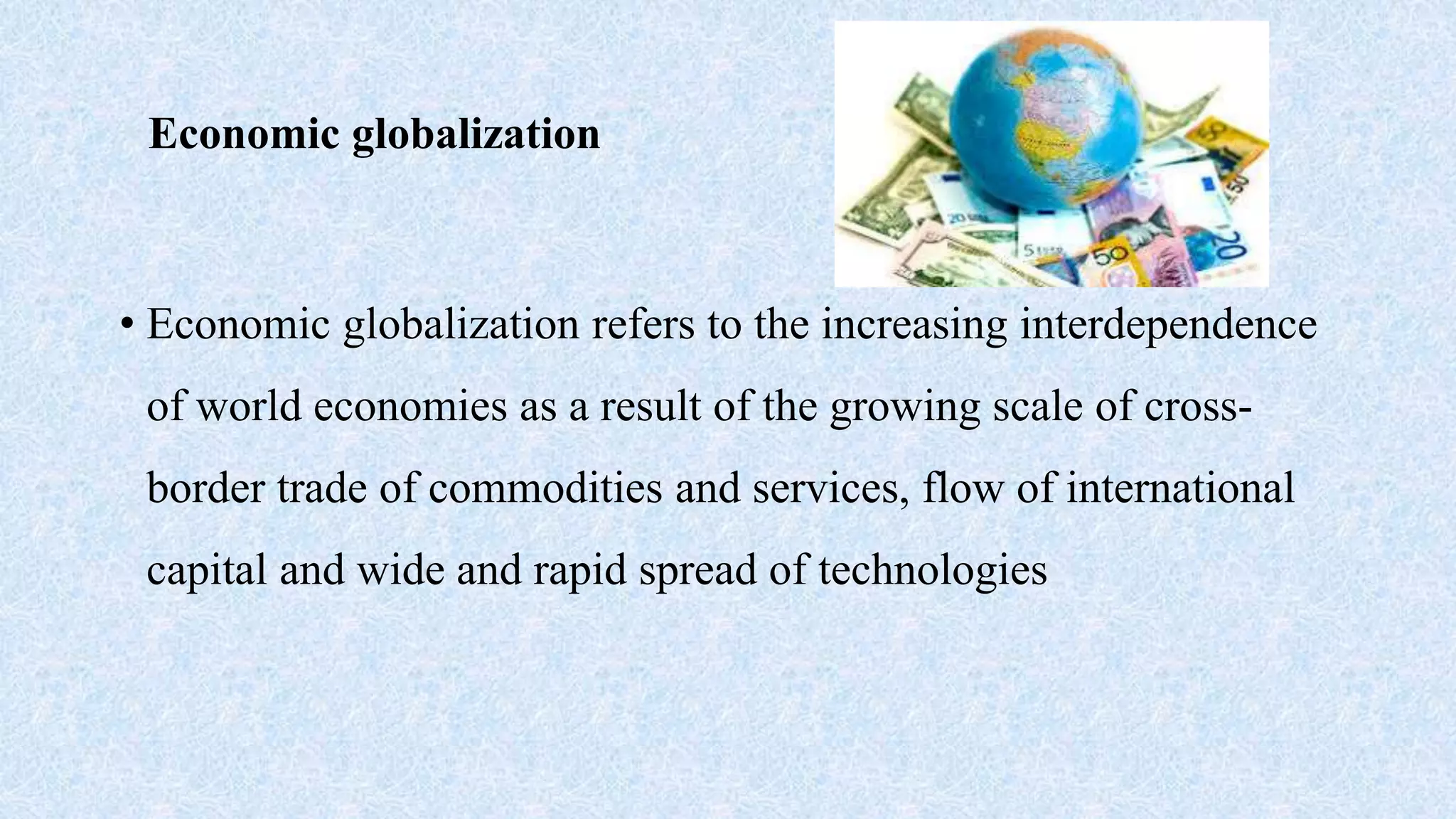
• Economic globalization refers to the increasing interdependence
of world economies as a result of the growing scale of cross-
border trade of commodities and services, flow of international
capital and wide and rapid spread of technologies
Economic globalization
• Under the framework of GATT and
WTO, many countries have gradually
cut down their tariff & non-tariff
barriers
• Multinational corporations (MNCs)
have become the main carriers of
economic globalization
Political globalization
• Under globalization, politics can take
place above the state through political
integration schemes (European Union)
& through intergovernmental
organizations (the IMF, the World Bank
& WTO)
• Refers to the impact of
globalization on the life & work
of people, on their families, and
their societies
Social globalization
Environmental globalization
• Environmental globalization refers
to the internationally coordinated
practices and regulations (often in
the form of international treaties)
regarding environmental protection
Spatial dimension
• Refers to how people organize and interact across physical or
territorial space
• The familiar image of globalization as a ‘global village’ describes
how social relations can increasingly happen on a worldwide scale
Temporal dimension
• Concerns how we think about and
experience time
• The contemporary world is characterized
by an acceleration of timeframe in which
many things can be, and are expected to be
done
Cognitive dimension
• Concerns how we think about ourselves and the world around us
• The dissemination and adoption of knowledge, ideas, values and
beliefs have become worldwide in scale through the global reach
of mass media, research and educational institutions, religious
organizations and political parties
• Internationalization
• Liberalization
• Universalization
• Westernization
Redundant concepts of globalization (Scholte, 2000 )
Jan Aart Scholte
Internationalization
• When globalization is interpreted as internationalization, the term
refers to a growth of transactions and interdependence between
countries
• From this perspective, a more global world is one where more
messages, ideas, merchandise, money, investments, pollutants &
people cross borders between national-state-territorial units
• It is simply a quantitative process which leads to a more extensive
geographical pattern of economic activity
• Qualitatively distinct from globalization processes – involves not
merely the geographical extension of economic activities across
national boundaries but more importantly the functional
integration of such internationally dispersed activities
Liberalization
• This term is used especially often by advocates of neoliberal ideas,
and their critics, to signal a global world that is defined as “one
without regulatory barriers to transfers of resources between
countries”
• Most ‘anti-globalization’ protesters are seen to reject neoliberal
globalization rather than globalization per se
• People have debated theories and practices of ‘free’ markets for
several centuries without invoking talk of globalization
• Globalization-as-liberalization opens no new insight today
Universalization
• Generally refers to the spread of people and cultures to all corners
of the world
• Globalization is taken to describe a process of dispersing various
objects and experiences to people at all inhabited parts of the
earth
• Globalization-as-universalization is assumed to entail
homogenization with worldwide cultural, economic, legal and
political convergence.
• This third type of conception, too, opens no new and distinctive
insight
Westernization
• The term ‘Westernization’ describes the belief that certain cultural
values, aspirations, and behaviors characteristic of Western
societies, and particularly U.S. society, are being adopted
increasingly throughout the world
• Scholte casts aside these “redundant” terms, and reserves the
term “globalization” to describe social interactions that not only
cross national boundaries, but also transcend them & only when
territorial boundaries, based on physical geography, are
circumvented or become irrelevant can we speak of globalization
HISTORY
Rise of the g-word
• In the English language, the noun “globe” dates from the fifteenth
century (Latin globus) and began to denote a spherical
representation of the earth several hundred years ago (Robertson,
2001)
• The adjective “global” entered circulation in the late seventeenth
century and began to designate “world scale” in the late nineteenth
century, in addition to its earlier meaning of “spherical” (OED,
1989)
• The verb “globalize” appeared in the 1940s, together with the
term “globalism” (Reiser and Davies, 1944)
• The word “globalization”, as a process, first surfaced in the
English language in 1959 and entered a dictionary two years later
(Schreiter, 1997; Webster, 1961)
• Notions of “globality”, as a condition, began to circulate in the
1980s (Robertson, 1983)
• Notions of the global appeared roughly simultaneously and
independently in several academic fields around the early 1980s
• In Sociology, for example, Roland Robertson began to interpret
“globality” in 1983 (Robertson, 1983)
• Concurrently, in Business Studies, Theodore Levitt wrote of “the
globalization of markets” (Levitt, 1983)
• Researchers in International Relations shift their focus to “global
interdependence” (Rosenau, 1980)
• In the 1990s globalization has become a major academic growth
industry
• The number of entries for “globalization” in the United States
Library of Congress multiplied from 34 in 1994 to 5,245 in 2005
(Waters, 1995; LoC, 2005)
• Since 2000 several new professional groups have also emerged
 Global Studies Associations in Britain and the USA
 A Globalization Studies Network with worldwide membership
• The history of globalization is a longer process of social change
occurring over the course of centuries
• The early beginnings of globalization might be described as
occurring when human species beginning with Homo erectus
migrated out of Africa 1 million years ago
• Major developments in social, political, and economic history
marked the acceleration of globalization
 The opening of the Silk Route between Asia and Europe
 The arrival of Christopher Columbus in the Americas
 European imperialism
 The Industrial Revolution
Brief history of globalization
For the first time in history, luxury
products from China started to
appear on the other edge of the
Eurasian continent – in Rome (along
the Silk Road)
Silk roads (1st century BC-5th century AD, & 13th -14th centuries AD)
Spice routes (7th -15th centuries)
• Islamic merchants as well as the new religion spread in all
directions from its Arabian heartland in the 7th century
• By the early 9th century, Muslim traders already dominated
Mediterranean and Indian Ocean trade(main focus of Islamic
trade in those Middle Ages were spices)
• Unlike silk, spices were traded mainly by sea since ancient times
Age of Discovery (15th -18th centuries)
It was in this era, from the end of the 15th
century onwards, that European explorers
connected East and West – and accidentally
discovered America by Christopher Columbus
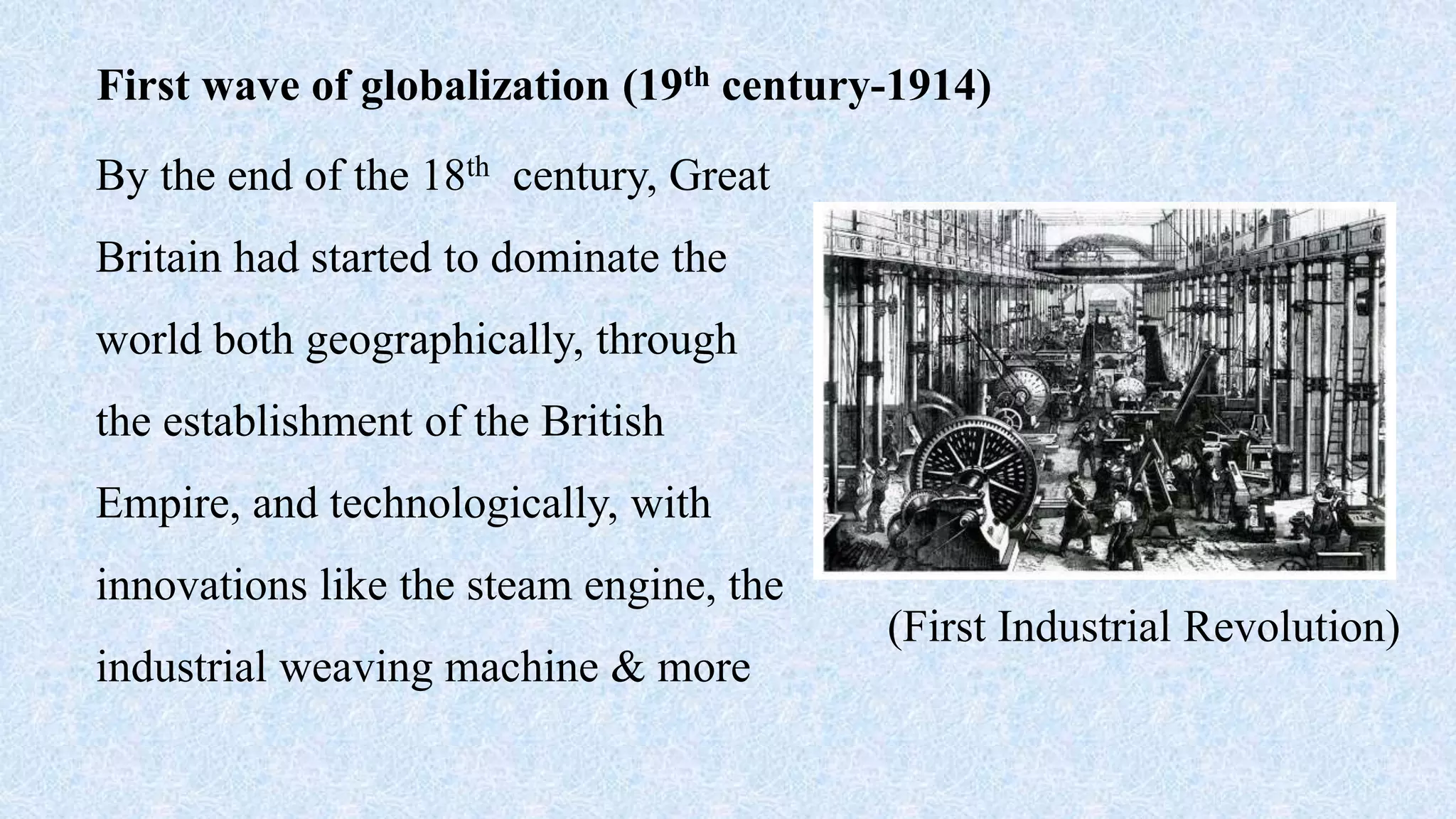
First wave of globalization (19th century-1914)
By the end of the 18th century, Great
Britain had started to dominate the
world both geographically, through
the establishment of the British
Empire, and technologically, with
innovations like the steam engine, the
industrial weaving machine & more
(First Industrial Revolution)
The world wars
• In 1914, the outbreak of World War I brought an end to
globalization
• Another world war followed in 1939-1945, by the end of World
War II, trade as a percentage of world GDP had fallen to 5% – a
level not seen in more than a hundred years
Second and third wave of globalization
• The end of the World War II marked a new beginning for the
global economy
• Under the leadership of the United States of America, and aided
by the technologies of the Second Industrial Revolution, like the
car and the plane, global trade started to rise once again
• A new technology from the Third Industrial Revolution, the
internet, connected people all over the world
History of globalization in India
• The East India Company (EIC)
ruled the beginnings of the British Empire in India.[5] I
basic commodities including cotton, silk, indigo
dye, salt, spices, saltpetre, tea, and opium. Company rule in
India effectively began in 1757 and lasted until 1858, when, following
the Indian Rebellion of 1857, the Government of India Act 1858 led to
the British Crown's assuming direct control of the Indian subcontinent
in the form of the new
Company rule in India effectively began in 1757 and lasted until 1858,
GLOBALIZATION IN POPULATION HEALTH
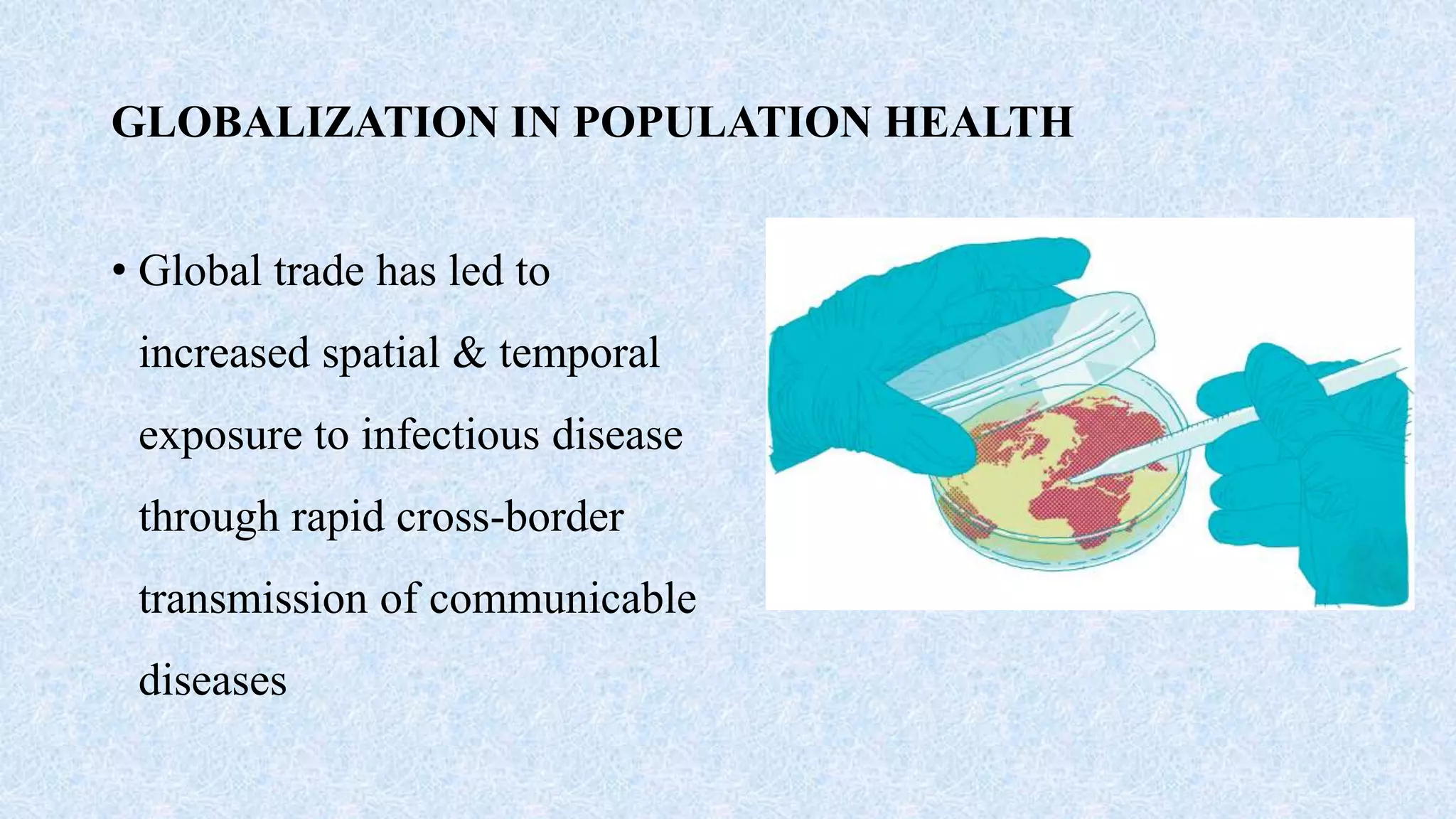
• Global trade has led to
increased spatial & temporal
exposure to infectious disease
through rapid cross-border
transmission of communicable
diseases
• Global trade increases the risk of
chronic diseases through
marketing of unhealthy products
& risk behaviours, such as
tobacco smoking and
consumption of fast food
• The global distribution of
health related goods
(pharmaceutical products,
medical equipments) and
people (both patients &
health professionals)
• Refugee health
 Inadequate vaccination
 Nutritional deficiencies
 Infectious diseases
 Dental disease
• The creation of the Bretton Woods Institutions
The World Bank
International Monetary Fund
General Agreement on Tariffs and Trade
International organizations
The World Bank
• The World Bank was created at the 1944 Bretton Woods
Conference along with the IMF
• An international financial institution that provides loans and
grants to the governments of poorer countries for the purpose of
pursuing capital projects
International Monetary Fund
• In 1944, representatives of 44 nations met in Bretton Woods, New
Hampshire, to draw up a plan for the post-World War II economic
order
• The IMF was created to promote international monetary
cooperation.
The General Agreement on Tariffs and Trade (GATT)
• A legal agreement between many countries, whose overall
purpose was to promote international trade by reducing or
eliminating trade barriers such as tariffs or quota
• It was signed by 23 nations in Geneva on 30th October 1947, and
took effect on 1st January 1948
• The World Trade Organization (WTO) is an intergovernmental
organization that is concerned with the regulation of international
trade between nations
• The WTO officially commenced on 1 January 1995, Headquarter
at Geneva, Switzerland
Role of United Nations
• The UN promotes and enhances globalization in a number of
ways
• In purely economic terms, the UN and its associated
organizations do a great deal to promote trade between nations
• The IMF, the World Bank, and the World Trade Organization
work closely with the UN
United Nations work mainly in the broader area of
• Peace and Security
• Economic and Social Development
• Human Rights and Humanitarian Affairs
• International Law
Main UN Events to Discuss
• Millennium Development Goals
• Sustainable Development Goals
Millennium Development Goals
Why globalization is occurring-
The Key drivers
Technology
• Communication and transportation
technologies, in particular, are enabling
people to travel the world more readily,
interact with one another across vast
distances, and carry out many forms of
interaction
• Lawrence Summers, former Secretary of the
U.S. Department of Treasury, stated,
“Transportation is the industry that connects
other industries . . . it is the key to
globalization”
Economy
• Real factors driving technological developments and their
application are economic in nature
• The global spread of capitalism has been spurred - on the one
hand by producers & on the other hand by the consumers around
the world
• The economic transactions called as the ‘invisible hand’ of the
market are seen as the real force behind globalization
Neo-liberalism
• Current globalization is driven by particular ideologically based
values & beliefs
• Also defined economic policies which encourage trade
liberalization, market-based competition & foreign investment
Globalists Opponents
Closer integration, shared
identities, greater efficiency &
productivity, rapid economic
growth, increased prosperity
Imbalances in wealth & power
which mutually divides the
world into winners and losers
Conceptual framework for globalization and health

Globalization and its impact on health

  • 1.
    Globalization and Health Presenters: LaishramSanjana Bikash Debbarma Moderator: Prof. T. Gambhir Singh 22/11/2019
  • 2.
    Outline of thepresentation • What is globalization? • Redundant concepts of globalization • History • Why globalization is occurring- the key drivers • Conceptual framework: globalization and health • Impact of globalization on health • Globalization: future & challenges • Conclusion
  • 3.
  • 4.
    Globalization, or theincreased interconnectedness and interdependence of people & countries • the opening of international borders to increasingly fast flows of goods, services, finance, people and ideas • the changes in institutions and policies at national and international levels that facilitate or promote such flows (WHO)
  • 5.
    Globalization as aunifying and progressive force, bringing unprecedented economic growth and prosperity to millions (Dollar and Kraay) David Dollar Aart Kraay
  • 6.
    Globalization can bedefined as a set of processes contributing to intensified human interaction in a wide range of spheres (economic, political, social, environment) and across three types of boundaries (spatial, temporal and cognitive) (Lee Kelley)
  • 7.
    • Economic globalizationrefers to the increasing interdependence of world economies as a result of the growing scale of cross- border trade of commodities and services, flow of international capital and wide and rapid spread of technologies Economic globalization
  • 8.
    • Under theframework of GATT and WTO, many countries have gradually cut down their tariff & non-tariff barriers • Multinational corporations (MNCs) have become the main carriers of economic globalization
  • 9.
    Political globalization • Underglobalization, politics can take place above the state through political integration schemes (European Union) & through intergovernmental organizations (the IMF, the World Bank & WTO)
  • 10.
    • Refers tothe impact of globalization on the life & work of people, on their families, and their societies Social globalization
  • 11.
    Environmental globalization • Environmentalglobalization refers to the internationally coordinated practices and regulations (often in the form of international treaties) regarding environmental protection
  • 12.
    Spatial dimension • Refersto how people organize and interact across physical or territorial space • The familiar image of globalization as a ‘global village’ describes how social relations can increasingly happen on a worldwide scale
  • 13.
    Temporal dimension • Concernshow we think about and experience time • The contemporary world is characterized by an acceleration of timeframe in which many things can be, and are expected to be done
  • 14.
    Cognitive dimension • Concernshow we think about ourselves and the world around us • The dissemination and adoption of knowledge, ideas, values and beliefs have become worldwide in scale through the global reach of mass media, research and educational institutions, religious organizations and political parties
  • 15.
    • Internationalization • Liberalization •Universalization • Westernization Redundant concepts of globalization (Scholte, 2000 ) Jan Aart Scholte
  • 16.
    Internationalization • When globalizationis interpreted as internationalization, the term refers to a growth of transactions and interdependence between countries • From this perspective, a more global world is one where more messages, ideas, merchandise, money, investments, pollutants & people cross borders between national-state-territorial units
  • 17.
    • It issimply a quantitative process which leads to a more extensive geographical pattern of economic activity • Qualitatively distinct from globalization processes – involves not merely the geographical extension of economic activities across national boundaries but more importantly the functional integration of such internationally dispersed activities
  • 18.
    Liberalization • This termis used especially often by advocates of neoliberal ideas, and their critics, to signal a global world that is defined as “one without regulatory barriers to transfers of resources between countries”
  • 19.
    • Most ‘anti-globalization’protesters are seen to reject neoliberal globalization rather than globalization per se • People have debated theories and practices of ‘free’ markets for several centuries without invoking talk of globalization • Globalization-as-liberalization opens no new insight today
  • 20.
    Universalization • Generally refersto the spread of people and cultures to all corners of the world • Globalization is taken to describe a process of dispersing various objects and experiences to people at all inhabited parts of the earth
  • 21.
    • Globalization-as-universalization isassumed to entail homogenization with worldwide cultural, economic, legal and political convergence. • This third type of conception, too, opens no new and distinctive insight
  • 22.
    Westernization • The term‘Westernization’ describes the belief that certain cultural values, aspirations, and behaviors characteristic of Western societies, and particularly U.S. society, are being adopted increasingly throughout the world
  • 23.
    • Scholte castsaside these “redundant” terms, and reserves the term “globalization” to describe social interactions that not only cross national boundaries, but also transcend them & only when territorial boundaries, based on physical geography, are circumvented or become irrelevant can we speak of globalization
  • 24.
  • 25.
  • 26.
    • In theEnglish language, the noun “globe” dates from the fifteenth century (Latin globus) and began to denote a spherical representation of the earth several hundred years ago (Robertson, 2001) • The adjective “global” entered circulation in the late seventeenth century and began to designate “world scale” in the late nineteenth century, in addition to its earlier meaning of “spherical” (OED, 1989)
  • 27.
    • The verb“globalize” appeared in the 1940s, together with the term “globalism” (Reiser and Davies, 1944) • The word “globalization”, as a process, first surfaced in the English language in 1959 and entered a dictionary two years later (Schreiter, 1997; Webster, 1961) • Notions of “globality”, as a condition, began to circulate in the 1980s (Robertson, 1983)
  • 28.
    • Notions ofthe global appeared roughly simultaneously and independently in several academic fields around the early 1980s • In Sociology, for example, Roland Robertson began to interpret “globality” in 1983 (Robertson, 1983) • Concurrently, in Business Studies, Theodore Levitt wrote of “the globalization of markets” (Levitt, 1983)
  • 29.
    • Researchers inInternational Relations shift their focus to “global interdependence” (Rosenau, 1980) • In the 1990s globalization has become a major academic growth industry • The number of entries for “globalization” in the United States Library of Congress multiplied from 34 in 1994 to 5,245 in 2005 (Waters, 1995; LoC, 2005)
  • 30.
    • Since 2000several new professional groups have also emerged  Global Studies Associations in Britain and the USA  A Globalization Studies Network with worldwide membership
  • 31.
    • The historyof globalization is a longer process of social change occurring over the course of centuries • The early beginnings of globalization might be described as occurring when human species beginning with Homo erectus migrated out of Africa 1 million years ago
  • 32.
    • Major developmentsin social, political, and economic history marked the acceleration of globalization  The opening of the Silk Route between Asia and Europe  The arrival of Christopher Columbus in the Americas  European imperialism  The Industrial Revolution
  • 33.
    Brief history ofglobalization
  • 34.
    For the firsttime in history, luxury products from China started to appear on the other edge of the Eurasian continent – in Rome (along the Silk Road) Silk roads (1st century BC-5th century AD, & 13th -14th centuries AD)
  • 35.
    Spice routes (7th-15th centuries) • Islamic merchants as well as the new religion spread in all directions from its Arabian heartland in the 7th century • By the early 9th century, Muslim traders already dominated Mediterranean and Indian Ocean trade(main focus of Islamic trade in those Middle Ages were spices) • Unlike silk, spices were traded mainly by sea since ancient times
  • 36.
    Age of Discovery(15th -18th centuries) It was in this era, from the end of the 15th century onwards, that European explorers connected East and West – and accidentally discovered America by Christopher Columbus
  • 37.
    First wave ofglobalization (19th century-1914) By the end of the 18th century, Great Britain had started to dominate the world both geographically, through the establishment of the British Empire, and technologically, with innovations like the steam engine, the industrial weaving machine & more (First Industrial Revolution)
  • 38.
  • 39.
    • In 1914,the outbreak of World War I brought an end to globalization • Another world war followed in 1939-1945, by the end of World War II, trade as a percentage of world GDP had fallen to 5% – a level not seen in more than a hundred years
  • 40.
    Second and thirdwave of globalization • The end of the World War II marked a new beginning for the global economy • Under the leadership of the United States of America, and aided by the technologies of the Second Industrial Revolution, like the car and the plane, global trade started to rise once again
  • 41.
    • A newtechnology from the Third Industrial Revolution, the internet, connected people all over the world
  • 42.
    History of globalizationin India • The East India Company (EIC) ruled the beginnings of the British Empire in India.[5] I basic commodities including cotton, silk, indigo dye, salt, spices, saltpetre, tea, and opium. Company rule in India effectively began in 1757 and lasted until 1858, when, following the Indian Rebellion of 1857, the Government of India Act 1858 led to the British Crown's assuming direct control of the Indian subcontinent in the form of the new Company rule in India effectively began in 1757 and lasted until 1858,
  • 43.
    GLOBALIZATION IN POPULATIONHEALTH • Global trade has led to increased spatial & temporal exposure to infectious disease through rapid cross-border transmission of communicable diseases
  • 44.
    • Global tradeincreases the risk of chronic diseases through marketing of unhealthy products & risk behaviours, such as tobacco smoking and consumption of fast food
  • 45.
    • The globaldistribution of health related goods (pharmaceutical products, medical equipments) and people (both patients & health professionals)
  • 46.
    • Refugee health Inadequate vaccination  Nutritional deficiencies  Infectious diseases  Dental disease
  • 47.
    • The creationof the Bretton Woods Institutions The World Bank International Monetary Fund General Agreement on Tariffs and Trade International organizations
  • 48.
    The World Bank •The World Bank was created at the 1944 Bretton Woods Conference along with the IMF • An international financial institution that provides loans and grants to the governments of poorer countries for the purpose of pursuing capital projects
  • 49.
    International Monetary Fund •In 1944, representatives of 44 nations met in Bretton Woods, New Hampshire, to draw up a plan for the post-World War II economic order • The IMF was created to promote international monetary cooperation.
  • 50.
    The General Agreementon Tariffs and Trade (GATT) • A legal agreement between many countries, whose overall purpose was to promote international trade by reducing or eliminating trade barriers such as tariffs or quota • It was signed by 23 nations in Geneva on 30th October 1947, and took effect on 1st January 1948
  • 51.
    • The WorldTrade Organization (WTO) is an intergovernmental organization that is concerned with the regulation of international trade between nations • The WTO officially commenced on 1 January 1995, Headquarter at Geneva, Switzerland
  • 52.
    Role of UnitedNations • The UN promotes and enhances globalization in a number of ways • In purely economic terms, the UN and its associated organizations do a great deal to promote trade between nations • The IMF, the World Bank, and the World Trade Organization work closely with the UN
  • 53.
    United Nations workmainly in the broader area of • Peace and Security • Economic and Social Development • Human Rights and Humanitarian Affairs • International Law
  • 54.
    Main UN Eventsto Discuss • Millennium Development Goals • Sustainable Development Goals
  • 55.
  • 57.
    Why globalization isoccurring- The Key drivers
  • 58.
    Technology • Communication andtransportation technologies, in particular, are enabling people to travel the world more readily, interact with one another across vast distances, and carry out many forms of interaction
  • 59.
    • Lawrence Summers,former Secretary of the U.S. Department of Treasury, stated, “Transportation is the industry that connects other industries . . . it is the key to globalization”
  • 60.
    Economy • Real factorsdriving technological developments and their application are economic in nature • The global spread of capitalism has been spurred - on the one hand by producers & on the other hand by the consumers around the world • The economic transactions called as the ‘invisible hand’ of the market are seen as the real force behind globalization
  • 61.
    Neo-liberalism • Current globalizationis driven by particular ideologically based values & beliefs • Also defined economic policies which encourage trade liberalization, market-based competition & foreign investment
  • 62.
    Globalists Opponents Closer integration,shared identities, greater efficiency & productivity, rapid economic growth, increased prosperity Imbalances in wealth & power which mutually divides the world into winners and losers
  • 63.
    Conceptual framework forglobalization and health

Editor's Notes

  • #5 is generally understood to include two inter-related elements:
  • #6 Aart Kraay is an economist in the Development Research Group at the World Bank. He joined the World Bank in 1995 after earning a Ph.D. in economics from Harvard University(Cambridge, US) (1995), and a B.Sc. in economics from the University of Toronto(Canada) (1990). The Development Research Group of the World Bank recruits research economists. The Development Research Group is the main department where policy-relevant research is conducted at the World Bank
  • #7  Kelly Lee is Professor in the Faculty of Health Sciences at the Simon Fraser University(Canada). Dr. Lee is trained in International Relations and Public Administration with a focus on international political economy. She spent over twenty years at the London School of Hygiene and Tropical Medicine, where she remains Honorary Professor of Global Health Policy, initially analyzing the role of the UN in health. Professor, Director of Global Health and Associate Dean – Research, at Simon Fraser University.(British Columbia, Canada) Dr Lee is trained in International Relations and Public Administration with a focus on international political economy. She joined the Faculty of Health Sciences, Simon Fraser University in 2011 as Associate Dean, Research and Director of Global Health. Kelley Lee is Tier 1 Canada Research Chair in Global Health Governance in the Faculty of Health Sciences, Simon Fraser University and previously Professor of Global Health Policy at the London School of Hygiene & Tropical Medicine for 20 yrs. She has authored around 80 scholarly papers, 40 book chapters and 10 books including Globalisation and Health, Global Health and International Relations….. A Master of Public Administration (MPA) degree and a Master of International Relations degree are two of the more common graduate degree options for students interested in government and public affairs. An MPA - Combining coursework from a Master of Business Administration (MBA) and a Master of Public Policy (MPP), MPA is generally a two-year, full-time degree.
  • #8 The global financial crisis (GFC) refers to the period of extreme stress in global financial markets and banking systems between mid 2007 and early 2009
  • #9 more and more countries open up their current accounts and capital accounts A tariff is a tax imposed by one country on the goods and services imported from another country. Governments may impose tariffs to raise revenue or to protect domestic industries.
  • #10 Political activity can also transcend national borders through global movements and NGOs. The European Union (EU) is a political and economic union of 28 member states that are located primarily in Europe. The EU has developed an internal single market through a standardised system of laws that apply in all member states in those matters, and only those matters, where members have agreed to act as one. EU policies aim to ensure the free movement of people, goods, services and capital within the internal market,[13] enact legislation in justice and home affairs and maintain common policies on trade,[14] agriculture,[15] fisheries and regional development. The European Union has grown from the six founding states (Belgium, France, West Germany, Italy, Luxembourg, and the Netherlands) to the current 28. 
  • #11 The World Commission on the Social Dimension of Globalization , ILO. Concerns and issues are often raised about the impact of globalization on employment, working conditions, income and social protection. Beyond the world of work, the social dimension encompasses security, culture and identity, inclusion or exclusion and the cohesiveness of families and communities
  • #12 The Kyoto Protocol is an international treaty which extends the 1992 United Nations Framework Convention on Climate Change (UNFCCC) that commits state parties to reduce greenhouse gas emissions. The United Nations Framework Convention on Climate Change (UNFCCC or FCCC) is an international environmental treaty negotiated at the United Nations Conference on Environment and Development (UNCED), informally known as the Earth Summit, held in Rio de Janeiro from 3 to 14 June 1992. The objective of the treaty is to "stabilize greenhouse gas concentrations in the atmosphere at a level that would prevent dangerous anthropogenic interference with the climate system."
  • #13 Eg. Long haul flights, internet (social media like facebook, twitter, you tube, wats app)-social interaction across distant location The death of distance driven largely by information and communication technologies
  • #14 Eg global finance transactions such as foreign exchange, buying and selling equities can take place in matter of seconds Travel greater distance in shorter amounts of time Spread of infectious diseases HIV, cholera, influenza
  • #15 Implication for public health-influence on lifestyle and health seeking behavior(diet, smoking) Health sector reform. Christian organization, Islamic organization, Buddist organization etc.
  • #16 Professor in Peace and Development at the School of Global Studies since 2013, born on 25 February 1959, University of Gothenburg, Gothenburg, Sweden, (Dutch origin, Netherlands)
  • #17 Industrialization is the process in which a society transforms itself from a primarily agricultural society into an economy based on manufacturing. Most attempts to quantify globalization have conceived of the process as internationalization. Thus, for example, Dani Rodrik has measured globalization in terms of the current account as a proportion of GDP (Rodrik, 2001). Similarly, the globalization indexes developed by A.T. Kearney consultants and Foreign Policy magazine since 2001 and by the Centre for the Study of Globalisation and Regionalisation since 2005 have been largely calculated with reference to amounts of cross-border activities between countries. That is, the scores mainly relate to foreign direct investment, international travel, membership in international organizations, international telephone traffic, etc. Moreover, the calculation measures and compares the indicators on a territorial basis, so that one country is said to be more, or less, globalized than another (Kearney/FP, 2001; CSGR, 2005
  • #18 Dicken K – Global shift transforming world economy, 1998
  • #19 globalization denotes a process of removing officially imposed restrictions on movements of resources between countries in order to form an „open‟ and „borderless‟ world economy. On this understanding, globalization occurs as authorities reduce or abolish regulatory measures like trade barriers, foreign-exchange restrictions, capital controls, and visa requirements.
  • #20 For example, no one needed the concept of globalization when the international economy experienced substantial liberalization in the third quarter of the nineteenth century (Marrison, 1998)
  • #21 everywhere‟. Hence there is a „globalization‟ of the Gregorian calendar, tobacco, business suits, curry dinners, bungalows, Barbie dolls, shotguns, and so on
  • #22 For example, some economists have assessed globalization in terms of the degree to which prices for particular goods and services become the same across countries (Bradford and Lawrence, 2004).
  • #23 A postindustrial form of colonization through Hollywood films, fast-food diets, and consumerism. Globalization could in principle take non-western directions: e.g. Buddhist globalization, Confucian globalization, Islamic globalization, or possible future post-modern globalizations. In any case, westernization, modernization and colonization have a much longer history than contemporary globalization Yet in this approach, too, westernization and globalization are not coterminous.
  • #24 Transcend=go beyond the range or limits of (a field of activity or conceptual sphere). This approach identifies globalization as the spread of transplanetary – and in recent times also more particularly supraterritorial – connections between people. From this perspective, globalization involves reductions in barriers to transworld social contacts. People become more able – physically, legally, linguistically, culturally, and psychologically – to engage with each other wherever on earth they might be.
  • #27 Robertson, R. (2001) „Globality‟, in N.J. Smelser and P.B. Baltes (eds), International Encyclopedia of the Social and Behavioral Sciences. Oxford: Elsevier/Pergamon, pp. 6254-8. Roland Robertson (born 1938) is a British sociologist and theorist of globalization who lectures at the University of Aberdeen in Scotland, United Kingdom. Formerly, he was a professor of sociology at the University of Pittsburgh, and in 1988 he was the President of the Association for the Sociology of Religion.
  • #28 Reiser, O.L. and B. Davies (1944) Planetary Democracy: An Introduction to Scientific Humanism. New York: Creative Age Press. Oliver Leslie Reiser (1895 - 1974) was an American philosopher known for his pseudoscientific views on evolution. Blodwen Davies is a Canadian writer who was born in Longueuil , Quebec in 1897 and died on September 10,1966.She studied in Montreal and then began a career as a journalist, then moved to Toronto to work on the Group of Seven . She lives in the United States for a while, then returns to Canada and settles in Markham , Ontario. Schreiter, R.J. (1997) The New Catholicity: Theology(Theology definition is - the study of religious faith, practice, and experience; especially : the study of God and of God's relation to the world.) between the Global and the Local. Maryknoll, NY: Orbis Books. Professor of Systematic Theology, Vatican Council II Professor of Theology, Robert Schreiter is a priest and member of the Missionaries of the Precious Blood. He has been at CTU(catholic theological union) since 1974. Webster (1961) Webster’s Third New International Dictionary of the English Language Unabridged. Springfield, MA: Merriam. Webster's Dictionary is any of the dictionaries edited by Noah Webster in the early nineteenth century, and numerous related or unrelated dictionaries that have adopted the Webster's name. "Webster's" has become a genericized trademark in the U.S. for dictionaries of the English language, and is widely used in English dictionary titles.[1] Merriam-Webster(American company that publishes reference books and dictionaries) is the corporate heir to Noah Webster's original works, which are in the public domain. Robertson, R. (1983) “Interpreting Globality‟, in World Realities and International Studies Today. Glenside, PA: Pennsylvania Council on International Education, pp. 7-20.
  • #29 Globality is the consciousness of the world as a single place. The concept of globality was introduced in the social sciences by British sociologist Roland Robertson. It signifies the spreading and deepening consciousness of the world-as-a-whole and could thus be considered the phenomenological aspect of globalization, which Robertson defined as "the compression of the world and the intensification of consciousness of the world as a whole“. Levitt, T. (1983) „The Globalization of Markets‟, Harvard Business Review, vol. 61, no. 3 (May-June), pp. 92-102. Theodore Levitt (March 1, 1925, – June 28, 2006) was an American economist and a professor at the Harvard Business School.(Boston, Massachusetts, US). He was editor of the Harvard Business Review, noted for increasing the Review's circulation and popularizing the term globalization. In 1983, he proposed a definition for corporate purpose: "Rather than merely making money, it is to create and keep a customer"
  • #30 Rosenau, J.N. (1980) The Study of Global Interdependence: Essays on the Transnationalization of World Affairs. London: Pinter. James N. Rosenau (November 25, 1924 – September 9, 2011) was an American political scientist and international affairs scholar. He served as President of the International Studies Association(professional association for scholars, practitioners & graduate students for international studies) from 1984 to 1985. Tomlinson, J. (1991) Cultural Imperialism(Imperialism is a policy or ideology of extending a nation's rule over foreign nations, often by military force or by gaining political and economic control of other areas.): A Critical Introduction. London: Pinter. Waters, M. (1995) Globalization. London: Routledge. Dr. Teresa M. Waters (PhD, Economics) is Professor and Chair of the Department of Health Management and Policy and Associate Dean for Research. Dr. Waters joined the UK College of Public Health in December 2017. Prior to joining UK, she served as Professor and Chair of the Department of Preventive Medicine in the College of Medicine at the University of Tennessee Health Science Center . LoC (2005) Website of the Library of Congress, http://catalog.loc.gov/. The Library of Congress was established April 24, 1800.
  • #31 Founded in 1975. The British International Studies Association (BISA) is a learned society which develops and promotes the study of International Studies, Global Politics and related subjects through teaching, research and the facilitation of contact between scholars. The Global Studies Consortium (GSC) is an international academic association of over 20 institutions of higher learning. It seeks to "promote and facilitate graduate teaching programs in global studies and to foster cooperation among them.“The GSC was founded at a meeting of representatives of university global studies programs held in February 2007 at the Orfalea Center for Global and International Studies of the University of California at Santa Barbara.[
  • #32 formed societies, and then interacted with one another across distant territories. This process accelerated and intensified with the development of long-distance modes of transportation (such as sea-going vessels) that travel farther and in greater numbers.
  • #33 The Silk Road is a name given to the many trade routes that connected Europe and the Mediterranean with the Asian world. The route is over 6,500 km long and got its name because the early Chinese traded silk along it. The Chinese learned to make silk thousands of years ago.  Only the emperor, his family and his highest advisers were allowed to wear clothes made of silk. The ancient Romans were the first Europeans who became aware of this wonderful material. Trading started, often with Indians as middlemen who traded silk with the Chinese in exchange for gold and silver which they got from the Romans. Travelling along the route was dangerous. The hot desert, high mountains and sandstorms made travelling a rough business. Most of the goods along the Silk Road were carried by caravans. Traders sometimes brought goods from one destination on the Silk Road to another, from where the goods would be transported by someone else. Over the centuries people settled along the ancient route and many cities emerged. Religion, languages and diseases also spread along the Silk Road. Buddhism, which originated in India, spread to China along this route. European traders probably brought the plague from Asia to Europe along the ancient road. The Silk Road lost its importance because new sea routes to Asia were discovered. In 1492, a Spanish-based transatlantic maritime expedition led by Italian explorer Christopher Columbus encountered the Americas, continents which were completely unknown in Europe, Asia and Africa and were outside the Old World political and economic system. The four voyages (1492, 1493, 1498, 1502) of Columbus began the Spanish colonization of the Americas. His objective was to sail west until he reached Asia (the Indies) where the riches of gold, pearls and spice awaited.   Imperialism is a policy or ideology of extending a nation's rule over foreign nations, often by military force or by gaining political and economic control of other areas. Imperialism did not begin in the nineteenth century. From the sixteenth to the early nineteenth century, an era dominated by what is now termed Old Imperialism, European nations sought trade routes with the Far East, explored the New World, and established settlements in North and South America as well as in Southeast Asia. Age of New Imperialism that began in the 1870s, European states established vast empires mainly in Africa, but also in Asia and the Middle East. The Industrial Revolution, now also known as the First Industrial Revolution, was the transition to new manufacturing processes in Europe and the United States, in the period from about 1760 to sometime between 1820 and 1840. This transition included going from hand production methods to machines, new chemical manufacturing and iron production processes, the increasing use of steam power and water power, the development of machine tools and the rise of the mechanized factory system. The Industrial Revolution also led to an unprecedented rise in the rate of population growth. Textiles were the dominant industry of the Industrial Revolution in terms of employment, value of output and capital invested. The Industrial Revolution began in Great Britain, and many of the technological innovations were of British origin.[2][3] By the mid-18th century Britain was the world's leading commercial nation. World War I (often abbreviated as WWI or WW1), also known as the First World War or the Great War, was a global war originating in Europe that lasted from 28 July 1914 to 11 November 1918.  The Second World War, was a global war that lasted from 1939 to 1945.
  • #35  People have been trading goods for almost as long as they’ve been around. But as of the 1st century BC, a remarkable phenomenon occurred. Trade had stopped being a local or regional affair and started to become global the original Belt (sea route) and Road (Silk Road) of trade between East and West did now exist
  • #36 ; afterwards, they could be found as far east as Indonesia, which over time became a Muslim-majority country, and as far west as Moorish Spain
  • #37 The Age of Discovery rocked the world. The most (in)famous “discovery” is that of America by Columbus. Christopher Columbus Discovers America, 1492. Columbus led his three ships - the Nina, the Pinta and the Santa Maria - out of the Spanish port of Palos on August 3, 1492. His objective was to sail west until he reached Asia (the Indies) where the riches of gold, pearls and spice awaited.
  • #38 This started to change with the first wave of globalization, which roughly occurred over the century ending in 1914.
  • #40 to just about everything the burgeoning high society of the West had gotten so used to, including
  • #41 Worldwide, trade once again rose to 1914 levels: in 1989, export once again counted for 14% of global GDP.
  • #42 The initial idea of the Internet is credited to Leonard Kleinrock after he published his first paper entitled "Information Flow in Large Communication Nets" on May 31, 1961.. The Internet as we know it today first started being developed in the late 1960s in California in the United States. The Internet as we know it today first started being developed in the late 1960s in California in the United States. Ray Tomlinson sends the first network e-mail in 1971. The first commercial ISP (Internet service provider) in the US, known as "The World," is introduced in 1989. The World was the first ISP to be used on what we now consider to be the Internet.
  • #48 The Bretton Woods Institutions are the World Bank and the International Monetary Fund (IMF). They were set up at a meeting of 43 countries in Bretton Woods, New Hampshire, USA in July 1944. Their aims were to help rebuild the shattered postwar economy and to promote international economic cooperation. The original Bretton Woods agreement also included plans for an International Trade Organisation (ITO) but these lay dormant until the World Trade Organisation (WTO) was created in the early 1990s.
  • #49 Motto Working for a World Free of Poverty. FormationJuly 1945; 74 years ago.Type-Monetary International Financial Organization Legal status-Treaty. Headquarters-1818 H Street NW, Washington, D.C., U.S.[1]Membership189 countries (IBRD)[2]173 countries (IDA). It comprises two institutions: the International Bank for Reconstruction and Development (IBRD), and the International Development Association (IDA). The World Bank is a component of the World Bank Group [
  • #50 The International Monetary Fund (IMF), also known as the Fund, is an international organization headquartered in Washington, D.C., consisting of 189 countries working to foster global monetary cooperation, secure financial stability, facilitate international trade, promote high employment and sustainable economic growth, and reduce poverty around the world while periodically depending on World Bank for its resource Their goal was to avoid a repetition of the destructive policies that could spark another conflict. Ever since, the IMF has played a vital role in maintaining global economic stability and ensuring broadly shared prosperity.
  • #51  It remained in effect until the signature by 123 nations in Marrakesh on 14 April 1994, of the Uruguay Round Agreements which established the World Trade Organization (WTO) on 1 January 1995.
  • #52 The WTO works to help international trade flow smoothly, predictably, and freely, and provides countries with a constructive and fair outlet for dealing with disputes over trade issues.
  • #56 While a goal remains as an individual’s ultimate achievement, targets are what drive the individual towards his goal.
  • #59 Hence, the advent of undersea cables, satellite communications, and the Internet, for instance, allows us to carry out financial transactions, information gathering and dissemination, and social interactions more quickly, cheaply and across greater distances (Hundley, Anderson, Bikson, & Neu, 2003). The availability of low-cost airlines, bullet trains, and automobiles allows millions of people to travel farther, faster, and more frequently.
  • #60 Lawrence Henry Summers (born November 30, 1954) is an American economist, former Vice President of Development Economics and Chief Economist of the World Bank (1991–93),[1][2][3] senior U.S
  • #61 Capitalism- an economic system based on private ownership of the means of production and their operation for profit