Soaps and Detergents
B. Sc. III Chemistry
Dr. S. R. Mane
M.Sc. B.Ed. Ph.D.
Associate Prof.& Head,
Dept. of Chemistry,
Smt. K.R.P.Kanya Mahavidyalaya,
Islampur
4. Soaps and Detergents Lectures 7
4.1 Introduction
4.2 Soaps
i. Raw materials,
ii. Types of soaps
iii. Cleaning action of soap
4.3 Manufacture of soap
i. Cold Process
ii. Semi-boiled Process
iii. Boiled or Hot Process
4.3 Detergents
i. Raw Materials
ii. Types of Detergents: Anionic, cationic and amphoteric
4.4 Comparisons between soaps and detergents.
Semester-V Paper-XII
(Industrial Chemistry)
INTRODUCTION
Soaps And Detergents
are used for washing.
It dissolves dirt, but some
dirt will not dissolve in water.
Soaps and detergents help water to
remove dirt.
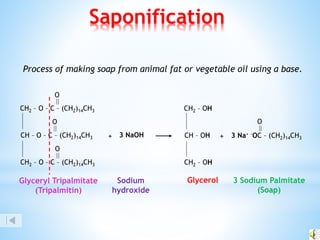
Saponification
Glyceryl Tripalmitate
(Tripalmitin)
Glycerol 3 Sodium Palmitate
(Soap)
CH2 – O – C – (CH2)14CH3
CH – O – C – (CH2)14CH3
CH2 – O – C – (CH2)14CH3
O
O
O
CH2 – OH
CH – OH
CH2 – OH
O
3 Na+ -OC – (CH2)14CH3
3 NaOH
+ +
Sodium
hydroxide
Process of making soap from animal fat or vegetable oil using a base.
Sodium Palmitate (Soap)
Palmitic acid, or hexadecanoic acid
Most common fatty acid (saturated) found in animals, plants and
micro-organisms.
Chemical formula CH3(CH2)14COOH.
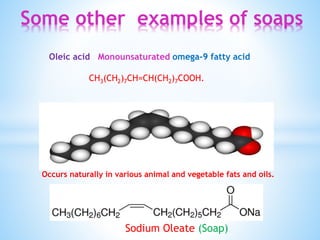
Some other examples of soaps
Sodium Oleate (Soap)
Oleic acid Monounsaturated omega-9 fatty acid
CH3(CH2)7CH=CH(CH2)7COOH.
Occurs naturally in various animal and vegetable fats and oils.
Sodium Stearate (Soap)
Kelter, Carr, Scott, Chemistry A Wolrd of Choices 1999, page 257
Fatty acid
Carboxylic acid group
Soap
COO- bonds to a metal ion (Na+)
Na+
H+ lost from COOH
Copyright © 2007 Pearson Benjamin Cummings. All rights reserved.
Sodium
stearate:
a soap
Sodium
dodecyl
sulfate:
a detergent
Raw Materials for Soap
Tallow- Obtained from cattle, sheep, goat etc. animals.
Olein 40% Stearin 60%.
Soap prepared from tallow alone is hard and
water insoluble.
In order to make it soft and water soluble it is mixed
with coconut oil, palm oil, cotton seed oil.
CH2 – O – C – (CH2)16CH3
CH – O – C – (CH2)16CH3
CH2 – O – C – (CH2)16CH3
O
O
O
Stearin
Saturated
CH2 – O – C – (CH2)7CH=CH-(CH2)7 -CH3
CH – O – C – (CH2)7 CH=CH-(CH2)7 -CH3
CH2 – O – C – (CH2)7CH=CH-(CH2)7 -CH3
O
O
O
Olein
Unsaturated
Grease or Lard- Obtained from mail pig and smaller domestic
animals.
Olein 60% Stearin 40%.
It is soft like butter. Used for making best quality soap
Coconut oil- Rich in Lauric and Myristic acid
CH3(CH2)10-COOH. Lauric acid CH3(CH2)12-COOH. Myristic acid
Gives hard white soap lathers even in salty water. So used as a marine soap
Palm oil- Toilet soaps Palmitin CH3(CH2)14-COOH
Olein CH3(CH2)7CH=CH(CH2)7COOH.
Castor oil- Trasperent Soaps Ricinolic acid (Hydroxy unsat. Acid)
CH3(CH2)6CH=CH(CH2)7-CH-COOH.
OH
Linseed oil- soft soaps
Linoleic acid C17H31-COOH
CH3(CH2)4CH=CH-CH2 -CH=CH-(CH2)7-COOH.
Di unsaturated
Cotton seed oil- olein ,stearin and palmitin
Soap lathers freely
Ground nut oil- Large proportion of unsat. Oleic acid so form
very soft soap. Therefore it is saturated.
Maize oil- Linoleic and oleic acid
Fatty Acids-
Alkaline Materials
Common salt
Other Additives
1 Rosins Plant product obtained from pine tree.
Abietic acid
Modified by hydrogenation, polymarisation
Increases Lathering property.
2 Builders- Increases cleaning capacity,T exture of soap, prevention
of precipitation in hard water.
Sodium metasilicate, Na2SiO3,
Borax-sodium borate
Washing soda
Starch
3Antioxidants- Sodium thiosulphate , EDTA, Sodium hyposulphite
4 Fillers-Magnesium carbonate, chalk
5 Coloring matter
6 Perfumes
7 Fixatives
8 Optical brightners- phenyl benzothizole,
benzocoumarin
Types of soaps
1.Washing Soap
2. Tiolet Soap
3. Shaving Soap
4. Industrial Soap
Ads’ and soaps
Among the consumer products aggressively
advertised, bath soap’s are in the top of the list.
Although, a bath soaps basic function is to clean
the body, the advertisements confer exotic
qualities to it. Soaps are being advertised as
- Beauty soaps - Cinema stars are their brand
ambassadors
- Health soaps - Sports person used to sponsor
them
- Complexion soaps
- Deodorant soaps
- Freshness soaps
- Baby soaps
- Herbal or medicinal soaps
None of the advertisements speak of what
exactly, goes into the making of such soaps.
Can medicated soaps readily cure skin diseases?
Are glycerine transparent soaps really gentle to
the skin ?
As mentioned earlier soaps are salts
particularly sodium or potassium of long chain
fatty acids. These carboxylic acids are derived
from fatty oils. The principal active cleaning
agent is sodium carboxylate.
This is how
its done in
the lab..!!
CHEMICAL REACTION:
Soap dissolves in water. A soap molecule has a long hydrocarbon
End and a short ionic end containing COONa+.The non-ionic
hydrocarbon end has the property to repel water. (hydrophobic
tail). The ionic end has the property to attract water. This end
attaches itself to water.(hydrophilic head). The hydrocarbon end
attaches to the dirt or grease to form structures called ‘micelles’
How does soap clean..
See how the dirt is removed..!!
*
Micelle
Timberlake, Chemistry 7th Edition, page 573
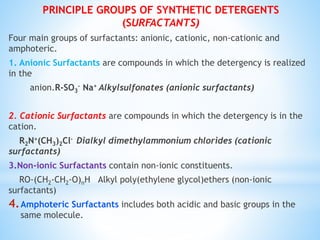
PRINCIPLE GROUPS OF SYNTHETIC DETERGENTS
(SURFACTANTS)
Four main groups of surfactants: anionic, cationic, non-cationic and
amphoteric.
1. Anionic Surfactants are compounds in which the detergency is realized
in the
anion.R-SO3
- Na+ Alkylsulfonates (anionic surfactants)
2. Cationic Surfactants are compounds in which the detergency is in the
cation.
R2N+(CH3)2Cl- Dialkyl dimethylammonium chlorides (cationic
surfactants)
3.Non-ionic Surfactants contain non-ionic constituents.
RO-(CH2-CH2-O)nH Alkyl poly(ethylene glycol)ethers (non-ionic
surfactants)
4.Amphoteric Surfactants includes both acidic and basic groups in the
same molecule.
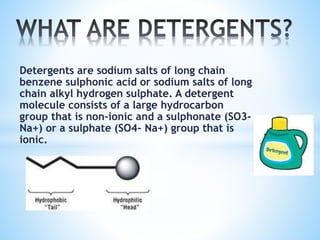
Detergents are sodium salts of long chain
benzene sulphonic acid or sodium salts of long
chain alkyl hydrogen sulphate. A detergent
molecule consists of a large hydrocarbon
group that is non-ionic and a sulphonate (SO3-
Na+) or a sulphate (SO4- Na+) group that is
ionic.
DETERGENT, The king
and DIRT, The Slave..!!
SOAPS V/S DETERGENTS
Detergents are not bio-
degradable. They pollute
water and soil.
DISADVANTAGES
Thanks

Soaps_and_Detergents_SRM_-1.pptx

  • 1.
    Soaps and Detergents B.Sc. III Chemistry Dr. S. R. Mane M.Sc. B.Ed. Ph.D. Associate Prof.& Head, Dept. of Chemistry, Smt. K.R.P.Kanya Mahavidyalaya, Islampur
  • 2.
    4. Soaps andDetergents Lectures 7 4.1 Introduction 4.2 Soaps i. Raw materials, ii. Types of soaps iii. Cleaning action of soap 4.3 Manufacture of soap i. Cold Process ii. Semi-boiled Process iii. Boiled or Hot Process 4.3 Detergents i. Raw Materials ii. Types of Detergents: Anionic, cationic and amphoteric 4.4 Comparisons between soaps and detergents. Semester-V Paper-XII (Industrial Chemistry)
  • 3.
    INTRODUCTION Soaps And Detergents areused for washing. It dissolves dirt, but some dirt will not dissolve in water. Soaps and detergents help water to remove dirt.
  • 6.
    Saponification Glyceryl Tripalmitate (Tripalmitin) Glycerol 3Sodium Palmitate (Soap) CH2 – O – C – (CH2)14CH3 CH – O – C – (CH2)14CH3 CH2 – O – C – (CH2)14CH3 O O O CH2 – OH CH – OH CH2 – OH O 3 Na+ -OC – (CH2)14CH3 3 NaOH + + Sodium hydroxide Process of making soap from animal fat or vegetable oil using a base.
  • 7.
    Sodium Palmitate (Soap) Palmiticacid, or hexadecanoic acid Most common fatty acid (saturated) found in animals, plants and micro-organisms. Chemical formula CH3(CH2)14COOH.
  • 8.
    Some other examplesof soaps Sodium Oleate (Soap) Oleic acid Monounsaturated omega-9 fatty acid CH3(CH2)7CH=CH(CH2)7COOH. Occurs naturally in various animal and vegetable fats and oils.
  • 9.
  • 10.
    Kelter, Carr, Scott,Chemistry A Wolrd of Choices 1999, page 257 Fatty acid Carboxylic acid group Soap COO- bonds to a metal ion (Na+) Na+ H+ lost from COOH
  • 11.
    Copyright © 2007Pearson Benjamin Cummings. All rights reserved. Sodium stearate: a soap Sodium dodecyl sulfate: a detergent
  • 12.
    Raw Materials forSoap Tallow- Obtained from cattle, sheep, goat etc. animals. Olein 40% Stearin 60%. Soap prepared from tallow alone is hard and water insoluble. In order to make it soft and water soluble it is mixed with coconut oil, palm oil, cotton seed oil. CH2 – O – C – (CH2)16CH3 CH – O – C – (CH2)16CH3 CH2 – O – C – (CH2)16CH3 O O O Stearin Saturated CH2 – O – C – (CH2)7CH=CH-(CH2)7 -CH3 CH – O – C – (CH2)7 CH=CH-(CH2)7 -CH3 CH2 – O – C – (CH2)7CH=CH-(CH2)7 -CH3 O O O Olein Unsaturated
  • 13.
    Grease or Lard-Obtained from mail pig and smaller domestic animals. Olein 60% Stearin 40%. It is soft like butter. Used for making best quality soap Coconut oil- Rich in Lauric and Myristic acid CH3(CH2)10-COOH. Lauric acid CH3(CH2)12-COOH. Myristic acid Gives hard white soap lathers even in salty water. So used as a marine soap Palm oil- Toilet soaps Palmitin CH3(CH2)14-COOH Olein CH3(CH2)7CH=CH(CH2)7COOH. Castor oil- Trasperent Soaps Ricinolic acid (Hydroxy unsat. Acid) CH3(CH2)6CH=CH(CH2)7-CH-COOH. OH
  • 14.
    Linseed oil- softsoaps Linoleic acid C17H31-COOH CH3(CH2)4CH=CH-CH2 -CH=CH-(CH2)7-COOH. Di unsaturated Cotton seed oil- olein ,stearin and palmitin Soap lathers freely Ground nut oil- Large proportion of unsat. Oleic acid so form very soft soap. Therefore it is saturated. Maize oil- Linoleic and oleic acid Fatty Acids- Alkaline Materials
  • 15.
    Common salt Other Additives 1Rosins Plant product obtained from pine tree. Abietic acid Modified by hydrogenation, polymarisation Increases Lathering property.
  • 16.
    2 Builders- Increasescleaning capacity,T exture of soap, prevention of precipitation in hard water. Sodium metasilicate, Na2SiO3, Borax-sodium borate Washing soda Starch 3Antioxidants- Sodium thiosulphate , EDTA, Sodium hyposulphite 4 Fillers-Magnesium carbonate, chalk 5 Coloring matter 6 Perfumes 7 Fixatives 8 Optical brightners- phenyl benzothizole, benzocoumarin
  • 17.
    Types of soaps 1.WashingSoap 2. Tiolet Soap 3. Shaving Soap 4. Industrial Soap
  • 18.
    Ads’ and soaps Amongthe consumer products aggressively advertised, bath soap’s are in the top of the list. Although, a bath soaps basic function is to clean the body, the advertisements confer exotic qualities to it. Soaps are being advertised as - Beauty soaps - Cinema stars are their brand ambassadors - Health soaps - Sports person used to sponsor them - Complexion soaps
  • 19.
    - Deodorant soaps -Freshness soaps - Baby soaps - Herbal or medicinal soaps
  • 20.
    None of theadvertisements speak of what exactly, goes into the making of such soaps. Can medicated soaps readily cure skin diseases? Are glycerine transparent soaps really gentle to the skin ? As mentioned earlier soaps are salts particularly sodium or potassium of long chain fatty acids. These carboxylic acids are derived from fatty oils. The principal active cleaning agent is sodium carboxylate.
  • 21.
    This is how itsdone in the lab..!! CHEMICAL REACTION:
  • 22.
    Soap dissolves inwater. A soap molecule has a long hydrocarbon End and a short ionic end containing COONa+.The non-ionic hydrocarbon end has the property to repel water. (hydrophobic tail). The ionic end has the property to attract water. This end attaches itself to water.(hydrophilic head). The hydrocarbon end attaches to the dirt or grease to form structures called ‘micelles’ How does soap clean..
  • 23.
    See how thedirt is removed..!!
  • 24.
  • 25.
    PRINCIPLE GROUPS OFSYNTHETIC DETERGENTS (SURFACTANTS) Four main groups of surfactants: anionic, cationic, non-cationic and amphoteric. 1. Anionic Surfactants are compounds in which the detergency is realized in the anion.R-SO3 - Na+ Alkylsulfonates (anionic surfactants) 2. Cationic Surfactants are compounds in which the detergency is in the cation. R2N+(CH3)2Cl- Dialkyl dimethylammonium chlorides (cationic surfactants) 3.Non-ionic Surfactants contain non-ionic constituents. RO-(CH2-CH2-O)nH Alkyl poly(ethylene glycol)ethers (non-ionic surfactants) 4.Amphoteric Surfactants includes both acidic and basic groups in the same molecule.
  • 26.
    Detergents are sodiumsalts of long chain benzene sulphonic acid or sodium salts of long chain alkyl hydrogen sulphate. A detergent molecule consists of a large hydrocarbon group that is non-ionic and a sulphonate (SO3- Na+) or a sulphate (SO4- Na+) group that is ionic.
  • 27.
    DETERGENT, The king andDIRT, The Slave..!!
  • 28.
  • 30.
    Detergents are notbio- degradable. They pollute water and soil. DISADVANTAGES
  • 31.