Common Toxicology sukit wipusattaya Emergency Medicine
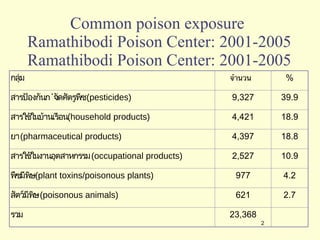
Common poison exposure  Ramathibodi Poison Center: 2001-2005 Ramathibodi Poison Center: 2001-2005 กลุ่ม จํานวน % สารป้องกันกำจัดศัตรูพืช  (pesticides) 9,327 39.9 สารใช้ในบ้านเรือน (household products) 4,421 18.9 ยา  (pharmaceutical products) 4,397 18.8 สารใช้ในงานอุตสาหกรรม  (occupational products) 2,527 10.9 พืชมีพิษ (plant toxins/poisonous plants) 977 4.2 สัตว์มีพิษ  (poisonous animals) 621 2.7 รวม 23,368
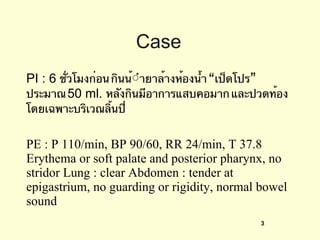
Case PI : 6  ชั่วโมงก่อน กินน้ํายาล้างห้องน้ำ “เป็ดโปร” ประมาณ  50 ml.  หลังกินมีอาการแสบคอมาก และปวดท้องโดยเฉพาะบริเวณลิ้นปี่ PE : P 110/min, BP 90/60, RR 24/min, T 37.8 Erythema or soft palate and posterior pharynx, no stridor Lung : clear Abdomen : tender at epigastrium, no guarding or rigidity, normal bowel sound
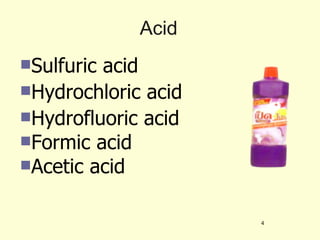
Acid Sulfuric acid Hydrochloric acid Hydrofluoric acid Formic acid  Acetic acid
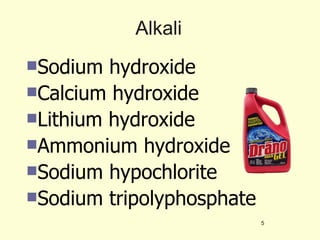
Alkali Sodium hydroxide Calcium hydroxide Lithium hydroxide Ammonium hydroxide Sodium hypochlorite Sodium tripolyphosphate
determinants of damaging potential Volume  Concentration Physical state pH
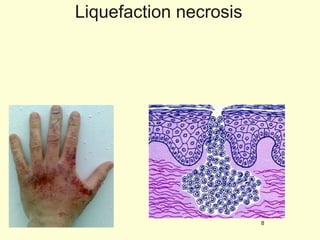
Alkali burn Liquefaction necrosis Protein dissolution, collagen destruction, fat saponification and cell membrane emulsification Facilitate penetration of the alkali often injure oropharynx and proximal esophagus
Liquefaction necrosis
Coagulation necrosis   protein precipitation and eschar formation tend to be protective against deep injury Acid Ingestion
Pathology Ingestion:  Squamous epithelium Erythema, edema, erosion, ulcer Lowest tensile strength of the esophagus: Day 3-14 Collagen organization and epithelial repair in months Shortening and dysmotility Increase risk of squamous cell CA x 20-40
Clinical manifestations Drooling --> oropharyngeal injury  Odynophagia ,dysphagia --> esophageal injury Abdominal pain,GI bleed --> stomach injury  Dysphonia,stridor,resp distress --> laryngotracheal injury  Retrosternal chest pain --> mediastinitis Signs of complication: GI hemorrhage Laryngeal involvement Esophageal perforation
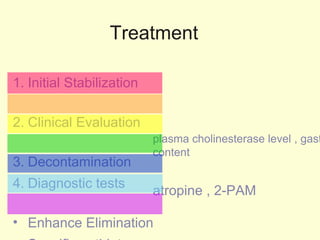
TREATMENT Initial Stabilization Clinical Evaluation Decontamination Diagnostic tests Enhance Elimination Specific antidotes Supportive care
Initial stabilization Personal protective equipment Airway: indications for  early intubation Stridor Dyspnea Oropharyngeal obstruction Blind nasotracheal intubation is  contraindicated
Clinical Evaluation History  type and amount of caustic ingested intentional or unintentional ingestion Physical examination determine hemodynamic stability etiology of shock (GI bleed , volume deplete) examine peritoneal sign & mediastinitis examine eye & skin
Decontamination contraindicated No role of dilution or neutralization
Diagnostic test arterial blood gas electrolyte liver function complete blood count coagulation profile calcium & magnesium ( HF acid) Chest x-ray EKG
Enhance elimination No role of enhance elimination
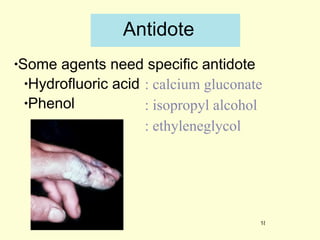
Antidote Some agents need specific antidote Hydrofluoric acid  Phenol : calcium gluconate : isopropyl alcohol  : ethyleneglycol
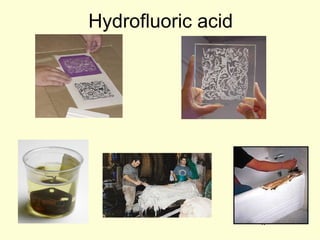
Hydrofluoric acid
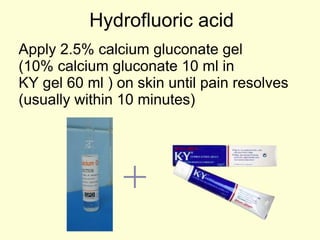
Hydrofluoric acid Apply 2.5% calcium gluconate gel  (10% calcium gluconate 10 ml in  KY gel 60 ml ) on skin until pain resolves (usually within 10 minutes) +
Supportive care Endoscopy Benefits: treatment plan, disposition and prognosis Timing:  4-6 hours post-ingestion: avoid underestimation Not later than 48 hours post-ingestion Indications: All intentional ingestion  Presence of symptom or sign of corrosive injury
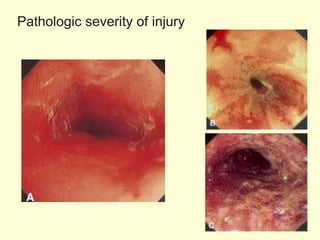
Grade 0: Normal Grade I: Mucosal edema or hyperemia Grade II: Ulceration IIa: superficial ulceration IIb: deep discrete or superficial ulceration Grade III: Necrosis IIIa: small, scattered areas of necrosis IIIb: extensive necrosis Grading of Esophageal injury
Pathologic severity of injury
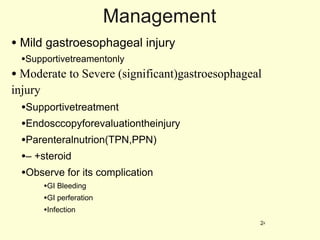
Management Mild gastroesophageal injury  Supportivetreamentonly Moderate to Severe (significant)gastroesophageal injury  Supportivetreatment Endosccopyforevaluationtheinjury  Parenteralnutrion(TPN,PPN)  –  +steroid Observe for its complication GI Bleeding GI perferation  Infection
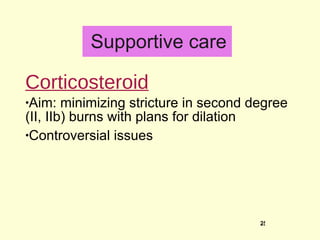
Supportive care Corticosteroid Aim: minimizing stricture in second degree (II, IIb) burns with plans for dilation Controversial issues
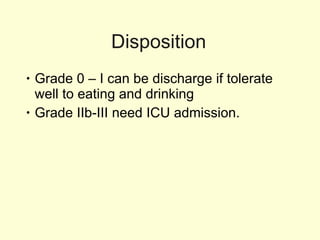
Disposition Grade 0 – I can be discharge if tolerate well to eating and drinking Grade IIb-III need ICU admission.
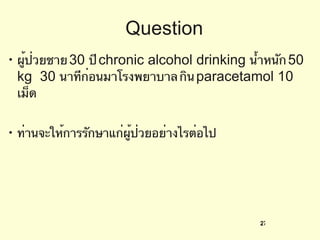
Question ผู้ป่วยชาย  30  ปี  chronic alcohol drinking  น้ำหนัก  50 kg  30  นาทีก่อนมาโรงพยาบาล กิน  paracetamol 10  เม็ด  ท่านจะให้การรักษาแก่ผู้ป่วยอย่างไรต่อไป
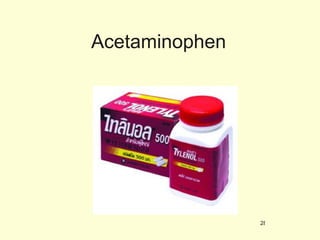
Acetaminophen
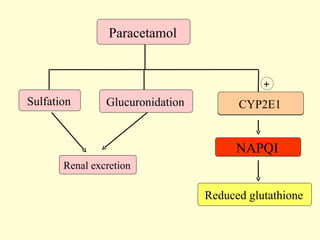
Paracetamol Sulfation Glucuronidation CYP2E1 Renal excretion NAPQI Reduced glutathione + CYP2E1 NAPQI
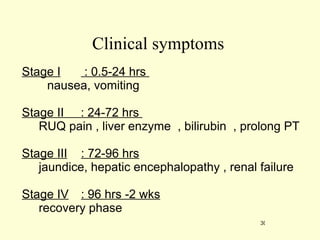
Clinical symptoms Stage I  : 0.5-24 hrs  nausea, vomiting Stage II  : 24-72 hrs  RUQ pain , liver enzyme  , bilirubin  , prolong PT Stage III : 72-96 hrs jaundice, hepatic encephalopathy , renal failure Stage IV : 96 hrs -2 wks recovery phase
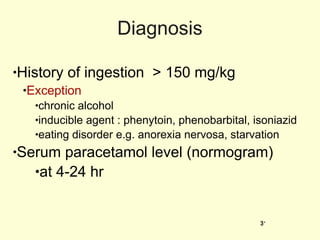
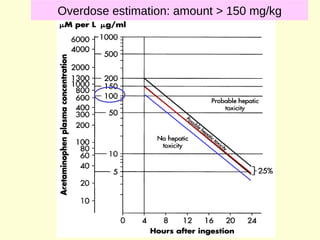
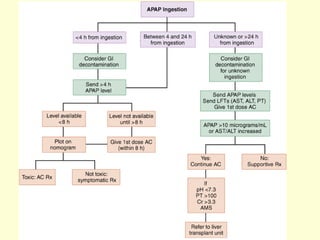
Diagnosis History of ingestion  > 150 mg/kg Exception   chronic alcohol inducible agent : phenytoin, phenobarbital, isoniazid eating disorder e.g. anorexia nervosa, starvation Serum paracetamol level (normogram) at 4-24 hr
Overdose estimation: amount > 150 mg/kg
 
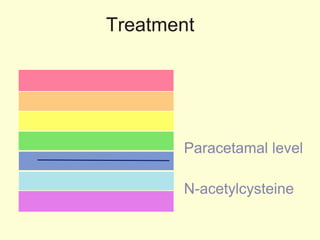
Treatment Paracetamal level N-acetylcysteine
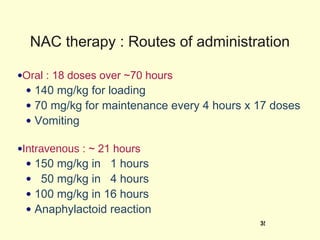
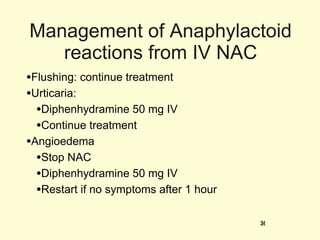
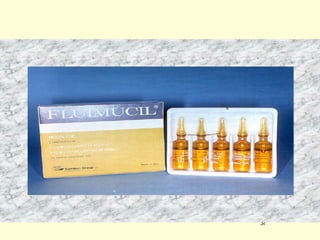
NAC therapy : Routes of administration Oral  : 18 doses over ~70 hours 140 mg/kg for loading 70 mg/kg for maintenance every 4 hours x 17 doses Vomiting Intravenous  : ~ 21 hours 150 mg/kg in  1 hours 50 mg/kg in  4 hours 100 mg/kg in 16 hours Anaphylactoid reaction
Management of Anaphylactoid reactions from IV NAC Flushing: continue treatment Urticaria:  Diphenhydramine 50 mg IV Continue treatment Angioedema Stop NAC Diphenhydramine 50 mg IV Restart if no symptoms after 1 hour
 
 
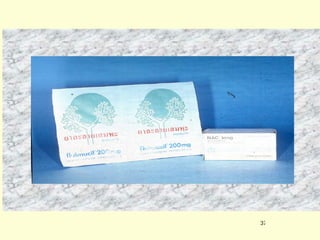
Disposition Follow up LFT at 48 hrs , PT BUN/Cr at day 7 If liver enzyme >1000  PT , BUN/Cr NAC 150 mg/kg/day  until clinical improve , PT normal
ผู้ป่วยรายใดที่กิน  paracent 10  เม็ดแล้วอาจไม่ต้องให้  acetylcysteine - chronic alcohol - acute alcohol  - seizure on phenytoin - TB on IRZE - starvation
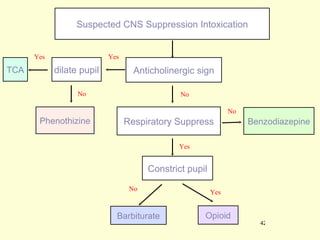
Case ผู้ป่วยชายอายุ  47  ปี มาด้วยอาการหมดสติ ไม่ค่อยรู้สึกตัว ตรวจร่างกายพบ  RR=8 , BP=80/50 , PR=60 T=36 O2sat = 85% E1V1M5 , pupil 1mm SRTL ,  lung clear  , absent bowel sound ,  no sweating , DTX=141
Suspected CNS Suppression Intoxication Anticholinergic sign Respiratory Suppress Constrict pupil dilate pupil Phenothizine TCA Benzodiazepine Opioid Barbiturate Yes Yes Yes Yes No No No No
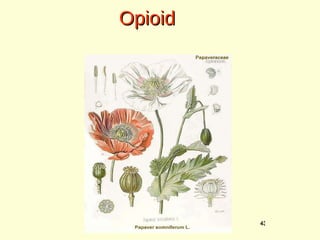
Opioid
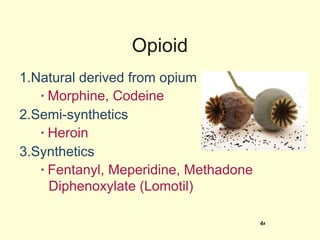
Opioid 1.Natural derived from opium Morphine, Codeine 2.Semi-synthetics Heroin 3.Synthetics Fentanyl, Meperidine, Methadone Diphenoxylate (Lomotil)
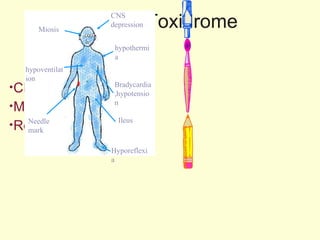
Opioid Toxidrome CNS depression Miosis Respiratory depression Miosis  hypoventilation hypothermia CNS depression Bradycardia ,hypotension Ileus  Hyporeflexia  Needle mark
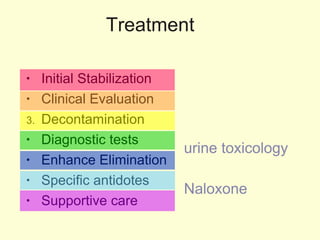
Treatment Initial Stabilization  Clinical Evaluation  Decontamination Diagnostic tests  Enhance Elimination Specific antidotes  Supportive care urine toxicology Naloxone
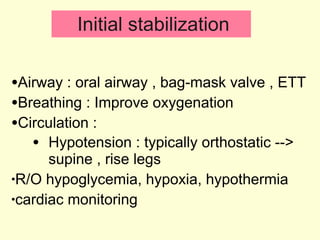
Initial stabilization Airway : oral airway , bag-mask valve , ETT  Breathing : Improve oxygenation  Circulation : Hypotension : typically orthostatic --> supine , rise legs R/O hypoglycemia, hypoxia, hypothermia cardiac monitoring
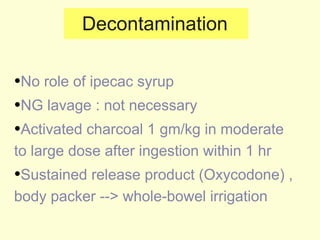
Decontamination No role of ipecac syrup  NG lavage : not necessary  Activated charcoal 1 gm/kg in moderate to large dose after ingestion within 1 hr Sustained release product (Oxycodone) , body packer --> whole-bowel irrigation
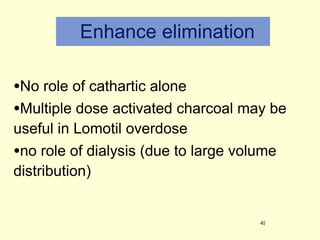
Enhance elimination No role of cathartic alone  Multiple dose activated charcoal may be useful in Lomotil overdose  no role of dialysis (due to large volume distribution)
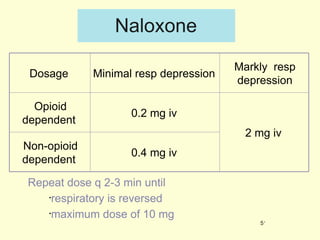
Naloxone   Opioid antagonist : reverses almost all adverse effects mediated through opioid receptors  Empiric use may assist in diagnosis Can administered IV , IM , ETT Onset of action (iv) 1-2 mins Duration of action 20-90 mins
Naloxone  Repeat dose q 2-3 min until  respiratory is reversed  maximum dose of 10 mg  Dosage  Minimal resp depression  Markly  resp depression Opioid dependent  0.2 mg iv  2 mg iv  Non-opioid dependent  0.4 mg iv
Case ผู้ป่วยชายอายุ  50  ปี มาด้วยอาการหมดสติ ไม่ค่อยรู้สึกตัว  PE : RR=14 , BP=120/80 , PR=60 T=36 O2sat = 92%  a man with drownsiness , hypersalivation heart : regular lung : wheezing and rhonchi  both lung  abdomen : hyperactive bowel sound  extremities: sweating  E2V2M5 , pupil 1 mm SRTL
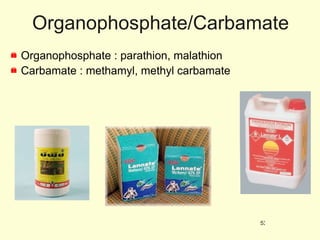
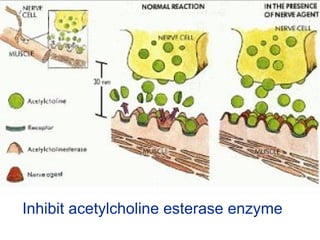
Organophosphate/Carbamate Organophosphate : parathion, malathion Carbamate : methamyl, methyl carbamate
Inhibit acetylcholine esterase enzyme
 
 
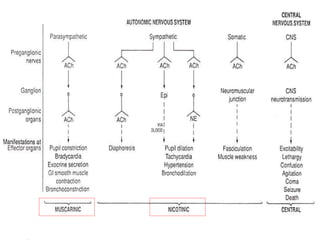
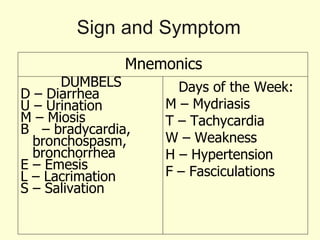
Sign and Symptom Mnemonics DUMBELS D – Diarrhea U – Urination M – Miosis B  – bradycardia, bronchospasm, bronchorrhea   E – Emesis L – Lacrimation S – Salivation Days of the Week: M – Mydriasis T – Tachycardia W – Weakness H – Hypertension F – Fasciculations
Treatment plasma cholinesterase level , gastric content atropine , 2-PAM Initial Stabilization  Clinical Evaluation  Decontamination Diagnostic tests  Enhance Elimination Specific antidotes  Supportive care
Atropine Atropine 0.02 - 0.05 mg/kg (1-3 mg)  q 5 min until Control of mucous membrane hypersecretion Airway clear May require 200 - 500 mg in 1st hr Not active at nicotinic sites
Pralidoxime (2-PAM) Pralidoxime 1-2 g bolus (20-50 mg/kg)   Then 500 mg/hr (10-25 mg/kg/hr) Monitor clinical and AChE level
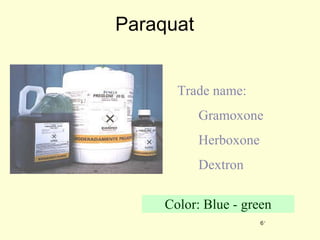
Paraquat Trade name: Gramoxone Herboxone Dextron Color: Blue - green
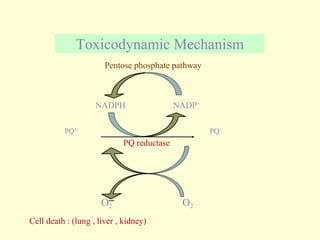
Toxicodynamic Mechanism PQ 2+ PQ + NADP + NADPH O 2 . PQ reductase Pentose phosphate pathway Cell death : (lung , liver , kidney) O 2
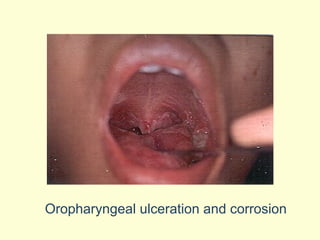
Oropharyngeal ulceration and corrosion
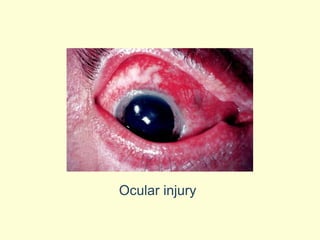
Ocular injury
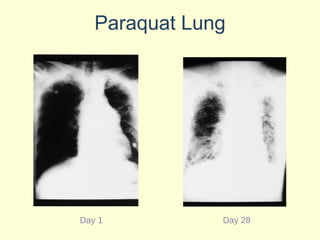
Clinical symptoms GI : like corrosive agent Cardiovascular : Hypovolemia, shock, dysrhythmias Renal  :  acute tubular necrosis , renal failure Hepatobilliary : hepatitis , hepatic necrosis Respiratory : mediastinitis, pneumothorax, hemoptysis, pulmonary edema, and hemorrhage,  pulmonary fibrosis
Paraquat Lung Day 1 Day 28
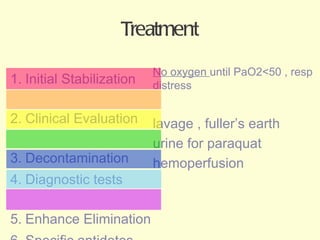
Treatment No oxygen  until PaO2<50 , resp distress lavage , fuller’s earth urine for paraquat hemoperfusion Initial Stabilization  Clinical Evaluation  Decontamination Diagnostic tests  Enhance Elimination Specific antidotes  Supportive care
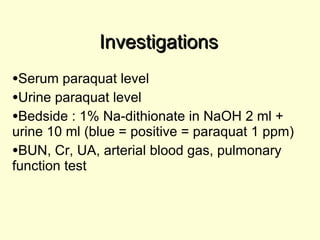
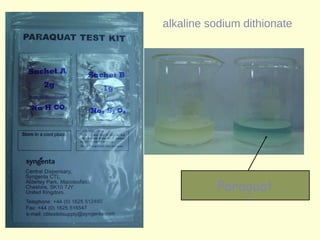
Investigations Serum paraquat level Urine paraquat level Bedside : 1% Na-dithionate in NaOH 2 ml + urine 10 ml (blue = positive = paraquat 1 ppm) BUN, Cr, UA, arterial blood gas, pulmonary function test
alkaline sodium dithionate Paraquat
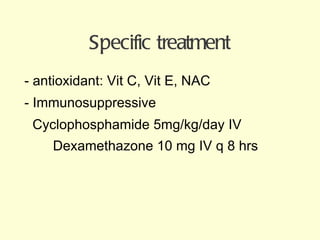
- antioxidant: Vit C, Vit E, NAC - Immunosuppressive Cyclophosphamide 5mg/kg/day IV  Dexamethazone 10 mg IV q 8 hrs  Specific treatment
Case เด็กผู้ชาย  5  ปี CC.  กินแชมพู 30  นาทีก่อนมาโรงพยาบาล PI. 30  นาที  ก่อนมารพ .  ผู้ป่วยกินแชมพูสระผมประมาณ  5  อึก หลังกินมีอาการปวดชาลิ้นเล็กน้อย มารดาพยายามล้วงคอผู้ให้อาเจียน แต่ไม่อาเจียน จึงมารพ .  ผู้ป่วยรู้สึกตัวดี ไม่สำลัก ไม่ปวดท้อง อาการอื่นปกติ PH. ไม่มีโรคประจำตัวใดๆ ไม่เคยแพ้ยาใดๆ
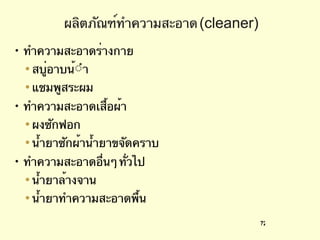
ผลิตภัณฑ์ทำความสะอาด  (cleaner) ทำความสะอาดร่างกาย สบู่อาบน้ํา  แชมพูสระผม ทําความสะอาดเสื้อผ้า ผงซักฟอก  นํ้ายาซักผ้าน้ำยาขจัดคราบ ทําความสะอาดอื่นๆ ทั่วไป  น้ำยาล้างจาน  น้ำยาทำความสะอาดพื้น
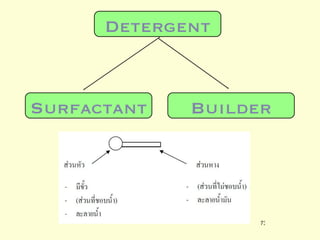
Detergent Surfactant Builder
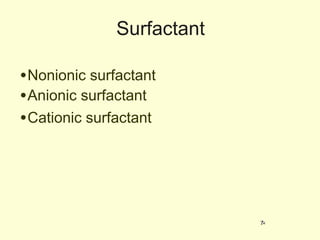
Surfactant Nonionic surfactant  Anionic surfactant  Cationic surfactant 3
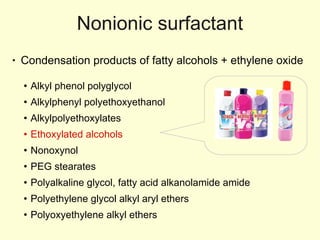
Nonionic surfactant Condensation products of fatty alcohols + ethylene oxide  Alkyl phenol polyglycol Alkylphenyl polyethoxyethanol Alkylpolyethoxylates Ethoxylated alcohols Nonoxynol PEG stearates Polyalkaline glycol, fatty acid alkanolamide amide Polyethylene glycol alkyl aryl ethers Polyoxyethylene alkyl ethers
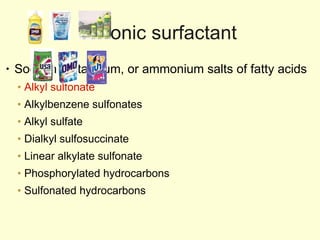
Anionic surfactant Sodium, potassium, or ammonium salts of fatty acids Alkyl sulfonate Alkylbenzene sulfonates Alkyl sulfate Dialkyl sulfosuccinate Linear alkylate sulfonate Phosphorylated hydrocarbons Sulfonated hydrocarbons
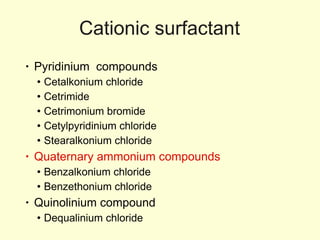
Cationic surfactant Pyridinium  compounds Cetalkonium chloride Cetrimide Cetrimonium bromide Cetylpyridinium chloride Stearalkonium chloride Quaternary ammonium   compounds Benzalkonium chloride Benzethonium chloride Quinolinium compound Dequalinium chloride
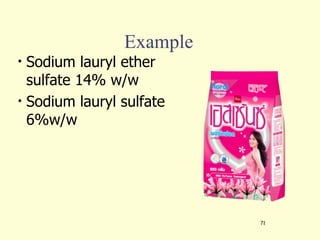
Example Sodium lauryl ether sulfate 14% w/w Sodium lauryl sulfate 6%w/w
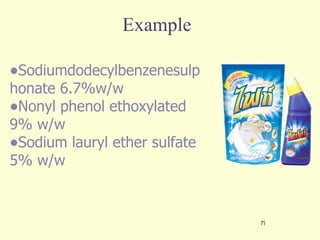
Sodiumdodecylbenzenesulphonate 6.7%w/w  Nonyl phenol ethoxylated 9% w/w Sodium lauryl ether sulfate 5% w/w Example
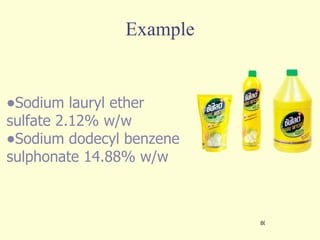
Sodium lauryl ether sulfate 2.12% w/w Sodium dodecyl benzene sulphonate 14.88% w/w Example
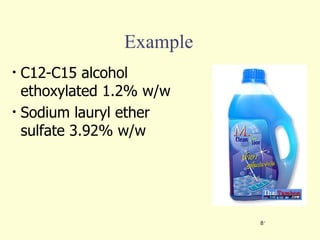
Example C12-C15 alcohol ethoxylated 1.2% w/w  Sodium lauryl ether sulfate 3.92% w/w
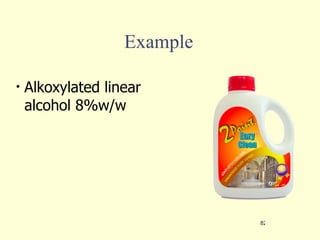
Example Alkoxylated linear alcohol 8%w/w
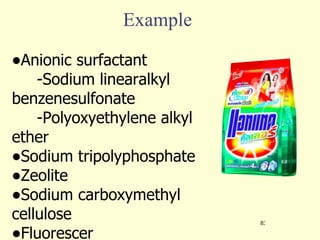
Anionic surfactant   -Sodium linearalkyl benzenesulfonate   -Polyoxyethylene alkyl ether Sodium tripolyphosphate Zeolite Sodium carboxymethyl cellulose Fluorescer Example
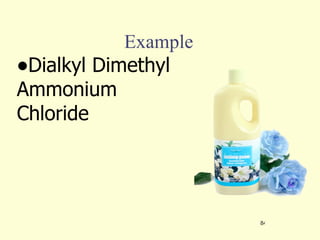
Example Dialkyl Dimethyl Ammonium Chloride
Builder sodium phosphate sodium carbonate sodium metasilicate
Symptoms Nonionic / Anionic  surfactant  mild irritation mild GI symptoms : N/V , abdominal pain --> dehydrate Cationic surfactant like corrosive agent upper airway edema ,  respiratory distress hypotension, metabolic acidosis, CNS depression
GASTROINTESTINAL Nausea, vomiting  diarrhea --> metabolic alkalosis Oral, pharyngeal,esophageal burns   Esophageal stricture  irritation of mucous membranes
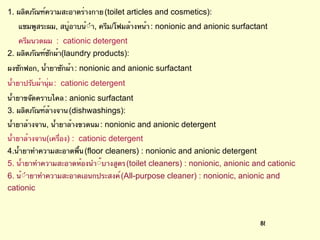
1.  ผลิตภัณฑ์ความสะอาดร่างกาย  (toilet articles and cosmetics):  แชมพูสระผม ,  สบู่อาบน้ํา ,  ครีม / โฟมล้างหน้า  : nonionic and anionic surfactant ครีมนวดผม  :  cationic detergent  2.  ผลิตภัณฑ์ซักผ้า (laundry products):  ผงซักฟอก ,  น้ำยาซักผ้า  : nonionic and anionic surfactant  น้ำยาปรับผ้านุ่ม  :  cationic detergent  น้ำยาขจัดคราบไคล  : anionic surfactant  3.  ผลิตภัณฑ์ล้างจาน  (dishwashings):  น้ำยาล้างจาน ,  น้ำยาล้างขวดนม  : nonionic and anionic detergent  น้ำยาล้างจาน ( เครื่อง ) :  cationic detergent 4. น้ำยาทําความสะอาดพื้น  (floor cleaners) : nonionic and anionic detergent  5.  น้ำ ยาทําความสะอาดห้องนํา้บางสูตร  (toilet cleaners) : nonionic, anionic and cationic  6.  น้ํายาทําความสะอาดเอนกประสงค์  (All-purpose cleaner) : nonionic, anionic and cationic
Additive  enzyme  carboxymethyl cellulose  flourescent whitening agent  เช่น  Pyrazolines, Coumarins corrosion inhibitor  เช่น  sodium silicate  preservative  corrosive  fragrance
TREATMENT Initial Stabilization Clinical Evaluation Decontamination Diagnostic tests Enhance Elimination Specific antidotes Supportive care
Initial Stabilization Airway Management Administer 100% humidified supplemental oxygen, Administer inhaled beta adrenergic agonists if bronchospasm Monitor for evidence of respiratory distress  (stridor, retractions, coughing, tachypnea)  ET tube
Decontamination Eye exposure Remove contact lenses & irrigate eyes with copious amounts of room temp 0.9%NSS or water for >15 mins.  If irritation, pain, swelling, lacrimation, photophobia persist after 15 mins of irrigation  ophthalmologic examination Dermal exposure remove contaminated clothing and jewelry  irrigate  exposed area with copious amounts of water Inhalation exposure Move patient from the toxic environment to fresh air
Nonionic or anionic   is generally self-limiting requiring  no treatment maybe dilute with 120 -  240 ml of water or milk  Cationic detergent  should treat as  corrosive agent Do not induce vomiting If signs or symptoms of esophageal irritation or burns are present, consider  endoscopy   Activated charcoal - unnecessary
Supportive care Treat dermal irritation / burns with standard topical drug Dermal hypersensitivity reactions   Rx.  with systemic / topical corticosteroids / antihistamines
Summary No activated charcoal Nonionic / anionic surfactant dilution by water/milk may NG lavage  improve in 24 hr Cationic surfactant  treat as corrosive agent --> endoscopic
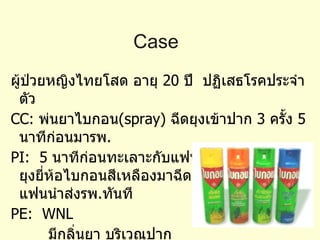
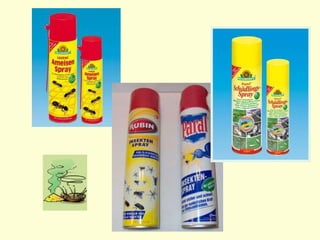
Case  ผู้ป่วยหญิงไทยโสด อายุ  20  ปี  ปฏิเสธโรคประจำตัว CC:  พ่นยาไบกอน (spray)  ฉีดยุงเข้าปาก  3  ครั้ง  5  นาทีก่อนมารพ . PI:  5  นาทีก่อนทะเลาะกับแฟน จึงนำ สเปรย์ฉีดยุงยี่ห้อไบกอนสีเหลืองมาฉีดเข้าปาก  3  ครั้ง  แฟนนำส่งรพ . ทันที PE:  WNL  มีกลิ่นยา บริเวณปาก
 
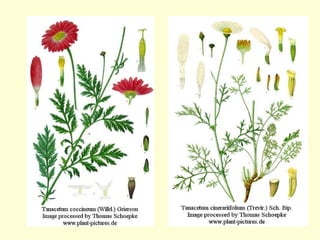
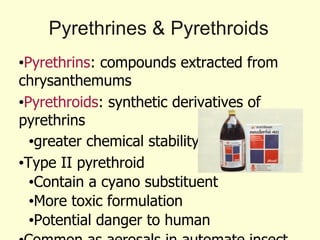
Pyrethrines & Pyrethroids Pyrethrins : compounds extracted from chrysanthemums Pyrethroids : synthetic derivatives of pyrethrins greater chemical stability Type II pyrethroid  Contain a cyano substituent More toxic formulation Potential danger to human Common as aerosals in automate insect spray Less toxic and safer than other compound
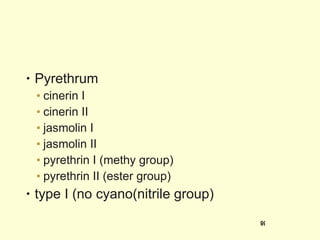
Pyrethrum cinerin I cinerin II jasmolin I jasmolin II pyrethrin I (methy group) pyrethrin II (ester group) type I (no cyano(nitrile group)
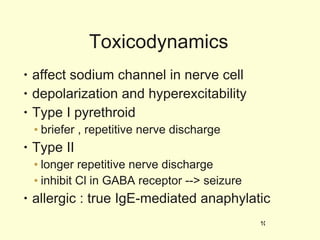
Toxicodynamics affect sodium channel in nerve cell depolarization and hyperexcitability Type I pyrethroid briefer , repetitive nerve discharge Type II longer repetitive nerve discharge inhibit Cl in GABA receptor --> seizure allergic : true IgE-mediated anaphylatic
 
Pyrethrines Pyretrum extract Pyrethrine I Pyretrhrine II Cinerin I Cinerin II Jasmolin I Jasmolin II Pyrethroids Allethine Barthrine Bioallethrine Bioresmethrine Cismethrine Cymethrine Cypermethrine Decamethrine Deltamethrine Fenothrin Fenvalerate Furamethrine tetramethrin
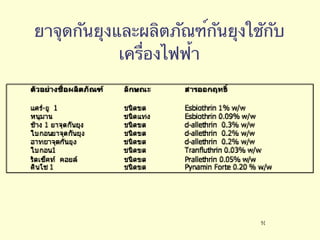
ยาจุดกันยุงและผลิตภัณฑ์กันยุงใชักับเครื่องไฟฟ้า
Mechanism of toxicity 1. Hypersensitivity immediate rhinitis and bronchial hyperreactivity uncertain mechanisms 2. Increase sodium influx into neurons Increase neurotransmitter release
Clinical manifestation Allergic and hypersensitivity Allergic rhinitis Contact dermatitis Asthma Anaphylactoid Dermal and systemic manifestations Abdominal pain, nausea, vomiting within 10 minutes to 1 hours Paresthesia, numbness: onset  hours, duration: less than 24 hours Weakness and muscle fasciculation Seizure In cases of ingestion, beware of hydrocarbon pneumonitis
Respiratory mildly irritate  rhinitis , bronchitis , bronchospasm , asthma Cardiovascular not direct effect Nervous type I : T-syndrome (tremor) type II : CS-syndrome ( choreoathetosis  salivation seizure) skin & mucous membrane allergic contact dermatitis allergic conjunctivitis
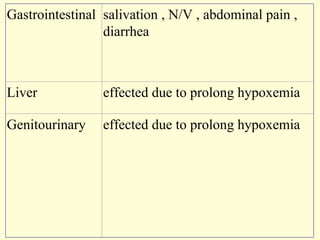
Gastrointestinal  salivation , N/V , abdominal pain , diarrhea Liver effected due to prolong hypoxemia Genitourinary effected due to prolong hypoxemia
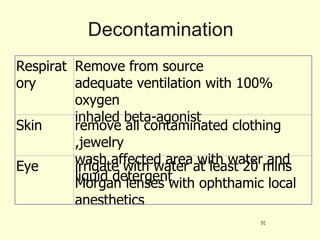
Decontamination Respiratory Remove from source adequate ventilation with 100% oxygen inhaled beta-agonist Skin remove all contaminated clothing ,jewelry wash affected area with water and liquid detergent Eye irrigate with water at least 20 mins Morgan lenses with ophthamic local anesthetics
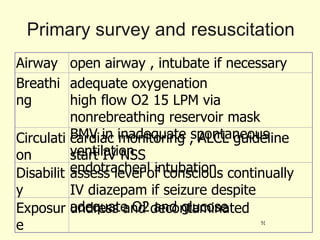
Primary survey and resuscitation Airway open airway , intubate if necessary Breathing adequate oxygenation  high flow O2 15 LPM via nonrebreathing reservoir mask BMV in inadequate spontaneous ventilation endotracheal intubation Circulation cardiac monitoring , ALCL guideline start IV NSS  Disability assess level of conscious continually IV diazepam if seizure despite adequate O2 and glucose Exposure undress and decontaminated
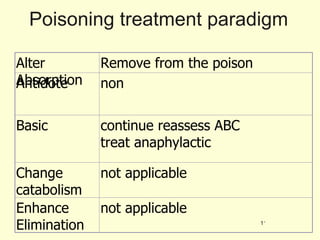
Poisoning treatment paradigm Alter Absorption Remove from the poison Antidote non Basic continue reassess ABC treat anaphylactic Change catabolism not applicable Enhance Elimination not applicable
Treatment Typical GI decontamination Be careful in case of hydrocarbon media Treat allergic symptoms with antihistamine Symptomatic Observe for 6 hrs and d/c if asymptomatic
SAD PERSONS score S ex (male) = 1 A ge less than 19 or greater than 45 years = 1 D epression (patient admits to depression or decreased concentration, sleep, appetite and/or libido =  2 P revious suicide attempt or psychiatric care = 1 E xcessive alcohol or drug use = 1 R ational thinking loss: psychosis, organic brain syndrome =  2 S eparated, divorced, or widowed = 1 O rganized plan or serious attempt =  2 N o social support = 1 S ickness, chronic disease = 1 1 - 2 points low risk, 3-5 points moderate risk, 7-10 high risk

Toxico for extern

  • 1.
    Common Toxicology sukitwipusattaya Emergency Medicine
  • 2.
    Common poison exposure Ramathibodi Poison Center: 2001-2005 Ramathibodi Poison Center: 2001-2005 กลุ่ม จํานวน % สารป้องกันกำจัดศัตรูพืช (pesticides) 9,327 39.9 สารใช้ในบ้านเรือน (household products) 4,421 18.9 ยา (pharmaceutical products) 4,397 18.8 สารใช้ในงานอุตสาหกรรม (occupational products) 2,527 10.9 พืชมีพิษ (plant toxins/poisonous plants) 977 4.2 สัตว์มีพิษ (poisonous animals) 621 2.7 รวม 23,368
  • 3.
    Case PI :6 ชั่วโมงก่อน กินน้ํายาล้างห้องน้ำ “เป็ดโปร” ประมาณ 50 ml. หลังกินมีอาการแสบคอมาก และปวดท้องโดยเฉพาะบริเวณลิ้นปี่ PE : P 110/min, BP 90/60, RR 24/min, T 37.8 Erythema or soft palate and posterior pharynx, no stridor Lung : clear Abdomen : tender at epigastrium, no guarding or rigidity, normal bowel sound
  • 4.
    Acid Sulfuric acidHydrochloric acid Hydrofluoric acid Formic acid Acetic acid
  • 5.
    Alkali Sodium hydroxideCalcium hydroxide Lithium hydroxide Ammonium hydroxide Sodium hypochlorite Sodium tripolyphosphate
  • 6.
    determinants of damagingpotential Volume Concentration Physical state pH
  • 7.
    Alkali burn Liquefactionnecrosis Protein dissolution, collagen destruction, fat saponification and cell membrane emulsification Facilitate penetration of the alkali often injure oropharynx and proximal esophagus
  • 8.
  • 9.
    Coagulation necrosis protein precipitation and eschar formation tend to be protective against deep injury Acid Ingestion
  • 10.
    Pathology Ingestion: Squamous epithelium Erythema, edema, erosion, ulcer Lowest tensile strength of the esophagus: Day 3-14 Collagen organization and epithelial repair in months Shortening and dysmotility Increase risk of squamous cell CA x 20-40
  • 11.
    Clinical manifestations Drooling--> oropharyngeal injury Odynophagia ,dysphagia --> esophageal injury Abdominal pain,GI bleed --> stomach injury Dysphonia,stridor,resp distress --> laryngotracheal injury Retrosternal chest pain --> mediastinitis Signs of complication: GI hemorrhage Laryngeal involvement Esophageal perforation
  • 12.
    TREATMENT Initial StabilizationClinical Evaluation Decontamination Diagnostic tests Enhance Elimination Specific antidotes Supportive care
  • 13.
    Initial stabilization Personalprotective equipment Airway: indications for early intubation Stridor Dyspnea Oropharyngeal obstruction Blind nasotracheal intubation is contraindicated
  • 14.
    Clinical Evaluation History type and amount of caustic ingested intentional or unintentional ingestion Physical examination determine hemodynamic stability etiology of shock (GI bleed , volume deplete) examine peritoneal sign & mediastinitis examine eye & skin
  • 15.
    Decontamination contraindicated Norole of dilution or neutralization
  • 16.
    Diagnostic test arterialblood gas electrolyte liver function complete blood count coagulation profile calcium & magnesium ( HF acid) Chest x-ray EKG
  • 17.
    Enhance elimination Norole of enhance elimination
  • 18.
    Antidote Some agentsneed specific antidote Hydrofluoric acid Phenol : calcium gluconate : isopropyl alcohol : ethyleneglycol
  • 19.
  • 20.
    Hydrofluoric acid Apply2.5% calcium gluconate gel (10% calcium gluconate 10 ml in KY gel 60 ml ) on skin until pain resolves (usually within 10 minutes) +
  • 21.
    Supportive care EndoscopyBenefits: treatment plan, disposition and prognosis Timing: 4-6 hours post-ingestion: avoid underestimation Not later than 48 hours post-ingestion Indications: All intentional ingestion Presence of symptom or sign of corrosive injury
  • 22.
    Grade 0: NormalGrade I: Mucosal edema or hyperemia Grade II: Ulceration IIa: superficial ulceration IIb: deep discrete or superficial ulceration Grade III: Necrosis IIIa: small, scattered areas of necrosis IIIb: extensive necrosis Grading of Esophageal injury
  • 23.
  • 24.
    Management Mild gastroesophagealinjury Supportivetreamentonly Moderate to Severe (significant)gastroesophageal injury Supportivetreatment Endosccopyforevaluationtheinjury Parenteralnutrion(TPN,PPN) – +steroid Observe for its complication GI Bleeding GI perferation Infection
  • 25.
    Supportive care CorticosteroidAim: minimizing stricture in second degree (II, IIb) burns with plans for dilation Controversial issues
  • 26.
    Disposition Grade 0– I can be discharge if tolerate well to eating and drinking Grade IIb-III need ICU admission.
  • 27.
    Question ผู้ป่วยชาย 30 ปี chronic alcohol drinking น้ำหนัก 50 kg 30 นาทีก่อนมาโรงพยาบาล กิน paracetamol 10 เม็ด ท่านจะให้การรักษาแก่ผู้ป่วยอย่างไรต่อไป
  • 28.
  • 29.
    Paracetamol Sulfation GlucuronidationCYP2E1 Renal excretion NAPQI Reduced glutathione + CYP2E1 NAPQI
  • 30.
    Clinical symptoms StageI : 0.5-24 hrs nausea, vomiting Stage II : 24-72 hrs RUQ pain , liver enzyme , bilirubin , prolong PT Stage III : 72-96 hrs jaundice, hepatic encephalopathy , renal failure Stage IV : 96 hrs -2 wks recovery phase
  • 31.
    Diagnosis History ofingestion > 150 mg/kg Exception chronic alcohol inducible agent : phenytoin, phenobarbital, isoniazid eating disorder e.g. anorexia nervosa, starvation Serum paracetamol level (normogram) at 4-24 hr
  • 32.
  • 33.
  • 34.
  • 35.
    NAC therapy :Routes of administration Oral : 18 doses over ~70 hours 140 mg/kg for loading 70 mg/kg for maintenance every 4 hours x 17 doses Vomiting Intravenous : ~ 21 hours 150 mg/kg in 1 hours 50 mg/kg in 4 hours 100 mg/kg in 16 hours Anaphylactoid reaction
  • 36.
    Management of Anaphylactoidreactions from IV NAC Flushing: continue treatment Urticaria: Diphenhydramine 50 mg IV Continue treatment Angioedema Stop NAC Diphenhydramine 50 mg IV Restart if no symptoms after 1 hour
  • 37.
  • 38.
  • 39.
    Disposition Follow upLFT at 48 hrs , PT BUN/Cr at day 7 If liver enzyme >1000 PT , BUN/Cr NAC 150 mg/kg/day until clinical improve , PT normal
  • 40.
    ผู้ป่วยรายใดที่กิน paracent10 เม็ดแล้วอาจไม่ต้องให้ acetylcysteine - chronic alcohol - acute alcohol - seizure on phenytoin - TB on IRZE - starvation
  • 41.
    Case ผู้ป่วยชายอายุ 47 ปี มาด้วยอาการหมดสติ ไม่ค่อยรู้สึกตัว ตรวจร่างกายพบ RR=8 , BP=80/50 , PR=60 T=36 O2sat = 85% E1V1M5 , pupil 1mm SRTL , lung clear , absent bowel sound , no sweating , DTX=141
  • 42.
    Suspected CNS SuppressionIntoxication Anticholinergic sign Respiratory Suppress Constrict pupil dilate pupil Phenothizine TCA Benzodiazepine Opioid Barbiturate Yes Yes Yes Yes No No No No
  • 43.
  • 44.
    Opioid 1.Natural derivedfrom opium Morphine, Codeine 2.Semi-synthetics Heroin 3.Synthetics Fentanyl, Meperidine, Methadone Diphenoxylate (Lomotil)
  • 45.
    Opioid Toxidrome CNSdepression Miosis Respiratory depression Miosis hypoventilation hypothermia CNS depression Bradycardia ,hypotension Ileus Hyporeflexia Needle mark
  • 46.
    Treatment Initial Stabilization Clinical Evaluation Decontamination Diagnostic tests Enhance Elimination Specific antidotes Supportive care urine toxicology Naloxone
  • 47.
    Initial stabilization Airway: oral airway , bag-mask valve , ETT Breathing : Improve oxygenation Circulation : Hypotension : typically orthostatic --> supine , rise legs R/O hypoglycemia, hypoxia, hypothermia cardiac monitoring
  • 48.
    Decontamination No roleof ipecac syrup NG lavage : not necessary Activated charcoal 1 gm/kg in moderate to large dose after ingestion within 1 hr Sustained release product (Oxycodone) , body packer --> whole-bowel irrigation
  • 49.
    Enhance elimination Norole of cathartic alone Multiple dose activated charcoal may be useful in Lomotil overdose no role of dialysis (due to large volume distribution)
  • 50.
    Naloxone Opioid antagonist : reverses almost all adverse effects mediated through opioid receptors Empiric use may assist in diagnosis Can administered IV , IM , ETT Onset of action (iv) 1-2 mins Duration of action 20-90 mins
  • 51.
    Naloxone Repeatdose q 2-3 min until respiratory is reversed maximum dose of 10 mg Dosage Minimal resp depression Markly resp depression Opioid dependent 0.2 mg iv 2 mg iv Non-opioid dependent 0.4 mg iv
  • 52.
    Case ผู้ป่วยชายอายุ 50 ปี มาด้วยอาการหมดสติ ไม่ค่อยรู้สึกตัว PE : RR=14 , BP=120/80 , PR=60 T=36 O2sat = 92% a man with drownsiness , hypersalivation heart : regular lung : wheezing and rhonchi both lung abdomen : hyperactive bowel sound extremities: sweating E2V2M5 , pupil 1 mm SRTL
  • 53.
    Organophosphate/Carbamate Organophosphate :parathion, malathion Carbamate : methamyl, methyl carbamate
  • 54.
  • 55.
  • 56.
  • 57.
    Sign and SymptomMnemonics DUMBELS D – Diarrhea U – Urination M – Miosis B – bradycardia, bronchospasm, bronchorrhea E – Emesis L – Lacrimation S – Salivation Days of the Week: M – Mydriasis T – Tachycardia W – Weakness H – Hypertension F – Fasciculations
  • 58.
    Treatment plasma cholinesteraselevel , gastric content atropine , 2-PAM Initial Stabilization Clinical Evaluation Decontamination Diagnostic tests Enhance Elimination Specific antidotes Supportive care
  • 59.
    Atropine Atropine 0.02- 0.05 mg/kg (1-3 mg) q 5 min until Control of mucous membrane hypersecretion Airway clear May require 200 - 500 mg in 1st hr Not active at nicotinic sites
  • 60.
    Pralidoxime (2-PAM) Pralidoxime1-2 g bolus (20-50 mg/kg) Then 500 mg/hr (10-25 mg/kg/hr) Monitor clinical and AChE level
  • 61.
    Paraquat Trade name:Gramoxone Herboxone Dextron Color: Blue - green
  • 62.
    Toxicodynamic Mechanism PQ2+ PQ + NADP + NADPH O 2 . PQ reductase Pentose phosphate pathway Cell death : (lung , liver , kidney) O 2
  • 63.
  • 64.
  • 65.
    Clinical symptoms GI: like corrosive agent Cardiovascular : Hypovolemia, shock, dysrhythmias Renal : acute tubular necrosis , renal failure Hepatobilliary : hepatitis , hepatic necrosis Respiratory : mediastinitis, pneumothorax, hemoptysis, pulmonary edema, and hemorrhage, pulmonary fibrosis
  • 66.
  • 67.
    Treatment No oxygen until PaO2<50 , resp distress lavage , fuller’s earth urine for paraquat hemoperfusion Initial Stabilization Clinical Evaluation Decontamination Diagnostic tests Enhance Elimination Specific antidotes Supportive care
  • 68.
    Investigations Serum paraquatlevel Urine paraquat level Bedside : 1% Na-dithionate in NaOH 2 ml + urine 10 ml (blue = positive = paraquat 1 ppm) BUN, Cr, UA, arterial blood gas, pulmonary function test
  • 69.
  • 70.
    - antioxidant: VitC, Vit E, NAC - Immunosuppressive Cyclophosphamide 5mg/kg/day IV Dexamethazone 10 mg IV q 8 hrs Specific treatment
  • 71.
    Case เด็กผู้ชาย 5 ปี CC. กินแชมพู 30 นาทีก่อนมาโรงพยาบาล PI. 30 นาที ก่อนมารพ . ผู้ป่วยกินแชมพูสระผมประมาณ 5 อึก หลังกินมีอาการปวดชาลิ้นเล็กน้อย มารดาพยายามล้วงคอผู้ให้อาเจียน แต่ไม่อาเจียน จึงมารพ . ผู้ป่วยรู้สึกตัวดี ไม่สำลัก ไม่ปวดท้อง อาการอื่นปกติ PH. ไม่มีโรคประจำตัวใดๆ ไม่เคยแพ้ยาใดๆ
  • 72.
    ผลิตภัณฑ์ทำความสะอาด (cleaner)ทำความสะอาดร่างกาย สบู่อาบน้ํา แชมพูสระผม ทําความสะอาดเสื้อผ้า ผงซักฟอก นํ้ายาซักผ้าน้ำยาขจัดคราบ ทําความสะอาดอื่นๆ ทั่วไป น้ำยาล้างจาน น้ำยาทำความสะอาดพื้น
  • 73.
  • 74.
    Surfactant Nonionic surfactant Anionic surfactant Cationic surfactant 3
  • 75.
    Nonionic surfactant Condensationproducts of fatty alcohols + ethylene oxide Alkyl phenol polyglycol Alkylphenyl polyethoxyethanol Alkylpolyethoxylates Ethoxylated alcohols Nonoxynol PEG stearates Polyalkaline glycol, fatty acid alkanolamide amide Polyethylene glycol alkyl aryl ethers Polyoxyethylene alkyl ethers
  • 76.
    Anionic surfactant Sodium,potassium, or ammonium salts of fatty acids Alkyl sulfonate Alkylbenzene sulfonates Alkyl sulfate Dialkyl sulfosuccinate Linear alkylate sulfonate Phosphorylated hydrocarbons Sulfonated hydrocarbons
  • 77.
    Cationic surfactant Pyridinium compounds Cetalkonium chloride Cetrimide Cetrimonium bromide Cetylpyridinium chloride Stearalkonium chloride Quaternary ammonium compounds Benzalkonium chloride Benzethonium chloride Quinolinium compound Dequalinium chloride
  • 78.
    Example Sodium laurylether sulfate 14% w/w Sodium lauryl sulfate 6%w/w
  • 79.
    Sodiumdodecylbenzenesulphonate 6.7%w/w Nonyl phenol ethoxylated 9% w/w Sodium lauryl ether sulfate 5% w/w Example
  • 80.
    Sodium lauryl ethersulfate 2.12% w/w Sodium dodecyl benzene sulphonate 14.88% w/w Example
  • 81.
    Example C12-C15 alcoholethoxylated 1.2% w/w Sodium lauryl ether sulfate 3.92% w/w
  • 82.
  • 83.
    Anionic surfactant -Sodium linearalkyl benzenesulfonate -Polyoxyethylene alkyl ether Sodium tripolyphosphate Zeolite Sodium carboxymethyl cellulose Fluorescer Example
  • 84.
    Example Dialkyl DimethylAmmonium Chloride
  • 85.
    Builder sodium phosphatesodium carbonate sodium metasilicate
  • 86.
    Symptoms Nonionic /Anionic surfactant mild irritation mild GI symptoms : N/V , abdominal pain --> dehydrate Cationic surfactant like corrosive agent upper airway edema , respiratory distress hypotension, metabolic acidosis, CNS depression
  • 87.
    GASTROINTESTINAL Nausea, vomiting diarrhea --> metabolic alkalosis Oral, pharyngeal,esophageal burns Esophageal stricture irritation of mucous membranes
  • 88.
    1. ผลิตภัณฑ์ความสะอาดร่างกาย (toilet articles and cosmetics): แชมพูสระผม , สบู่อาบน้ํา , ครีม / โฟมล้างหน้า : nonionic and anionic surfactant ครีมนวดผม : cationic detergent 2. ผลิตภัณฑ์ซักผ้า (laundry products): ผงซักฟอก , น้ำยาซักผ้า : nonionic and anionic surfactant น้ำยาปรับผ้านุ่ม : cationic detergent น้ำยาขจัดคราบไคล : anionic surfactant 3. ผลิตภัณฑ์ล้างจาน (dishwashings): น้ำยาล้างจาน , น้ำยาล้างขวดนม : nonionic and anionic detergent น้ำยาล้างจาน ( เครื่อง ) : cationic detergent 4. น้ำยาทําความสะอาดพื้น (floor cleaners) : nonionic and anionic detergent 5. น้ำ ยาทําความสะอาดห้องนํา้บางสูตร (toilet cleaners) : nonionic, anionic and cationic 6. น้ํายาทําความสะอาดเอนกประสงค์ (All-purpose cleaner) : nonionic, anionic and cationic
  • 89.
    Additive enzyme carboxymethyl cellulose flourescent whitening agent เช่น Pyrazolines, Coumarins corrosion inhibitor เช่น sodium silicate preservative corrosive fragrance
  • 90.
    TREATMENT Initial StabilizationClinical Evaluation Decontamination Diagnostic tests Enhance Elimination Specific antidotes Supportive care
  • 91.
    Initial Stabilization AirwayManagement Administer 100% humidified supplemental oxygen, Administer inhaled beta adrenergic agonists if bronchospasm Monitor for evidence of respiratory distress (stridor, retractions, coughing, tachypnea)  ET tube
  • 92.
    Decontamination Eye exposureRemove contact lenses & irrigate eyes with copious amounts of room temp 0.9%NSS or water for >15 mins. If irritation, pain, swelling, lacrimation, photophobia persist after 15 mins of irrigation  ophthalmologic examination Dermal exposure remove contaminated clothing and jewelry irrigate exposed area with copious amounts of water Inhalation exposure Move patient from the toxic environment to fresh air
  • 93.
    Nonionic or anionic is generally self-limiting requiring no treatment maybe dilute with 120 - 240 ml of water or milk Cationic detergent should treat as corrosive agent Do not induce vomiting If signs or symptoms of esophageal irritation or burns are present, consider endoscopy Activated charcoal - unnecessary
  • 94.
    Supportive care Treatdermal irritation / burns with standard topical drug Dermal hypersensitivity reactions  Rx. with systemic / topical corticosteroids / antihistamines
  • 95.
    Summary No activatedcharcoal Nonionic / anionic surfactant dilution by water/milk may NG lavage improve in 24 hr Cationic surfactant treat as corrosive agent --> endoscopic
  • 96.
    Case ผู้ป่วยหญิงไทยโสดอายุ 20 ปี ปฏิเสธโรคประจำตัว CC: พ่นยาไบกอน (spray) ฉีดยุงเข้าปาก 3 ครั้ง 5 นาทีก่อนมารพ . PI: 5 นาทีก่อนทะเลาะกับแฟน จึงนำ สเปรย์ฉีดยุงยี่ห้อไบกอนสีเหลืองมาฉีดเข้าปาก 3 ครั้ง แฟนนำส่งรพ . ทันที PE: WNL มีกลิ่นยา บริเวณปาก
  • 97.
  • 98.
    Pyrethrines & PyrethroidsPyrethrins : compounds extracted from chrysanthemums Pyrethroids : synthetic derivatives of pyrethrins greater chemical stability Type II pyrethroid Contain a cyano substituent More toxic formulation Potential danger to human Common as aerosals in automate insect spray Less toxic and safer than other compound
  • 99.
    Pyrethrum cinerin Icinerin II jasmolin I jasmolin II pyrethrin I (methy group) pyrethrin II (ester group) type I (no cyano(nitrile group)
  • 100.
    Toxicodynamics affect sodiumchannel in nerve cell depolarization and hyperexcitability Type I pyrethroid briefer , repetitive nerve discharge Type II longer repetitive nerve discharge inhibit Cl in GABA receptor --> seizure allergic : true IgE-mediated anaphylatic
  • 101.
  • 102.
    Pyrethrines Pyretrum extractPyrethrine I Pyretrhrine II Cinerin I Cinerin II Jasmolin I Jasmolin II Pyrethroids Allethine Barthrine Bioallethrine Bioresmethrine Cismethrine Cymethrine Cypermethrine Decamethrine Deltamethrine Fenothrin Fenvalerate Furamethrine tetramethrin
  • 103.
  • 104.
    Mechanism of toxicity1. Hypersensitivity immediate rhinitis and bronchial hyperreactivity uncertain mechanisms 2. Increase sodium influx into neurons Increase neurotransmitter release
  • 105.
    Clinical manifestation Allergicand hypersensitivity Allergic rhinitis Contact dermatitis Asthma Anaphylactoid Dermal and systemic manifestations Abdominal pain, nausea, vomiting within 10 minutes to 1 hours Paresthesia, numbness: onset hours, duration: less than 24 hours Weakness and muscle fasciculation Seizure In cases of ingestion, beware of hydrocarbon pneumonitis
  • 106.
    Respiratory mildly irritate rhinitis , bronchitis , bronchospasm , asthma Cardiovascular not direct effect Nervous type I : T-syndrome (tremor) type II : CS-syndrome ( choreoathetosis salivation seizure) skin & mucous membrane allergic contact dermatitis allergic conjunctivitis
  • 107.
    Gastrointestinal salivation, N/V , abdominal pain , diarrhea Liver effected due to prolong hypoxemia Genitourinary effected due to prolong hypoxemia
  • 108.
    Decontamination Respiratory Removefrom source adequate ventilation with 100% oxygen inhaled beta-agonist Skin remove all contaminated clothing ,jewelry wash affected area with water and liquid detergent Eye irrigate with water at least 20 mins Morgan lenses with ophthamic local anesthetics
  • 109.
    Primary survey andresuscitation Airway open airway , intubate if necessary Breathing adequate oxygenation high flow O2 15 LPM via nonrebreathing reservoir mask BMV in inadequate spontaneous ventilation endotracheal intubation Circulation cardiac monitoring , ALCL guideline start IV NSS Disability assess level of conscious continually IV diazepam if seizure despite adequate O2 and glucose Exposure undress and decontaminated
  • 110.
    Poisoning treatment paradigmAlter Absorption Remove from the poison Antidote non Basic continue reassess ABC treat anaphylactic Change catabolism not applicable Enhance Elimination not applicable
  • 111.
    Treatment Typical GIdecontamination Be careful in case of hydrocarbon media Treat allergic symptoms with antihistamine Symptomatic Observe for 6 hrs and d/c if asymptomatic
  • 112.
    SAD PERSONS scoreS ex (male) = 1 A ge less than 19 or greater than 45 years = 1 D epression (patient admits to depression or decreased concentration, sleep, appetite and/or libido = 2 P revious suicide attempt or psychiatric care = 1 E xcessive alcohol or drug use = 1 R ational thinking loss: psychosis, organic brain syndrome = 2 S eparated, divorced, or widowed = 1 O rganized plan or serious attempt = 2 N o social support = 1 S ickness, chronic disease = 1 1 - 2 points low risk, 3-5 points moderate risk, 7-10 high risk

Editor's Notes

  • #5 Acid H2SO4 ( น้ำกรดแบตเตอรี่ , น้ำยาล้างท่อน้ำ ) HCl (metal cleaning) HF (hydrofluoric acid)( ล้างสนิม , ล้างแก้ว ) Formic acid ( กาว , ฟอกหนัง ) Acetic acid (printing&amp;photography)
  • #6 NaOH,KOH ( น้ำยาล้างท่อน้ำ ) (drano) Ca(OH)2 ( ผสมในคอนกรีต ) LiOH ( น้ำยาล้างรูป , แบตเตอรี่ ) NH4OH ( สารฟอกขาว , ปุ๋ยอินทรีย์ ) NaOCl (sodium hypochlorite)( สารฟอกขาวหรือ bleach) Sodium tripolyphosphate ( ผงซักฟอก )
  • #12 Clinical Drooling  oropharyngeal injury Odynophagia ,dysphagia  esophageal injury Abdominal pain,GI bleed  stomach injury Dysphonia,stridor,resp distress  laryngotracheal injury Retrosternal chest pain  mediastinitis การที่ไม่มี lesion ที่ oropharynx ไม่ได้บ่งว่าจะไม่มี lesion ที่ต่ำกว่าลงไป 12% ของผู้ที่มาตอนแรกไม่มี lesion อะไร พบว่า มี esophageal injury ในภายหลัง Perforation อาจเกิดขึ้นในช่วงใดก็ได้ ภายใน 2 wk แรก
  • #21 จับกับ calcium ion เกิดภาวะ hypocalcemia นอกจากนี้ ยังทำให้เกิด hypomagnesemia, hyperkalemia, metabolic acidosis, cardiac dysrhythmia และ cardiac arrest ได้
  • #28 If the time of ingestion is unknown or the span of uncertainty of estimation is large: AST (SGOT) Serum paracetamol level
  • #30 glutathione &lt; 30%
  • #32 enzyme inducer
  • #36 oral VS IV ไม่มีเปรียบเทียบ ผลพอๆกัน ควร start ภายใน 8 ชั่วโมง 0-4,4-8 ผลพอๆกัน ( เกิด significant hepatitis หลัง 8 hr)
  • #37 If the AST &gt; 1,000 u/L or INR &gt; 2 or hepatic encephalopathy develops, intravenous NAC should be given. Endpoint: AST &lt; 1,000 and INR &lt; 2 and Hepatic encephalopathy resolve
  • #40 AST, INR should be followed at least every 24 hours Renal function should be checked when AST &gt; 1,000. The patient should be followed to at least 36 hours after the ingestion. NAC therapy can be discontinue, if at 36 hours (or more) after the ingestion: AST, PT and INR is normal or have returned to normal Serum paracetamol level &lt; 10 mg/L
  • #45 lomotil : diphenoxylate hydrochloride 2.5 mg + atropine sulfate 0.025 mg - เริ่มแรก : anticholinergic toxidrome -2 nd phase : opioid toxidrome - เด็ก &lt; 6yr admit ทุกราย แม้จะกินมาเม็ดเดียวก็ตาม -delayed absorption ได้ถึง 6-12 hr - มี enterohepatic circulation ฉะนั้นมี role ของ multiple dose activated charcoal
  • #46 pethidine,dextro,lomotil,mixed agonist-antagonist, co-ingest with stimulant
  • #49 decontamination no role ipecac syrup NG lavage ไม่จำเป็น โดยเฉพาะถ้าซึม protect airway ไม่ได้ Activated charcoal 1gm/kg within1hr( แต่อาจ delayed ได้ถึง 4hr)
  • #50 increase elimination no role ยาระบาย alone multiple dose activated charcoal อาจมีประโยชน์ใน lomotil overdose (Tintinalli5th) sustained release ,body packer : whole bowel irrigation no role HD
  • #52 dose : ในกลุ่มที่ติดยา ถ้าให้ dose มากไป อาจทำให้เกิด withdrawal ได้ - แนะนำให้ 0.4 mg iv (1 amp ) ในคนไข้ที่ไม่ได้ ติดยาอยู่เดิม - แต่ถ้าติดยาอยู่เดิม ใน Rosen6th แนะนำให้ 0.2 mg iv (1/2 amp) ส่วน Tintinalli ให้ 0.05 mg iv เพราะ Tintinalli กลัว withdraw มากกว่า - แต่ถ้าผู้ป่วย marked resp depression ให้ 2 mg iv ไปเลย ( แต่ในทางปฏิบัติ เราก็จำง่ายๆ ให้ 1 amp iv ไปก่อนทุกราย ) - repeat ได้ทุก 2-3 min จนหายใจดีขึ้น ไม่ใช่ pupil ดีขึ้น - max 10 mg - dose เด็ก สรุปเลย เท่าผู้ใหญ่ - neonate ให้ dose 0.1mg/kg ( ถ้าหนัก 4kg ก็ให้ 0.4mg ก็คือ 1 amp นั่นเอง ) สรุป คือ dose เท่าผู้ใหญ่ - continuous drip กรณี long acting opioid เช่น propoxyphene, methadone, fentanyl โดย drip dose 2/3 ของ wake up dose : เช่น wake up dose = 1 mg , 2/3 = 0.6 mg ให้ผสม 6 mg + 5DW 1000 ml iv drip 100 ml/hr ( จะได้ 0.6 mg/hr) - side eff : น้อย อาจมี n/v ,diarrhea , abd cramp ได้
  • #55 ยับยั้งการทำงานของเอนไซม์ Acetylcholinesterase (AChE) ทำให้มี ACh คั่งสะสมที่ receptor ผลจากการกระตุ้นของ ACh จำนวนมากที่ปลายประสาท
  • #60 1-3 mg
  • #73 ในอดีตเรามีสบู่ใช้ในการทำความสะอาดร่างกาย เสื้อผ้า และ ของใช้ต่างๆ ถึงแม้ว่าสบู่จะเป็นสารที่มีอันตรายน้อย แต่ก็มีความจำกัดอยู่พอสมควร เนื่องจากในบางภาวะสบู่อาจจะไม่สามารถทำงานได้ดี เช่นกรณีของน้ำกระด้างที่ทำให้สบู่ไม่แตกฟอง จึงได้มีการพัฒนาผลิตภัณฑ์ทำความสะอาดขึ้น ผลิตภัณฑ์เหล่านี้เรียกว่า &amp;quot;synthetic detergent&amp;quot; หรือ &amp;quot;detergent&amp;quot; ผงซักฟอกเป็นผลิตภัณฑ์แรกของผลิตภัณฑ์ในประเภทนี้ ต่อมาได้มีการดัดแปลงปรับปรุงจนได้เป็นผลิตภัณฑ์ที่จำเพาะเจาะจง ตามวัตถุประสงค์ของการใช้งาน ซึ่งแบ่งได้เป็น ผงซักฟอก น้ำยาล้างจาน น้ำยาทำความสะอาดพื้น น้ำยาทำความสะอาดสุขภัณฑ์ น้ำยาเช็ดกระจก น้ำยาฟอกผ้าขาว (Bleach) น้ำยาปรับผ้านุ่ม สารแก้ไขท่อน้ำอุดตัน (Unplug drains)
  • #74 Surfactant ลดแรงตึงผิวของน้ำ ทำให้สามารถแทรกซึมเข้าทำความสะอาดได้ง่าย Builder ช่วยให้ detergent ทํางานได้ดีขึ้น + ฆ่าเชื้อโรค
  • #75 ส่วนประกอบสำคัญของ detergent คือสารที่เรียกว่า &amp;quot;surfactant&amp;quot; ซึ่งจะทำหน้าที่ช่วยให้น้ำสามารถแทรกซึมเพื่อชะล้างละลายสิ่งสกปรกต่างๆ ได้ดีขึ้น surfactant ที่มีใช้ใน detergent สามารถแบ่งออกเป็น (ตารางที่ 1) Nonionic ได้แก่สารพวก alcohol ethoxylates Anionic ได้แก่พวก linear alkyl sulfonates Cationic ได้แก่สารประกอบของ quaternary ammonium
  • #76 เปน็ สารไม่มีประจุ เกิด จาก การทําปฏิกริยาของ fatty alcohol กับ ethylene oxide พบในผลิตภัณฑ์ทําความสะอาดที่มีฟองน้อย ได้แก่ อัลคิลฟีนอล โพลีเอทิลีนไกลคอลอีเทอร์ (Alkylphenol polyethylene glycol ether, APEO) อัลคิลแอลกอฮอล์ โพลีเอทิลีนไกลคอลอีเทอร์ (Alkyl alcohol polyethyleneglycol ether) สารลดแรงตึงผิวชนิดนี้เมื่อละลายน้ำ จะไม่มีประจุ ปัจจุบันมีการนำมาใช้อย่างกว้างขวางมากขึ้นในผลิตภัณฑ์ชำระล้างต่างๆ โดยเฉพาะที่ใช้ทำความสะอาดพื้นผิว เนื่องจากให้ฟองน้อย และมีสมบัติในการรวมตัวเป็นไมเซลที่ความเข้มข้นต่ำ จึงป้องกันสิ่งสกปรกกลับมาเกาะพื้นได้ดี
  • #77 เป็นสารที่มีประจุลบโดยเปน็ เกลอื sodium, potassium, ammonium ของ fatty acid ได้แก่ อัลคิลเบนซินซัลโฟเนต (Alkylbenzenesulphonate, LAS) อัลเคนซัลโฟเนต (Alkanesulphonate, SAS) เมื่อละลายน้ำแล้วส่วนหัวจะมีประจุลบ มีคุณสมบัติการชำระล้างที่ดี ถูกนำมาใช้อย่างกว้างขวางในผลิตภัณฑ์ที่ใช้ชำระล้างทั่วๆ ไป เช่น สบู่ แชมพูสระผม ผลิตภัณฑ์ทำความสะอาดเสื้อผ้า จาน ชาม
  • #78 เป็นสารที่มีประจุบวกจาก nitrogen atom ที่่จับกับ halogenated hydrocarbon จัดเป็นสารที่มีฤทธิ์ระคายเคืองมากที่สุดในกลุ่มนี้ และสามารถดูดวูมได้อย่างรวดเร็ว ทำให้เกิดอันตรายได้มากกว่า surfactant ชนิดอื่นๆ เมื่อละลายน้ำจะแตกตัวให้ส่วนหัวที่มีประจุบวก ส่วนใหญ่เป็นสารประกอบของ ควอเทอร์นารีแอมโมเนียม (Quaternary ammonium) หรือไพริดิเนียม (Pyridinium) ซึ่งมีฤทธิ์ฆ่าเชื้อแบคทีเรีย ส่วนใหญ่ใช้ในน้ำยาปรับผ้านุ่ม ครีมนวดผม น้ำยาทำความสะอาดที่มีฤทธิ์ฆ่าเชื้อโรค    
  • #84 1. Anionic surfactant 2. Sodium tripolyphosphate 3. Zeolite 4. Sodium carboxymethyl cellulose 5. Fluorescer 6. etc 1. Anionic surfactant - สารลดแรงตึงผิวหรือสารที่ทำให้เปียกง่าย สารชนิดนี้เมื่อละลายน้ำแล้วจะช่วยลดแรงตึงผิวของน้ำ เสื้อผ้าหรือภาชนะต่าง ๆ จึงเปียกน้ำได้รวดเร็ว ช่วยละลายไขมันและความสกปรกต่าง ๆ ให้หลุดออกมาได้ง่าย สารลดแรงตึงผิวที่เคยนิยมใช้กันได้แก่ เอบีเอส (ABS) หรือ อัลคิลเบนซีน ซัลโฟเนท (alkyl benzene sulfonate) แต่เนื่องจาก ABS เป็นสารเคมีที่สลายตัวได้ยาก ทำให้ตกค้างในสิ่งแวดล้อมเป็นเวลานาน ส่งผลให้แหล่งน้ำเน่าเสีย บรรดาประเทศที่พัฒนาแล้ว เช่น สหรัฐอเมริกา ญี่ปุ่น เยอรมนี ออสเตรเลีย อัลคิล เบนซีน ซัลโฟเนท (linear alkyl benzenbne sulfonate) แทน เพราะสลายตัวได้ง่ายกว่า สำหรับประเทศไทยนั้นกระทรวงอุตสาหกรรมได้ประกาศห้ามใช้สาร ABS เป็นสารลดแรงตึงผิวในผงซักฟอก ตั้งแต่วันที่ 1 พฤศจิกายน 2528 เป็นต้นมา ผู้ผลิตจึงหันมาใช้สาร LAS แทน โดยนำเข้าจากญี่ปุ่น สเปน และเยอรมนี 2. Sodium tripolyphosphate และ 3. Zeolite - สารลดความกระด้างของน้ำ ซึ่งในปัจจุบันเกิดข้อกล่าวหาว่าฟอสเฟตที่เคยใช้เป็นสารลดความกระด้างนี้เป็นตัวการทำลายแหล่งน้ำ จึงได้เริ่มมีการลดการใช้ฟอสเฟตลงและใช้สารซีโอไลท์แทนในผงซักฟอกบางยี่ห้อและบางรุ่น สารพวกนี้ไม่ช่วยทำให้น้ำเป็นด่างเพื่อให้ผงซักฟอกทำงานได้ดีขึ้น นอกจากนี้ยังเป็นตัวยึดสิ่งสกปรกที่หลุดออกมาไม่ให้กลับไปจับเสื้อผ้าอีก สารลดความกระด้างนี้ส่วนใหญ่นำเข้าจากญี่ปุ่นและสเปน 4. Sodium carboxymethyl cellulose - สารป้องกันการตกตะกอน ได้แก่ โซเดียม คาร์บอกซีเมททิล เวลลูโลลส (sodium carboxymethyl cellulose) ช่วยไม่ให้ผงซักฟอกตกตะกอน สารนี้นำเข้าจากญีปุ่น อังกฤษและสหรัฐอเมริกา 5. Fluorescer - สารเพิ่มความสดใส อาจเป็นสีครามหรือผงฟอกนวลอื่น ๆ ที่นิยมใช้กันมากได้แก่ ทิโนปอล ดีเอ็มเอส (tinopal DMS) ซึ่งมีคุณสมบัติดูดรังสีอุลตร้าไวโอเลตจากแสงอาทิตย์ได้ดี จึงเกิดการเรืองแสงสะท้อนทำให้ดูเหมือนว่าผ้าขาวสะอาดและสีสดใส สารเพิ่มความสดใสนี้นำเข้าจากประเทศญี่ปุ่น และสวิสเซอร์แลนด์
  • #86 สารเหลา่ น้ี มีฤทธิ์ค่อนข้างเป็นด่าง ทําให้เกิดการระคายเคืองขึ้นได้เมื่อสัมผัส
  • #87 ความรุนแรงขึ้นอยู่กับชนิดของสาร , ความเข้มข้น , ปริมาณที่ได้รับ , ทางที่ได้รับเข้าสู่ร่างกาย และปัจจัย ทเ่ี กดิ จากตวั ผทู้ ไ่ี ดร้ บั สารเอง เชน่ ภาวะของรา่ งกายในขณะทไ่ี ดร้ บั สาร การตอบสนองของรา่ งกาย
  • #89 ผงซักฟอก : Anionic-nonionic detergent น้ำยาล้างจาน : Nonionic detergent น้ำยาทำความสะอาดพื้น : Anionic-nonionic detergent น้ำยาทำความสะอาดสุขภัณฑ ์ : Anionic-nonionic detergent (+) Acid หรือ hypochlorite น้ำยาเช็ดกระจก : Nonionic detergent + isopropanol หรือ ammonia น้ำยาปรับผ้านุ่ม : Cationic detergent น้ำยาฟอกผ้าขาว : hypochlorite หรือ hydrogen peroxide + surfactant สารแก้ไขท่อน้ำอุดตัน : sodium hydroxide (NaOH) หรือ enzymes + microorganism
  • #90 enzyme เพื่อช่วยขจัดคราบสกปรกที่เกิดจากคราบอาหารบนเสื้อผ้า Carboxymethyl cellulose เพื่อเสริมประสิทธิภาพของสารลดแรงตึงผิวในการป้องกันการกลับมาเกาะติดอีกครั้งของสิ่งสกปรก flourescent whitening agent เช่น Pyrazolines, Coumarins เพื่อช่วยเพิ่มความขาวสว่าง corrosion inhibitor เช่น sodium silicate สำหรับผลิตภัณฑ์ทำความสะอาดเสื้อผ้าที่ใช้กับเครื่องซักผ้า เพื่อป้องกันการกัดกร่อนชิ้นส่วนที่เป็นโลหะของตัวเครื่อง preservative เพื่อช่วยยืดอายุการเก็บรักษาผลิตภัณฑ์ กรดหรือด่าง เพื่อช่วยขจัดคราบสกปรกได้ดียิ่งขึ้น fragrance เพื่อกลบเกลื่อนกลิ่นของสารเคมีที่ใช้
  • #94 endoscopy to determine the extent of injury.
  • #99 type2 มีการเติม alpha cyano group (greater insecticidal , photostability , mammal toxic) แต่ปัจจุบันสารออกฤทธิ์มักเป็น type I ทั้งหมด
  • #101 ทำให้เกิดการ influx Na เข้าไปในเซลล์ ทำให้เกิด depolalization and hyperexcitability pyrethroid ไม่ถูก metobolize ในแมลง แต่ถูก metabolize อย่างรวดเร็วในตับของคน จึงเป็นพิษไม่มาก นอกจากมีผลทางระบบประสาท ยังำให้เกิดการแพ็
  • #107 T-synd : sens to external stimuli and hyperthermia CS-synd : chereoathetosis (slow , writhing , irregular , involuntary , spasmodic movement),tonic-clonic seizure
  • #108 liver ค่อนข้างทน เพราะมี blood supply จาก portal vein and hepatic artery kidney : ATN