


*


    MUKUND VINAYAK (1029010060)
*
*SNMP is a tool (protocol) that allows for remote
 and local management of items on the network
 including servers, workstations, routers, switches
 and other managed devices.
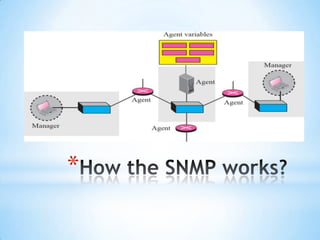
*Comprised of agents and managers
   •Agent - process running on each managed node collecting
   information about the device it is running on.


   •Manager - process running on a management workstation that
   requests information about devices on the network.
*
• SNMP is a “client pull” model
  The management system (client) “pulls” data from the agent
  (server).


• SNMP is a “server push” model
    The agent (server) “pushes” out a trap message to a (client)
    management system
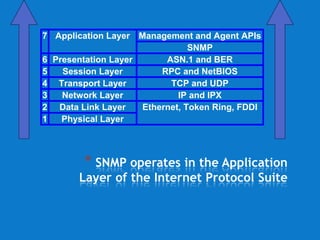
7 Application Layer    Management and Agent APIs
                                  SNMP
6   Presentation Layer      ASN.1 and BER
5     Session Layer        RPC and NetBIOS
4    Transport Layer         TCP and UDP
3     Network Layer            IP and IPX
2    Data Link Layer   Ethernet, Token Ring, FDDI
1     Physical Layer


          * SNMP operates in the Application
         Layer of the Internet Protocol Suite
*
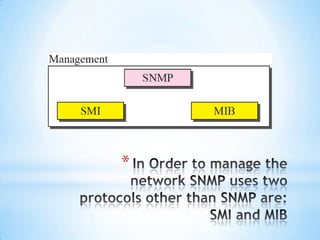
SNMP network management is based on
 three parts:
•SNMP Protocol

  •Defines format of messages exchanged by management
  systems and agents.
  •Specifies the Get, GetNext, Set, and Trap operations
•Structure of Management Information (SMI)

  •Rules specifying the format used to define objects managed
  on the network that the SNMP protocol accesses

•Management Information Base (MIB)

   •A map of the hierarchical order of all managed objects and
   how they are accessed
*
*
   Items in an SNMP Network are called nodes. There are different types of
   nodes.

      •Managed nodes

               Typically runs an agent process that services requests from a management node


      •Management nodes

                Typically a workstation running some network management & monitoring software

      •Nodes that are not manageable by SNMP

              A node may not support SNMP, but may be manageable by SNMP through a proxy
              agent running on another machine

Nodes can be both managed nodes and a management node at the same time
(typically this is the case, since you want to be able to manage the workstation that your management application is
running on.)
*
Two basic designs of agents

  •Extendible Agents

     •Open, modular design allows for adaptations to new
     management data and operational requirements


•Monolithic Agents

  •not extendible
  •optimized for specific hardware platform and OS
  •this optimization results in less overhead (memory and system resources)
  and quicker execution
*
Proxy & Gateway Agents extend the capabilities of SNMP by allowing it
to:
 •Manage a device that cannot support an SNMP agent
 •Manage a device that supports a non-SNMP management agent
 •Allow a non-SNMP management system to access an SNMP agent
 •Provide firewall-type security to other SNMP agents (UDP packet filtering)
 •Translate between different formats of SNMP messages (v1 and v2)
 •Consolidate multiple managed nodes into a single network address (also
 to provide a single trap destination)
*
•Get
  Retrieves the value of a MIB variable stored on the agent machine
  (integer, string, or address of another MIB variable)

•GetNext
   Retrieves the next value of the next lexical MIB variable


•Set

   Changes the value of a MIB variable

•Trap

       An unsolicited notification sent by an agent to a management
       application (typically a notification of something unexpected, like an error)
*
•Traps are unrequested event reports that are sent to a management system by
an SNMP agent process
•When a trappable event occurs, a trap message is generated by the agent and is
sent to a trap destination (a specific, configured network address)
•Many events can be configured to signal a trap, like a network cable fault, failing
NIC or Hard Drive, a “General Protection Fault”, or a power supply failure
•Traps can also be throttled -- You can limit the number of traps sent per second
from the agent
•Traps have a priority associated with them -- Critical, Major, Minor, Warning,
Marginal, Informational, Normal, Unknown
*
•Traps are received by a management application.
•Management applications can handle the trap in a few ways:

  •Poll the agent that sent the trap for more information about the event,
  and the status of the rest of the machine.
  •Log the reception of the trap.
  •Completely ignore the trap.
•Management applications can be set up to send off an e-mail, call a voice mail
and leave a message, or send an alpha-numeric page to the network
administrator’s pager that says:


          Your PDC just Blue-Screened at 03:46AM. Have a nice day. :)
*
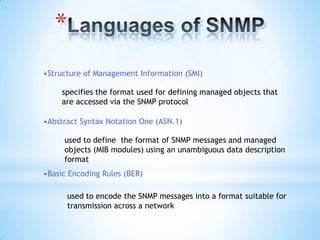
•Structure of Management Information (SMI)

     specifies the format used for defining managed objects that
     are accessed via the SNMP protocol

•Abstract Syntax Notation One (ASN.1)

     used to define the format of SNMP messages and managed
     objects (MIB modules) using an unambiguous data description
     format
•Basic Encoding Rules (BER)

       used to encode the SNMP messages into a format suitable for
       transmission across a network
*
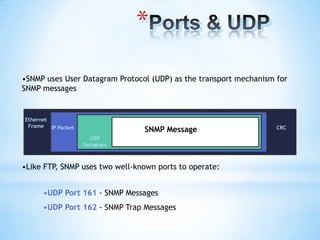
•SNMP uses User Datagram Protocol (UDP) as the transport mechanism for
SNMP messages


Ethernet
 Frame IP Packet                                                   CRC
                                SNMP Message
                     UDP
                   Datagram


•Like FTP, SNMP uses two well-known ports to operate:


     •UDP Port 161 - SNMP Messages
     •UDP Port 162 - SNMP Trap Messages
*
* www.wikipedia.com
                   (What is SNMP?)
* www.google.co.in
                (SNMP and its parts)
* www.autherstream.com
                  (Different slides)
* www.youtube.com
                    (Video Help)
-> Communication and Data Networking(book) by B.A.
  Forouzan


                            *
*
I WANT YOU
    TO ASK A QUESTION


*

SNMP

  • 2.
    * MUKUND VINAYAK (1029010060)
  • 3.
    * *SNMP is atool (protocol) that allows for remote and local management of items on the network including servers, workstations, routers, switches and other managed devices. *Comprised of agents and managers •Agent - process running on each managed node collecting information about the device it is running on. •Manager - process running on a management workstation that requests information about devices on the network.
  • 4.
    * • SNMP isa “client pull” model The management system (client) “pulls” data from the agent (server). • SNMP is a “server push” model The agent (server) “pushes” out a trap message to a (client) management system
  • 5.
    7 Application Layer Management and Agent APIs SNMP 6 Presentation Layer ASN.1 and BER 5 Session Layer RPC and NetBIOS 4 Transport Layer TCP and UDP 3 Network Layer IP and IPX 2 Data Link Layer Ethernet, Token Ring, FDDI 1 Physical Layer * SNMP operates in the Application Layer of the Internet Protocol Suite
  • 6.
    * SNMP network managementis based on three parts: •SNMP Protocol •Defines format of messages exchanged by management systems and agents. •Specifies the Get, GetNext, Set, and Trap operations •Structure of Management Information (SMI) •Rules specifying the format used to define objects managed on the network that the SNMP protocol accesses •Management Information Base (MIB) •A map of the hierarchical order of all managed objects and how they are accessed
  • 7.
  • 8.
    * Items in an SNMP Network are called nodes. There are different types of nodes. •Managed nodes Typically runs an agent process that services requests from a management node •Management nodes Typically a workstation running some network management & monitoring software •Nodes that are not manageable by SNMP A node may not support SNMP, but may be manageable by SNMP through a proxy agent running on another machine Nodes can be both managed nodes and a management node at the same time (typically this is the case, since you want to be able to manage the workstation that your management application is running on.)
  • 9.
    * Two basic designsof agents •Extendible Agents •Open, modular design allows for adaptations to new management data and operational requirements •Monolithic Agents •not extendible •optimized for specific hardware platform and OS •this optimization results in less overhead (memory and system resources) and quicker execution
  • 10.
    * Proxy & GatewayAgents extend the capabilities of SNMP by allowing it to: •Manage a device that cannot support an SNMP agent •Manage a device that supports a non-SNMP management agent •Allow a non-SNMP management system to access an SNMP agent •Provide firewall-type security to other SNMP agents (UDP packet filtering) •Translate between different formats of SNMP messages (v1 and v2) •Consolidate multiple managed nodes into a single network address (also to provide a single trap destination)
  • 11.
    * •Get Retrievesthe value of a MIB variable stored on the agent machine (integer, string, or address of another MIB variable) •GetNext Retrieves the next value of the next lexical MIB variable •Set Changes the value of a MIB variable •Trap An unsolicited notification sent by an agent to a management application (typically a notification of something unexpected, like an error)
  • 12.
    * •Traps are unrequestedevent reports that are sent to a management system by an SNMP agent process •When a trappable event occurs, a trap message is generated by the agent and is sent to a trap destination (a specific, configured network address) •Many events can be configured to signal a trap, like a network cable fault, failing NIC or Hard Drive, a “General Protection Fault”, or a power supply failure •Traps can also be throttled -- You can limit the number of traps sent per second from the agent •Traps have a priority associated with them -- Critical, Major, Minor, Warning, Marginal, Informational, Normal, Unknown
  • 13.
    * •Traps are receivedby a management application. •Management applications can handle the trap in a few ways: •Poll the agent that sent the trap for more information about the event, and the status of the rest of the machine. •Log the reception of the trap. •Completely ignore the trap. •Management applications can be set up to send off an e-mail, call a voice mail and leave a message, or send an alpha-numeric page to the network administrator’s pager that says: Your PDC just Blue-Screened at 03:46AM. Have a nice day. :)
  • 14.
    * •Structure of ManagementInformation (SMI) specifies the format used for defining managed objects that are accessed via the SNMP protocol •Abstract Syntax Notation One (ASN.1) used to define the format of SNMP messages and managed objects (MIB modules) using an unambiguous data description format •Basic Encoding Rules (BER) used to encode the SNMP messages into a format suitable for transmission across a network
  • 15.
    * •SNMP uses UserDatagram Protocol (UDP) as the transport mechanism for SNMP messages Ethernet Frame IP Packet CRC SNMP Message UDP Datagram •Like FTP, SNMP uses two well-known ports to operate: •UDP Port 161 - SNMP Messages •UDP Port 162 - SNMP Trap Messages
  • 16.
  • 17.
    * www.wikipedia.com (What is SNMP?) * www.google.co.in (SNMP and its parts) * www.autherstream.com (Different slides) * www.youtube.com (Video Help) -> Communication and Data Networking(book) by B.A. Forouzan *
  • 18.
  • 19.
    I WANT YOU TO ASK A QUESTION *