SNMP
Simple Network Management Protocol (SNMP)
Md. Asifur Rahman Siddiki
ID: 1834902563
Batch: 49
SNMP:
Simple Network Management Protocol (SNMP) is an application–layer
protocol defined by the Internet Architecture Board (IAB) in RFC1157
for exchanging management information between network devices. It is
a part of Transmission Control Protocol⁄ Internet Protocol (TCP⁄IP)
protocol suite.
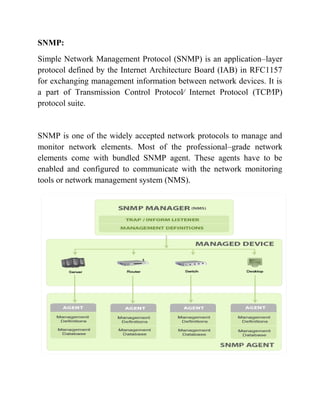
SNMP is one of the widely accepted network protocols to manage and
monitor network elements. Most of the professional–grade network
elements come with bundled SNMP agent. These agents have to be
enabled and configured to communicate with the network monitoring
tools or network management system (NMS).
SNMP Manager:
A manager or management system is a separate entity that is responsible
to communicate with the SNMP agent implemented network devices.
This is typically a computer that is used to run one or more network
management systems.
SNMP Manager’s key functions
Queries agents
Gets responses from agents
Sets variables in agents
Acknowledges asynchronous events from agents
Managed Devices:
A managed device or the network element is a part of the network that
requires some form of monitoring and management e.g. routers,
switches, servers, workstations, printers, UPSs, etc...
SNMP Agent:
The agent is a program that is packaged within the network element.
Enabling the agent allows it to collect the management information
database from the device locally and makes it available to the SNMP
manager, when it is queried for. These agents could be standard (e.g.
Net-SNMP) or specific to a vendor (e.g. HP insight agent)
SNMP agent’s key functions
Collects management information about its local environment
Stores and retrieves management information as defined in the MIB.
Signals an event to the manager.
Acts as a proxy for some non–SNMP manageable network node.
Management Information database or Management Information
Base (MIB)
Every SNMP agent maintains an information database describing the
managed device parameters. The SNMP manager uses this database to
request the agent for specific information and further translates the
information as needed for the Network Management System (NMS).
This commonly shared database between the Agent and the Manager is
called Management Information Base (MIB).
Typically these MIB contains standard set of statistical and control
values defined for hardware nodes on a network. SNMP also allows the
extension of these standard values with values specific to a particular
agent through the use of private MIBs.
In short, MIB files are the set of questions that a SNMP Manager can
ask the agent. Agent collects these data locally and stores it, as defined
in the MIB. So, the SNMP Manager should be aware of these standard
and private questions for every type of agent.

Snmp

  • 1.
    SNMP Simple Network ManagementProtocol (SNMP) Md. Asifur Rahman Siddiki ID: 1834902563 Batch: 49
  • 2.
    SNMP: Simple Network ManagementProtocol (SNMP) is an application–layer protocol defined by the Internet Architecture Board (IAB) in RFC1157 for exchanging management information between network devices. It is a part of Transmission Control Protocol⁄ Internet Protocol (TCP⁄IP) protocol suite. SNMP is one of the widely accepted network protocols to manage and monitor network elements. Most of the professional–grade network elements come with bundled SNMP agent. These agents have to be enabled and configured to communicate with the network monitoring tools or network management system (NMS).
  • 3.
    SNMP Manager: A manageror management system is a separate entity that is responsible to communicate with the SNMP agent implemented network devices. This is typically a computer that is used to run one or more network management systems. SNMP Manager’s key functions Queries agents Gets responses from agents Sets variables in agents Acknowledges asynchronous events from agents Managed Devices: A managed device or the network element is a part of the network that requires some form of monitoring and management e.g. routers, switches, servers, workstations, printers, UPSs, etc... SNMP Agent: The agent is a program that is packaged within the network element. Enabling the agent allows it to collect the management information database from the device locally and makes it available to the SNMP manager, when it is queried for. These agents could be standard (e.g. Net-SNMP) or specific to a vendor (e.g. HP insight agent)
  • 4.
    SNMP agent’s keyfunctions Collects management information about its local environment Stores and retrieves management information as defined in the MIB. Signals an event to the manager. Acts as a proxy for some non–SNMP manageable network node. Management Information database or Management Information Base (MIB) Every SNMP agent maintains an information database describing the managed device parameters. The SNMP manager uses this database to request the agent for specific information and further translates the information as needed for the Network Management System (NMS). This commonly shared database between the Agent and the Manager is called Management Information Base (MIB). Typically these MIB contains standard set of statistical and control values defined for hardware nodes on a network. SNMP also allows the extension of these standard values with values specific to a particular agent through the use of private MIBs. In short, MIB files are the set of questions that a SNMP Manager can ask the agent. Agent collects these data locally and stores it, as defined in the MIB. So, the SNMP Manager should be aware of these standard and private questions for every type of agent.